For what it is worth. Here are a few things to consider. I know this is going to be a bit off topic but lets paint a picture of posts before we get to my point.
Originally posted by Sal Glesser
"Hi Dulleddown,
More profit is usually associated with higher price. That's normal. Profit is usually a percentage of sales price. To think that a high priced auto should garner the same proft as a low priced auto is not in accord with business. It might be the same percentage, but being more expensive, it will be more profit.
Unless you are a manufacturer, familiar with close tolerance manufacturing of heat treated steel & Titanium parts, you are not likely to be able to see all of the differences between one of Chris' knives and others. For example; CRK keeps 0.0005 tolerance on surface grinding. That's one sixth the thickness of a hair. Do you have the knowledsge and equipment to discover that tolerance?
In the end, it's all about trust. CRK took many years to build and maintain their repuation. Built with consistent focus. Even those trying to make a "cheaper" version must "leave out processes" or "soften their tolerance", or they will cost as much.
Rarely do you pay for the "name". That's a bullshit sales pitch made up by the ignorant claiming to offer the same for less. Money valuation between countries might offer a "deal" for a while until the money value balances, but all in all, you will get what you pay for.
sal
-----------------------------------------------------
Just because you can't see the difference doesn't mean it isn't there, it just means you can't see it. "
"Well, I cannot speak for Chris Reeve Knives, but I will offer an opinion.
I've known Chris and Ann for many years. We worked together when Chris was in South Africa.
A CRK knife is not a custom knife, nor is it a production knife. They are in a class by themselves. They've taken many years to develop their reputation.
Each piece is custom made by skilled custom makers. CRK tolerances and standards are the highest I've seen in processes like surface grinding and heat treat. There is a limit to their production capacity.
Chris is pretty anal on quality. "Quality is time. = Time is money". He pays his craftsmen a fair wage, and he charges a fair margin, he gives the world a product like no other. Chris and Ann work hard and they make a good living. "Enormous profits" is an inside joke that Chris and I laugh about. Frankly, I think they'd feel guilty if they made too much money.
The "Market" will determine if his business strategies work, regardless of what they are. If they don't work, adjustments are made....that's how businesses survive.
BTW, the flip side of a "bargain driven" market is manufacturers are forced to import product (export jobs) from China to compete in the need for the "lower price". More complications.
sal "
On another note:
Originally posted by Bearcut
Baseline:
Cheap Chinese folder- $10-15
RESULT: A barely usable knife or an unsafe POS, it depends. Most people feel they get their moneys worth, if barely.
An inexpensive knife- $25-$45 (CRKT, low end Spyderco, BM, Kershaw etc).
RESULT: Huge difference. The knife should function reasonably well. Most people feel they get their moneys worth. There is some satisfaction and pride in these purchases. Almost no buyers remorse or diminishing returns here.
Low to mid grade folder- $50-100, (Spyderco, BM, Kershaw, CS, etc.)
RESULT: Really big difference. Now you are getting very good construction and higher end blade steel. People are happy with these offerings, they get a good product that could last many, many years. No buyers remorse, and almost no diminishing returns on this class.
Mid to high end production folder- $ 125-250: (Al Mar, ZT, Fallkniven, Emerson, Spyderco, BM, etc)
RESULT: People start to see what the fuss is all about. These are nice knives. A person jumping from a $60 folder will immediately see the difference and understand why he paid so much for the knife. These are knives that you could hand to a total non-knife person and they would probably comment on how nice a knife it is. These are so close to high-end offerings that there is really no practical need to spend anymore for a superb quality folder. Lot’s of pride of ownership involved with this class of folder. Material quality, and construction, is top notch. Blade steel is near, or at the highest level available. The average person knows they paid a lot for the knife, but probably feel they got their moneys worth and would recommend them to others. Probably not too much buyers remorse if the person could afford it in the first place. Diminishing returns are more prevalent at this point.
High end Production folders- $300-500: ( CRK, Strider, Hinderer, etc.)
RESULT: These knives are the epitome of production craftsmanship. Everything (should) be tight, smooth and strong.
But, there is not that much immediate difference between this price point and the $125-250 price point.You could hand one of these knives over to a non-knife person and they may comment on how nice the knife is. If you told them how much it costs, they would probably be shocked and think you were crazy for paying so much for a knife.
You are not getting twice the knife for the money. Most of the cost involved for these knives are for things you can’t even see; tight tolerances, warranty, prestige. Spyderco, Kershaw/ZT and BM make several knives that are more exciting, different, and fun than these knives, for a lot less money. Things you can see in other words.
A person going from a $60 folder may truly wonder why the heck he paid so much for a knife that may not seem all that great. The quality may be obvious, but not for the extra $300 they just dropped. The knife may have annoying traits, (Strider break-in), be much thicker and heavier than he is used to, (Hinderer), or may just seem plain and unexciting compared to his other folders, (CRK). There may be major buyers remorse.
Bottom line, buy what you like, with a design that appeals to you. Forget about the price.
Bragging rights only last so long.
Another post by me discussing a ZT with another member (R = Rand our currency):
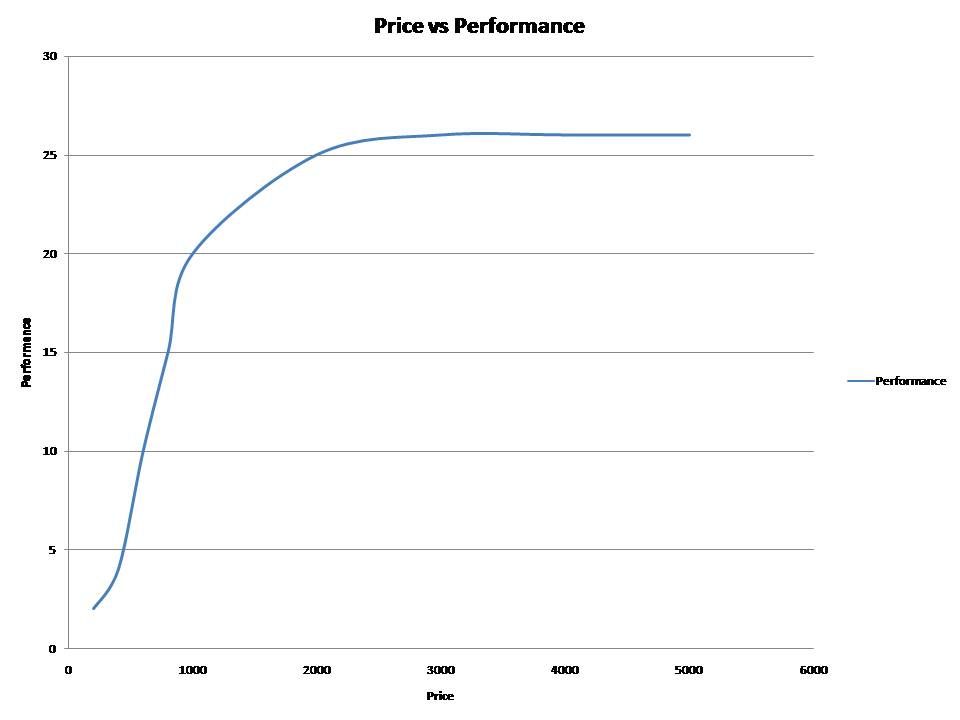
But then again you wont see much improvement performance wise between a R1750 knife and a R5000 knife when doing cutting taks. The difference in steel can increase the price, fit and finish, materials used for handles.
The best way I can show this is by using this graph.
Between a R300 knife and a R1500 knife there is a big difference between fit and finish, design, performance while cutting, steel etc. But as the price goes up the performance tend to plain out and you start paying for aesthetics, materials such as ivory and engraving etc.
As far as hard use.....
I think some clarification of definition might help. This is just my opinion, of course. I’ll try to include some history for the “younger afi’s”. No doubt some will disagree with me. That's ok. My credentials are sound.
The first “Hard Use” production folder was probably Al Buck’s “110” in the mid 60’s.
The intent was to create a folding knife that could take on many of the pressures put on a fixed blade knife but be easier to carry. The knife had the ability to cut harder to cut materials and deal with difficult environments. The blade was thicker than “normal” folders, (fairly fine tip though). The lock was strong and exceptional steel (stainless 440C) was used to be able to cut the harder to cut materials. Pete Gerber followed with his folders, also made with exceptional steel. Al Mar began producing hard use knives with exceptional steels. Al also had a military background which influenced his designs.
Chris Reeve and Spyderco made hard use folders in the early 80’s. They were using better steels, strong locks and tough handles, many of these earlier hard use folders are still in service. In the mid 80’s a number of companies also began producing knives intended to go through tougher materials.
(“Hard use” is a marketing term that was created far later than the designs. The same is true of “tactical”

.
Chris was using Titanium for his handles and he invented a new type of lock which proved to take impact well. The Reeve Integral Lock (often called a “frame-lock”
has “enjoyed” much attention. These were designed and built for hard use.
Then along comes Mick Strider. Here we have a knuckle dragging knife maker making knives for knuckle draggers. That sounds good to me. He said; What if I have to abuse my knife. What if I have to pry with it, or twist or dig, maybe hammer? Prying, digging and hammering with a knife is no longer “hard use”, it is “abuse”. Mick’s knives were made for abuse.
Another knuckle dragger, Ken onion, chimed in with the ZT line. Again, the knives were designed and built for abuse. Lynn Thompson was another that creates knives to be abused. First he made fixed blades and later with folders. These were also designed and built to take abuse.
It is interesting to note that some of these designers paid special attention to using exceptional steels. They usually used the best steels available at the time. They also used edge geometries that were more abuse friendly. The theory being; if you are going to pry, dig and hammer with your knife, these activities are very hard on the edge and once the edge is gone, what you have left is a folding club. Generally, exceptional steel will perform better and last longer.
I question the theory that a “lesser” steel can be easily sharpened. If you are not carrying a pry-bar, a shovel, or a hammer, you are not likely carrying a sharpening stone.
With that in mind, our Military model was designed to be a light weight, strong cutting tool and I guarantee it will poke and cut with the best of the “hard use” and “abuse” folders, and probably better. It was not designed or built for abuse.
We have had many of our troops write to us thanking us for making the model that saved their booty when needed. They had it with them because it was light weight and easy to carry. When we create a knife for our troops, law enforcement or emergency personnel (SAS – Save And Serve), we are very serious about cutting performance and reliability.
Perhaps some think that there is only one way to design and build a knife? Or that their definition of usage is the only one there is? Perhaps they can show me the knives they’ve designed and produced and we can discuss the merits and drawbacks of their design? There are ALWAYS trade-offs in design. Weight, performance, price, etc.
I will say that there seems to be a growing demand for folding abuse knives and we have several on the drawing board. They are being designed and built to take abuse. But they will not likely be able to cut and poke with the efficiency of the thinner Military blade nor will they be as light.
Just some thoughts to share.
sal
I know I quote Sal Glesser a lot, but I do consider him as a person that knows what he is talking about (Others might disagree).
Anyway...now my point.....
look at my signature...



 The answer from me is that even with S30V they are worth what you pay...but you won't believe it until you try it. Suggestion: buy a used one, and if it doesn't float your boat you can probably resell it for what you paid. If you buy new, you'd obviously take some degree of loss on a resale. I feel very comfortable recommending that because I recently sent a 1997 small regular Seb back for service...I had it double-lugged while it was there, but I think the total cost of tune-up/sharpening, etc. would have been <$15 excluding postage, and the knife is like new. Actually, a little too much like new, since as part of the double-lug installation on the regular they have to mill some material off the off-side handle and therefore have to re-blast (refinish) the handles - booo.




 It just exudes quality, even to the uninitiated.:thumbup:


