Serrations

jfever311

If you really want serrations on your ZT 0560, There is a Mr. Veff who offers this service for a reasonable price. Google him.

I have looked at his serrations. They seem very fragile, and I do not think they would hold up very well in my line of work. I might be mistaken though. Have you ever had the opportunity to use a knife with his serrations?
 
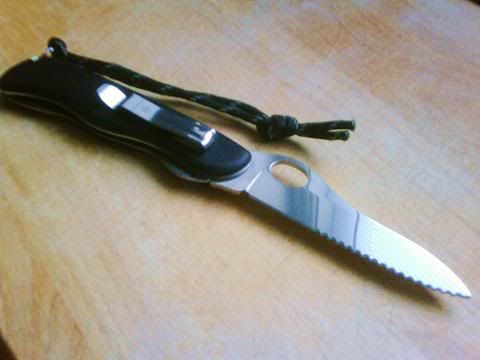
Full SE or plain edge for me. The only PS blade I really like is by Victorinox...

sentinel01.jpg
 
I prefer plain edges due to the ease of sharpening, and I would feel dumb in criticizing something because I found it too difficult. Sharp serrations slice really well, there's no getting around that. A lousy serrated edge is a lousy edge; a dull, overly obtuse, or poorly ground plain edge is going to suck just as much. I like being able to sharpen a plain edge to hair shaving sharp on a cinder block, brick, side of a 36 grit grinding wheel, bastard file, bottom of a ceramic mug, etc. I have sharpened serrations by rounding the edge of a waterstone, with tapered diamond files, and with sharpmaker and profile rods, but not much else. The need for specific equipment makes serrations less attractive when resharpening, but has nothing to do with how they cut. I avoid serrated knives because I don't have to do the kind of work that benefits from them. A plain edge can push cut better at any random point on the edge, and most of my cutting is push type.

 
A plain edge can push cut better at any random point on the edge, and most of my cutting is push type.

:thumbup:, so am I.

When push cutting, the force is almost perpendicular/normal to the edge, thereby plain edge is ideal/optimal. Serration/scallop excel where cutting forces are combined of some downward/normal + parrallel/tangent, where the resultant force is almost perpendicular to tooth leading edge at 2x pressure.

Serration geometry actually converge the applied (cutting) forces, while plain edge diverge most forces except the force vector perpendicular/into edge. By diverging, I mean, deflecting + lateral + longitude, which result in dull/roll/chip/displace edge. And not accidentially, ppl observed serration edge stays sharp longer. Over all, I think serration has better geometry for most type of cutting activities; however the current serration design (single bevel + big teeths) makes it difficult to sharpen and far from optimal double-bevel scallop v or convex tooth edges.

brain:barf:
 
Serrated edges have their place. I used to be a "hater" but I've come to appreciate well designed serrations under certain circumstances. In most situations I prefer plain edges, but sometimes they just fall flat on their face compared to serrated blades.
 
Interesting thread, I'm thinking of picking up a Spyderco Dragonfly 2 to keep with me out on the water / beach and have been going through the whole plain edge/serrated edge indecision.....

The only serrated blades I have are a bread knife and utility knife from a Henckel knife set and the serrated blade on my Leatherman Wave, I find them all useful.
Henckels choose to use serrations on a kitchen utility knife, is this due to better cutting performance of non-food items? It certainly opens food packaging far easier then the rest of the Henckels set and that is despite them all being sharp - try cutting frozen foods with a plain edge.

Serrations have the advantage of a more efficient sawing action depending of course on the material being cut. They also maintain cutting power longer over a plain edge (require less sharpening).

This is all my opinion and experience.
 
Full SE or plain edge for me. The only PS blade I really like is by Victorinox...

sentinel01.jpg

I'm liking that combo design, with the serrations on the distal blade for slicing (string/line, box tops, etc) and the proximal pain edge for tasks such as whittling, sharpening, peeling.
 
I tend to stay away from serrations just because of the sharpening. However I've heard serrations make cutting seat belts easier (and in my line of work I'm more likely to encounter that scenario). All that being said I carry a ZT 0200 and 0400 non serrated versions at work.
 
Well, another problem with serrations is that it's really hard (I would imagine) to maintain a specific serration pattern when you're trying to sharpen it. Every serrated edge has a specific serration designed for a specific purpose. Some of them are crazy, with various large serrations mixed in with tiny serrations. Try sharpening that and *not* alter the pattern.
 
I'm liking that combo design, with the serrations on the distal blade for slicing (string/line, box tops, etc) and the proximal pain edge for tasks such as whittling, sharpening, peeling.

Yeah--it's the only combo edge configuration I really like. Otherwise I want full plain edge or fully serrated.
 
Yeah--it's the only combo edge configuration I really like. Otherwise I want full plain edge or fully serrated.

I'm with ya on that. I am surprised that there aren't more manufacturers offering that configuration. I believe there is a niche for it. I'd love to see a beefy blade with a Strong short wharncliff tip for trimming, distal serrations for cutting rope, ties, box tops, etc and a fine straight edge for whittling points, peeling, etc. The blade could even have a gentle hawk curve, though that could impede sharpening of the straight portion.
 
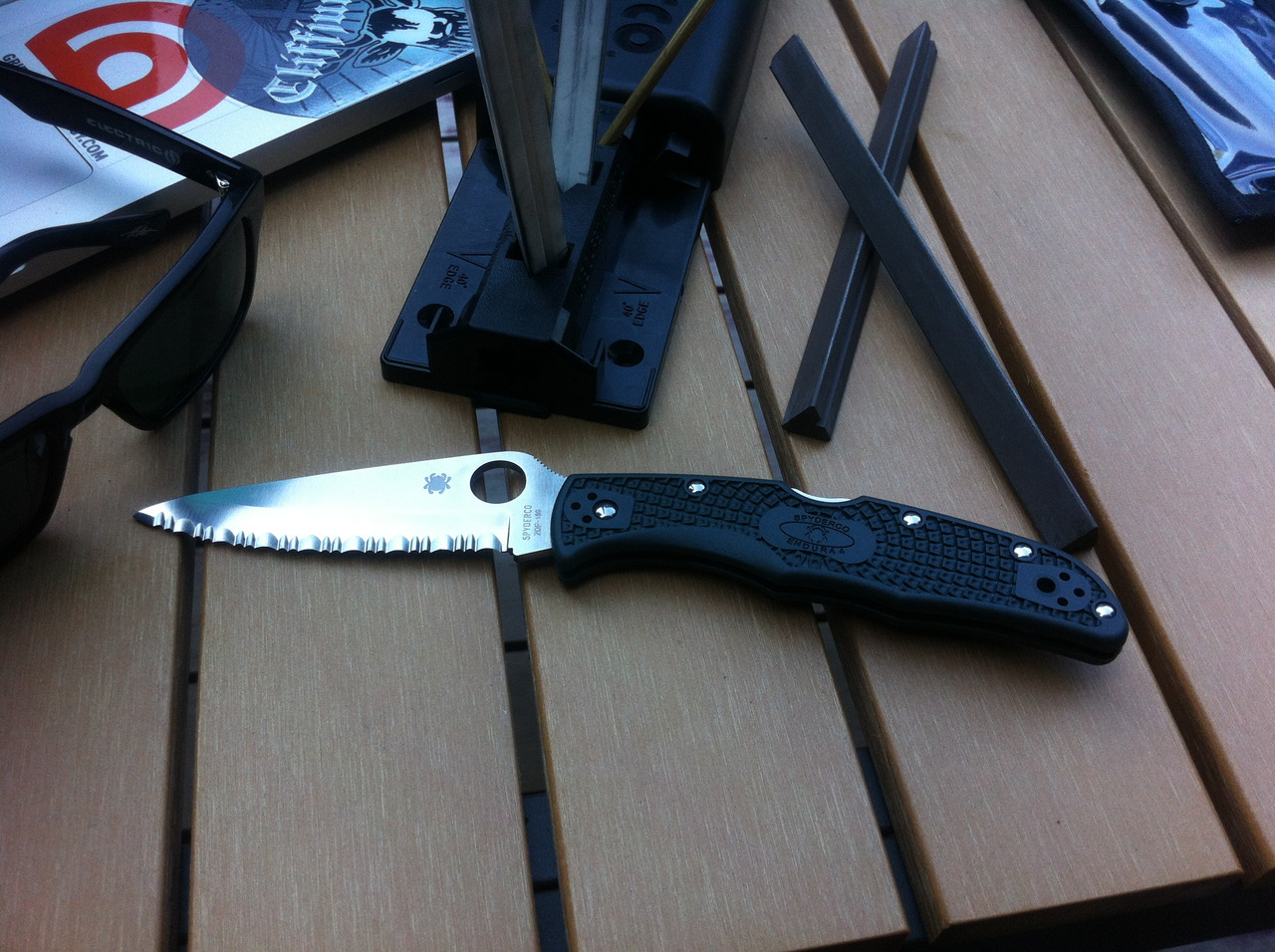
I never cared for serrations until I got a fully serrated Spyderco Endura, and I've liked them (Spyderco serrations) ever since, for certain applications, which many members have spelled out here. I'd rather have a plain edge for most work I do, and I still use the serrated Endura on occasion when needed. (It excels at cutting up cactus. :thumbup:) I have a cheap Smith & Wesson round diamond stick sharpener that works fine for sharpening the Endura.
To me, the best of both worlds would be a model like the Spyderco Byrd Wings. I have one, and my only complaint - actually, two complaints - is I wish it had better steel, and a little thicker liner lock. I didn't like it at first, but once I rounded the tops of the blades, it was easier to hold & use.

The best partially serrated design, in my opinion, is the Victorinox One-Hand Trekker, with the serrations on the forward part of the blade.

~Chris
 
My knowledge is lacking on this subject but I would think that a combo edge would work well especially on larger blades like the Spyderco Military or Benchmade 710.
Example: For tougher materials the serrated part could get the initial cut started and then the plain part could continue through with the cutting.

Does this make sense or is my reasoning incorrect?
 
Back
Top