Slipjoint questions

I use the friction cutter dremmel tool but I put it in the drill press at high speed, I clamp the blade into a drill clamp and set the table height to where I want the nail groove and then carefully move it back and forth.

I have been using the the thin cut off and it works well. lately I have expermented with cutting an angle on a thicker grinding wheel to make more of nic shape and it works pretty well. The key is to use a vice and drill press to keep it steady.

brnfolder006.jpg
 
There are some of the older makers that used a chisel to make the nail nicks. I was sent one by Dan Burke, a pretty good maker if I say so myself. I used it for the first several knives I make. You need to round one side in the shape that the nail nick should be. It works well, you need to tape the blade down on an anvil so it doesn't fly away as you hit it. It should be beaten into the metal with with several taps.

Larry Jones
 

Attachments

  • my knife pictures 042.jpg
    my knife pictures 042.jpg
    18.5 KB · Views: 43
  • my knife pictures 040.jpg
    my knife pictures 040.jpg
    24 KB · Views: 58
Last edited:
Hi Guys,

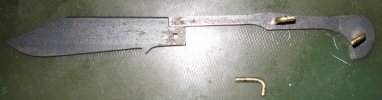
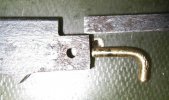
Well, what do you know? First thing out of the starting gate and I'm already stumped. I've cut out my blade and spring and rough profiled them. I have not surfaced them down at all from their 1/8" thickness. Anyway, I've tried to pin them up, but am bamboozled as to how to go about it.

I laid the blade and pin out in the open position and drilled a hole for the blade and the pivot hole for the spring. I then "lifted" the spring's back pin hole by what I thought was about half the pin's width, or about 3/64". Another way to say this might be, I drilled and pinned the spring by both its pivot and rear pin. I then drilled the hole for the blade about a half a pin closer to the spring than the blade's pin hole. (It looks like it might of ended up almost a whole pin width closer.)

Anyway, no matter how I go about it, I can't wrestle all three pins into place. The metal parts are just too tough for me. Please advise.

Thanks, Phil
 

Attachments

  • Folder3.jpg
    Folder3.jpg
    28.7 KB · Views: 56
  • Folder4.jpg
    Folder4.jpg
    32.8 KB · Views: 54
Hi Guys,

Well, what do you know? First thing out of the starting gate and I'm already stumped. I've cut out my blade and spring and rough profiled them. I have not surfaced them down at all from their 1/8" thickness. Anyway, I've tried to pin them up, but am bamboozled as to how to go about it.

I laid the blade and pin out in the open position and drilled a hole for the blade and the pivot hole for the spring. I then "lifted" the spring's back pin hole by what I thought was about half the pin's width, or about 3/64". Another way to say this might be, I drilled and pinned the spring by both its pivot and rear pin. I then drilled the hole for the blade about a half a pin closer to the spring than the blade's pin hole. (It looks like it might of ended up almost a whole pin width closer.)

Anyway, no matter how I go about it, I can't wrestle all three pins into place. The metal parts are just too tough for me. Please advise.

Thanks, Phil

Is this a test fit? If it is take the rear pin out and use hand pressure to adjust the action you want,
 
Last edited:
That is about the way slip joints work when you first start them. I don't know if the blade and backspring are heat treated or not, if they aren't they need to be heated treated first. This will keep you from bending your spring. I always use a set of dummy liners with the pins in them, put the liners together with a pin in the blade hole and the rear hole. Place the center pin hole at the center pin in a small vice with the backspring facing the lip of the vice, this will let you see if the pen will line up. , everything being correct, the pin should go thru the center hole and liners. Don't be shocked when the blade tiip tilts down as the spring moves forward. the spring will streach forward as the tension is applied. It also looks as if the spring might be just a little bit stought. If they are heat treated the spring will go in the hole you have drilled now.

Hope this helps some, slip joints are a totally different animal than anything else you might make.

Larry Jones
 
I usualy have one of the pins longer and tapered for about 2 or 3 inches , a good long taper to a point makes that alot easier. You realy dont want to do that much before you heat treat and temper the spring like Mr Jones said. you may need a bigger block or put someting under it so the taper has enough room to get to the wide part of the pin.
 
I had issues here also. After profiling some scrap 1084 which I thought would be perfect, I discovered that I hadn't annealed it since the last time I used the other end of it, and drilling was useless. I annealed it, but scale buildup made me decide to scrap it and go with some 440C I found in a drawer.

After drilling and pinning, I ended up bending the spring so the blade would stay open and closed in what seems like a good fashion. But, as soon as I open the blade once, the annealed spring bends and the fit is loosened. After a couple of trial runs, I set it where I think it will be good after it is heat treated.

I'm hoping I'll be able to adjust the spring after heat treatment, but have no idea. This is going to be very challenging if not. Luckily I don't think these dainty little parts will damage much when I chuck 'em across the shop:thumbup:
 
The only way you can adjust the spring is after heat treating, unless you made the pattern from an exact existing knife. Be prepared to take the thing apart numbers of time as you will only be taking thousands of an inch away at a time. Remember if you take too much off, you can't put it back on. A little bit at a time is the rule here.

Larry
 
Just bend it back to the place you had it before you heat treat, most times you wont get it bent back after heat treat. dont try to open it or close it before you heat treat with all the pins in.
 
I have a heat treat question. What's the right Rc for a spring in D2? I've gotten some very different answers. If I ever get one of these to the point where I'm happy with it, I'll be sending it out for professional HT. Thanks for the advice.
 
BJR: I temper D2 springs at 1200 F one time only. Works well. When I am fitting the spring after heat treat and trying to get the proper tension...and don't have enough...I can heat quickly to orange or so and bend, cool quickly and it works every time. I do not retemper. This works with D2..not O1, 1095 etc.
 
Phil, I pin the spring to the board, put in the pivot pin and place the blade on the pin. The blade will be resting on the spring. I use a screwdriver to push the front of the spring up and let the blade slip into place.
 
Thanks guys for all your suggestions. I'm gunna try and tackle it again tomorrow. Craig, it was good talking with you in Texas. That slipjoint build you're doing in the Great Lakes Water Jet forum looks great! Patrick, where have you been? I've been missing you!
 
John, if you heat and bend your spring to adjust it after you temper, don't you have to normalize it again and re HT it? Aren't you just making a huge stress point that will fail later? Christ I have a lot to learn. What hardness for the spring? Soft right? Like in the mid 40s?
 
Spring temper should be about 48-50. At least that is what I shoot for. As far as a weak point where I reheat and bend spring...I don't know. I have had knives for several years that are still working just fine and I tend to make slipjoints that have strong springs. ??
 
Yeah, I think a stong spring is key, not just so it lasts, but because I like a stiff pull and close, you know? I like it to really snap when it opens. It's the walk and talk that my knives are still missing.
 
I may be wrong in my thinking but at least some of the snap can be achieved with proper tension on the spring. The rest of the snap {in my belief} is the blade tang end geometry and how that contact is made between the blade and spring. The amount of rise you want in the spring in transition between open, half stop and closed. Controlling these dimensions will put more snap into your slip joints, or at least for me they have.

The height from spine to blade edge measurement on the spring or thickness {as I call it} will play a role in the stiffness of the spring at any hardness I have used. The length or distance from the center hole to the end of the spring will change this also.

Just remember when you change one thing there are others that will need changing also. Welcome to slip joints.

The RC hardness for springs may change for different steels used and I will not profess to know that. I do know that learning your steel and using that to your advantage is very helpful.

I use what works for me and my way of making slip joints.
 
Ok, let's talk bolsters. This is going to be hard to describe here, but how do you grind a nice round bolster? I know people with good 2x72s will grind the curve of the bolster on a slack belt, but I use a small Craftsman 2x42 and I can't really let any tension off the belt. Can anyone describe how they do this or do you just have to "feel" it.
 
You are probably better off using a file, it really doesn't take long and you have alot of control. I paint the edge with blue (or magic marker) and draw a line for the curve to end. and start rounding with a file. (I leave a small flat edge all the way around so that when the handle material is matched it is not ground to a fine edge. Check the thickness of your handle material first to make sure you dont take off too much. If the two are close to the same thickness then file round and leave flat in the middle so you know you are not taking off too much.

Once you have the shape I use 1 x 30 belts by hand to complete the sanding up to 320, no reason to go any farther until its pinned.

Just for info, I will rough shape the bolster and then glue and pin the handle in place, and then finish the shaping. At that point I should not be removing much material from the bolster. The handle material should be just a little thicker than the bolster. Remember that if you have your handle material too thick there will be a steep angle to the bolster. Sand the back of the handle until its only about 1/32" thicker than the bolster.

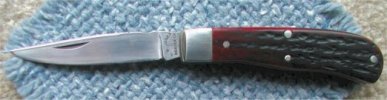
I think this picture shows the flat on the edge and the angle of the handle material to the bolster, looking now I think I left it a bit thick. Let me me know when you get ready to pin the handles and I will discuss how I do it.


green017.jpg
 
Back
Top