
-
The BladeForums.com 2024 Traditional Knife is available! Price is $250 ea (shipped within CONUS).
Order here: https://www.bladeforums.com/help/2024-traditional/
You are using an out of date browser. It may not display this or other websites correctly.
You should upgrade or use an alternative browser.
You should upgrade or use an alternative browser.
Snake identification?
- Thread starter peripatew
- Start date
nephildevil
BANNED
- Joined
- Apr 30, 2007
- Messages
- 1,152
damn
once again i am kinda glad we dont have them here
here we only have one poisonous viper if i am correct, and its a rare species.
once again i am kinda glad we dont have them here
here we only have one poisonous viper if i am correct, and its a rare species.
nephildevil
BANNED
- Joined
- Apr 30, 2007
- Messages
- 1,152
i quickly looked the guy up, here it is in english:
http://en.wikipedia.org/wiki/Crossed_Viper
in the past they even made a drink out of it, its venom supposed to add an extra taste

http://en.wikipedia.org/wiki/Crossed_Viper
in the past they even made a drink out of it, its venom supposed to add an extra taste
- Joined
- Sep 22, 2003
- Messages
- 13,182
Yes they can bite through leather gloves (and boots), unless they're
especially designed to be "snake proof).
I've spent M A N Y days (and nights) hunting and collecting snakes,
and the only time I was ever bitten by a poisonous snake was in
the lab....and there too It was my own fault...a momentary lapse
of attention.
One time I was setting on these rocks shooting a pellet gun. There were two rocks, side by side with cavities under them. I was setting with one cheek of my ass on one rock and one on the other. I looked down to see a copperhead crawling between my legs from out from under the one rock to under the other. We killed that one. However looking back here I was right in his territory and he didn't even try to strike me.
A few years later in high school we were up at the same place partying and our lighter ran out.
My friend who was hyper anyway said "last time I was up here I put a lighter under this rock" and reached under. One of the same rocks I was setting on. He leaned under and then jerked his hand out with the lighter real quick, saying "Oooh. That snake struck at me"
 We backed off and there was another big copperhead under there! I guess his hyper ADD'ness worked in his favor in this instance. He was faster than the snake!
- Joined
- Nov 27, 2002
- Messages
- 2,088
Sounds like an "Educational" experience, Hollowdweller.
Though rarely fatal, snake bites are painful and deforming. In the US there only a couple venomous snakes; rattlesnakes, copperheads, cottonmouths aka water moccasins and the rare coral snake.
I used to bird hunt in topsiders until I saw the some pics taken by my father-in-law on this farm... now, I wear big ass snake boots bird hunting when in the millet, corn and cotton fields.
I used to bird hunt in topsiders until I saw the some pics taken by my father-in-law on this farm... now, I wear big ass snake boots bird hunting when in the millet, corn and cotton fields.

- Joined
- Mar 18, 2006
- Messages
- 520
Popular outdoor mags commonly mention that rattler bites are seldom fatal. True, but terribly misleading. They are tragic events that are not only deforming and debilitating, they are very expensive in lost work and thousands in medical bills.
I've come very close several times but never hit. I wear snake boots in warm weather, have my dogs treated with the new vaccine, and carry an Extractor. I don't know how much the Extractor would help, although it can't hurt and any help at all would be great. I don't hate snakes but I sure hate rattlers. Regards, ss.
I've come very close several times but never hit. I wear snake boots in warm weather, have my dogs treated with the new vaccine, and carry an Extractor. I don't know how much the Extractor would help, although it can't hurt and any help at all would be great. I don't hate snakes but I sure hate rattlers.
Regards, ss.nephildevil
BANNED
- Joined
- Apr 30, 2007
- Messages
- 1,152
but those are rattlers, there are ther snakes that are more deadly
how about a tourniquet or sucking out there?
or hell
how about even chopping off one's own arm to prevent the poison reaching the vital parts?
viable options?
how about a tourniquet or sucking out there?
or hell
how about even chopping off one's own arm to prevent the poison reaching the vital parts?
viable options?
nephildevil
BANNED
- Joined
- Apr 30, 2007
- Messages
- 1,152
yeah well, mine is one, never seen it, chances are slim if i ever will
and should i, it is endangered species, so no killing
but i asked that question so i'll know what to do in case i end up in a diff part of the world
out of "preparedness"
and should i, it is endangered species, so no killing
but i asked that question so i'll know what to do in case i end up in a diff part of the world
out of "preparedness"
- Joined
- Jun 29, 1999
- Messages
- 10,256
A family friend down in Texas stuck his hand down a hole to grab an armadillo (brave? stupid?) and got bitten by a rattlesnake. Pretty well maimed his hand, and that was 50 years ago. His arm is still crippled though he gets by OK, even learned to fly.

- Joined
- Dec 31, 2006
- Messages
- 4,302
but those are rattlers, there are ther snakes that are more deadly
how about a tourniquet or sucking out there?
or hell
how about even chopping off one's own arm to prevent the poison reaching the vital parts?
viable options?
The only effective treatment for the lethal effects of venomous snakebite is antivenom (antivenin). The Arizona Poison Control Centers in Phoenix and Tucson probably treat/consult more venomous bites than any other facilities in the country. Arizona has more varieties of rattlesnakes than any state in the U.S., about 18 different forms. There are a lot of bites here.
You can get the basics on prevention and treatment from this site: http://www.pharmacy.arizona.edu/outreach/poison/venom.php
Incidentally, Venom Week will be held in Tucson next week:
http://www.tucsoncitizen.com/ss/local/61580.php
GB
- Joined
- Mar 5, 2007
- Messages
- 516
Look at the head. Venomous snakes (with very few exceptions) generally have a trangular head, and vertical pupils. They also tend to have better camouflage than nonvenomous snakes. The first exception to both rules that springs to mind the coral snake. Coral snakes are the most venomous in the United States, and can be extra dangerous because people confuse them with the almost harmless milk snakes and king snakes. In this case, remember the rhyme:'Red touches yellow, kill a fellow. Red touches black, friend of Jack.'
Hognose snakes, oddly enough, resemble cobras. When threatened, their first line of defense is to play dead. If that doesn't work, it will flatten out it's head and rear up like a cobra. This is odd, because to my knowledge, there are no native cobras in the United States.
Hognose snakes, oddly enough, resemble cobras. When threatened, their first line of defense is to play dead. If that doesn't work, it will flatten out it's head and rear up like a cobra. This is odd, because to my knowledge, there are no native cobras in the United States.
- Joined
- Dec 31, 2006
- Messages
- 4,302
The best thing is to buy a field guide to the state/region that you live in, as some have rightly suggested. Some state wildlife agencies publish books on their state's reptiles. What part of the country are you in? For the East, Roger Conant's Field Guide is probably the best: A Field Guide to the Reptiles and Amphibians of Eastern and Central North America. Peterson Field Guide Series #12. For the west, Robert Stebbins' A Field Guide to Western Reptiles and Amphibians. Peterson Field Guide Series #16. Both great books, inexpensive and handy.
GB
GB


- Joined
- Oct 8, 1998
- Messages
- 8,917
Rattlesnakes have a very powerful lobby.
We could kill every damned rattlesnake, cottonmouth and copperhead in this country and it wouldn't hurt a thing. The reason they are valuable is because they eat rodents but they are also easily replaced by other snakes like King snakes.
This is an unpopular opinion to have, but if it's safe to kill them, kill any you see. Enough of this mystical new age...
I liked the fellow earlier who said don't believe people that start making grand pronouncements about poisonous snakes, i.e., "they ALWAYS do this...that or the other..." I agree.
My Dad taught me to respect nature but I just don't get the whole rattlesnakes are too valuable to eliminate way of thinking, I'm not into magical, mystical Tom Brownisms, either. I know that won't sit well with most people but these animals are incredibly dangerous. If you are way out in the sticks and you see one and you can safely get away from it, get away from it. But if there is any doubt, kill the thing immediately.
Fortunately for the rattlesnake, you can usually get away from them without having to kill them - what I am saying is - if there is any doubt, kill it if you have the means to.
They don't have to be coiled to strike, this is a myth.
They can strike two to three times in a second if they want to.
Sometimes they have one or both fangs broken or otherwise damaged and they won't be able to give you as much venom as they would be able to do if the venom transport system worked properly.
If they just used their venom to eat, they won't have as much to inject into you.
They don't always get a good shot on you.
THE SAWYER EXTRACTOR - This continues to be a no-brainer controversy. If you can get MedEvac'd out, do so.
When the snake bites, what it physically makes is an abscessed area, the area of envenomation is a pocket. If you have ever had sutures and had an ER Doc that didn't care how bad he hurt you, you have experienced something similar - the local anesthetic creating a very painful abscessed area until the surrounding tissue absorbs the medication or in the case of a snakebite, the venom.
When you go to the Dentist and you taste the novacaine before you go numb, that is because the Dentist has basically created an abscessed area and the novacaine is leaking back out into your mouth. This "weeping" from an abscessed area created by hypodermic injection can be taken advantage of with the Sawyer. You have to remember, if you get a teaspoon of rattlesnake venom in you and you can get 25% of it back out with a Sawyer, that might be the 25% that KILLED YOU or made the wound much, much worse in any event.
In snake country, carry the Sawyer Extractor where it is immediately accessible and USE IT as soon as you secure your own personal area - kill the snake and/or get away from it.
I'm NOT telling you that you should NOT receive medical treatment, I'm not saying this is so critical if you are on a golf course in Jackson Hole, Wyoming where you can get medical treatment in minutes.
I'm talking about being miles from help.
If you have a reaction like that boy Justin did on that website, he had to take an extraordinary amount of Anti-Venin and had he been a few miles further away from a place where the Helo could pick him up - he might not have made it.
Beware of even the medical community when they give you pie-in-the-sky alternatives to using something like the Sawyer. The Sawyer is not "Cut and Suck" like the old Cutter kits, it doesn't have little crappy rubber cups and you don't have to use your mouth. It is a reverse syringe and it is powerful. The only thing you are trying to do is take advantage of that "weeping" I mentioned earlier and you have to do this before the injection site swells shut, you have to do this within a few minutes.
It could save your life. In some cases, it might just get enough venom out to make the difference, I would not discount it.
I don't believe for a SECOND that you can't get SOME of the venom out with a Sawyer and that little amount could mean the difference between living and dying.
We could kill every damned rattlesnake, cottonmouth and copperhead in this country and it wouldn't hurt a thing. The reason they are valuable is because they eat rodents but they are also easily replaced by other snakes like King snakes.
This is an unpopular opinion to have, but if it's safe to kill them, kill any you see. Enough of this mystical new age...
I liked the fellow earlier who said don't believe people that start making grand pronouncements about poisonous snakes, i.e., "they ALWAYS do this...that or the other..." I agree.
My Dad taught me to respect nature but I just don't get the whole rattlesnakes are too valuable to eliminate way of thinking, I'm not into magical, mystical Tom Brownisms, either. I know that won't sit well with most people but these animals are incredibly dangerous. If you are way out in the sticks and you see one and you can safely get away from it, get away from it. But if there is any doubt, kill the thing immediately.
Fortunately for the rattlesnake, you can usually get away from them without having to kill them - what I am saying is - if there is any doubt, kill it if you have the means to.
They don't have to be coiled to strike, this is a myth.
They can strike two to three times in a second if they want to.
Sometimes they have one or both fangs broken or otherwise damaged and they won't be able to give you as much venom as they would be able to do if the venom transport system worked properly.
If they just used their venom to eat, they won't have as much to inject into you.
They don't always get a good shot on you.
THE SAWYER EXTRACTOR - This continues to be a no-brainer controversy. If you can get MedEvac'd out, do so.
When the snake bites, what it physically makes is an abscessed area, the area of envenomation is a pocket. If you have ever had sutures and had an ER Doc that didn't care how bad he hurt you, you have experienced something similar - the local anesthetic creating a very painful abscessed area until the surrounding tissue absorbs the medication or in the case of a snakebite, the venom.
When you go to the Dentist and you taste the novacaine before you go numb, that is because the Dentist has basically created an abscessed area and the novacaine is leaking back out into your mouth. This "weeping" from an abscessed area created by hypodermic injection can be taken advantage of with the Sawyer. You have to remember, if you get a teaspoon of rattlesnake venom in you and you can get 25% of it back out with a Sawyer, that might be the 25% that KILLED YOU or made the wound much, much worse in any event.
In snake country, carry the Sawyer Extractor where it is immediately accessible and USE IT as soon as you secure your own personal area - kill the snake and/or get away from it.
I'm NOT telling you that you should NOT receive medical treatment, I'm not saying this is so critical if you are on a golf course in Jackson Hole, Wyoming where you can get medical treatment in minutes.
I'm talking about being miles from help.
If you have a reaction like that boy Justin did on that website, he had to take an extraordinary amount of Anti-Venin and had he been a few miles further away from a place where the Helo could pick him up - he might not have made it.
Beware of even the medical community when they give you pie-in-the-sky alternatives to using something like the Sawyer. The Sawyer is not "Cut and Suck" like the old Cutter kits, it doesn't have little crappy rubber cups and you don't have to use your mouth. It is a reverse syringe and it is powerful. The only thing you are trying to do is take advantage of that "weeping" I mentioned earlier and you have to do this before the injection site swells shut, you have to do this within a few minutes.
It could save your life. In some cases, it might just get enough venom out to make the difference, I would not discount it.
I don't believe for a SECOND that you can't get SOME of the venom out with a Sawyer and that little amount could mean the difference between living and dying.

Peppe
Always Ready
- Joined
- Feb 19, 2007
- Messages
- 176
Naked,
I am glad that you are ok. Snake venom works in two ways. One attacks the nervous system and the other attacks the skin tissue. Rattle Snakes, Copperheads, and Coral Snakes attack the skin tissue. Cotton Mouths attack the nervous system. Depending on the size of the person and health condition they do not like to inject any antivenin to a victim whom received a Cotton Mouth bite until they show symptoms. They told me that the antivenin causes severe arthritis on the limbs with time. With Rattle Snakes, Copperheads, and Coral Snakes they immediately apply the antivenin because it destroys the skin tissue immediately.
This is what I was told when I was bitten by a juvenile Cotton Mouth Snake and was in the Emergency Room for 6 hours. I constantly had a nurse inspecting my wound making sure that the swelling did not increase too much every 15 minutes while I was there. I got bitten on my left thumb just past the nail where it was barely visible. It honestly looked like a small pin needle hole. I only had one fang mark and the other struck the nail. If it wasn't for the swelling no one would have known. The first thing that I did was to remove my watch and rings. I first waited to see if it was a dry bite but within 5 minutes I could tell that the thumb was getting numb and within 15 minutes swelling appeared. I walked out of the area calmly until I was able to seek help. The doctors were very pleased of how calm I was. I knew that calmness was the key factor here. I also knew that sucking the poison out will not help. You can put a tourniquet for a toxin that affects the nervous system and release it every 15 minutes for a bit but I did not know which toxic the Cotton Mouth fell under. At the end I was able to walk out of the hospital without any worries.
The doctors asked me why I did not bring the dead snake with me. They apparently prefer this method to clearly identify the snake. I told them that my shotgun with 00 Buck put that little critter back in hell. If I was going to go so would the snake. In reality they prefer that you bring the dead snake in with you. I don’t blame them but I knew the type of snake it was.
I know that modern medicine is constantly improving and there might be newer methods. I am not a doctor but can only tell you what I experienced. I know that if you are around to tell the story it has a good ending. Again, I am glad that you are ok.
I am glad that you are ok. Snake venom works in two ways. One attacks the nervous system and the other attacks the skin tissue. Rattle Snakes, Copperheads, and Coral Snakes attack the skin tissue. Cotton Mouths attack the nervous system. Depending on the size of the person and health condition they do not like to inject any antivenin to a victim whom received a Cotton Mouth bite until they show symptoms. They told me that the antivenin causes severe arthritis on the limbs with time. With Rattle Snakes, Copperheads, and Coral Snakes they immediately apply the antivenin because it destroys the skin tissue immediately.
This is what I was told when I was bitten by a juvenile Cotton Mouth Snake and was in the Emergency Room for 6 hours. I constantly had a nurse inspecting my wound making sure that the swelling did not increase too much every 15 minutes while I was there. I got bitten on my left thumb just past the nail where it was barely visible. It honestly looked like a small pin needle hole. I only had one fang mark and the other struck the nail. If it wasn't for the swelling no one would have known. The first thing that I did was to remove my watch and rings. I first waited to see if it was a dry bite but within 5 minutes I could tell that the thumb was getting numb and within 15 minutes swelling appeared. I walked out of the area calmly until I was able to seek help. The doctors were very pleased of how calm I was. I knew that calmness was the key factor here. I also knew that sucking the poison out will not help. You can put a tourniquet for a toxin that affects the nervous system and release it every 15 minutes for a bit but I did not know which toxic the Cotton Mouth fell under. At the end I was able to walk out of the hospital without any worries.
The doctors asked me why I did not bring the dead snake with me. They apparently prefer this method to clearly identify the snake. I told them that my shotgun with 00 Buck put that little critter back in hell. If I was going to go so would the snake. In reality they prefer that you bring the dead snake in with you. I don’t blame them but I knew the type of snake it was.
I know that modern medicine is constantly improving and there might be newer methods. I am not a doctor but can only tell you what I experienced. I know that if you are around to tell the story it has a good ending. Again, I am glad that you are ok.

- Joined
- Jul 31, 2007
- Messages
- 1,421
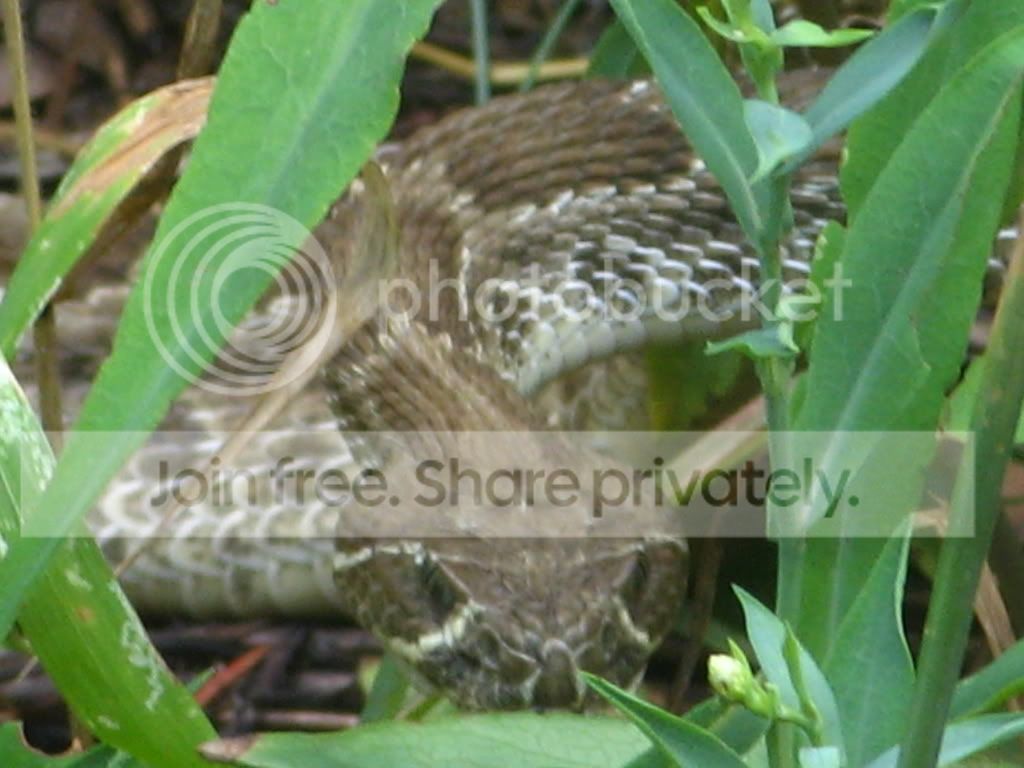
Thanks for all the posts everyone. I went out today to test some new knives, and look what I found!

There are more images of it here: http://picasaweb.google.com/lltmcfadden/Snaked
Sorry they are blurry. Is this a cottonmouth? It was hard for me to get a good look at it since it was "wearing camo".
L
There are more images of it here: http://picasaweb.google.com/lltmcfadden/Snaked
Sorry they are blurry. Is this a cottonmouth? It was hard for me to get a good look at it since it was "wearing camo".
L
- Joined
- Oct 8, 1998
- Messages
- 8,917
Cotton Mouths attack the nervous system.
They have hemotoxin, not neurotoxin.
Added:
The Cottonmouth
Scientific Name: Agkistrodon piscivorous
The Cottonmouth is a large semi-aquatic pit viper, it is the only one native to the Southeastern United States. The brownish juveniles look superficially like copperheads but lose the pattern as they mature. This snake has a reputation for being aggressive which is only partly true. The Cottonmouth will flee when disturbed unless it is defending its territory. Fish make up most of its diet. Cottonmouth bites are fairly serious. When cornered or nervous individuals will open their mouths to expose the cotton-white interior ... hence the name Cottonmouth.
Source: http://www.hswsp.com/animals/reptiles.html
This is what I mean when I say poisonous snakes have a very powerful lobby. The Cottonmouth tends to be aggressive when it is defending its territory...ya think? If you have one in front of you, I'm thinking he thinks that's his damned territory.
Anyway, they are not Coral Snakes which have neurotoxin, they are Pit Vipers like Rattlesnakes and they have hemotoxin like Rattlesnakes and Copperheads although the Copperhead has the mildest of them all.
Also, just FYI, if you are in a hospital that regularly deals with a nasty creature like a Cottonmouth, they might not choose to use Anti-Venin but they would probably be hitting you with some serious antibiotics because the mouth of these snakes are absolutely filthy and the infection you can receive from one might give the venom a run for its money.