- Joined
- Sep 29, 2015
- Messages
- 229
Anyone who read my thread on testing 1095 with different quench mediums will know that I realized after I normalized my test pieces that the decarb layer was much thicker than I realized so I couldnt go back and retest the sample pieces to see what the hardness was deeper below the surface.
So I thought I would revisit that test taking hardness readings at various depths on pieces quenched with different quenchants. Because 1095 and W-2 are both shallow hardening hypereutectoid steels with the same heat treat I decided to use W-2 on this test because I had scrap pieces left over from cutting out my knife from bar stock.
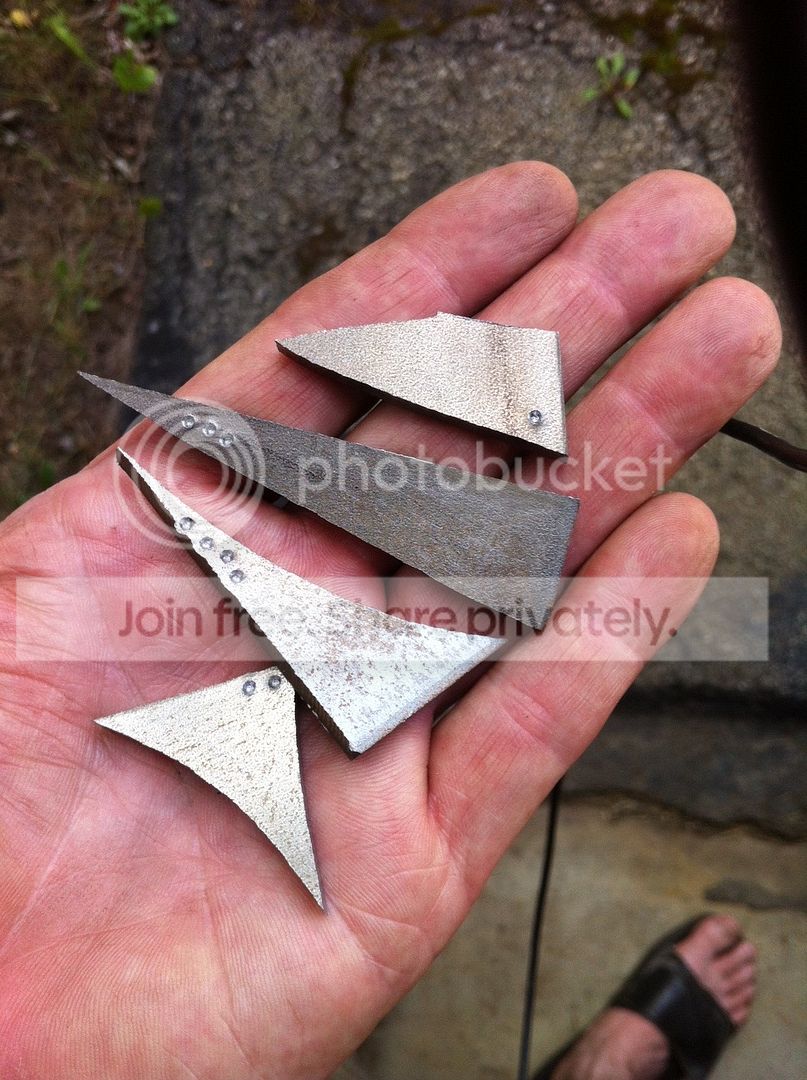
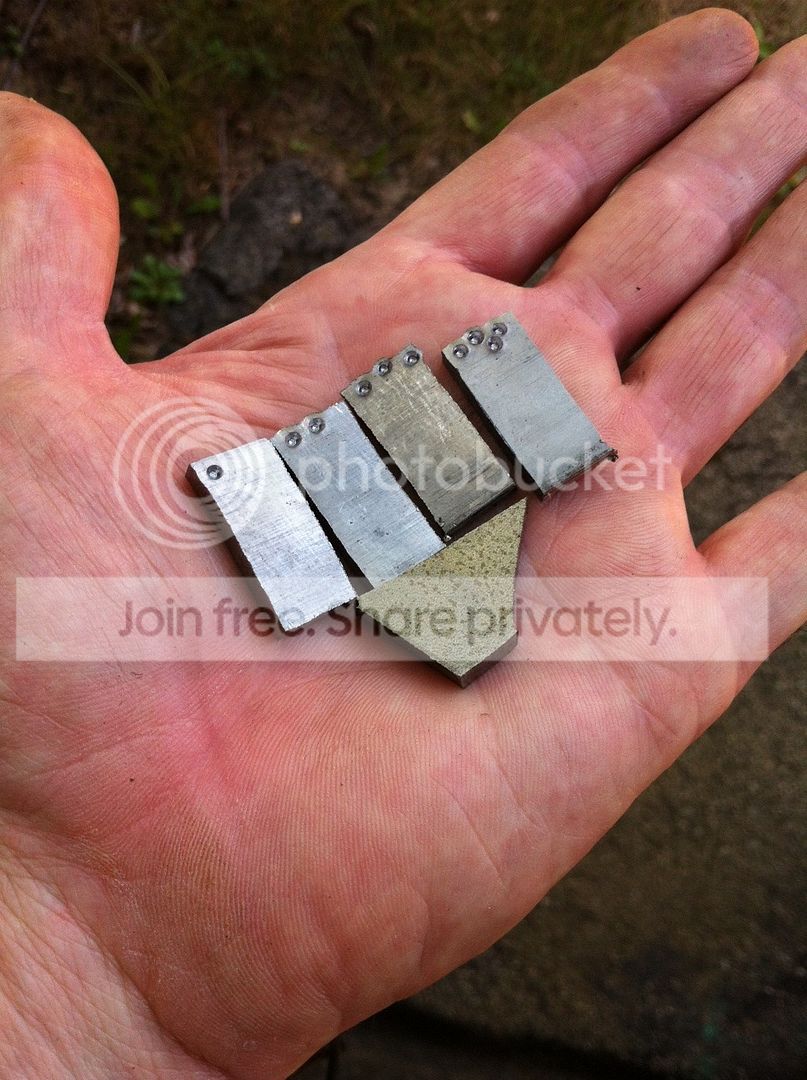
Sample pieces punch marked.
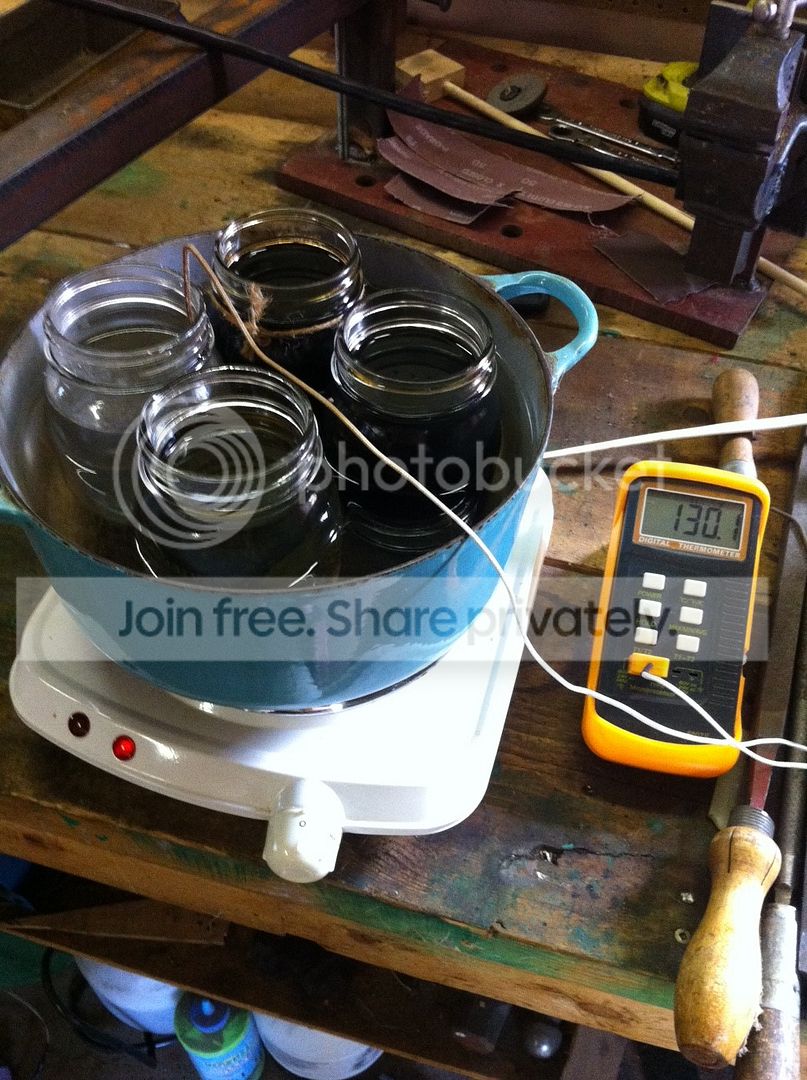
Quenchants all at 130F.
I assumed because they were similar steels the hardness tests would be very similar but I was very wrong. The original thickness of the steel was .207 and after heat treating and skimming off the scale the original test thickness was still .207. I removed accurate amounts of steel and retested at various depths.
No matter how well I line up the columns once I post they don't line up but hopefully it's pretty easy to decipher my readings?
Thickness .207 .205 .200 .195 .190 .180
Amount removed 0 .002 .007 .012 .017 .027
Brine 63 65 65.5 65.5 66
Houghto-Quench® K 48 54 53.5 53 53.5 49
APCO 9-11 second oil: 41.5 42 43 42 42
Canola Oil: 39 39.5 40 41 40
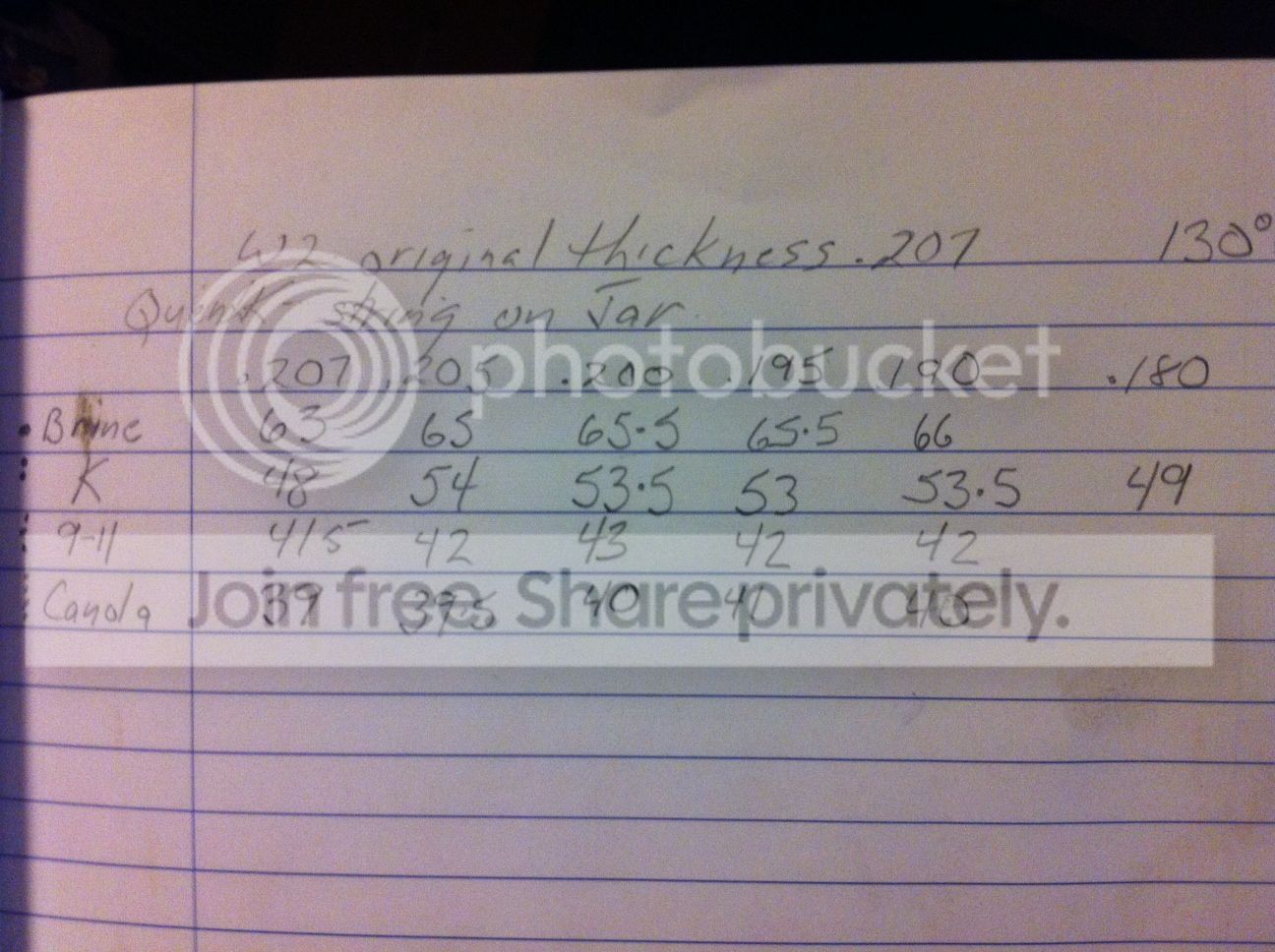
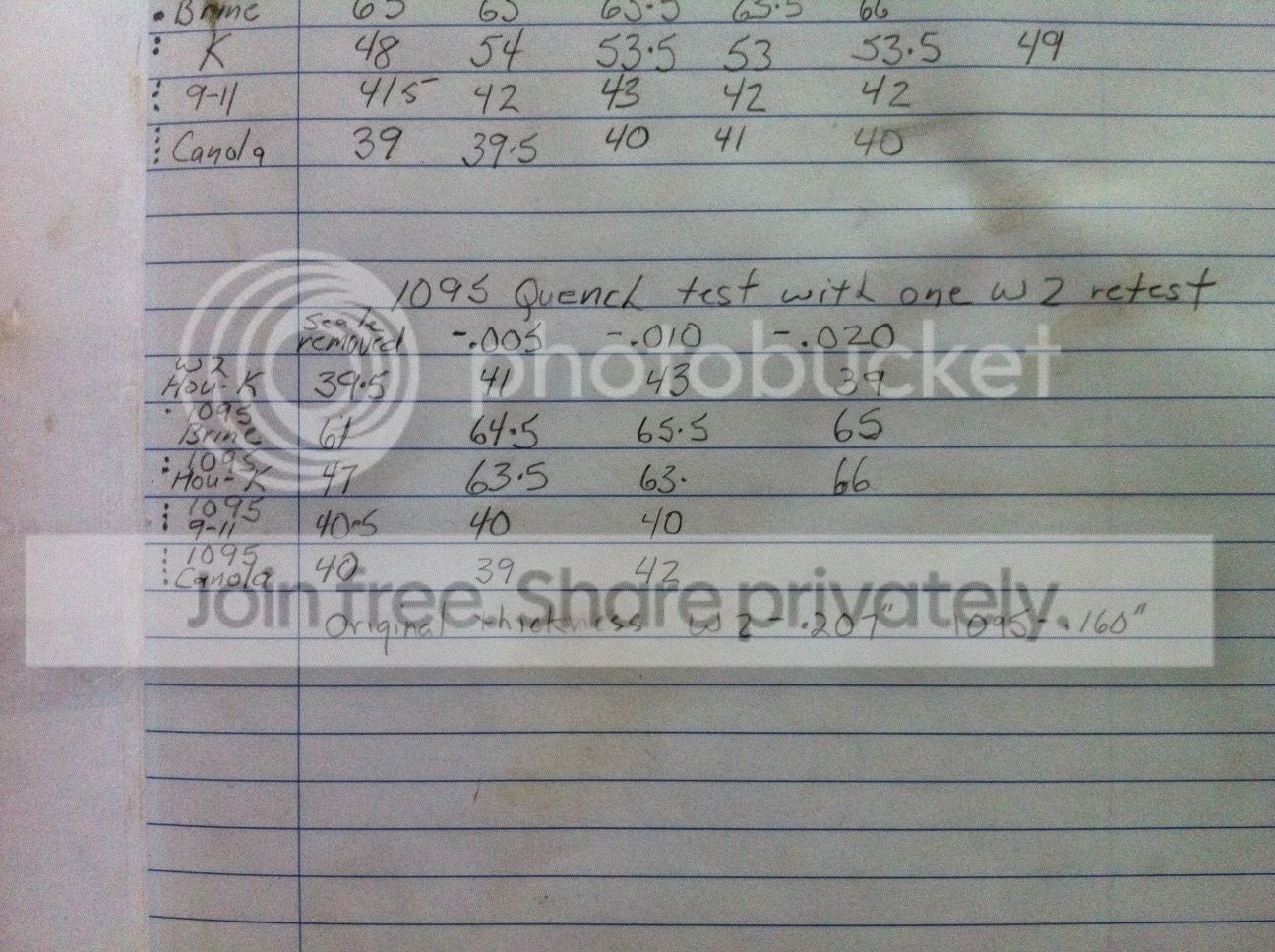
Because my columns don't line up I included a photograph of my notebook showing my readings lining up properly.
The Brine results were about as expected in both hardness and verifying that brine hardens much closer to the surface than other mediums. Also I find the Brine results verification that my methods are sound because these are about the hardnesses expected.
What was very disappointing was my Houghto-Quench® K results. This being a 7 to 9 second oil like Parks 50 I expected my results to be very close to the Brine results. I find this surprising because I did get 65 hardness with 1095 using Houghto-Quench® K once ground down to a depth of about .020 and I thought these two steels were very similar in their hardening requirements.
It did show however that canola seems to be about a 9 to 11 second oil as it performed very close to the industrial oil of that rating which of course are both even more inadequate than Houghto-Quench® K for W-2.
What this test shows me is that W-2 can only be used with a water Brine quench. I was really hoping this test would serve as a double test because I expected the results to be the same as with 1095 but since they arent I am going to do the exact same test with 1095 soon.
This just verifies again to me that if youre going to do your own heat treating you need a heat controlled oven and hardness tester. By the way I placed samples in the oven ramped up to 1475°F and soaked for 10 minutes. All quenching mediums were at 130F.
I did grind off .010 more on my test sample using the Houghto-Quench® K because I was curious if it got harder deeper down because I have 5 gallons of this stuff and some W-2 left over but what surprised me is after I ground down .027 the hardness fell off five points so it is definitely a shallow hardening steel which makes me think it isnt a great steel for a knife because once you remove that much sharpening your knife you are into soft steel and your knife becomes pretty much useless.
I guess I put the horse in front of the cart because I made a knife using W-2 and quenching with Houghto-Quench® K that I really like but obviously it only has a hardness in the low 50s if I am lucky after tempering. Once again live and learn. So now Im going to do the same test on 1095 and really nailed down how good Houghto-Quench® K is on it and at what depth. Stay tuned!
So I thought I would revisit that test taking hardness readings at various depths on pieces quenched with different quenchants. Because 1095 and W-2 are both shallow hardening hypereutectoid steels with the same heat treat I decided to use W-2 on this test because I had scrap pieces left over from cutting out my knife from bar stock.
Sample pieces punch marked.
Quenchants all at 130F.
I assumed because they were similar steels the hardness tests would be very similar but I was very wrong. The original thickness of the steel was .207 and after heat treating and skimming off the scale the original test thickness was still .207. I removed accurate amounts of steel and retested at various depths.
No matter how well I line up the columns once I post they don't line up but hopefully it's pretty easy to decipher my readings?
Thickness .207 .205 .200 .195 .190 .180
Amount removed 0 .002 .007 .012 .017 .027
Brine 63 65 65.5 65.5 66
Houghto-Quench® K 48 54 53.5 53 53.5 49
APCO 9-11 second oil: 41.5 42 43 42 42
Canola Oil: 39 39.5 40 41 40
Because my columns don't line up I included a photograph of my notebook showing my readings lining up properly.
The Brine results were about as expected in both hardness and verifying that brine hardens much closer to the surface than other mediums. Also I find the Brine results verification that my methods are sound because these are about the hardnesses expected.
What was very disappointing was my Houghto-Quench® K results. This being a 7 to 9 second oil like Parks 50 I expected my results to be very close to the Brine results. I find this surprising because I did get 65 hardness with 1095 using Houghto-Quench® K once ground down to a depth of about .020 and I thought these two steels were very similar in their hardening requirements.
It did show however that canola seems to be about a 9 to 11 second oil as it performed very close to the industrial oil of that rating which of course are both even more inadequate than Houghto-Quench® K for W-2.
What this test shows me is that W-2 can only be used with a water Brine quench. I was really hoping this test would serve as a double test because I expected the results to be the same as with 1095 but since they arent I am going to do the exact same test with 1095 soon.
This just verifies again to me that if youre going to do your own heat treating you need a heat controlled oven and hardness tester. By the way I placed samples in the oven ramped up to 1475°F and soaked for 10 minutes. All quenching mediums were at 130F.
I did grind off .010 more on my test sample using the Houghto-Quench® K because I was curious if it got harder deeper down because I have 5 gallons of this stuff and some W-2 left over but what surprised me is after I ground down .027 the hardness fell off five points so it is definitely a shallow hardening steel which makes me think it isnt a great steel for a knife because once you remove that much sharpening your knife you are into soft steel and your knife becomes pretty much useless.
I guess I put the horse in front of the cart because I made a knife using W-2 and quenching with Houghto-Quench® K that I really like but obviously it only has a hardness in the low 50s if I am lucky after tempering. Once again live and learn. So now Im going to do the same test on 1095 and really nailed down how good Houghto-Quench® K is on it and at what depth. Stay tuned!
Last edited: