Surprising W-2 various quench medium hardness test results: Brine, Houghto-Quench k,

I am using 16 ounces for my test pieces and after quenching it didn’t even go up 2°F. My test pieces were only 1” x 0.5 of an inch and if you scale that up to the size of a knife I think it would be like using over a gallon. And that is the same amount of quench oil I used for the 1095 that did harden to 66.

For the pieces that don't reach at least 60 HRC, why don't you re harden them with brine and see if they end up that hard? Then you will know for sure whether it is the oil or the steel.
 
For the pieces that don't reach at least 60 HRC, why don't you re harden them with brine and see if they end up that hard? Then you will know for sure whether it is the oil or the steel.

I just don’t see the point of doing that duurza because I am convinced that it is the oil and not the steel because all my samples of steel were taken from the same bars and cut in the same way so virtually identical and my results are consistent.

I am not trying to convince anyone that my conclusions are true I am just trying to learn and share what I have discovered so others can come to their own conclusions but for me I am convinced until someone has compelling evidence otherwise that Houghto-Quench® K will adequately quench 1095 but not W-2. So far no one has posted that they have successfully hardened W-2 with Houghto-Quench® K and I find that omission compelling in itself.

The W in W-2 means water quench and I think it just needs a slightly faster quench than 1095 and this oil is just simply not that fast.

I do still have about 3' of W-2 left though so maybe down the road I will try and do a knife with a Brine quench and see if it pings? :)

But I think for now I will just stick with Houghto-Quench® K and 1095. I am really regretting not getting Parks 50 and will probably get some when I don't feel so bad about wasting $265.00 on five gallons of Houghto-Quench® K.
 
Last edited:
I could send you a pint of parks so you could verify your conclusions.
 
Actually kuraki I would love to have some parks and that way I could do a test with Parks 50 and Houghto-Quench® K and Brine with both 1095 and W-2 and put this definitively to rest and be certain it is the oil before I spend more on Parks.

It is a hassle on your part so it’s really up to you if you want to go to the bother of sending a pint of parks to Canada. I don’t know what kind of problem you would have sending a liquid over the border not in its original container; I can see it not being allowed to go through? I would be happy to send you $20 to cover the cost of shipping.

It’s really up to you so don’t feel obligated but if you want to I definitely could put it to good use.:)
 
Last edited:
Let me look into what it would take. Labeling it properly is no problem and I think a lot of the hassle you described for a commercial shipment is less of a problem for a personal one.

ETA: Yeah. Email me your address. I think I can get this done through First Class Mail for $22 with a single customs form.
 
I know it's not very scientific but I heat treated a piece of 1/8" 1095 by bringing it to non mag a holding a couple minutes and quenching in the McMaster Carr oil. Then put it into the vice and it easily snapped in half with a small 6" crescent wrench. Then I tempered another piece I had quenched and tried again and it was VERY hard to snap in half.


Sent from my iPhone using Tapatalk
 
The quench tanks in my shop hold 8 gallons of oil. A pint of any quenching liquid is not enough to do the job that needs to be done. There is no place for the heat to migrate to.

Fred
 
There have been several references to the volume of quenches that I have been using in these tests and I have ignored them because I don’t want to be argumentative and I just considered it a non-issue but since it keeps being brought up I guess it has to be addressed.

The main reason and I think most convincing argument that the amount of quenchant I am using is adequate is the fact that all my samples are consistently being hardened by 1 pint of brine and my 1095 samples have been hardened by 1 pint of Houghto-Quench® K so I don’t know how you can argue that’s an issue when my tests have proven it simply isn’t.

Also once this was raised I checked the temperature rise after quenching and it was less than 2°F. I can’t see that insignificant temp rise making any difference at all in my quench. And it takes several minutes for this temperature rise to show up so obviously the heat is migrating to the full volume of my 1 pint container long after the hardening has occurred.

And besides that with these steels the hardening is accomplished in less than half a second. It was mentioned that the heat needs somewhere to migrate to but how far do you think that heat can migrate in less than half a second. I doubt there is any temperature rise in half a second more than a quarter inch from the sample so it seems logically to me you could quench my samples in a shot glass.

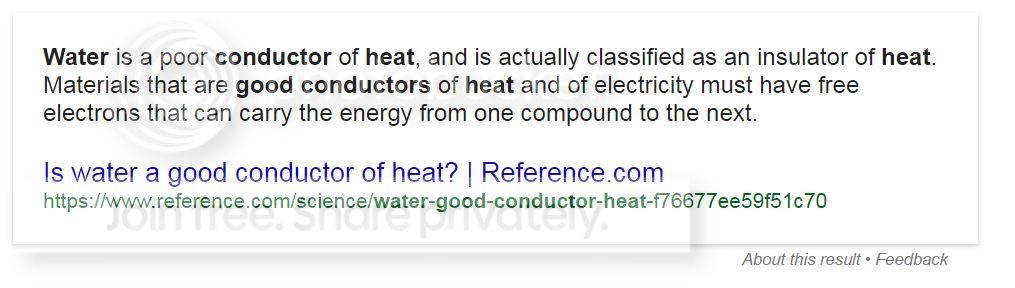
And finally I did a Google search on if water is a good conductor of heat and this is what I got so obviously in less than half a second the heat is going to migrate almost not at all and the cooling is done by the liquid in a shell directly around the piece.
water_zpsz51ain7t.jpg


One can disagree with my reasoning but I don’t see how one can counter the fact that already in my tests 1 pint of quenchant is hardening the samples. The proof is in the pudding.:)
 
Last edited:
Jeff, I've been looking at this thread & have found it both interesting & informative. About the quench volume issue, I guess the only way it could be put completely to rest would be to try with a large volume & then compare it to the pint you use in your tests. Read the numbers, then decide what you think. If there is only a 2 degree rise in temps & the actual hardening takes place as rapidly as is shown from immersion, it seems to me that you should be fine using your tests as you do.

If others wish to try the same thing, spend their time & money, then publish the results that's fine too. I appreciate your posting on this subject & look forward to more results as you go. Thanks, tim
 
When eliminating potential issues, usually the easier ones to change are the first to change. If all you have to do is get a bigger container, why not? Particularly when people are consistently getting higher hardness from an oil than your tests show in brine. It may not make any difference, but it seems easy enough to try and be sure.
 
Thank you noseoil, it is gratifying to know that my efforts are useful to others.

And yes you are right I could test a larger volume against a smaller volume of quench medium to see if it does make a difference but I find I have to draw the line somewhere because if I investigated every single suggestion I would never stop experimenting and never get around to making knives.

I do feel satisfied for the reasons I stated that the quantity of quenchants that I am using is adequate but there is another reason why I don’t feel this needs further investigation.

That reason is that I am trying to use the classic scientific investigative approach with my experiments where I have a standard procedure which is my control group and then I introduce one deviation which I compare against my control.

That is why I always do a brine test because I consider that my control which I compare my deviation against. So even if the volume of oil that I use isn’t giving full hardening it doesn’t matter because that same handicap applies to my control so it basically is nullified.
 
Did you do an agitated quench in the oil? If you get better results, then that would prove that the oil is definitely not thin enough to provide a high enough rate of heat transfer.
 
I believe I addressed your concern me2 in the post I was writing before I saw your post that I posted after yours but I believe your issue needs further addressing.

As I said because the size of my quench if it is a handicap is nullified because it is also applying to my control which is the brine. And the reason I am using the small volumes is because I have to heat all the quenchants to the same temperature and it would be difficult to heat four 1 gallon containers at the same time with the equipment I have.

And as I stated previously in the standard scientific investigative model you can only have one variable introduced at a time or you don’t know what is causing your changes. This experiment is solely designed to investigate different quench mediums so that is all I am going to change.

But yes you are exactly correct that other people are getting higher numbers than my brine using Parks 50 and on other experiments I will investigate things like volume of quenchant and temperature and normalizing and aust. Temperature etc.

I plan on doing all those eventually but with the standard model you can only introduce one variable at a time so what you suggest is for future experiments once I have finished this one.
 
No duurza I did not agitate but for a reason. With these steels the hardening takes place in less than half a second so once the test piece is plunged into the quench it is done and any agitation is post hardening and does nothing.

And besides that as I keep saying I am comparing these against my standard model which is my brine test and just plunging my sample in those I am getting hardness of 65 without agitation so for a fair test I am treating all samples the same.
 
Jeff, please allow me to agree with you 100%. My understanding is the purpose of the larger volume of liquid for quenching is to prevent the liquid from getting too hot during quench to be fully effective. Since you've measured and there is <2ºF temp rise, I can not see how a larger volume could possibly affect anything.

Allow me to also add, I am NOT an expert on using liquid (water, brine, oil, etc) for quenching. I work almost totally with air hardening steels and use quench plates. comparing the mass of your test coupons to 1 pint of quenchant vs a big bowie using a couple (or 4) gal of quenchant, I expect you might well have a more favorable ratio.

Ken H>
 
I believe I addressed your concern me2 in the post I was writing before I saw your post that I posted after yours but I believe your issue needs further addressing.

As I said because the size of my quench if it is a handicap is nullified because it is also applying to my control which is the brine. And the reason I am using the small volumes is because I have to heat all the quenchants to the same temperature and it would be difficult to heat four 1 gallon containers at the same time with the equipment I have.

And as I stated previously in the standard scientific investigative model you can only have one variable introduced at a time or you don’t know what is causing your changes. This experiment is solely designed to investigate different quench mediums so that is all I am going to change.

But yes you are exactly correct that other people are getting higher numbers than my brine using Parks 50 and on other experiments I will investigate things like volume of quenchant and temperature and normalizing and aust. Temperature etc.

I plan on doing all those eventually but with the standard model you can only introduce one variable at a time so what you suggest is for future experiments once I have finished this one.

It's not just temperature of oil . In a larger container you can move steel ..............
 
Thank you Ken H for your affirmation of my opinion on quench oil volumes but what I think I haven’t really made clear is that even if it was an issue it’s been nullified because all my quench tests have the same handicap.

Let me give an analogy that may get my point across. Let’s say you have four people that are having a 100 yard race. They will probably come in a particular order every time they run.

But let’s say you put ankle weights on just one runner. That runner in subsequent races would do worse than the other runners so it wouldn’t be a fair test and the results would be invalid. But let’s say you put ankle weights on all four runners. Even though they were handicapped they were all handicapped in the same manner and degree so they would still finish in the same order as if they were not handicapped but just at a slower rate and that is my point.

Because all my samples are using the same standards including volume of quenchant even if they are being handicapped they are all being handicapped to the same degree so the results are valid.
 
It's not just temperature of oil . In a larger container you can move steel ..............

How much do you think you can move the steel in half a second because once it’s plunged in it’s over.

I don’t know how I can make this more clear that it doesn’t matter if one has ideal conditions to attain maximum hardness in this test. All it matters is that all the samples are treated exactly the same other than one variable which is using different quench mediums. If I got 65 hardness with Brine all it matters is that the other tests with other quench mediums is done exactly the same in all other ways. The brine wasn’t agitated so the others don’t get agitated, Period!

This test is not designed to get maximum hardness it is designed to compare the effect of changing only the quench medium with a standardized procedure.
 
The scientific method doesn't mean one variable only.

If one uses a matrix one can change multiple things and come to conclusions with less experiments than the number of variables.
Let say there are 20 factors. Do we need 20 experiments? No.
How?
Change 10 factors and then the other 10. Now pick the group of 10 which were most interesting.
Now change 5 of those and then the other 5. Pick the most interesting 5. Change 3 of those then the other two.
Pick the most interesting. Do 2 of them and the remaining one.
Pick the best.
Change one factor then the other.
Now you identified the most influential variable with only 8-10 experiments instead of 20.
 
Back
Top