Tanto Advice

Joined
Jan 18, 2010
Messages
217
Greetings BF,

I recently tried to make a traditional Japanese inspired Tanto. As a new knifemaker I always thought this type of blade was far beyond my ability, but this style speaks to me. In a thousand years i'd be happy to make a knife half as good as the aikuchi featured on mgregoryknives's website. For now, I want to build the foundations of proper tanto design. I don't have forging equipment/skills yet, so i'm doing stock removal. I realize a process is very individual, but was looking to consolidate advice/critique into a single BF thread that I can track refer back to. I often find myself mixing pieces of advice which leads to poor decisions. I have a new bar of 1084 (.187" thick, 1.5" wide) Aldo steel that i plan on using entirely for a tanto of the same dimensions. If any experienced tanto guys would be willing to take on a "virtual apprentice", i'm your man!

See how my 1st tanto met its demise below...
Od5REPn.jpg


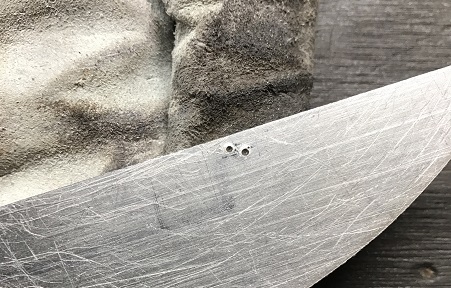
After rough profiling I noticed these marks on my steel, and cannot figure how i could have put them there. I didn't use any punches, and don't own a hardness tester. Can steel come like this or manifest marks like this due to a mistake i made?

b9jXDQE.png


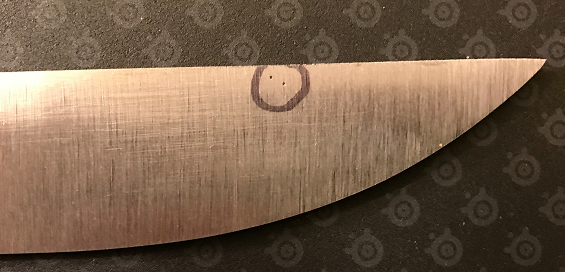
I was very pleased with this side of the knife. Used a fresh VSM 50 grit ceramic belt on the bevels and realized it was probably too aggressive. It took me awhile just to get to this point until i realized i shouldn't waste anymore time hand sanding. I also used a bubble jig @3.5 degrees. The tang hole is 3/16".
2Y7rIPU.png


I tried to grind away those imperfections, and no dice...
n8TDJmN.png


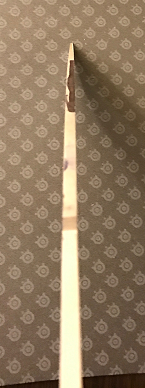
...and fouled up my geometry. the black sharpie area on the spine is where i think i ground away too much metal trying to get rid of the imperfections. The mistake was obvious as the blade lies different on each side.
eXN2kxu.png


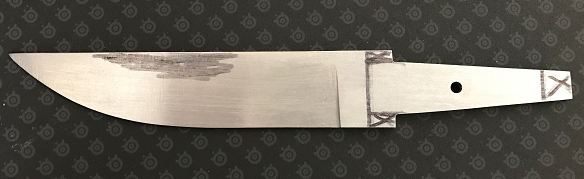
In this pic, i try to show my design flaws. the tang proportions seem wrong due to the space underneath what would be the Habaki (ricasso?) being too wide. I don't plan on doing a Habaki or other traditional elements as these are way out of my league currently. I'd like to put a brass guard in this area instead.


I appreciate any tips/tricks/suggestions/critiques and hope everyone has a wonderful day.
 
Here are a few suggestions that are specific to this tanto:
1) The ratio of length to width is a little bit odd. Traditional tanto are usually under 1" wide and 8-10" long. This gives yours a slightly stubby appearance--this isn't the end of the world, but it would be easier to make it look graceful if it were slimmer and/or longer.
2) Most tanto taper in width before they get to the kissaki. Yours appears to be the same width throughout, which makes the kissaki look abrupt.
3) The spine has no curvature. "Mu sori" tanto, like yours, existed but they are a little bit harder to get them to look good. If you add some forward curve to the spine (uechizori), it will look more elegant and lively.
4) The spine is flat (kakumune). Again, this has historical precedent, but a ridged spine (iorimune) will make almost any knife look more like a tanto, and give it a sense of depth.
Aside from the curvature, the aikuchi on Matt Gregory's site has all of these features.
More generally, take some time and make a careful study of the design elements that go into traditional tanto. If you have not already, learn the different geometries, and the different ways that they can vary. Study measurements. There is no shame in copying the shapes of the blades of long-dead smiths.
Have a look here: https://markussesko.com/2015/04/13/kantei-1-sugata-7/
And here: http://www.ksky.ne.jp/~sumie99/information.html
Your blade shows that you have some technical ability, and that is a great start. The blade really isn't bad, and if it's your first attempt at a tanto-inspired blade, then it's a good one.

Chris
 
Hesparus, thank you for that awesome reply. Appreciate the reading links too.
 
I'd consider grinding some height out of it, pulling the grind back if possible, radius the tang corners and finishing it up. You have done some really nice work here and I bet it will look great!
 
I'd consider grinding some height out of it, pulling the grind back if possible, radius the tang corners and finishing it up. You have done some really nice work here and I bet it will look great!

Daniel, thanks for the reply. As a super newbie i should probably feel more shame, but i'm fuzzy on 2/3 of your suggestions :)

- grinding the height out. do you mean to have a more drastic angle down from the spine to the edge?
- radius tang corners. would it look more like a semi circle at the end of the tang?
 
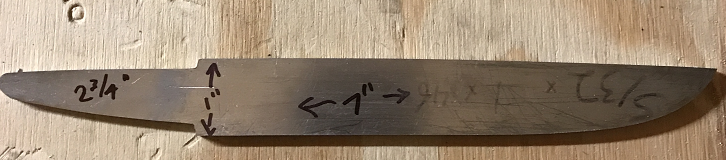
Ok...the Japanese weapons rabbit hole is DEEP! Hesparus, motivated me to do more research -- armed with enough information to be dangerous I HAD to hit the garage for some hands-on action. I'll probably jack the terms up. But i'm going for a Hira-Zukuri Tanto with a iori-mune. I like the rounded fukura with chu-kissaki. I also tried to incorporate Mr. Fairly's advice. I believe my nabasa is shorter than a traditional tanto, but i'm ok with that if it looks good proportionally. Initially, i cut out a piece of the 1.5" 1084 steel and mocked it up...it looked way too fat to be a stabbing weapon. I transitioned to a 1" thick piece of 1095. I have a taper, but wouldn't claim forward curve...still mu sori?

N7K06Lz.png


Some thoughts I want to get out before i hit the sack...

- If i were to go forward w/this knife, would you recommend a plunge line? I sense that a no-plunge look only works w/the habaki.

- Whats the best way to grind the iori-mune?

- Thoughts on a good/cheap wood to use for the handle? Where do folks typically get their handle materials for a tanto?
 
Daniel, thanks for the reply. As a super newbie i should probably feel more shame, but i'm fuzzy on 2/3 of your suggestions :)

- grinding the height out. do you mean to have a more drastic angle down from the spine to the edge?
- radius tang corners. would it look more like a semi circle at the end of the tang?

I think he meant on this corners .

2v2gvib.png
 
You are getting closer. The original blade was a western camp knife, not a tanto. There is no ricasso or guard shoulders on a tanto.

As said by others, tanto are not normally short and fat. They should look sleek. Your new length to width is much better.

Hira-zukuri with iori-mune is a good choice.

I would have made the machi a bit less severe ( not as deep), but that isn't a big issue. Normally, they only need to be deep enough to make a stop for the habaki. In grinding/shaping a tanto ( as with most Japanese blades), it is simpler to do the sugata as a smooth shape and add the machi after the bevels are all done. This allows for adjustments in curvature and shape as well as makes the machi placement less likely to end up in the wrong spot. In your current shape, I would have ground the nakago right up the ha and mune to make a "torpedo" shape. This assures an even thickness where I place the machi later on. It would also make the mihaba at the machi a bit less than center blade, which I personally like. You can still do this and place the machi later on.

What I can't quite describe easily is how your blade looks "stiff". It looks like you took a bar of steel and make a knife from it. There should be some slight curvature and "flow" of the blade. The slight drop to the tip is OK for a western knife, but sort of the opposite of what a Japanese tanto should have. The tip should be slightly raised giving the whole blade a tad of sori. This is another reason why the machi should be done last, as the shaping is easier to see and get a feel for.


The divots on the original blade were probably test marks on the steel bar from the annealing process at the mill. There are also other things in the rolling and handling that put marks in the steel. I always give the surface a quick clean up and inspect the bar to look for any defects to work around before grinding the blade. I rarely use the bar end for the tip It has had the most abuse). If you had reversed the blade blank sketch on the bar, the divots would have been in the tang and would have been removed in shaping.
 
This looks much better. You could move forward from here as-is and you would probably be happy with the outcome. But here are a couple more suggestions:
1) Your nakago (tang) is way too short. If you were going to do a traditional mounting, the habaki would take up about an inch of your nakago, and you would only be left with less than 2". Even if you were to do a western hidden tang, that's probably too short. You could move your machi up another inch and you'd be in good shape. If you don't plan on mounting this, then you don't need to move it.
2) If you do an oil quench (and with 1095 you should), your knife will bend forward by probably at least 1/8" or so. This will increase the uchizori, but it will also make problems for your edge. The edge is currently dead-flat for most of the length of the blade. (I think this is part of what Stacy meant about it looking stiff.) This will mean that you will end up with a little bit of a recurve after your oil quench. Profile your edge such that every part of it curves towards the spine at least a little bit.
3) You could do this with a plunge line and mount it like a hidden tang, western knife, or bevel the entire thing like a traditional tanto. The latter will lead you down a much deeper rabbit hole of Japanese mounting, or you could leave it unmounted. If you go with the former, I wouldn't leave much of a ricasso.
4) Use a hand file to shape the mune, or use a slanted tool rest on your grinder.
5) Traditional handle material for Japanese blades is Ho wood, which is a kind of poplar. This works well if you are then going to cover it in rayskin and to tsukamaki. If you are going to leave it bare, I would recommend something else, because ho and other poplars are quite soft.

- Chris
 
Daniel, thanks for the reply. As a super newbie i should probably feel more shame, but i'm fuzzy on 2/3 of your suggestions :)

- grinding the height out. do you mean to have a more drastic angle down from the spine to the edge?
- radius tang corners. would it look more like a semi circle at the end of the tang?

height - more like your second profile which is looking good!

yes on the radius, just a small one to reduce stress during heat treat

on pulling the grind back I just mean less flat/ricasso area... probably easier to extent the tang by grinding away instead of messing with the bevel grind
 
Ho wood is a magnolia, not a poplar. American substitutes are holly and alder. Poplar is OK for shira-saya, but isn't any good for a working handle.
 
Stacy where would a chap find alder to use on a handle? I tried poplar from home depot w/a crap chisel and that doesn't seem to be a good idea even discounting the process w/my low-end skills.
 
Stacy where would a chap find alder to use on a handle? I tried poplar from home depot w/a crap chisel and that doesn't seem to be a good idea even discounting the process w/my low-end skills.

Alder is very prevalent in guitars, the American Fender Stratocaster and Telecasers are usually alder, sometimes ash.

Warmoth or USA guitar will have body blanks of Adler and you could make a ton of handles from one blank.

Carvin.com used to sell alder blanks they may still.

Do a search for guitar body blank on eBay and you may find some cheaper options I have found a lot of guitar related stuff there.

I suppose you could butcher up a guitar but please don't tell me if you do!

Edit to add, I have never tried it but a Call to warmoth might get you some suitable scrap pieces that are too small for a body for cheap, I'm sure they end up with scraps they can't use.
 
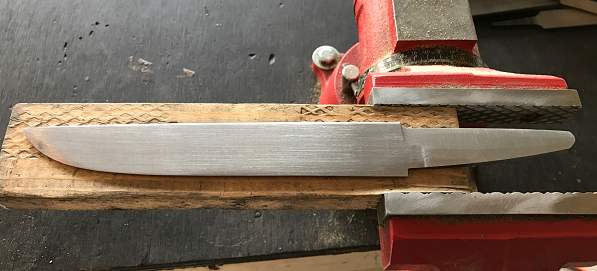
Version 2. The iori-mune was actually fun to work on, and i did them before the bevels. I tried to incorporate the ideas presented here re: machi.

oqkXFJL.png


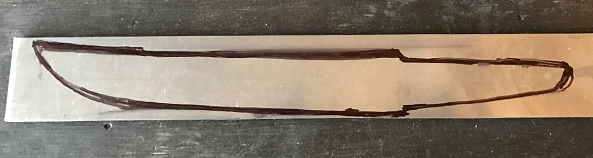
Version 3. Will shape the machi after bevels on this one.

akoa8DV.png


Should I shape the iori-mune before or after bevels?

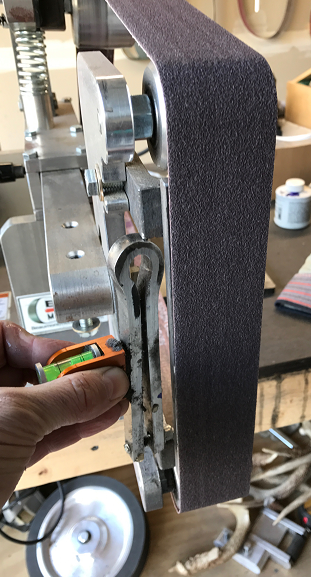
I made the same mistake on the other side of the blade again -- making it flatter than the side shown above. I realized this may be due to the buble-jig. it doesn't allow the blade to sit flush on my KMG platen on the left side -- the jig is too tall. i'll try without the bubble jig on the next run, and maybe use the costa jig.

kzXyhyw.png
 
I'm making an Alder Telecaster right now... got the wood locally at a lumber mill for about $25. I had it milled for that price and got about 8' by 6" by 1". It might make 100 handles!

Alder would be nice, interesting on the Poplar too as I have a some I want to eventually try for a Saya.
 
@ Daniel
Hope I'm not derailing the thread but what part of the country are you in, alder is pretty rare in Louisiana we have to have it shipped in.

I still have one Tele I built a few years ago for myself, but that one I did with mahogany with a maple cap, andGibson scale length.

I play heritage guitars mostly and occasionally an SG , I don't really get along with strats and teles anymore.
 
Daniel, you make guitars too?! I'm hoping they're horrible and it baffles you daily...talent hog! j/k of course.
 
A hardware store won't have alder, but any good lumber yard that carries exotics will have thick planks of it.

Good woods for a tanto in a natural finish tsuka/saya are curly maple and other figured maples. I have also used cherry, olive, blackwood, ebony, bocote, cocobolo, and other exotics. Use buffalo horn for the kojiri, koi-guchi, tsuba ( if used), fuchi, and kashira.


Try drawing the version 3.0 sketch WITHOUT the machi. After it looks right, then lightly shade in the maki on the sketch. Make the blank without the machi, and after the bevels and mune are done, do the HT. After tempering and sanding to to 400 grit, then add the machi. On some blades, I don't add them until after the habaki is fitted (sans the machi-gane). This makes it easy to get a perfect habaki fit. You fit the habaki and then add the machi-gane. Then you slowly remove the metal along the nakago edges to make the machi. Check the habaki every few moments as you reduce the width.
 
Last edited:
Back
Top