
-
The BladeForums.com 2024 Traditional Knife is available! Price is $250 ea (shipped within CONUS).
Order here: https://www.bladeforums.com/help/2024-traditional/
You are using an out of date browser. It may not display this or other websites correctly.
You should upgrade or use an alternative browser.
You should upgrade or use an alternative browser.
Tanto Advice
- Thread starter shamu
- Start date

- Joined
- Jan 18, 2010
- Messages
- 217
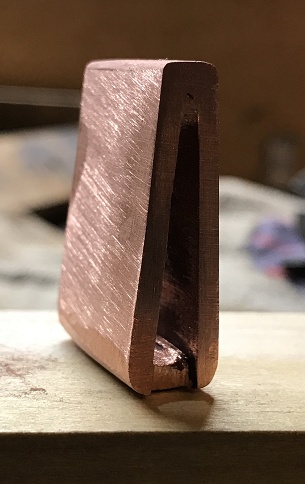
re-shaped the nakago just a touch. hit the habaki w/600 grit belt then scotch-brite belt. i have a couple of issues...
1. no room for a tsuba based on my mekugi hole
2. the forward angle (from spine to blade) of the habaki is slanted, and i'm not sure its right/wrong or correctable
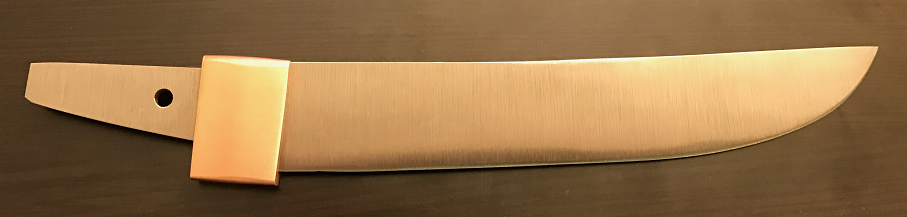
1. no room for a tsuba based on my mekugi hole
2. the forward angle (from spine to blade) of the habaki is slanted, and i'm not sure its right/wrong or correctable

Stacy E. Apelt - Bladesmith
ilmarinen - MODERATOR
Moderator
Knifemaker / Craftsman / Service Provider
- Joined
- Aug 20, 2004
- Messages
- 38,590
Your habaki is similar to most first habaki. It is way to thick and sticks out from the blade too much at the ha-machi. The bottom should fit like your top does. I think you followed Jesus Hernandez's tutorial, which is good, but it is not a habaki for a tanto. That type habaki is for a larger blade.
On a tanto, the habaki sits mostly on the blade, not the nakago. The mune and ha sides are generally cut out back to the machi-gane to alloy the habaki to slide forward along the blade. If it is a four sided habaki, it needs to be very thin on the edges. As yours is right now, it will be difficult to insert the blade into the saya. Adding bevels to the ends can help this. Also thinning and tapering the habaki a lot more than you have will improve the look and fit.
I like the part that sits on the nakago to be half of the habaki or less. The machi-gane (part that stops on the shoulders) is only about 1/8" to 1/4" on some habaki. At a minimum, I think one should have half the habaki on the blade of a tanto. Others like a short habaki with a smaller seat.
On a tanto, the habaki sits mostly on the blade, not the nakago. The mune and ha sides are generally cut out back to the machi-gane to alloy the habaki to slide forward along the blade. If it is a four sided habaki, it needs to be very thin on the edges. As yours is right now, it will be difficult to insert the blade into the saya. Adding bevels to the ends can help this. Also thinning and tapering the habaki a lot more than you have will improve the look and fit.
I like the part that sits on the nakago to be half of the habaki or less. The machi-gane (part that stops on the shoulders) is only about 1/8" to 1/4" on some habaki. At a minimum, I think one should have half the habaki on the blade of a tanto. Others like a short habaki with a smaller seat.
Last edited:
- Joined
- Jan 18, 2010
- Messages
- 217
Ok Stacy, i worked on your suggestions. i see what you're talking about now. your advice will definitely be on my mind when i make the next habaki. i'm not sure how much i can squeeze out of this current habaki. i kept having newbie-knife-maker-flashbacks of decent work being rendered junk because i don't know when to quit. i'm shocked my solder joint is still in tact. the micro adjustments are challenging. i think im satisfied w/my 1st habaki.
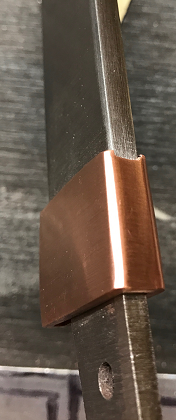
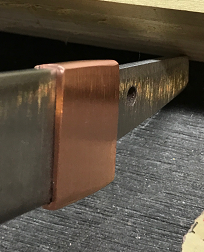
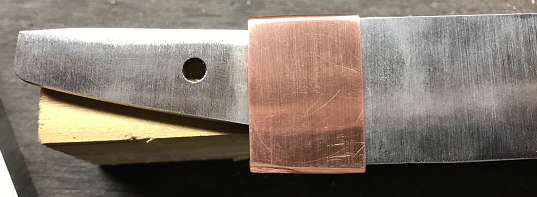
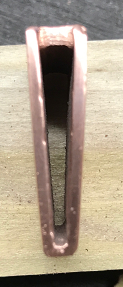
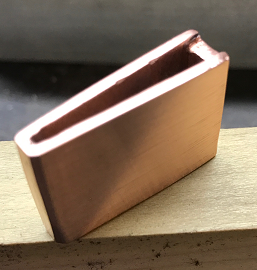
Not bad at all for a first attempt!!!
I suggest to have a look here: http://islandblacksmith.ca/process/making-aikuchi-tanto-kuro-urushi-koshirae/#/habaki
Dave is a great smith! Remember to browse his site deeply since bits of very important informations are scattered through the different posts rather than being intended as full tutorials.
Plus it is a work of art of narration and pictures
I suggest to have a look here: http://islandblacksmith.ca/process/making-aikuchi-tanto-kuro-urushi-koshirae/#/habaki
Dave is a great smith! Remember to browse his site deeply since bits of very important informations are scattered through the different posts rather than being intended as full tutorials.
Plus it is a work of art of narration and pictures
Last edited:

Stacy E. Apelt - Bladesmith
ilmarinen - MODERATOR
Moderator
Knifemaker / Craftsman / Service Provider
- Joined
- Aug 20, 2004
- Messages
- 38,590
That is a lot better fit at the ha machi. I would suggest cutting it in half (top to bottom cut) to make it less wide. As it is, you have a very short nakago, and the mekugi-ana is really close to the habaki. By the time you add the tsuba, the hole will be at the front edge of the tsuka. You almost surely will need to drill a new ana.
If you look at the last photo of the habaki on the blade, you will notice a slightly dark line down the middle from top to bottom ... that is where I would cut the habaki in half. Save the cut off piece to make a habaki for another tanto blade.
If you look at the last photo of the habaki on the blade, you will notice a slightly dark line down the middle from top to bottom ... that is where I would cut the habaki in half. Save the cut off piece to make a habaki for another tanto blade.

- Joined
- Feb 27, 2006
- Messages
- 5,191
i agree with stacy, you can half the length, then cut your top and bottom slots a bit deeper so it slides up the blade more and you should have enough room for a tsuba. looking good !
- Joined
- Jan 18, 2010
- Messages
- 217
Not bad at all for a first attempt!!!
I suggest to have a look here: http://islandblacksmith.ca/process/making-aikuchi-tanto-kuro-urushi-koshirae/#/habaki
Dave is a great smith! Remember to browse his site deeply since bits of very important informations are scattered through the different posts rather than being intended as full tutorials.
Plus it is a work of art of narration and pictures
Yah, that guy is awesome. Thanks stezann.
- Joined
- Jan 18, 2010
- Messages
- 217
Very good looking, glade you are having fun and making progress. Makes me want to make one.
Do it JT, let's get habaki crazy around here. Wouldn't be this far without your awesome HT -- so thanks again!
- Joined
- Jan 18, 2010
- Messages
- 217
Are you aware that copper could be made soft again?
Just heat it to dull red and you are good to go...you could even quench it to cool it quickly.
Yes, but i guess my issue is confidence. Confidence that i can get that cut from top to bottom straight while my habaki is squirrelly in the vise because i dont want to overclamp. Also, a hacksaw blade seems pretty thick. i guess a jewelers saw would work?
- Joined
- Feb 27, 2006
- Messages
- 5,191
sure a jewelers saw would work fine. a bandsaw would work too if you have one. that way you would not need to clamp it.
Stacy E. Apelt - Bladesmith
ilmarinen - MODERATOR
Moderator
Knifemaker / Craftsman / Service Provider
- Joined
- Aug 20, 2004
- Messages
- 38,590
OK, I had a few extra minutes this morning while setting some diamonds, so I grabbed a tanto blade from my run bag and made a habaki for it. I started with a pipe coupling, annealed it, flattened it, opened it up enough to hammer ( brass hammer) it up the nakago, then started fitting it. Once the basic shape was formed, I cut the piece in half. At this point I silver soldered the joint at the ha. Next, I added the machi-gane, cleaned the inside up a bit with some needle files and a ball burr. Then I cut the mune-machi slot to fit the machi. Once it was fitting pretty good, I cut the piece down a bit more from the back side to remove some dings and make it narrower ( I had been striking the back of the habaki with a flat block of steel as I fit it), and started the final filing and shaping. Once the surfaces were clean of dents and dings, I beveled the very front bottom corner at the ha at 45 degrees, and beveled the front edges on the sides. With the bevels on all forward edges, when a finger or the saya is run up the blade against the habaki there is no appreciable stop at the sides or top/bottom to snag. At this point, I reduced the metal sticking out past the ha until it was about 1mm thick. This is plenty for strength, but projects very little. Once the rest of the habaki is sanded smooth, all sides will be about 1mm thick, with the back being a tad thicker. This is plenty to grip the saya, but not enough to affect the knife in use.
From here it will just be some sandpaper and it is done. Finished width is about 12mm (1/2"). On a tanto, the habaki is much shorter than on a sword.
It took about 30 minutes to make the habaki, with most of that being time to take the photos. I will clean up the photos tonight and post them as a tutorial thread. I have been working on a tanto project for a future book, and will add blade and koshirae procedures to the habaki tutorial as I go, to make it a complete Japanese Tanto tutorial. I'll post a link tonight or tomorrow morning when I get the habaki thread posted.
I want to make one thing clear to all who read my posts and tutorials. There are no hard and fast rules on making Japanese swords and knives. One smith will do it one way and another will do it quite different. Jesus Hernandez may prefer a small machi notch, and I may prefer one 50% down the habaki ... both are correct to the person who makes them. The posts I make are how I do things, and are not necessarily the only or the best way. If you have another way, please tell/show/link it. The way we all learn is by seeing how others do things. No one will ever upset me by saying they think a different way would be better. It is quite the opposite, I appreciate being shown other ways, as mine are self taught. I still have much to learn from others.
BTW, the alder wood goes out in tomorrow mornings mail.
From here it will just be some sandpaper and it is done. Finished width is about 12mm (1/2"). On a tanto, the habaki is much shorter than on a sword.
It took about 30 minutes to make the habaki, with most of that being time to take the photos. I will clean up the photos tonight and post them as a tutorial thread. I have been working on a tanto project for a future book, and will add blade and koshirae procedures to the habaki tutorial as I go, to make it a complete Japanese Tanto tutorial. I'll post a link tonight or tomorrow morning when I get the habaki thread posted.
I want to make one thing clear to all who read my posts and tutorials. There are no hard and fast rules on making Japanese swords and knives. One smith will do it one way and another will do it quite different. Jesus Hernandez may prefer a small machi notch, and I may prefer one 50% down the habaki ... both are correct to the person who makes them. The posts I make are how I do things, and are not necessarily the only or the best way. If you have another way, please tell/show/link it. The way we all learn is by seeing how others do things. No one will ever upset me by saying they think a different way would be better. It is quite the opposite, I appreciate being shown other ways, as mine are self taught. I still have much to learn from others.
BTW, the alder wood goes out in tomorrow mornings mail.
MBurks, i received your package today. Thank you very much for the alder block.
Good deal I hope it helps!
- Joined
- Jan 18, 2010
- Messages
- 217
I'm starting the plan for the the next steps and need to gather some material. For tsuba it seems like wrought iron is a good choice. May skip a tsuba altogether unless that's a horribly dumb idea? Does anyone have ideas for common items that can be repurposed for koiguchi, seppa? The fuchi still mystifies me a bit, but doesn't seem mandatory. I really need to physically examine a finished tanto one of these days...could enhance my hazy understanding of this art. 😀
Stacy E. Apelt - Bladesmith
ilmarinen - MODERATOR
Moderator
Knifemaker / Craftsman / Service Provider
- Joined
- Aug 20, 2004
- Messages
- 38,590
The habaki tutorial is here:
http://www.bladeforums.com/forums/s...e-of-a-Tanto-tutorial?p=16887164#post16887164
For the koi-guchi (carp's mouth - AKA sheath throat), tsuba, and ends of the tsuka and saya nothing is simpler and looks better than water buffalo horn. You can buy it in slabs or in pieces from most knife suppliers. It is cheap. Just sand all mating surfaces flat with a 50 grit belt and epoxy together. It will grind and sand easily, but avoid too much speed and building up any heat. It sands to 400 grit and buffs to a glass shine in seconds.
Other popular choices are African blackwood, bone and ivories, and any tight pattern wood that looks right.
A tsuba on a tanto is either very small or not there at all. The big sword size tsuba you see on Mall Ninja tanto are humorous.
Many tanto tsuba only project past the tsuka by 6mm ( 1/4") or so. A 12mm (1/2") projection is a very large tsuba on a tanto. If you have no tsuba, or it is level with the tsuka, the mounting type is called aikuchi (without a giard). You usually still have a tsuba, but it does not stick out, so it is a bolster not a guard. As said water buffalo is a good choice. If using metal, WI, low carbon steel, damascus, mokume, etc., will be good. Don't try to decorate them like a katana tsuba. At the most, a hammered or etched rim is all they need. A few on fancy ceremonial type tanto might have a file worked rim.
Seppa are best made from the same material as the habaki, but can contrast if you wish. I make the slot in the seppa first, and trim and shape it after all the other parts are finished and fitted. I slide the tsuka with the fucchi on it ( if you have one) and draw a pencil line around it on the seppa piece. This is the line I have to stay inside of. From there you can make the seppa the size and shape you wish. On a tanto, a basic oval or a fluted edge is all you need. On aikuchi, it can be the same size as the tsuba/bolster.
If the tsuba is a solid material, you may not even have a seppa. Just let the tsuba seat against the habaki.
http://www.bladeforums.com/forums/s...e-of-a-Tanto-tutorial?p=16887164#post16887164
For the koi-guchi (carp's mouth - AKA sheath throat), tsuba, and ends of the tsuka and saya nothing is simpler and looks better than water buffalo horn. You can buy it in slabs or in pieces from most knife suppliers. It is cheap. Just sand all mating surfaces flat with a 50 grit belt and epoxy together. It will grind and sand easily, but avoid too much speed and building up any heat. It sands to 400 grit and buffs to a glass shine in seconds.
Other popular choices are African blackwood, bone and ivories, and any tight pattern wood that looks right.
A tsuba on a tanto is either very small or not there at all. The big sword size tsuba you see on Mall Ninja tanto are humorous.
Many tanto tsuba only project past the tsuka by 6mm ( 1/4") or so. A 12mm (1/2") projection is a very large tsuba on a tanto. If you have no tsuba, or it is level with the tsuka, the mounting type is called aikuchi (without a giard). You usually still have a tsuba, but it does not stick out, so it is a bolster not a guard. As said water buffalo is a good choice. If using metal, WI, low carbon steel, damascus, mokume, etc., will be good. Don't try to decorate them like a katana tsuba. At the most, a hammered or etched rim is all they need. A few on fancy ceremonial type tanto might have a file worked rim.
Seppa are best made from the same material as the habaki, but can contrast if you wish. I make the slot in the seppa first, and trim and shape it after all the other parts are finished and fitted. I slide the tsuka with the fucchi on it ( if you have one) and draw a pencil line around it on the seppa piece. This is the line I have to stay inside of. From there you can make the seppa the size and shape you wish. On a tanto, a basic oval or a fluted edge is all you need. On aikuchi, it can be the same size as the tsuba/bolster.
If the tsuba is a solid material, you may not even have a seppa. Just let the tsuba seat against the habaki.