Tanto Advice

I think i want to do aikuchi on my first tanto for the sake of simplicity. if there was a tsuba, it seems to me that you'd only be able to see the koi-guchi (assuming its possible on the tsuka) from a side view.

Is it still called koi-guchi if i have it on the tsuka? w/aikuchi, the habaki would sit on the koi-guchi right?

I don't want to do a wrap -- i really like the idea of showing the alder wood somehow. I may put some water buffalo horn on butt end of the tsuka in addition to the koi-guchi.

there's so much variation in the research i'm seeing -- which is great -- just a bit confusing.
 
If using a solid wood tsuka, the front will still need something on the end to seat up against the habaki ( and to cover the opening in the tsuka). This is where the tsuba would normally be. In an aikuchi, it is just the size of the handle .... what we call a bolster in western blades. It is usually 4-6mm thick. Any wood, ivory, bone, or metal can be used. The koi-guchi is the slotted mate to it and is on the end of the saya. When the blade is inserted into the saya, the two should sit against each other and be identical in thickness and material. I like to mount aikuchi with a seppa that is the match in size ( not thickness) to the tsuba/bolster. This makes the habaki have metal to seat against, and when the knife is in the saya thee will be a thin metal line between the tsuba/bolster and the koi-guchi.

On some aikuchi, a metal fuchi ( handle collar or ferrule) is made so it seats snug against the habaki, and does the job of the tsuba/bolster and the seppa as one piece. It may have a tiny lip, or be smooth with the handle. As normal, the kashira (butt cap) is a match to the fuchi. The koi-guchi is a match to the fuchi and kashira. There is usually a ko-jiri on the saya end ( metal or wood end to the sheath), and it should also match the other fittings. I use water buffalo horn or African Blackwood most of the time when the handle is solid wood. I also make them in copper or silver. I always pattinate the copper fittings in Livers of Sulfur so it is shiny black.


I'll try and pull up some photos this weekend. I have the symphony tonight and dinner at Ruth's Chris tomorrow evening, so my evenings may not get much computer time.
 
Quick update.

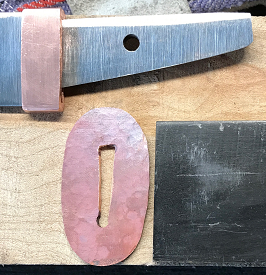
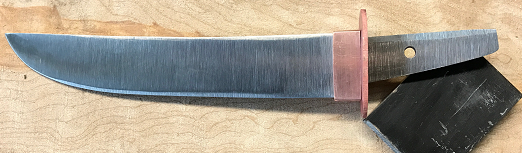
Trimmed my habaki as suggested. I agree, it looks more proportionate and allows more room for tsuka.

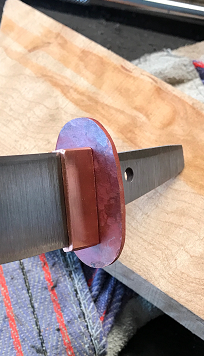
Made a copper seppa. I toyed with hammer marks on the visible part, but don't think it turned out well. The nakago shape looks a bit wonky, but it surprisingly fits snug despite some over-zealous filing. I also may try to force a patina on the seppa with the boiled egg trick (need to stop spending money on this knife so i'll save the liver of sulfer for another day). My favorite color of copper is after it has been annealed. Any way to preserve that color? I presumed that I don't want my seppa to be "soft" copper.

I received alder wood from 2 fine folks on the forum and my black water buffalo horn came in. This build inspired me to profile my next tanto while I had my last one w/JT for heat-treat. Thankfully i'm all-set with materials for this build too.

IXwsKgx.png

6Dey3bn.png

tcu8k3v.png
 
Last edited:
To hammer texture metal:
Copper, brass, nickel silver, and sterling are the best for this. You can do steel, but it is a lot more work.

Make sure it is fully annealed, Re-anneal as often as needed.

Sand to remove any deep scratches. I like a 400 grit surface when I hammer.

Use a smali ball peen hammer with the head polished. You can grind the head down into a cone and make the end a polished dome for smaller dents. If the head isn't polished, it will leave rough dents.
Go around in circles and fill in slowly. If you start at one side and go fully to the other the sheet will curl and the two sides won't be the same in dent density.

If it curls , re-anneal and flatten with a wooden or plastic mallet.

When done, brush with a brass wire wheel or brass wire brush and sand with 400-800 grit paper. Hand finish to 1000 grit is desired, Don't power buff, as it will smear the pattern.
 
Last edited:
Sooooo....tsukas are TOUGH!

They're made even tougher when you realize you didn't drill the mekugi hole (still mekugi an when referring to wood section?) in the handle before you glued up. MBurks gave me a nice piece of alder, and thankfully I was able to get a serviceable tsuka -- i wasted much of it. I made so many mistakes with my crappy stanley chisel (not discounting my horrible lack of skill). I need to make/buy a saya nomi before i do another tsuka. For tanto #2, I'll try a saya/tsuka on the alder Stacy gave me.

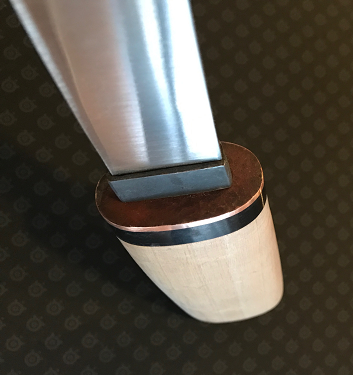
I ended up using liver of sulphur on the habaki and seppa. While working the buffalo horn i thought it would look good to grind the patina off the outside ring of my seppa. I like the contrast.

I want to stain the alder wood. I have tung oil, but have never liked the outcome from using it. ideas?

I don't have any carbide drill bits, so I don't know how i'm going to tackle the final assembly. I may drop epoxy in there.

oeoRoqi.png

B1cIu1G.png
 
Sooooo....tsukas are TOUGH!

They're made even tougher when you realize you didn't drill the mekugi hole (still mekugi an when referring to wood section?) in the handle before you glued up. MBurks gave me a nice piece of alder, and thankfully I was able to get a serviceable tsuka -- i wasted much of it. I made so many mistakes with my crappy stanley chisel (not discounting my horrible lack of skill). I need to make/buy a saya nomi before i do another tsuka. For tanto #2, I'll try a saya/tsuka on the alder Stacy gave me.

I ended up using liver of sulphur on the habaki and seppa. While working the buffalo horn i thought it would look good to grind the patina off the outside ring of my seppa. I like the contrast.

I want to stain the alder wood. I have tung oil, but have never liked the outcome from using it. ideas?

I don't have any carbide drill bits, so I don't know how i'm going to tackle the final assembly. I may drop epoxy in there.

oeoRoqi.png

B1cIu1G.png

I think it's looking great. Glad the alder helped.
 
The metal-dark wood-light wood looks fine. The handle looks much too fat. You can make the saya and grind both down together.

It is best to stain the wood and then apply a finish. Build up the stain in several applications, letting dry between each. Then rub in a oil finish like Tung, Watco, or other oil. Rub in with lots of finger pressure ( wear rubber gloves) and when well rubbed, wipe off all the excess immediately. Let cure for at least 24 hours ( until not tacky at all), buff with 4/0 steel wool, wipe clean with a tack cloth, and repeat 2 to 4 times.

You can use a 1/4" masonry drill bit to make the mekugi-ana in the hardened blade. A second option is to draw the temper back a lot on the tang. I usually do that anyway to remove any brittleness at the blade/handle junction. Wrap the blade in a damp cloth and use a torch on the tang. Heat the spot you want softened and when it gets to a just visible dull red, let cool to black and quench in water. It should drill fine after that.
 
The metal-dark wood-light wood looks fine. The handle looks much too fat. You can make the saya and grind both down together.

It is best to stain the wood and then apply a finish. Build up the stain in several applications, letting dry between each. Then rub in a oil finish like Tung, Watco, or other oil. Rub in with lots of finger pressure ( wear rubber gloves) and when well rubbed, wipe off all the excess immediately. Let cure for at least 24 hours ( until not tacky at all), buff with 4/0 steel wool, wipe clean with a tack cloth, and repeat 2 to 4 times.

You can use a 1/4" masonry drill bit to make the mekugi-ana in the hardened blade. A second option is to draw the temper back a lot on the tang. I usually do that anyway to remove any brittleness at the blade/handle junction. Wrap the blade in a damp cloth and use a torch on the tang. Heat the spot you want softened and when it gets to a just visible dull red, let cool to black and quench in water. It should drill fine after that.

Thanks Stacy.

I already have a hole drilled in the tang. Is there any way to accurately drill corresponding holes in the tsuka to mate w/that hole?
 
OK, Got ya.

Lay the knife with handle on the nakago down on a table. Use a couple pieces of tape to hold the tuska down firmly. Place a couple pieces of steel or some books on each side if needed to hold it. Set some magazines under the blade until it is resting on them. Place a sheet of paper on the magazines and draw around the blade. Now, slide the blade out without disturbing the tsuka. Set it on the tsuka, observing the outline until the blade is as close as possible to the same alignment when it was in the tsuka. Make the ana of the blade on the wood. Repeat a couple times to make sure that is the best guess.

Take the handle to the drill press, and drill a 1/8" hole on the rearward inside edge of the ana circle you drew. Hold up to a light and slide the blade in. If everything is perfect, you will see the nakago ana just barely allow light through the hole as it is fully seated. Put a 1/8" drill bit or metal pin through the hole and pull the blade forward. Hopefully it will barely come forward. Decide how the hole aligns with the nakago ana and re-drill the hole through the tsuka with a 3/16" bit. Move the hole whatever direction you think will align it with the very back of the nakago ana. The trick at this point is to only drill through the first half of the tsuka. Leave the smaller hole on the other side. Once you have exposed the ana properly, it should be so the mekugi will strike the back side of the hole and pull the blade rearward. I shoot for about 75% of the ana being exposed. Once the hole is aligned, drill the tapered hole for the mekugi. To do this, make a tapered bit. Chuck a standard 1/4" drill bit in the cordless drill and take it to the belt grinder. Grind it so it tapers from 1/4" at the shank to 1/8" at the point over the shank length. This will now drill a tapered hole. Make your mekugi pegs the same taper.

Always err on the side of being too tight. If necessary, you can make a too tight fit-up looser by filing or grinding the ana back side to make the hole oval. A chain saw sharpening burr or a 1/4" carbide cylinder burr works great for this. This also can be done to move the hole up move down on the blade if it does not align right. Another way to make the too tight fit align is to carefully grind/file back the front of the tsuka ... or carefully move the machi forward. If it is just a tad too tight, you can also file the back of the habaki down a little.To make a too loose fit snugger, add more seppa or make a thicker one.
 
Last edited:
thx again Stacy. that sounds like a veteran move -- i may temper back the tang and drill a hole in a different spot.
 
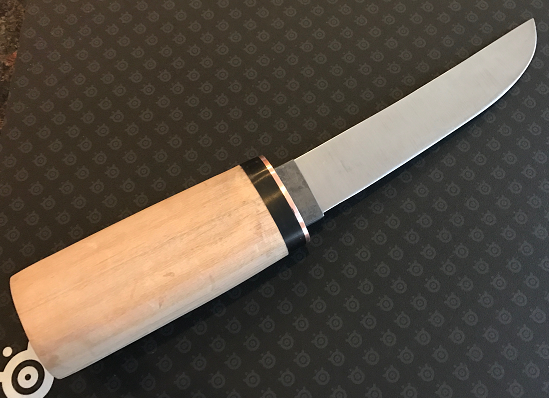
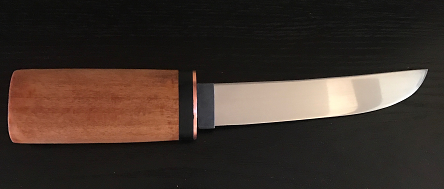
Here's the latest. Stained the tsuka "gun oil" and polished blade to 2k grit.

HIeqoiP.png


I made this tanto for a friend/co-worker who is an avid martial artist and fan of Japanese culture. We're parting ways and I couldn't get the mekugi finished in time. I hope to reunite w/the tanto and finish the mekgui situation one day, although he insists he likes it just as it is. It felt really good to make something and give it away to someone who appreciates it. To my surprise, he even bought me a saya nomi after i explained the difficulties of carving a tsuka w/a standard chisel. i'm not so sure he didn't get the bad end of that deal...

I made tons of errors, and there's still things that aren't perfect, but I never thought I could turn out something like this on my first try. I already have plans for tanto #2, and this time I intend to hold on to it as a gift to myself...clearing all time constraints. I suppose i'll keep updating this thread as not to junk up the forum w/more tanto madness.

thanks to everyone on this thread who has offered inspiration, support, advice, critique, and even materials. this really is an amazing community.
 
Ah so that's where the new chisel came from. Really nice work man.
 
I'm in between shops (aka garages) and am thinking about my next tanto. I profiled it in Virginia, and hope to finish it in Texas. I'll be using Stacy's alder wood gift for tsuka/saya. Initially, i had the spine in iori-mune (triangle), but decided i want to go with maru-mune (rounded spine). anyone have advice on how to round the spine? i considered making a wooden semi-circle jig and sanding by hand. i'm trying to conceptualize this while out of action, and figured BF would have better advice than what i came up with.
 
When I round a spine I knock the corners off on the grinder at 45 degrees, then another short facet not quite as steep. From there I just round it over with shop roll like a shoe shine.
 
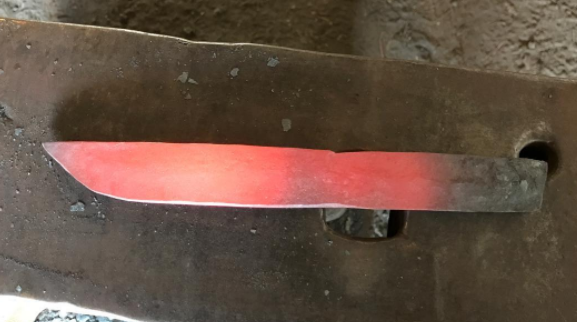
I had an opportunity to start forging a tanto today -- I've been doing a few clip-points, but nearly jumped out of my shoes when I was asked if i'd like to try a tanto. I had some course correction (aka experienced smith get me on the right track) along the way, and enjoyed the difference in how the point is created. I'm using Aldo's 1075, and plan to try a hamon.

I didn't finish, but i did; hot-cut the point, set the bevels on edge and nakago, taper to point and to end of nakago. I set the mune-machi (although its not as pronounced now after working the taper). here's a pic of where i left it after a normalizing heat.

qk2ovNr.png


I just finished a move, and am slowly getting my home shop setup. i hope to take this one to the goal line, and finally use Stacy's alder wood on the tsuka/saya :)
 
Last edited:
Looking good, it's rather rewarding to forge isn't it. Don't take this the wrong way I'm just asking a question. Why hot cut the point. I see people do this and it just baffles me. You forge so you can move metal where you want it. I watched a guy hot cut a point on forged n fire and it left me scratching me head. Maybe I'm weird but I like moving the steel around to where I want it. What do you do with the little waisted bit of steel you cut off. One thing I love about forging is how much blade you can get out of so little steel. If you have a chance thy forging the point, I think you will find that it goes rather quickly.
 
It is best to leave the machi for doing the final filing on the blade and nakago. Trying to assign them too soon will just limit your finishing.
 
Looking good, it's rather rewarding to forge isn't it. Don't take this the wrong way I'm just asking a question. Why hot cut the point. I see people do this and it just baffles me. You forge so you can move metal where you want it. I watched a guy hot cut a point on forged n fire and it left me scratching me head. Maybe I'm weird but I like moving the steel around to where I want it. What do you do with the little waisted bit of steel you cut off. One thing I love about forging is how much blade you can get out of so little steel. If you have a chance thy forging the point, I think you will find that it goes rather quickly.

JTknives JTknives , very rewarding! Re: the point, i'm not exactly sure to be honest. I've forged the point on my previous 3 clip-points. This point was hot-cut, and then reversed the other way. It seems to be part of the Japanese tradition...but I don't know the reason.
 
Last edited:
Back
Top