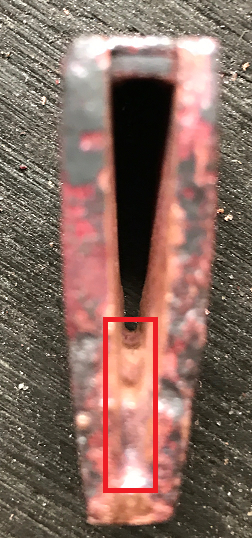
Hammering the habaki as you fit it is the normal way to sneak up on a perfect fit. You want to end up with a habaki that slides on fairly snug - not too tight, not loose at all. If it is loose, just squish it from the sides (while not on the blade) a bit and it will snug up when slipped back on the nakago. If tight, a few taps with a small ball peen or brass hammer will move it. About 75% of the habaki should be past the machi. Sometimes, I fit it so 90% is past the machi, and only a little is seated on the machi. A steel "guard fitting tool" can be made by welding two pieces of 1/2X2" steel bar with a 1/2X1/4" spacers between them. Assemble with a clamp so the nakago (tang) will slide between them. Once arranged so you can move the nakago in and out, weld the spacers to the heavier bars. Grind the ends flat and square. This can then be slid down the nakago and slapped against the habaki to seat it firmly and shape the machi-gane to be a perfect fit. The same tool (or one like it) can be used to seat a slotted guard or tsuba on a tang.
To allow final filing and fitting, I always leave plenty of extra metal on the habaki ends and in the thickness of the metal used. On the tsuba end, it allows the end to be filed smooth after being seated to the machi. On the blade end extra thickness in the habaki and extra on the end allows beveling and making a perfect fit to the blade where it enters the koi-guchi. Extra metal in all dimensions ( length, width, thickness) makes all final shaping and finishing simpler. The rule in every language is the same - "It is far easier to remove excess than it is to add on even the smallest shortage."
The tsuba and seppa will be what makes the habaki seat so it doesn't move. On an aikuchi style ( no guard type tsuba), the tsuba is merely a spacer the same shape as the tsuka .... basically a bolster. You still use seppa with aikuchi. They will be sanded to make a smooth fit with the tsuka/tsuba/saya once assembled. I like a contrasting seppa on each side of the tsuba in an aikuchi style mount. It has the same look as spacers on each side of a bolster on a western knife. You can also use a stack of seppa in place of the tsuba. All sorts of metals and materials work. Stacked leather with metal spacers is one option. The traditional is water buffalo horn and your choice of brass/nickel/copper/silver. The reason seppa are used in the koshirae is to adjust how tight the fit-up is. Too tight - use thinner or fewer seppa. Too loose, use thicker or more seppa. I usually don't do any shaping of the seppa until after everything is fitted up and tight. Then disassemble the koshirae and shape and engrave the seppa as desired. I like a simple brushed or coarse sanded finish on the exposed seppa, and often use the same finish on the habaki.