We did a lot of RD and prototyping on the chopper handles. I was out of my depths at first but I would consider myself to be a subject matter expert on it now.
We had actually tooled up and prepared to start production but stopped and scrapped the tooling and continued. This was a part of my tuition. It was humbling, how much I did not know at first. This is part of the reason why I am such an insufferable knife snob now.
I can tell you one thing for a fact. Knife handle design has to involve extended use because something that feels great when you pick it up and play with it is not necessarily ideal in real use, and this is something we had to learn. I believe we have the best handles for real use in the industry.
A there was lot of development at the beginning with input and prototypes from Lorien and Dan Keffeler with some smaller tweaks over time.
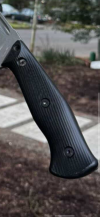
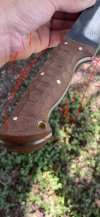
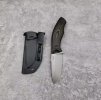
What's the difference between those handles? If you've really used them, it will be self evident.
Early versions had a deeper area in that pinky notch. It's one of those things that seems like a good idea and works fine when you're just holding it but when you actually put it to extended use it's clearly wrong.
The bulge in the middle and the drop at the back both conform to your palm better, and resist rotation. You do not want a broomstick handle, your blade will turn and you will bend a bevel.
The handle is wider at the top towards the front than it is at the bottom, but narrower at the top than it is at the bottom at the rear. All of my handles are this way and it's pretty obvious why if you ever look at the inside of your hand. It's a characteristic of a CPK knife. If you look at the contouring on that knock-off a couple pages back, you will see that they missed that.
In addition to the drop at the butt, within certain limits a larger circumference increases your hand grip's ability to apply torque to resist rotation. As a thought experiment, imagine turning the screwdriver from the handle side versus turning it from the tip side. You have a longer moment arm to apply torque. This is key to preventing harmful rotation and also reducing fatigue. This contributes to your safety, the well-being of the knife, and your comfort in extended use.
The handle on our chopper is long and narrower towards the front and wider towards the rear. You hold it towards the rear for heavy chopping and you hold it towards the front for use as a camp knife. It is helpful to choke up close to the blade for fine use, obviously. This also puts the balance point closer to being neutral which helps the blade be more controllable and comfortable. You hold the blade towards the rear for heavy chopping. This effectively moves the center of percussion of the blade back, which also moves the sweet spot back. When chopping you should be aiming to hit about an inch behind the center of percussion. You can find this point by slapping the side of the blade with your palm and finding the dead spot. That's your center of percussion. On my blades, I usually put the sweet spot right in the middle of the blade. By holding the chopper at the rear of the grip and moving the center of percussion back a little bit, you're effectively using a longer chopper. Experimentation shows the more blade you have in front of the center of percussion, the heavier it is, and the farther away it is, the deeper the blade bites. As a thought experiment, consider chopping with a blade holding it in the middle of the blade and then consider attaching the blade to a pole and swinging that. Which hits harder?
A longer handle, shaped the way this is shaped, is optimal for this kind of knife. There are no aesthetic considerations of any kind here.
Retention is primarily a function of the geometry in your palm, followed by material, followed by texture. That little curve for your pinky is the wrong way to do it on a chopper. Anyone who has done extended work with one will see that.