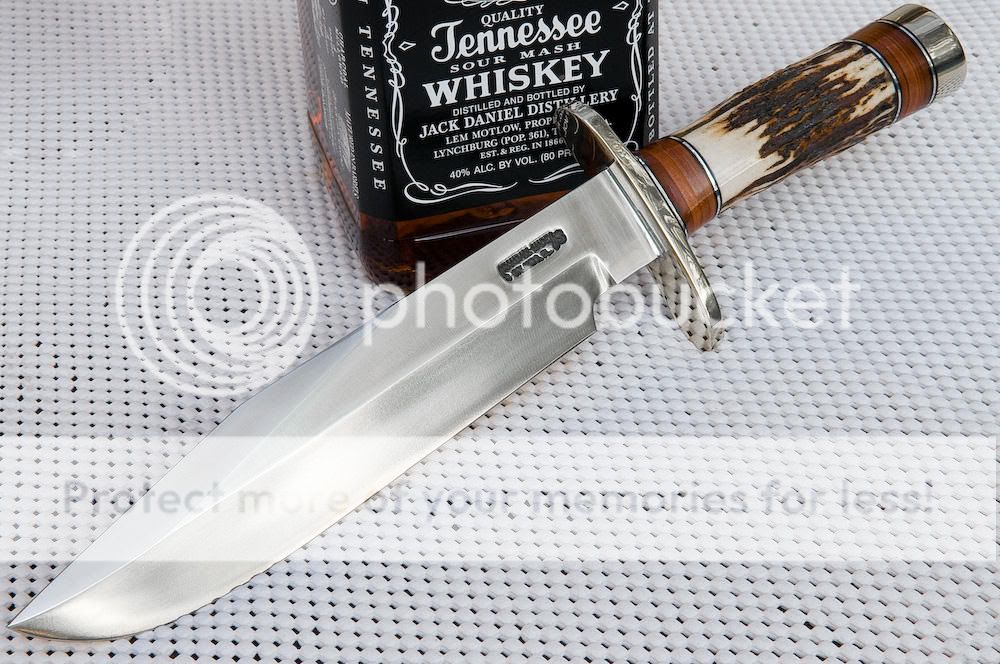
Thinking about a Randall. Are they up to serious use?

To me the thin 0.5 mm Randall edge is thinner than any other large fixed blade I am familiar with, and that makes Randalls flat-out better in use, period. (Yet I still think them inferior in finish quality, so actually they make more sense as users to me than most other knives)... I recently was forced to put some brutal abuse on my 14's 0.5 mm 440B edge sharpened to 10° per side, and though it showed one 0.3 mm chip (my mistake of leveraging on the more vulnerabe straight edge portion) and some very slight lateral edge bending, it kept its edge and showed me even the thinnest edge, sharpened to well below the recommended 40 inclusive angle (20 inclusive), is still plenty strong enough to withstand incredible lateral force abuse without major failure...

I mistakenly stated elsewhere the Neeley SA9 had a 3 mm thick edge: That edge is actually more like 1.59 mm, yet that is still over 3 times the thickness of my Randal 14... In my view, this is why the Randalls are actually the last knives you want to "save" from actual use: It took minutes to resharpen my heavily abused 14 to a good standard, the 1.59 mm thick Neeley edge took 3 days to get a nice edge from stock... The Neeley is amazingly precisely made compared to the Randall (truly amazing flawlessness, like the Neeley steel was moulded in plastic), so I'd much rather keep that as a "safe queen", and use the Randall...

Gaston
 
Randalls? Nah. They're pieces of junk.

Just don't mess with me while I've got this in my hand.:D

Randall12-9-14-25Lunde.jpg

Now,this is definition of exemplary looking knife! Its amazing...From all Randalls i like most is large Smithsonian bowie 12-11 model
 
greetings,
had a model-14 in nam. absolutely indestructible but way to heavy to hump around. also didn't hold up too well in the moisture. still a great piece. can't go wrong.
 
image_zps8npbcm6q.jpeg
[/URL][/IMG]
image_zps8npbcm6q.jpeg
[/URL][/IMG]
image.jpg6_zpsiufcjjzz.jpg
[/URL][/IMG]
image.jpg5_zpstfmiihc7.jpg
[/URL][/IMG]
image.jpg4_zps2aajacu6.jpg
[/URL][/IMG]
image.jpg3_zpsbdv6vggq.jpg
[/URL][/IMG]
image.jpg1_zpsegwlivte.jpg
[/URL][/IMG]
image.jpg2_zpsvyt8nw5t.jpg
[/URL][/IMG]I bought a Randall 12-9 merely because this thread made me as curious as everyone else on how Randall Made Knives basically compare to a contemporary design. I used a Busse FBM LE for 6 years. It was a so so chopper. It was a little too thick with a steep edge that would not penetrate hard woods well, plus, it had a flat grind and would basically gall onto the tree when you did manage to get a deep cut in a softer wood. The steel was ok, would chip like any other quality knife that hit a rock in the process of being used in the field. The material, marketed as INFI, relies on the steep bevel to hold its edge, if you take it down a bit to improve penetration, it goes dull like any other high quality production knife. I used it for 6 years and chopped hundreds of small trees that grow out of control on my rural property. It was thick, hence strong. Finally sold it because it took too much energy to use and found it unproductive in the field. Then I used a Bill Buxton made of forged 52100, it was was much better, and held an edge like no other. I did not take Bill's advise and ordered an 8 instead of a 9 inch blade, and it was a bit too short. As a result of this thread I decided to try a Randall 12-9 Sportsman with a 14 grind. It was the most effective chopper of the three. The cuts were deep even in hard woods, the hollow grind did not gall, the edge held up better than the Busse, but chipped a bit easier when the edge came in contact with a rock than the two other knives that were convexed. I used in an abusive manor in an effort to cause a break at the tang, which I presume is 1/2 X 1/4 X 4.75 inches as it is based in a # 14 CDT grind. It seems one would have to break this knife on purpose in order to effectuate failure. The Randall and the Bill Buxton are expensive, and expensively made. The Busse appeared to be mostly machine made, but high priced. My point is, Busse prices into its MSRP an abuse warrantee. The FBM LE in 2007 was a simple construction $375 knife that actually retailed for $697 sans a sheath. The price of the hand forged Randall and Buxton prices do not reflect an abuse warrantee, so the buyer has to self insure the knife. But, they are forged, and the advantage seems to be the same for a carbon steel knife as it is on the cranks of a mountain bicycle, forged units require less material to create the same amount of strength compared the those CNC'd, making this production method perfect for a hollow grind blade. The cost of self insuring the knife for abuse versus having it packed into the retail price would be a consideration a purchaser would have to weigh relative to their own personal comfort level.
 
Last edited:
Too bad that the images of this test are no longer available.

http://www.bladeforums.com/forums/showthread.php/645414-Randall-14-Vs-Busse-Sarsquatch

Also, please be aware that you do not have to wait 5 years. Contact one of the Randall dealers. Rick Ward (for example) has a delivery schedule of 5 months... just check out his web site and you're paying catalog prices of your delivery year. And military personnel get priority on orders directly from the shop, so, I think they wait even less.
 
Last edited:
I bought a stainless 12-9 / 14 Grind with a stag and leather handle for the sole purpose to see how the the stainless performed on a large Randall Made Knife under hard use in order to respond again to this thread, old or not. I used it as a utility knife and was surprised at how well it prepared food and processed meat for such a large knife. It is a great camp knife as it's large size make short order of big tasks and the blade design is dexterous enough for small chores. The bottom line is a well constructed large knife must be sturdy enough to withstand hard use in the unlikely event it is called upon to do so.

This unit is made made from forged domestic 440 steel. I read a post that quoted the owner of Randall Made explaining how they determine the carbon content of the 440 stock at the time of purchase, and that actually determines whether it is 440B or 440C, and the small non forged stainless knives are ATS-34. I was impressed with the magnitude of Randall's quality control that goes into purchase of materials.

The tang is 1/4 thick and about 5/8 high (I actually was able to obtain a measurement off a blank), which is very heavy duty and strong enough hard use. Another great feature is how the tang goes strait through and threads to the butt cap.

The quality of the stag is first rate, as well as the dense leather in the handle. I soaked the handle in pure filtered bees wax in an attempt to get what I could in the leather washers for good measure. Did the same with the sheath. I noticed when I look at old knives from the WWII and Korea era, the stag and leather handles held up, that is why I selected this handle configuration. I have owned two Micarta handled knives (one 45 yr old linen, one 15 yr old canvas) that started exhibiting early stages early stages of delaminating upon using them, and both were unused when I purchased them. Micarta is strong, sticky and has a secure grip in all conditions, whereas G-10 is super strong but slippery when wet or bloody and doesn't absorb shock. My observation is no handle material perfect, and that leather, stag, and wood should not be underestimated. I chopped and chopped and chopped without gloves with the stag/leather combo and never got a blister, never slipped, even when my hands were wet. I decided to test the waterproof quality of Randall's compressed shoe leather washers and the cement holding them together. I took the knife for a day in the water fly fishing, and let it sit in the river in back of my house for 45 minutes. I wiped it dry and the leather was hard as a rock. It was perfectly fine.

Randall's forged 440 stainless is tough as nails. For those like myself who believe a big knife must be tool or bearing steel because their experience with stock removal powered stainless super steels chipping under the stress of heavy blows, this stainless RandalI seemed put that fear to rest. I put this knife through the ringer. Took out a bunch of saplings as a warm up, and then took down and deconstructed two hard wood trees over 15 inches in circumference. I did not chop and break off, I chopped strait through each trunk and every limb. I also chopped each tree trunk in half. If the knife was gonna break, it would have. I even batoned it, avoiding the sharpened top edge of course. Worked like a champ. In the end, the blades factory edge was not dull, rolled, or chipped. I never saw anything like it. Net net net bottom line, the Randall S stamp #12 actually out performed in the field 52100, INFI, A2, and the couple of CPM's I have owned and used. I was in shock.

As for a big question, 01 or S, which is superior? In my mere opinion, if one were to rely on only one knife, the 01 is extremely fatigue resistant and will most likely never fail or rust (providing you allow the blade to oxidize). On the other hand, if one one lives primarily in a saltwater environment, or cuts a lot of synthetic materials, like carpeting, hoses, etc, the the harder near corrosion proof S blades have an advantage. That it why Randall makes both, and I personally use both.

I have used two large Randall Made 12-9 knives, same model with two totally different configurations, blade material, hilt, handle material and configuration. They both performed as well as a knife possibly could. It appears as though Randall pays particular attention to the quality of the blade steels every time they order, as well as every other component of the knife. The construction and temper is second to none. It's seems that 75 plus years of making knives really does add up to getting it right consistently. Luckily I live in a rural area, because the 12-9 is basically my EDC and it gets a lot of use.

image_zpsjshy6log.jpeg
[/URL][/IMG]

image_zps3vji3t5t.jpeg
[/URL][/IMG]

image_zpskdl9uwww.jpeg.html][IMG


image_zpskdl9uwww.jpeg
[/URL][/IMG]

[URL=http://s296.photobucket.com/user/oohhaann/media/image_zpsrdz3kst1.jpeg.html]
[IMG]http://i296.photobucket.com/albums/mm199/oohhaann/image_zpsrdz3kst1.jpeg[/URL][/IMG]

image_zps9btmwres.jpeg
[/URL][/IMG]

image_zps8npbcm6q.jpeg
[/URL][/IMG]
 
Last edited:
You know of any other knives selected to be issued to Astronauts by NASA for the Space Missions?.

Camillus 1760 "Demo" knife. A 4 blade scout/camp/utility knife. Issued for all Mercury and Appllo missions.
 
yeah, there are more modern steels, and newer styles, but the Randall still does the job. Year after year, dead animal after dead animal, this old Model 11 keeps on doing what it was designed to do. Over 25 years for this one.
 
You know of any other knives selected to be issued to Astronauts by NASA for the Space Missions?
Question is what did they do with them. Were they actually used? How long and for what? Just the fact that they went up there doesn't tell much.
Yes, the Case M-1, Camillus MC-1, and Victorinox Master Craftsman were also NASA space knives that flew.

The Victorinox was used by astronauts in space vs for use after returning to earth which was the intent of the Randall, Case, and Camillus.
 
Last edited:
In Oct 70 I got orders to go back to Vietnam (4th tour) and wanted something larger than my Ben Hibben Jungle Fighter, so wrote to Van Sickle (?) a dealer in Texas that you could get your Randall right away, but with about a 25% mark up. Got a Model 14 in stainless (440B), carried it for that tour as an Advisor to a Border Ranger Battalion (read old SF A-Team Camp) and continued carrying it for another 20 years. Served me well in Vietnam, Thailand, Brunei, Philippines, in the Black Forest, Italy and all over the USA. Swam it in salt and fresh water, carried it on multiple Winter warfare exercises, one at minus 40 C/F, multiple field exercises and it is still good to go. I never liked the finger grip handle so in 1988 I had Wayne Goddard, put a new handle on it (I know Heresy) and did buy a new bees waxed sheath. Having said that I agree many people buy Randalls and never use them. I had one friend look at my Model 14, and exclaim in amazement "John, you actually use your Randall?" John
 
So you say you've used both 12-9's in 440 and O1. My question is which steel is easier to sharpen and which one will hold an edge longer? Thanks,

When cutting corrosives such as meat the SS maintains a crisp edge longer. Although when chopping hard woods the performance is close, the SS holds an edge a better. The 01 is so easy to sharpen one could use a stone found in a brook to obtain a usable edge. In the end, the SS holds an edge a longer and the 01 sharpens easier as per my experience.
 
Last edited:
As for a big question, 01 or S, which is superior?

I have used two large Randall Made 12-9 knives, same model with two totally different configurations, blade material, hilt, handle material and configuration. They both performed as well as a knife possibly could. It appears as though Randall pays particular attention to the quality of the blade steels every time they order, as well as every other component of the knife. The construction and temper is second to none. It's seems that 75 plus years of making knives really does add up to getting it right consistently. Luckily I live in a rural area, because the 12-9 is basically my EDC and it gets a lot of use.

I agree with everything you say: The steel just seems to be better, the stainless best of all, but the o-1 remarkably good as well. All my other knives don't keep their edges as well while chopping: I don't know how they do it...

One thing though is the Model 14 with finger grooved micarta handle cannot chop worth a damn... It is way too blade light and the handle hurts the hand while chopping: My Model 18 chops way better with the big round handle... The finger grooved handle on my CLinton dagger seems better than the Model 14's, but finger grooves and chopping just don't seem to mix...

Gaston
 
I agree with everything you say: The steel just seems to be better, the stainless best of all, but the o-1 remarkably good as well. All my other knives don't keep their edges as well while chopping: I don't know how they do it...

One thing though is the Model 14 with finger grooved micarta handle cannot chop worth a damn... It is way too blade light and the handle hurts the hand while chopping: My Model 18 chops way better with the big round handle... The finger grooved handle on my CLinton dagger seems better than the Model 14's, but finger grooves and chopping just don't seem to mix...

Gaston

I normally do not like finger groves for chopping. Surprisingly, the finger grove handle on the tool steel 12-9 I tested was the single best chopping handle I ever used, but that finger grove configuration was not made in Randall's "14 Room" where the military units are produced and the configuration for finger groves as well as the wrist thong placement appear to be different. I love the #14 type finger groves on my smaller knives because the design is comfortable enough and provides a very secure grip for short duration tasks. It also allows one to hold the knife further back on the handle to provide more weight forward for heavier blows while still maintaining a positive grip, especially if a wrist thong is not being used. I also like the fact that I can easily feel the finger grove handle quickly and identify it as my knife when it is cluttered among other items on my belt or in my bag. That is why my #14 has finger groves. But in the final analysis, I agree with you 100%, the finger grove configuration on the #14 for prolonged chopping duties is its biggest shortcoming, and for me as well, becomes uncomfortable. I also agree the #18 handle is superior to the #14 FG for chopping. Further more, as you stated, blade weight is your friend in the deconstruction process.

image_zps81ut6qn4.jpeg
[/URL][/IMG]
 
Last edited:
Especially that a knife is not astronauts primary working tool. At least in their "astronauty" work, they try to stay away from all things sharp, because the gloves on space suits are the most vulnerable parts, small tear could be potentially lethal.

A small tear in the space suits we all wear every day is potentially lethal

Think about that
 
My question is which steel is easier to sharpen and which one will hold an edge longer? Thanks,

I just spent some time sharpening some Randalls. The tool steel seemed to effortlessly take a razor edge, seriously took about 3 minutes to get it hair popping sharp. The stainless took much longer, and I never could get it quite as sharp. It wasn't my first time getting those results either. That said, the stainless did get more than sharp enough for my needs and I don't hesitate to carry, use, and recommend stainless Randalls. So maybe if super super sharp is the priority go with tool steel, but for everything else like edge retention etc they seem pretty equal to me.
 
Last edited:
I've carried a Randall 14 for over 20 year while camping/canoeing. It's never failed me in any task. It's done everything from cutting down small trees to cleaning a lake trout with no problem. If you mess up a Randall, it's because you were being an idiot.
 
Back
Top