tips, tricks, hacks

Thanks for the tips guys. I'm just starting out so I don't really have much to contribute. My only trick so far is using a big pencil eraser as a backing pad for hand sanding blades. It grips the sandpaper nicely.

 
I saw a little trick for filling a hidden tang with JB weld once. The maker mixed it, softened it up by applying heat underneath it, sucked it up with a straw, stuck the straw down into the hidden tang hole, and blew the epoxy out into it. I'm not really a fan of JB weld but thought I might try it with flex down the road.
 
Thanks for the tips guys. I'm just starting out so I don't really have much to contribute. My only trick so far is using a big pencil eraser as a backing pad for hand sanding blades. It grips the sandpaper nicely.

The problem with doing that, is an eraser is soft and isnt the best way to sand something flat
 
When using epoxy I squirt both epoxy and harder in the corner of a plastic bag. The epoxy can be mixed easily by kneading the bag then to dispense cut a small corner of the bag and squeeze it out. Works great for filling the cavity in a hidden tang knife.
That's how I mix and dispense the filling for deviled eggs.[emoji3]
 
I'll post some pictures once I get them uploaded but the biggest piece of advice I have from my limited experience is keep a running log of your process and lessons learned. I have a google doc that I wrote down my process from start to finish. Any mistakes, observations, tricks, or lessons learned are recorded at the specific stage where they apply. This way I can double check to make sure that I don't miss anything or make the same mistakes again. This can be a life saver but tHe trick is to keep it up to date. It sucks realizing that you made a similar mistake again as you did before.....Don't ask me how I know this lol.
 
The problem with doing that, is an eraser is soft and isnt the best way to sand something flat


Look a nick wheelers YouTube videos on hand sanding. He goes in depth on the topic of using different backers while sanding. It Is great advise and was a game changer for me!
 
Easiest way to chamfer a pin head is with a cup bur btw, no need to use a grinder. I just hold the bur in my hand and rotate a couple of times to knock the corners off before peening.

3.5 mm is the size you need for 3/16 pins btw. 2.3mm for 1/16
 
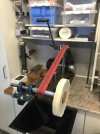
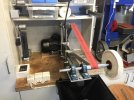
I made an attachment for buffing from the leftovers when upgrading to direct drive and VS.

Saw another thread on this forum that suggested this solution.

Thank you for that. It works great.

ImageUploadedByTapatalk1471686711.253290.jpg
ImageUploadedByTapatalk1471686730.571040.jpg
 
Last edited:
When gluing oily woods, dont just wipe with solvent before you glue.

Wipe the inside once about 15 minutes before you are ready to glue, wipe again just before you epoxy it together. If you do it only once, the capillary action of the wood will draw more oil down to the surface. Two wipes means you get a better joint.
 
Fine, I'll play.


Sanding or chamfering the end of pins can be tricky. The disc or belt wants to pull it out of your hand and it heats up very quickly which makes it hard to hang on very long. So, I use an artist's pencil lead holder. I use this larger diameter lead holder for 1/8" pins.


is that a Caran d'Ache?
I thought I recognized that :-)
 
Like many, I have limited shop space and money. I saved up and got a KMG and a VFD. After a shop visit to Bruce Bingenheimer's place, I REALLY wanted a disc grinder. Thankfully, he also had his set up where I could get myself one like it for minimal cost using my KMG and existing VFD.


Jeremy
 
I've always used a sharpie and wrapped sandpaper around the body of it to sand choils and curves in the knife. It works great, it keeps the tang nice and square.
 
Speaking of sharpies, if you're not following Nick Wheeler on instagram, you're missing out.
He uses a razor to sharpen a sharpie.
Who thinks of stuff like that?
Nick Wheeler, that's who!
 
Anyone who has tried to put epoxy in a hidden tang knows that most of it ends up running all over the place. Air gets trapped in the hole and the resin won't go in.

When filling a hidden tang, I put a coffee stir in the hole and then pour in the resin. This prevents the vapor-lock that stops the resin from going in. The air goes out the coffee stir as the resin goes in the hole. Once filled, slowly remove the stir.
 
Using screws for handle bolts isn't the greatest. The screw edge will want to show due to the threads.
Frank
 
Using screws for handle bolts isn't the greatest. The screw edge will want to show due to the threads.
Frank

Hi Frank,
I assume you are referring to my trick of using screws for pins? Just to clarify, I am not using the screw as a through pin. I drill pockets for the screw to fit inside the scales when I do a hidden pin, full tang knife. The holes for the screws in the scales do not break through to the outside of the scale.
 
Back
Top