Valar God, I see that you have a habit of finding threads about heat treating and hijacking them with your haughty and "metallurgically idealistic" point of view. I've seen a couple of pics of your work that were OK, but it seems that you do not water harden yourself, and that you are a hobbyist working by stock removal. This further reinforces my belief that you are an armchair quarterback who has done a lot of reading but have little practical experience in the realms of which you so authoritatively speak.
When you disagree with the practical experience of MANY respected sword smiths, including Walter Sorrels, Jesus Hernandez, Howard Clark, Dave Lisch, Tom Ferry, to name a few, and indeed the methods of many of the Japanese smiths who you vaunt so highly, I begin to suspect that the error in judgement lies not with them.
You do make some valid points from a certain point of view, but your rigid and proud style does you no favors.
Have you tried water quenching, or forging a blade?
Hijacking ?
A bit harsh words ?
Are you hijacking this thread now ?
Yes, I do not heat treat my work myself, I can't do that with D2.
I wanted to do with W2 but I have realized that, because of my lack of proper equipment,
I wouldn't be able to do it myself and I am not satisfied with less quality
than my knowledge and skills could provide me because of my lack of equipment.
And it would be unreasonable for me to take W2 for heat treating knowing
how people perform it.
Even for D2 I had a hard time finding someone who will do it as I had requested.
You should say "Thank you" instead of what you are saying,
because you are lucky to get an advice from me, because,
in case I was doing a water quenching steel myself,
I might have been not willing to share my info with others
but keep it to myself, watching you struggle.
I like swords and I would like to see more blades, especially long ones,
here on forum, successfully hardened in water, so I am writing this.
Why do you have to keep mentioning certain names as they are ultimate bladesmiths ?
How can you take as some positive reference a work from someone who makes blades
out of mix of steel for damascus while claiming that it to be tamahagane ?
When did tamahagane ever give a damascus pattern ?
And yet, he makes his own tamahagane in homemade tatara
while neither tatara od the smelting process itself got anything to do with Japanese style.
Not only that, but he uses scrap metal as feedstock.
Even if the process of making is the same you must have a proper feedstock (only one of them is Japanese sand)
in order to claim something as tamahagane.
Further more, in the process of making folded blades,
Japanese swordsmiths had used wide range of "additives" while forging,
further improving and changing the quality of the primary steel
in which they probably affected (reduced) decarburization
while western folding process consists of mere folding and forge welding.
Not to mention oil quenching in a tube where the diameter of that tube is just enough
for the blade to fit in, which means that the blade hasn't been quenched at all
because the volume of that tube is to small for enough oil to fit in it
so that the quenching can be performed properly
because the oil is heated too high to be functional after the first few seconds.
And you keep attacking me like the water quenching failures are a consequence
of following my instructions.
Hello ?
Again, I gave you and advice.
If you don't like it (and you haven't given any reason for not liking it, like "I have tried and it doesn't work"),
(all you are doing is attacking me and my credibility while the issue is credibility of the information itself)
just move along.
My rigid style has saved me many times in life from making a mistake
which I could have made if I have listened to the expert on that certain matter.
And there isn't really any reason why I should change my opinion.
The thing about 40% failures in japanese sworsmith.
You have just confirmed what I have said.
Japanese swordsmiths didn't have digital ovens nor steel of consistent quality and composition.
They had to determine the right temperature only by color.
And there are always forging errors which can lead to quenching failures too.
And I don't know what is it with forging and normalization.
After the forging you leave the blade to cool down, right ?
You probably don't quench it.
So, isn't there already what you call a normalization ?
Why would you do it again, only then to claim that you have performed it?
(not to mention that normalization is not properly performed as you do it)
If you like my advice, you can try it, in either way it won't be the first nor the last blade you will crack.
If you don't, sometimes even a bad advice can lead to success.
But there really isn't a reason for all that aggressive attitude towards different opinion.
Looking at how thing are going, I don't expect that someone will thank me someday for this.
Unless this thread gets deleted, the heat treatment that will be a standard in near future
without "normalization", without overheated furnace and without cracked blades
(unless because of some forging error)
will be know as "Valar God's heat treatment".
Cheers.



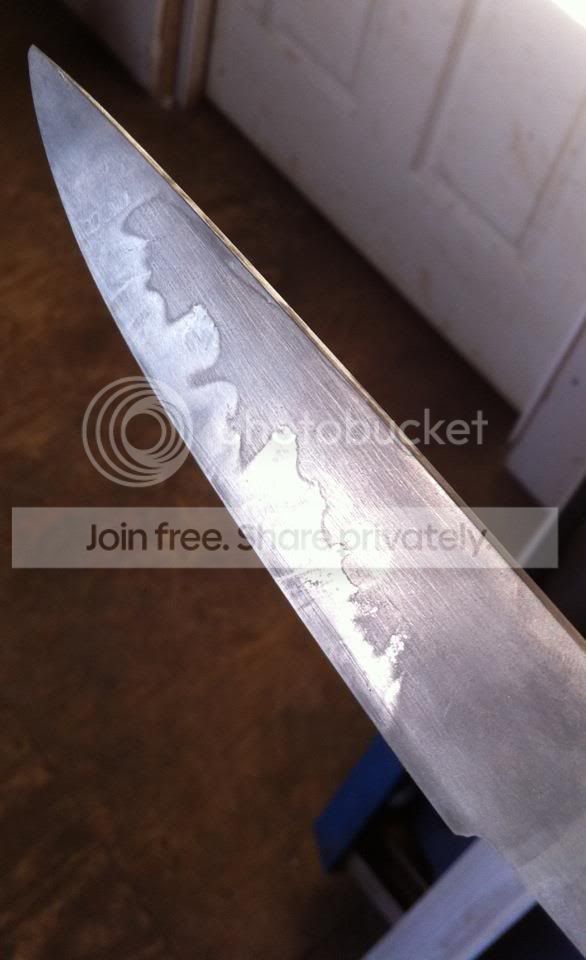
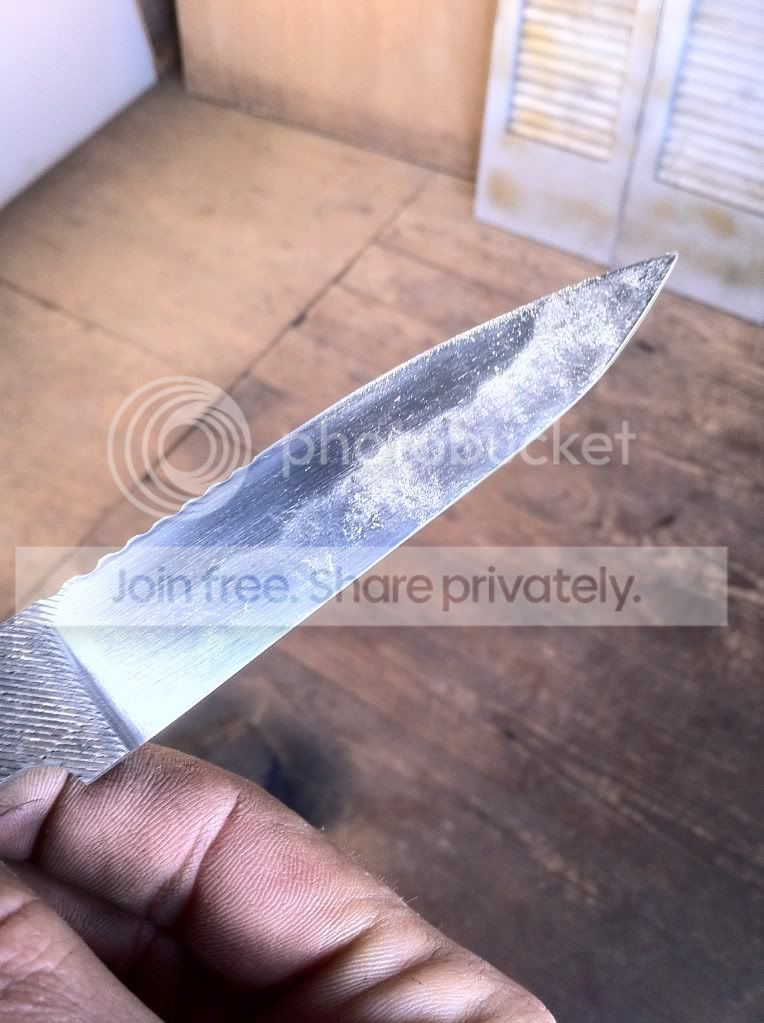


 .
.
