Water Quench.. Words of wisdom... :(

Status
Not open for further replies.

I have found this thread in search of your results after our last conversation.

Even though your blades still brake you have managed to cause damage with them.

Perhaps I should seek advice from you on how to make "Shards of Narsil" ?

This has been a great disappointment.

Carry on, I don't really care.

Good luck with your karma.
:p
 
You're funny, giving advice about something you've never tried.

Yes I did break a couple blades and learned from my mistakes; if you bothered to read this thread. I got caught up in certain details and overlooked others.

I have since done a wakizashi quenched in water with success.

I'm glad you don't care anymore.
 
Last edited:
hey Stuart don't worry about not reading/remembering what I said because I just retaught myself this same leason recently.

I was using w2 and 1095 when I first found out that if I kept the spine below critical I had far fewer failures the when evenly heating the blade. I usually just quench in room temperature water, could be anywhere from 50 to 80 degrees in my shop. Also the tamahagane that I brought homr from Japan and the stuff that I make seem to be less temperature sensitive than w2 or 1095.

Thanks Bill. Interesting that the tamahagane is less sensitive. Any thoughts as to why? Simpler composition?


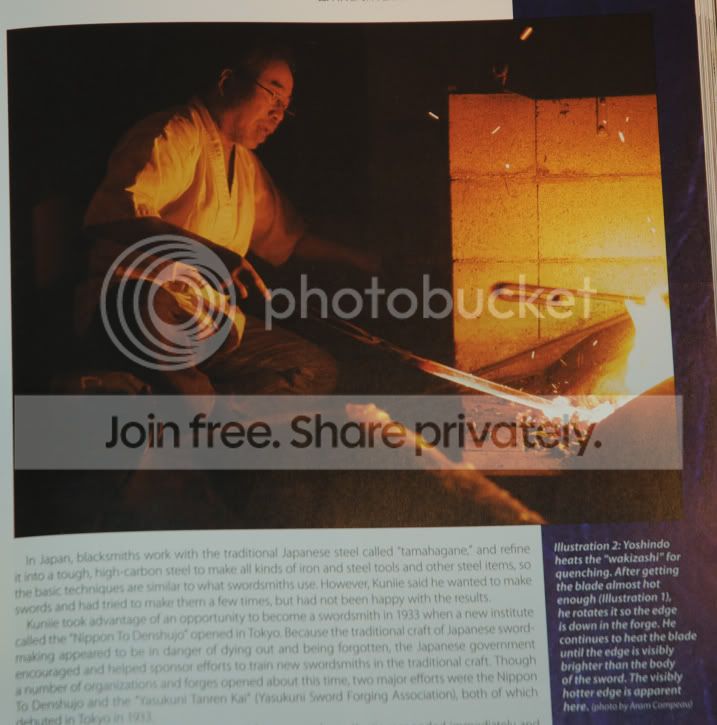
Here's that picture I mentioned.

yoshindo1.jpg


yoshindo.jpg
 
There was nothing aggressive about my post. You have stated how you feel all of us are doing everything wrong, and that you know just what to do. Since I have personally seen many wonderful examples of work by makers that have posted in this thread (and are apparently doing it all wrong) I can only imagine that your work must be simply mind blowing... and I would love to see it.

But it seems as though your work only exists in theory.... not in real life application.

This sums up my feelings toward anything you've posted:

"In theory there is no difference between theory and practice. In practice, there is." ~Yogi Berra~
 
Stuart there is something that uses propane as a fuel but will pretty much imitate a charcoal forge. I was going through this same thing a few years back and didi a bunch of searching and found that there is a product made of ceramic that is in a bead/cube form. these are placed in a forge with the burner coming in the bottom, the flame from the burner is dipersed into the ceramic heating them up and duplicating the flame in a charcoal forge. I just never got around to building the forge or ordering the ceramic and have sence lost the link. anyway just some food for thought.
 
Thanks Bill. Interesting that the tamahagane is less sensitive. Any thoughts as to why? Simpler composition?

Stuart I don't really have a clue. the stuff that I made was analized and was found to be 98% fe and 1.2% C with the balance being trace elements of several other elements.
 
Stuart there is something that uses propane as a fuel but will pretty much imitate a charcoal forge. I was going through this same thing a few years back and didi a bunch of searching and found that there is a product made of ceramic that is in a bead/cube form. these are placed in a forge with the burner coming in the bottom, the flame from the burner is dipersed into the ceramic heating them up and duplicating the flame in a charcoal forge. I just never got around to building the forge or ordering the ceramic and have sence lost the link. anyway just some food for thought.

That's exactly what I was thinking. I will try to find the information about it.. Thanks.
 
There was nothing aggressive about my post. You have stated how you feel all of us are doing everything wrong, and that you know just what to do. Since I have personally seen many wonderful examples of work by makers that have posted in this thread (and are apparently doing it all wrong) I can only imagine that your work must be simply mind blowing... and I would love to see it.

But it seems as though your work only exists in theory.... not in real life application.

This sums up my feelings toward anything you've posted:

"In theory there is no difference between theory and practice. In practice, there is." ~Yogi Berra~

I agree Nick, I'd like to see many examples from this person to back up their claims
 
if I kept the spine below critical I had far fewer failures the when evenly heating the blade.

Stuart: Dr. Batson used one of my forgings at the Piney Woods hammer-in for a heat treating demonstration, and he did precisely the same process that you and Bill are describing: heated the blade spine-down in the coal. Once the main part of the blade (the greatest thermal mass) was up to temperature, he flipped it edge down, and let the edge heat up to austentizing temperature. Very slick way to create a thermal differential (edge quench).

Pictures are in the current issue of the ABS Journal, but your picture of Yoshindo doing it is much more dramatic. :)

Unfortunately (for me, working in a garage) I don't see any way to do that in a forge, short of the faux-coal setup Bill is describing.

By the way Bill -- very nice to meet you in San Antonio.
 
Last edited:
the stuff that I made was analized and was found to be 98% fe and 1.2% C with the balance being trace elements of several other elements.

IIRC, there are at least two processes for making tamahagane, using various compositions of hematite and magnetite from river sand. One has a lot more silicon and phosphorous.

No clue which method or mixture of river sand the Okuizumo tatara uses...
 
And to think,... just a few days ago people were asking for examples of metallurgical gibberish... ;)

I think everyone actually has a few good points to make (not sure they were said right though),... but, collectively it adds up to mumbo jumbo.

It just goes to show how a person's perspective and personality effects the objectivity of it.

As a side note, I hear Bush Monkey has been having a great success rate water quenching 1095 on his "scandi grinds".


.... I'm out. ;(
 
And to think,... just a few days ago people were asking for examples of metallurgical gibberish... ;)

I think everyone actually has a few good points to make (not sure they were said right though),... but, collectively it adds up to mumbo jumbo.

It just goes to show how a person's perspective and personality effects the objectivity of it.

As a side note, I hear Bush Monkey has been having a great success rate water quenching 1095 on his "scandi grinds".


.... I'm out. ;(

on second thought
 
Last edited:
Yup, this thread has gone in the toilet.. I think I will lock it down before it attracts more stupid.

I'm sorry you don't approve Tai. Your post wasn't very constructive and I would've liked to hear real thoughts rather than just your personality.
It'll have to be another thread though because this one was mine and I'm tired of the dumping ground it became.

In a nutshell, I just wanted to reiterate Bill Burke's advice as it was instrumental in my being able to repeat successful water quenches in W2 and achieve some of the benefits (even if only aesthetic) of water quenching.
Since many did not see Bill's advice, I thought to express it again.

As anyone with experience knows, every part of the process affects all the other parts; steel, heat, time etc.

On a last note...

The forge design I was thinking about is called a Ceramic Chip Forge and seems to be popular in Europe.

Here's an example. I think I may try to make my own some day.

images


A starting point may be the Pine Ridge Burners http://www.pineridgeburner.com/sales#prices

photo3-300x235.jpg
 
Status
Not open for further replies.
Back
Top