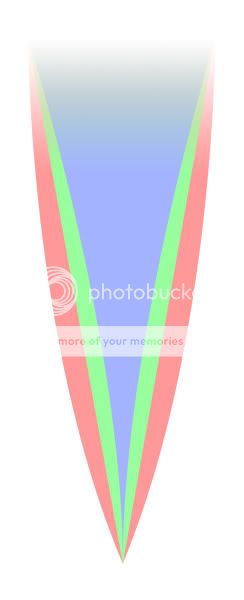
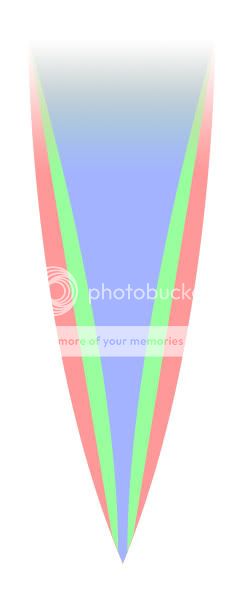
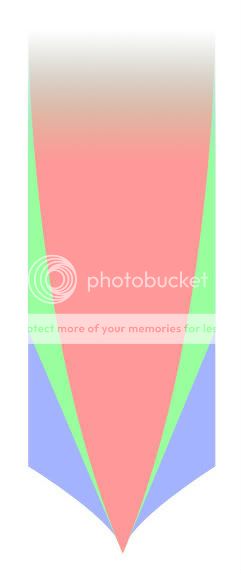
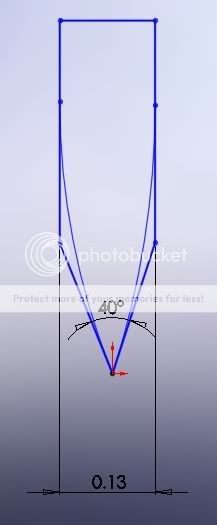
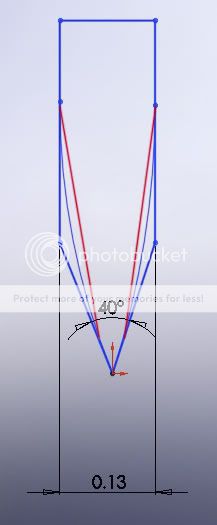
There is an awful lot of debate going on for something that is just simple geometry. I'm gonna attempt to say everything that needs to be said to end this, though I fully expect this to spark further debate

The more angles you throw on a V edge, the more closely you approximate a convex edge (the optimal solution is but one of many convex shapes). The question becomes "how many stages do I need to do before the difference is insignificant?" and relatedly "Is that too much of a PITA to do that many different bevels?"
Scandi grinds suck because for the final edge to hold up, the rest of the knife is too thick and has poor cutting ability. One V wont approximate the optimal solution very well. This doesn't make "convex edges be better". The thing is that it the same holds for crappily convexed edges as well.
You have to compare the geometries with all other relevant variables equal. In this case, it's a question of strength at any distance from the edge and the stress it is going to be subject to. Since the stress it will be subject to is a smooth function of distance (there aren't any magical distances), the optimal strength curve will be continuous (ie convex) as well.
Since multiple bevels reduces the amount of material removed at each step, it is actually more convenient than doing fewer bevels anyway (up to about as many grits you use). I typically have 4 distinct bevels on my knives (primary grind down to ~10mils, coarse diamond down to 50 microns, 600 grit down to the last 10-15 microns, then polished to the edge).
The difference between a geometry like that and the convex edge that follows the spline defined by the V geometry is very small. The biggest difference is gonna be on the corner of the second bevel which is only 10 mils wide anyway, so the difference is gonna be a few mils. I'd be amazed if someone was able to reliably detect the difference in cutting ability.
I don't know how to control the geometry of a convex edge that well, so I expect any convex edge I make to be farther from optimum than my V approximation, but others may have better skills than I here (how do you determine the geometry?). I suppose I could grind the series of Vs and then round the shoulders off, but that is strictly more effort than grinding the V edge, and I expect negligible improvement.
Clamp setups and microbevels make sharpening quite independent of hand skills, and it just takes a couple paragraphs to describe the technique needed to get to hair whittling edges in a few minutes.
Summary: The optimal edge will be convex, but it is easy to do a near perfect approximation with a series of V bevels, while it may be significantly harder to achieve a decent approximation with a convex edge.
There are other benifits of convex edges of course, but a better geometry just is not one in practice.