What do the custom makers sharpen with?

So for the guys using stones, if you could only buy two stones. What grit of the two stones would you buy?

 
I would get a Norton Fine India and practice with that. That 1 stone can cover a lot of bases. If you like that method haunt the maintenance forum for water stone suggestions.
 
So for the guys using stones, if you could only buy two stones. What grit of the two stones would you buy?
alot depends on the knives you make
for me DMT 3x10 1200 grit and norton 4/8K grit water stone

tho it woudl be reall easy to get a 500/1k and 2/4 or 4/8k combo hone set and be good for most knives
if you plan o honing high alloy knives then the options change
DMT 600 and 1200 grit plates
 
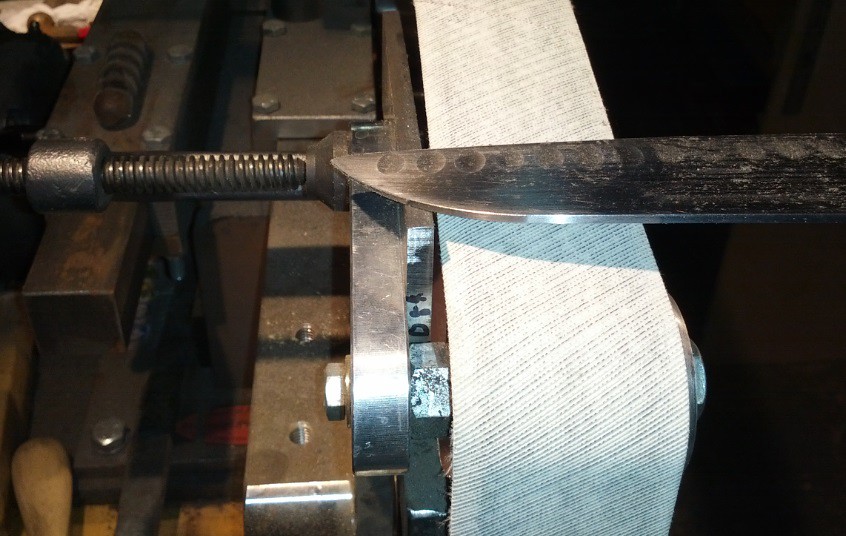
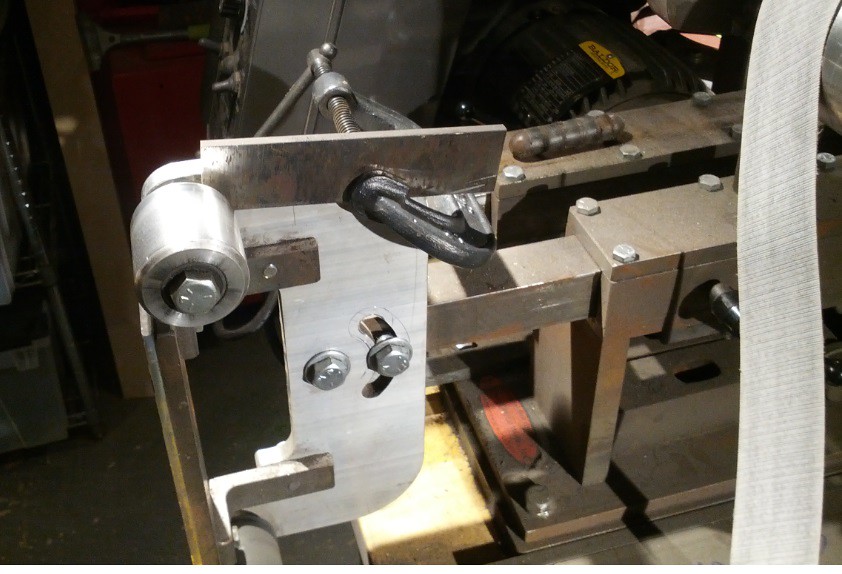
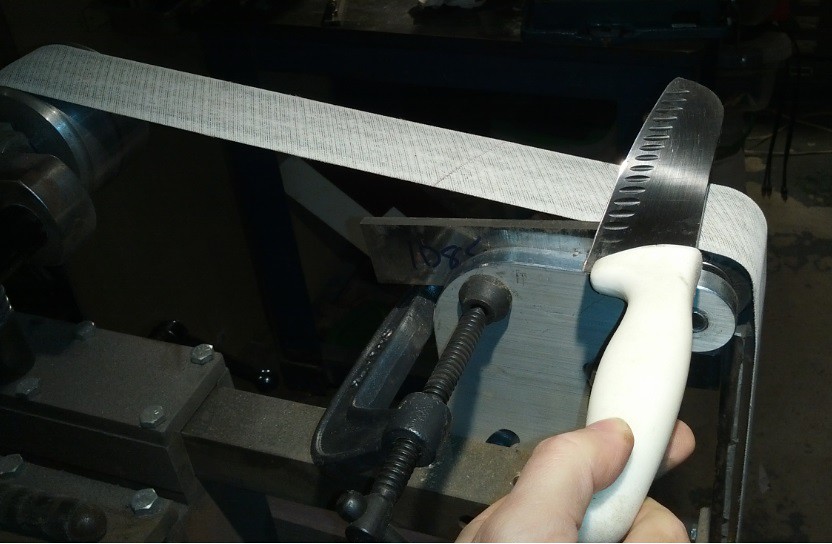
I use a jig to sharpen with my KMG. It is likely the simplest/cheapest jig ever made (C-clamp and a flat piece of steel), but it works for me. It is quick and easy, but it does require a variable speed as well as a reversing switch on the VFD controller. This technique produces a convex edge.

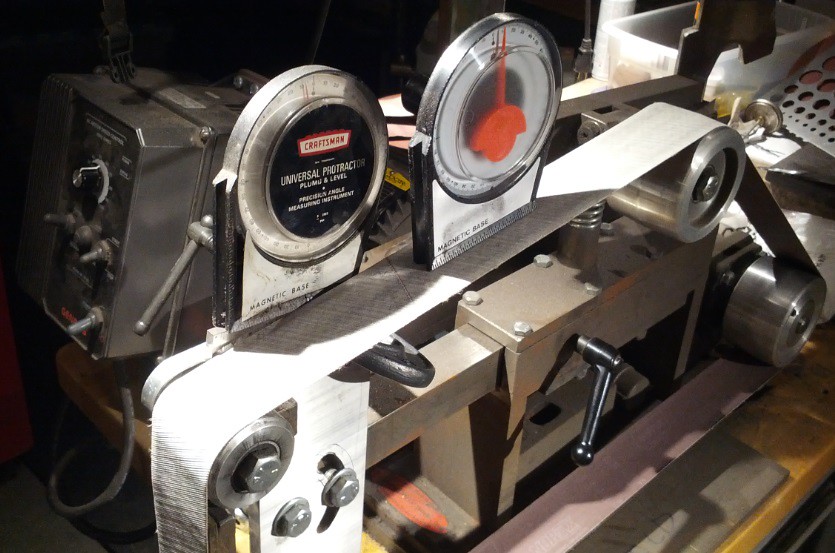
I use three belts: 220 Jflex, 400 Jflex followed by 16x NORAX. I run the belts at the slowest speed possible (a couple feet per sec) IN REVERSE and sharpen above the top wheel of the platen arm. Pics will help.

A simple piece of 0.25 blade stock (any steel with a flat edge will do)
11742915915_27e30f28d2_b.jpg


The jig is used more as an angle reference rather than a guide. If I start with the correct angle, it is much easier to hold it fairly accurately. Once I have the angle, I move the blade maybe a half inch up the belt to sharpen, so the side of blade does not get scuffed on jig. I have thought of making it out of bronze/brass, but steel works.
11743669636_24ba9dd857_b.jpg


My view as I sharpen.
11743323904_3ab430b7e5_b.jpg


I use a magnetic protractor to measure angle on jig and angle of belt. Edge bevel is the sum of the two.
11743168553_065914bca4_b.jpg


After the NORAX (Thanks to Butch for introducing me to them), I strop with green chrome on leather strop.

Yes, it is a crappy commercial knife. I have lots of them. Can't let the kids or wife use my Harners or my Ealy petty; somebody might get hurt. -Doug
 
alright here is another guy who has a question that doesnt have the big power tools. Now also remember I am a beginner too. I have been making knives by stock removal with a file. When I get my knife back from HT, what would be a good way to put that initial edge on the sucker? I am wondering if a stone would work for that first blunt edge? I suppose the polishing from 220-2000/4000 on up by hand to get all the carbonization off will lead to a smaller edge than i started with before the HT.
So, after I get all my post HT polishing done should i just get a course stone and sit there for an hour taking the edge down? or is there a better way? I like the idea of the DMT or Lansky system for the edge, but will that work for material removal on the first edge?

sorry. lots of questions.
 
I'm sure I will get critiqued for this but... I use a standard ken onion worksharp which get my knives razor sharp.

Why would you get critiqued for that? I played around with one at a local dealer. The price + the ease of them made ME think about buying one.

Personally I use my beltgrinder with a trizact belt for setting the bevel. After that I finetune the edge with DMT stones and a Belgian Coticule natural waterstone.
 
Believe it or not, a very good solution can be found at HF. They sell a cheap diamond block that has four surfaces (grits). No, I don't recommend it for high quality final edges, but for bevel setting it works.

If you are not familiar with diamond/nickel sharpeners, be aware that they all start out very coarse. If used correctly they will smooth out then cut fine for a very long time.

Using correctly means light pressure. It's not terribly easy to rip the abrasive from the nickel binder, but at first you'll probably need to keep reminding yourself to lighten up. If swarf becomes an issue, in terms of clogging, use a dish detergent and running water to clean. Non-interrupted surfaces can be found on "stones" from DMT and others. I don't really care for the swarf perforations on diamond plates as they can hook points and other bits, but most inexpensive stones employ them. That said, I find the HF block to be an excellent tool for rough work.

Also, for those of you who would like to try an Edge Pro, but cannot afford the steep buy in, be aware that the patent expired a while back. There is a clone on the market (yes, it's Chinese) that works very well. I had an opportunity to try both and aside from the terrible quality of provided stones and questionable degree markings, the quality is there. EP stones (any of them) work just fine and the sharpener runs about 30 bucks when bought from a seller here in the US. I check my angles with an angle app on my phone otherwise an angle cube (digital angle box found at chefs knives to go or HF) are more or less the standard device for checking sharpening system angles.
 
alot depends on the knives you make
for me DMT 3x10 1200 grit and norton 4/8K grit water stone

tho it woudl be reall easy to get a 500/1k and 2/4 or 4/8k combo hone set and be good for most knives
if you plan o honing high alloy knives then the options change
DMT 600 and 1200 grit plates

Hunting style knives mainly, I want to do bowies as well. I have been thinking about the DMT 600 and 1200 grit, so maybe I am not so far off.

DougSeward - I think that is pretty clever.
 
DMT has a 120 grit "stone" for ski's and snowboards. That's what I start with
 
i use nothing but the paper wheels for a v edge but i finish off both v edges and convex edges with the paper wheels. when i have guys telling me they have a hard time dulling a knife i made, that tells me the wheels are doing a good job.

check out what the guys say in these threads.
http://www.bladeforums.com/forums/s...amed-the-Pitbull!-Kinda-sharp-well-you-ll-see!!

http://www.bladeforums.com/forums/showthread.php/960269-Knife-from-Richard-J knife i made for singularity 35

http://www.bladeforums.com/forums/showthread.php/1092684-Knives-by-Richard-J?p=12533188#post12533188 macks necker
 
i use nothing but the paper wheels for a v edge but i finish off both v edges and convex edges with the paper wheels. when i have guys telling me they have a hard time dulling a knife i made, that tells me the wheels are doing a good job.

check out what the guys say in these threads.
http://www.bladeforums.com/forums/s...amed-the-Pitbull!-Kinda-sharp-well-you-ll-see!!

http://www.bladeforums.com/forums/showthread.php/960269-Knife-from-Richard-J knife i made for singularity 35

http://www.bladeforums.com/forums/showthread.php/1092684-Knives-by-Richard-J?p=12533188#post12533188 macks necker

I think there are many viable methods for getting a high quality toothy edge for general use. I think maybe some of the bad luck with paper wheels might just come from improper implementation. For machine stropping to work well (IME), you have to keep a proper load of compound on the wheel. I could see a wire edge being formed during the stropping step on an underloaded wheel, as it would be heating and smearing the edge more than cutting with the compound as it is supposed to. This also could happen with improper pressure or angle in either step.

I eventually came to loading a hard wheel with diamond powder, it was inspired by diamond loaded felt lapidary pads that I used for a process at an old job. It works very well on the tough stuff and I've never seen a wire edge form in the stropping step unless I was outright doing something wrong. Even so, my process will fail if I do not keep a proper load on the wheel, and I have seen this happen in my loupe inspections.


I think the most important thing is no matter how you sharpen, to inspect your work until you've found the weak spots in your process and correct them to get a good result. Now I'm not quite so obsessive about checking my edges (although I still do inspect each one), because I am comfortable that I have developed a working process for my needs.
 
Last edited:
i have had guys with the wheels send me knives to sharpen that they have a duplicate of. they tell me they take the knife i sharpen and use it as a guide to see if they are getting their knife as sharp. a lot of guys tell me that the knife i did was sharper. i showed a barber a knife i made from some of the 1075 that i use and some m 4 that i am making neck knives from. although both knives will shave easily, he said the 1075 felt much sharper than the m 4.

i have never had problems getting the burr off or having a burr smear. i have buffed knives on a wheel without adding any compound and had it get freakishly sharp with no burr left. protourist and a buddy here in town that goes by mr. coffee on the forum have seen me do this with the knives i have made for them. you could actually watch the edge cut into a hair crossways on a hair held by the end sticking straight out.
this kind of edge is fun to do to show off but i put some compound on the wheel and took that edge off so to speak and put my normal edge on.

i have sharpened both by hand, with a guided system and i will never go back to either method. the guided system never gave me the angle it was marked to give since a wider blade would end up with a steeper angle compared to a narrower blade which ended up with the opposite (or obtuse) edge. with the wheels you can match the existing angle or change it to a steeper or more obtuse edge depending on what you are wanting.

some guys complain about heat buildup. i have always ran my wheels on a 1725 rpm motor and i have never had to worry about burning a blade. i have pushed extremely hard on a blade i made using the slotted wheel experimenting to see if i could buff out a really dulled edge and get it back to shaving sharp again. i was able to and that edge was on k II. if that edge was hurt in any way, it would not have been able to have held up to the abuse i have gave it or others have gave it. the vid unit made shows that. http://www.youtube.com/watch?v=8q_eMwRaHYg

when the knife arrived to unit, he was the 2nd person to get it in the private passaround i sent it on. now protourist has it and he is the 2nd person to get k II in the 2nd private passaround i'm sending it on. i'll have him post his opinion on the edge but i already know what he is going to say :D
 
Last edited:
i went witht the 600-1200 as hones due to most makers having 200-400 grit paper in house and that can be clamped to a block and used to set the edge
when funds allow then if you feel the need you can get the XC or XXC plate or get sucked into the water stone world (i have many hones now but only use a few most the time )
 
i went witht the 600-1200 as hones due to most makers having 200-400 grit paper in house and that can be clamped to a block and used to set the edge
when funds allow then if you feel the need you can get the XC or XXC plate or get sucked into the water stone world (i have many hones now but only use a few most the time )

thanks man. i know you arent the only guy answered my question about setting the edge, but this makes the most sense to me. i have plently of wetdry paper on hand and will use that to set the edge.
 
Thanks everyone for a great thread about sharpening! A question for my heroes. Y'all say to use stones, not the grinder. I hear ya, but it looks like you get things pretty damn close with the grinder before you get to the stones. Care to elucidate a bit more on that score?

I sharpen all my knives on stones. After I am done grinding and polishing, whether hunter or kitchen knife, the blade is nearly sharp enough to shave with.
IMHO, if you need to use a belt grinder to sharpen, the edge is too thick. Like Bill, my blades are pretty well sharp after the finish grinding and/or hand finishing.
My finish beveling usually ends up with a rather sharp but yet unrefined edge.
 
So for the guys using stones, if you could only buy two stones. What grit of the two stones would you buy?

For everyday I could get by with a medium or fine India, and a soft Arkansas. I use a hard Arkansas as well, but it's because I can, not because I need to.

If I was going diamond, it would be 600 and 1200. Diamond works fast enough that you don't need coarser unless you've really beat up the blade.
 
Thanks everyone for a great thread about sharpening! A question for my heroes. Y'all say to use stones, not the grinder. I hear ya, but it looks like you get things pretty damn close with the grinder before you get to the stones. Care to elucidate a bit more on that score?
Aloha Phil... I do get very close to finish with my grinder, then go to hand sanding. After hand sanding with papers, the knife(by definition) is sharp. At this point, it doesn't take much to refine it to a high degree of sharpness. I choose to do that last bit with waterstones.
 
Freehand diamond stones to create the edge bevel, then a quick strop on a nail buffer to remove the wire.
Like Nick (woo, I can say that!), I worry about the belt sander ruining an enormous amount of work at the final step. I HAVE used it to set edge bevels occasionally, but usually not for something valuable. And yeah, if I need the sander it means I left the edge too thick during grinding.
 
Going to chime in here, been sharpening knife far longer than hammering them. Speaking from a kitchen knife standpoint I use only waterstones. Reason being that I prefer to put (slightly) different geometries on the primary and secondary edges based off of the edges relation to spine thickness and the fact that with more general purpose double bevel knives; different lengths of the edge are used for different types of tasks so I profile them accordingly. All to the point of at least shaving to popping freestanding hairs. Using a 220, 500, 1000, 3k, 5k, 8k and 16k depending on what needs to be done. Wish I could do it with a belt but I always manage to ass it up somehow. I'm sure that there are others here too that like to wind down on the stones after hours in front of the forge/grinder.
 
Back
Top