My priority is make as good knife as I can do. I use freehand grinding or with jig depending on situation but mostly freehand. Because I am hobbyist maker it can take long time from blade to blade grind so when it will happen I use grinding jig especially if I do with expensive steel. My grinding jig is homemade and is adjustable in tenth of degree. I use it often on finishing blade after HT. I use lot of other "jigs" too ...

-
The BladeForums.com 2024 Traditional Knife is available! Price is $250 ea (shipped within CONUS).
Order here: https://www.bladeforums.com/help/2024-traditional/
You are using an out of date browser. It may not display this or other websites correctly.
You should upgrade or use an alternative browser.
You should upgrade or use an alternative browser.
Why are gtinding jigs frowned upon?
- Thread starter Justin Schmidt
- Start date

kuraki
Fimbulvetr Knifeworks
- Joined
- Jun 17, 2016
- Messages
- 4,679
I've freehand ground knives. I've used the bubble jig. I've used a rigid jig. If I'm doing repeat blades or really any quantity greater than 1, I use the jig. Jig holds the knife square and I set the bevel angle by angling my platen. It saves me a lot of time. When I freehand grind a blade I spend a lot of time fixing screwups, or if not exactly a screwup, getting the right and left bevels to match. I don't have to do that with a jig. I grind to my scribed centerline and plunge line and they're both even and true.
I ground a double edged dagger with my jig. I wouldn't have even attempted that freehand because I know I would have thrown it away.
Sometimes I will rough grind with the jig and then finish grind after heat treat freehand to tweak the distal bevel since the jig doesn't allow it.
I don't look down on anyone who does something to improve their process stability or reliability or reduce their process time through standardized work procedures. That's like looking down on people for heat treating with a PID controlled furnace rather than by sight in a coal forge. I know both processes can produce a good hard knife. I also know which I'd rather purchase myself.
I agree the jig can be a crutch that limits what one can do if they learn the technique and feel for grinding freehand. A maker just needs to decide where he wants to be in the scale of artisan <-------------------------> manufacturer on any particular knife.
For me, and my goal of a self funding hobby, jigs make good sense. They help me keep the time per blade at a level that allows me to price them competitively in the market I'm trying to cater to, and they reduce frustration thereby increase my enjoyment of the process.
I ground a double edged dagger with my jig. I wouldn't have even attempted that freehand because I know I would have thrown it away.
Sometimes I will rough grind with the jig and then finish grind after heat treat freehand to tweak the distal bevel since the jig doesn't allow it.
I don't look down on anyone who does something to improve their process stability or reliability or reduce their process time through standardized work procedures. That's like looking down on people for heat treating with a PID controlled furnace rather than by sight in a coal forge. I know both processes can produce a good hard knife. I also know which I'd rather purchase myself.
I agree the jig can be a crutch that limits what one can do if they learn the technique and feel for grinding freehand. A maker just needs to decide where he wants to be in the scale of artisan <-------------------------> manufacturer on any particular knife.
For me, and my goal of a self funding hobby, jigs make good sense. They help me keep the time per blade at a level that allows me to price them competitively in the market I'm trying to cater to, and they reduce frustration thereby increase my enjoyment of the process.
It's probably because of the crutch aspect. It takes many hours to perfect free hand grinding and that can be a point of pride for some folks. I also think the word "jig" is far to ambiguous. Using a push stick to assist your grinding can be considered using a jig.
That being said I think a fair number of us newbies do both. I can't seem to get a jig or make a jig that works the want i want it to yet. I like the feel of freehand grinding and it is a different learning curve for sure. A jig can introduce you to new methods and styles. I agree with Rick completely.
That being said I think a fair number of us newbies do both. I can't seem to get a jig or make a jig that works the want i want it to yet. I like the feel of freehand grinding and it is a different learning curve for sure. A jig can introduce you to new methods and styles. I agree with Rick completely.

- Joined
- Oct 1, 2013
- Messages
- 901
It's probably because of the crutch aspect. It takes many hours to perfect free hand grinding and that can be a point of pride for some folks. I also think the word "jig" is far to ambiguous. Using a push stick to assist your grinding can be considered using a jig.
That being said I think a fair number of us newbies do both. I can't seem to get a jig or make a jig that works the want i want it to yet. I like the feel of freehand grinding and it is a different learning curve for sure. A jig can introduce you to new methods and styles. I agree with Rick completely.
And that's one of the most important points right there, what is free hand grinding. My opinion is that if you use anything to help like an extension handle for folder blades or even a push stick it's not free hand.
Free hand grinding on a flat platen vs a wheel is also very different. I know a lot of makers that change their blade geometry so they don't have to deal with the up sweep towards the tip, i.e. Drop point or swedge.
Grinding jigs work well unless you are doing an upsweep on a hollow grind with traditional blade, recurves or hawkbills, depending on the curves.
I used jigs to learn how to free hand, and after ruining 80 something practice blades I can safely say I can free hand hollow grind. But, why does that matter to anyone? Why are people so invested in how another maker makes their knives.... it's usually when a maker claims to freehand grind and then you see them using a jig some how.
I personally don't care what anyone does, as long as they are doing it and making a good knife. For myself, I am developing arthritis real bad in my wrist and I can sense that I'll need to use a jig in the future. Right now I spend 3 hrs grinding one of my blades, if I could use a jig to do my hollows I probably would.
Last edited:

- Joined
- Jul 31, 2015
- Messages
- 3,118
I free hand grind exclusively at the moment. I tried using jigs, but I found them distracting. That said, I only do FFGs. I have a really good friend who has been after me for a year to have him over to make a knife. We finally got our schedules together and he wants to make a scandi grind bush craft knife. I know he wants to do as much of this himself as possible, so i figure what do we have to lose? (except maybe a finger). So i grab a piece of aluminum angle and bolt the blank to it. In about 15 minutes and a little coaching, he has a respectable grind on both sides, nice and even. I know if I feel like doing a scandi grind in the future, i will be revisiting the use of a jig. As many have said, it's about the end product, and I can attest that grinding with a jig can be as challenging for some as going freehand. Make better knives, that's it.

- Joined
- Feb 18, 2016
- Messages
- 2,209
Well said guys. It's nice to know that jigs or "fixtures" as a whole are completely shunned like I thought they were.
kuraki
Fimbulvetr Knifeworks
- Joined
- Jun 17, 2016
- Messages
- 4,679
Fwiw, We were supposed to use the term "fixture". That word "jig" was considered offensive.
By whom? These guys?
View attachment 673735

I started selling knives in Feb of this year. I've sold 35 or so to date
That's about 25 discrete customers.
Not one of them asked my how I ground the blade.
They mostly want to know how to best sharpen the knife.
They mostly purchased the knife based on the overall looks and the blade steel reputation.
My best grinding starts freehand, Then I switch to a work rest and push stick.
Then I freehand as required. It's generally the fastest and most consistent grind for me.
If I had a consistent design and constant pattern I was making all the time, I would make a fixture for it.
Why not?, why struggle with inconsistencies and wasted time?
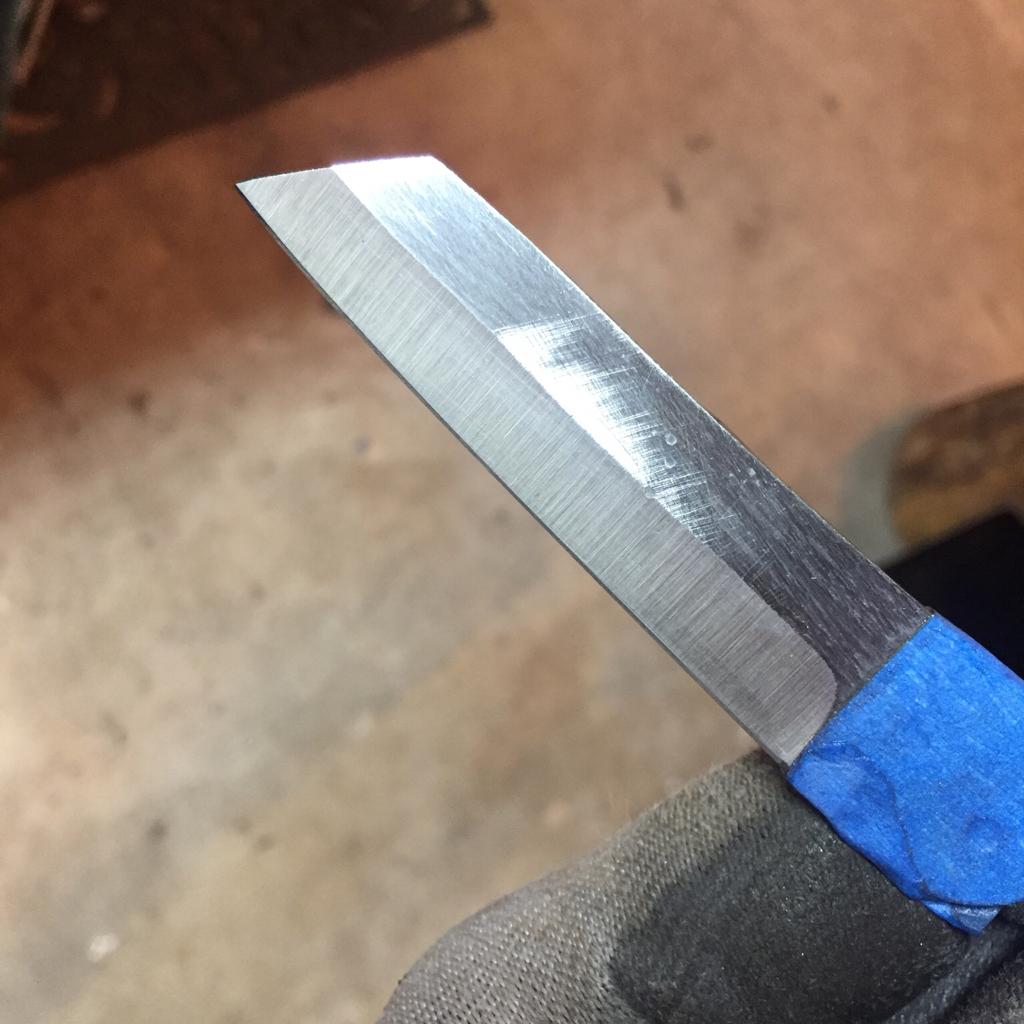
Here you go, this was just done in about 3 minutes with a 60 grit Hermes, yes on the work rest with a push stick.
Now I can goto a 120 and freehand consistently If I want since the bevel flat is already defined.
Knifemaking is hard enough, I think my friend Kuraki explained it well earlier.
That's about 25 discrete customers.
Not one of them asked my how I ground the blade.
They mostly want to know how to best sharpen the knife.
They mostly purchased the knife based on the overall looks and the blade steel reputation.
My best grinding starts freehand, Then I switch to a work rest and push stick.
Then I freehand as required. It's generally the fastest and most consistent grind for me.
If I had a consistent design and constant pattern I was making all the time, I would make a fixture for it.
Why not?, why struggle with inconsistencies and wasted time?
Here you go, this was just done in about 3 minutes with a 60 grit Hermes, yes on the work rest with a push stick.
Now I can goto a 120 and freehand consistently If I want since the bevel flat is already defined.
Knifemaking is hard enough, I think my friend Kuraki explained it well earlier.
- Joined
- Feb 18, 2016
- Messages
- 2,209
I started selling knives in Feb of this year. I've sold 35 or so to date
That's about 25 discrete customers.
Not one of them asked my how I ground the blade.
They mostly want to know how to best sharpen the knife.
They mostly purchased the knife based on the overall looks and the blade steel reputation.
My best grinding starts freehand, Then I switch to a work rest and push stick.
Then I freehand as required. It's generally the fastest and most consistent grind for me.
If I had a consistent design and constant pattern I was making all the time, I would make a fixture for it.
Why not?, why struggle with inconsistencies and wasted time?
Here you go, this was just done in about 3 minutes with a 60 grit Hermes, yes on the work rest with a push stick.
Now I can goto a 120 and freehand consistently If I want since the bevel flat is already defined.
Knifemaking is hard enough, I think my friend Kuraki explained it well earlier.
Doin it tim hancock style, I like that approach. He makes it look very effortlessly.
Using the 2x42 I've probably gone through close to 15 ft of metal most if it mild steel some AEBL. It's extremely frustrating not getting everything right. That's why I was looking into using a jig
Doin it tim hancock style, I like that approach. He makes it look very effortlessly.
Using the 2x42 I've probably gone through close to 15 ft of metal most if it mild steel some AEBL. It's extremely frustrating not getting everything right. That's why I was looking into using a jig
I personally know 3 ABS Mastersmiths that do it that way and they learned from Tim Hancock.
It takes about 20-30 blades before u get it the way u want
Sent from my iPhone using Tapatalk

- Joined
- Feb 6, 2010
- Messages
- 1,427
I have to throw in my opinion here if I may. I think the most important thing is how the knife looks and functions when it's finished. When we see a great looking knife on this site most of us don't ask what equipment was used unless the knife has a perplexing feature and we need to know how it was achieved. Whether the knife maker used a sophisticated CNC machine, lathes, or a 3-d printer is only secondary to the thing itself ( in my opinion). Using "fixtures" may be because the knife maker has a limiting disability, a desire for repeatability, or just because it works so well for him or her. I have no problem with this. That said, I have tried a variety of them and built several myself and have found that that my own dexterity has served me better. I like band saws, variable speed everything, and vertical and horizontal quality grinders. I would not make knives with a file and a vise unless I was in prison. It is hard enough to design something nice and carry it out well anyway. I say that the ends justify the means in this case... or maybe I"m "full of it". Larry
- Joined
- Feb 18, 2016
- Messages
- 2,209
I have to throw in my opinion here if I may. I think the most important thing is how the knife looks and functions when it's finished. When we see a great looking knife on this site most of us don't ask what equipment was used unless the knife has a perplexing feature and we need to know how it was achieved. Whether the knife maker used a sophisticated CNC machine, lathes, or a 3-d printer is only secondary to the thing itself ( in my opinion). Using "fixtures" may be because the knife maker has a limiting disability, a desire for repeatability, or just because it works so well for him or her. I have no problem with this. That said, I have tried a variety of them and built several myself and have found that that my own dexterity has served me better. I like band saws, variable speed everything, and vertical and horizontal quality grinders. I would not make knives with a file and a vise unless I was in prison. It is hard enough to design something nice and carry it out well anyway. I say that the ends justify the means in this case... or maybe I"m "full of it". Larry
Always appreciate your opinion Larry. That's been my kinda mindset as well is "do what works for you "
HSC: even the great one (nick wheeler lol) uses that method and praises it. So it's gotta be good

- Joined
- Oct 17, 2007
- Messages
- 4,302
For those of you who state that grinding jigs are limiting; a short story. I shipped a Bubble Jig to a gentleman in California last year. He wrote back to me within a month telling me how his 13 year old daughter kept asking him about grinding a full length dagger. She wanted to give it a try. He contacted me again, I told him how simple it was and the following month he sent me an e-mail along with a pic of the dagger his daughter had ground. Just about perfect, he was amazed. She said it was easy using the Bubble Jig; just keep the bubble centered.
We have shipped close to 3,000 Bubble Jigs over the last 7 years so there are a lot of makers out there that grind with jigs. It's still free hand guys, its just a sight reference instead of feeling your way along. Don't limit yourself by trying to fill an open slot. Risk something, you will amaze yourself.
The only thing that is limiting in knife making is the makers imagination, Fred
I wouldn't really consider your bubble jig a 'jig' in the sense of what I was thinking of when I posted my response. I think when most makers think of a jig (or fixture, or shop aide, or whatever you want to call it) they're thinking of something that clamps the blade into a single position, and slides along a work rest, table, or some other guide. Most of the fixtures I've seen pretty much eliminate all but one axis of movement, which works for some blade profiles, but not very many others.
Your bubble jig by design is not so limiting. You still have full range of motion should you need it, but instead of leaving only one axis to move in, it's basically helping to eliminate variance in the more critical axis, while still allowing for full hands on grinding, range of motion, developing muscle memory, etc... It can be used with tables, rests, fixtures, or without.
Heck, one day I'd even like to have one to try out!
Now, just to further clarify on my point, if I could get a near perfect bevel using a jig, as effectively or efficiently as I can free hand grind, I'd probably use nothing but. I'm sure we'd all be surprised by the number of great makers who use jigs or fixtures. Now, if a maker can get a finished product that looks great with nothing but a fixture, more power to them... Send me some hints.

I do think it's important to be ABLE to free hand grind though, as invariably something is going to come up where a jig or fixture just won't quite cut it, and you'll need to change things up a bit.

- Joined
- Sep 17, 2013
- Messages
- 430
The jig debate reminds me of the primitive archery world where some people think if you're not using a stone axe and flint flakes and wearing deer skins while carving a bow then you're doing it wrong.
To me a tool is a tool. A device to perform a particular function. A means to an end. If someone has a problem with a maker using a grinding jig then they should have a problem with 99% of the tools we use. Personal preference is one thing but I find it mind boggling that someone could have the opinion that there is only one "correct" way to grind bevels especially when the end products are most likely indistinguishable.
Sent from my 0PM92 using Tapatalk
To me a tool is a tool. A device to perform a particular function. A means to an end. If someone has a problem with a maker using a grinding jig then they should have a problem with 99% of the tools we use. Personal preference is one thing but I find it mind boggling that someone could have the opinion that there is only one "correct" way to grind bevels especially when the end products are most likely indistinguishable.
Sent from my 0PM92 using Tapatalk

- Joined
- Jan 10, 2015
- Messages
- 1,673
I don't use a jib but would have no qualms if I felt the need. When I was a total noob I looked into it a bit, but glad I learned freehand. It was hard, but well worth the effort.
- Joined
- Jul 31, 2015
- Messages
- 3,118
Larry,
I have a feeling you could make even a sharpened toothbrush look good.
I have a feeling you could make even a sharpened toothbrush look good.
As a knife user, if the knife works awesome the way I expect it to, I don't care how you made it. As a knife collector, I have no interest in a fully CNC'ed knife, but a jig is fine by me; just my personal bias for human handmade versus robot made. As a knife making doofus, I'm too stupid, poor, and inexperienced to make a jig for my teeny 1x30 grinder and am having fun freehanding by eye.
I'm making kitchen knives, so they have distal taper, full convex grind that's asymmetric, i.e. more convex on the right for right handed knife for better food separation. I'm sure a jig could help but there would be a lot more stopping to adjust it.
I'm making kitchen knives, so they have distal taper, full convex grind that's asymmetric, i.e. more convex on the right for right handed knife for better food separation. I'm sure a jig could help but there would be a lot more stopping to adjust it.
Wouldn't it be funny if this was a woodworking forum and people were saying, don't use a fence on a table saw, you should be able to make a straight cut without it.
Yeah, maybe...
My background is in blacksmithing, and there's huge value in putting as many hours/days/years as possible practicing freehand with a hand hammer- there's no substitute if you want to really know how metal moves when it's hot, and then things you can do with just a hammer and anvil are really surprising- and then when you use a power hammer or fixtures, it's a breeze.
If you want to do accurate, repeatable work, use a jig. If you want to grind quickly to shape, do it freehand.
Finishing, you slow that grinder down and it's sort of like an aid to hand sanding.
Just my $0.02 worth of random thoughts, currently trading on Wall Street for about $0.000000000043
Yeah, maybe...
My background is in blacksmithing, and there's huge value in putting as many hours/days/years as possible practicing freehand with a hand hammer- there's no substitute if you want to really know how metal moves when it's hot, and then things you can do with just a hammer and anvil are really surprising- and then when you use a power hammer or fixtures, it's a breeze.
If you want to do accurate, repeatable work, use a jig. If you want to grind quickly to shape, do it freehand.
Finishing, you slow that grinder down and it's sort of like an aid to hand sanding.
Just my $0.02 worth of random thoughts, currently trading on Wall Street for about $0.000000000043