
-
The BladeForums.com 2024 Traditional Knife is available! Price is $250 ea (shipped within CONUS).
Order here: https://www.bladeforums.com/help/2024-traditional/
You are using an out of date browser. It may not display this or other websites correctly.
You should upgrade or use an alternative browser.
You should upgrade or use an alternative browser.
Why are the chisel ground Emersons ground on the "wrong" side?
- Thread starter Macchina
- Start date


- Joined
- Apr 7, 2006
- Messages
- 5,215
April, 2006. 1440 posts. And this guy all of a sudden decides to get a bug up his a__ about nothing? Yeesh.
Michael, relax. Have a beer. Take deep breaths. The knife isn't a pencil sharpener and was never intended to be. If that's what you want, you can get a Buck 110 at Wally World for $30, and it'll get the job done perfectly.
I've had a bug up my a__ for quite a while now, I thought about putting a spider in there to get catch the bug, but I don't want to go down that road... I am a Product Design Engineer, I make my living designing objects with optimal performance at a minimum cost. When I see a design flaw that would cost $0 to improve, the bug in my a__ squirms and squirms inside me!
I'm not excited, just disappointed that such a nice knife design is degraded for utility purposes. I understand that the knife is designed for SD, but to grind it on the other side would not at all hinder this design aspect. I own my knives 0% for SD and 100% for utility. On the other hand, I own my pistols 100% for SD and 0% for utility.
P.S. why would I buy a Buck 110 at Wally World, when I can get one of these?
So I read Emerson's quote about the chisel grind and read/skimmed over all the posts here, but nobody has mentioned a certain aspect of the chisel grind.
It has the same cross-sectional area as a double sided grind. If anything is different/beneficial about the chisel grind, it is that the edge and point angles are more obtuse, thus making them "tougher."
Does this make sense, or am I wrong?
Oh, please don't take this post the wrong way. I have a chisel ground tanto Raven and a standard clip point Rave and I love them both. I've used the tanto Raven a lot and it hasn't let me down!
It has the same cross-sectional area as a double sided grind. If anything is different/beneficial about the chisel grind, it is that the edge and point angles are more obtuse, thus making them "tougher."
Does this make sense, or am I wrong?
Oh, please don't take this post the wrong way. I have a chisel ground tanto Raven and a standard clip point Rave and I love them both. I've used the tanto Raven a lot and it hasn't let me down!

- Joined
- Aug 27, 2004
- Messages
- 12,957
So I read Emerson's quote about the chisel grind and read/skimmed over all the posts here, but nobody has mentioned a certain aspect of the chisel grind.
It has the same cross-sectional area as a double sided grind. If anything is different/beneficial about the chisel grind, it is that the edge and point angles are more obtuse, thus making them "tougher."
Does this make sense, or am I wrong?
Oh, please don't take this post the wrong way. I have a chisel ground tanto Raven and a standard clip point Rave and I love them both. I've used the tanto Raven a lot and it hasn't let me down!
The cross sectional mass is thicker and that is to say if we cut the blade or broke it in half you could see that in the middle running down the length of the blade its thicker. However, the edge is actually thinner so therefore its weaker, hence all the knives mailed to me with chips up and down the edge and even in the tanto tips. When it slices that easily there is only one way it can do that and its with a thin edge to start the cut. It remains thin going up for quite a while and then thickens toward the middle but by that time the blade has already done its damage. In CQC the idea is that the cut need not be neat or precise it need only be and this edge no matter which side the grind on is very effective at this for this purpose. For those wanting a V grind Emerson does offer them just look around and find one of those. I've seen and even done my own edges on those to both sides also instead of the one side edge they come with even if it does void the warranty.
STR
- Joined
- Aug 27, 2004
- Messages
- 12,957
I have a CQC-7 on the way, and just realized it is one of the Emersons with a primary and secondary chisel grind. I really like the look of the knife, but the grind looks like it would be difficult to sharpen a pencil, remove wrap from steel bars, and other task that require you to slide the blade along a surface. Is there a reason why Emersons are ground on the left side instead of the right side?
You know even though I've already answered this the more I thought about it the more worthwhile it seemed to mention one other thing I avoided bringing up before. You ask for a reason and you are not alone. Many have asked this but lets look at Ernest Emerson for a moment and give some thought to what he is good at. What is Ernest perhaps even better at than making and designing knives? I would say he excels in marketing his knives and himself even better than making and designing knives. How many other makers do you know that make more in one show than most others do all year or in half a year if they are good? When you stop to think about it Ernest Emerson is a great salesman. Being a retired professional salesman myself I can say that when I sold and dealt with manufacturers and their representatives and designers that every now and then I was introduced to what could only be termed an excellent marketing strategy and Ernest certainly has that going for him.
Actually when you think about generating sales it goes even further with Ernest than what he does on his customs and his manufacturing company. With his customs there is a whole secondary market that was created from resales of the knives after he made what he wanted at the shows on them.
Then when we stop to think about how he set things up to maximize profits on his own end we can find things there as well. For one example, how many grinding belts a year do you imagine that it saves him having to buy by only having to grind one side of the blade? Just a thought coming from a fellow maker. From a profit stand point its going to add up I'm sure. Is that why he did it? Doubtful but looking at the genius in other avenues it should not surprise one to find out it was considered. Perhaps saving some $ there allowed for some extra to go elsewhere in the knives we'll never know. The point is the man is a great example of marketing genius and designing genius for what he does and the two don't often come together so well or that often. There are many other great designers and makers as we all know but not all sell 60 knives per show plus or minus for exactly what they want leaving the crowd wanting more now do they?
STR
So, to check for myself, I did a rough cross section sketch of a chisel grind and double grind on Solid Works and added dimensions to check the thickness of the cross sections. This is what I came up with:
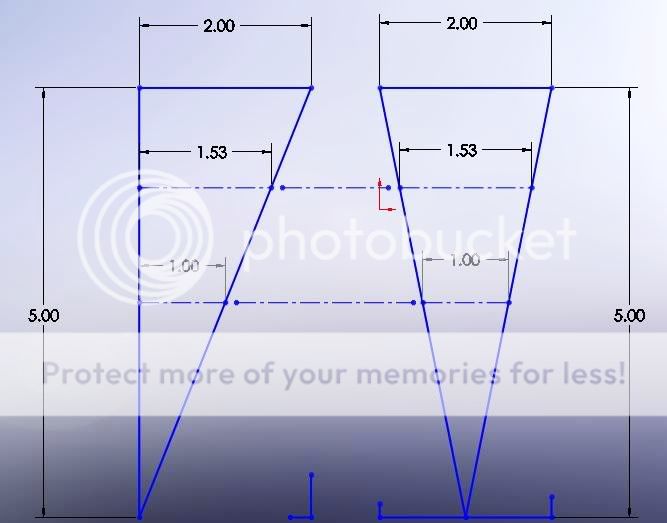
The cross-sectional thicknesses are the same. So far, to me, cost seems to be the most logical explanation for the chisel grind; one grind vs. two grinds.
Oh, I did check the angles of the grinds and yes, it does appear that the chisel grind really is more acute than the double grind.
The cross-sectional thicknesses are the same. So far, to me, cost seems to be the most logical explanation for the chisel grind; one grind vs. two grinds.
Oh, I did check the angles of the grinds and yes, it does appear that the chisel grind really is more acute than the double grind.
For one example, how many grinding belts a year do you imagine that it saves him having to buy by only having to grind one side of the blade? Just a thought coming from a fellow maker. From a profit stand point its going to add up I'm sure.STR
Here are my thoughts on this:
Given that the cross sections of both chisel and double grinds are the same, that means that the same amount of material is removed from both types of grinds. Where I could see money really being saved is setup time. If the blade blanks only need to be set up for a grind on one side, that means it should take half the time to set up chisel ground blades vs. double sided ground blades. Also, I'm assuming that the production Emerson blades are machine ground, not done by hand.
- Joined
- Aug 27, 2004
- Messages
- 12,957
Here are my thoughts on this:
Given that the cross sections of both chisel and double grinds are the same, that means that the same amount of material is removed from both types of grinds. Where I could see money really being saved is setup time. If the blade blanks only need to be set up for a grind on one side, that means it should take half the time to set up chisel ground blades vs. double sided ground blades. Also, I'm assuming that the production Emerson blades are machine ground, not done by hand.
If we are assuming then I can say that the part about the cross section of the chisel grind being thicker comes from Ernest from the post in the link given by Esav means we can assume Ernest has compared the two types of grinds by actually cutting one of each as they are done in half and measuring them to reach this conclusion which would mean something is off on your diagram above. I believe it is off because you can take out a CQC7A blade and compare the edge to the CQC7B and see with the naked eye that the B blade is thinner and less obtuse on the edge. The B blade also out slices the A in some mediums for ease of cutting.
Its also an assumption on my part as to grinding belts because we don't know how they are done to my knowledge. Emerson doesn't offer tours so there is no telling really how they are done. They could be laser done for all I know but it looks like a belt puts the satin finish on some of them to me. I assume you are correct though. Set up time would save time and money also so either way, belt, milling, or possibly laser or grinding service wouldn't matter its savings of $ one way or the other.
STR
...something is off on your diagram above.STR
There is nothing wrong with my diagram. If a flat grind is done on both a chisel grind and double sided grind of the same thickness material, my diagram holds true. The blade thicknesses at any given height and the cross section areas are the same. The only things that seem to differ are the angles. On the chisel grind, the edge angle is slightly smaller than the edge angle of the double grind. There you have it; no assumptions. Just proven geometry.

Oh, if you're not familiar with Solid Works, it's a very powerful CAD type program used widely in the engineering field. There is no way those thickness dimensions could be wrong. The program would not allow that.
As for what Emerson himself said, he refers to "cross sectional mass." Quite frankly, this doesn't mean anything to me. When referring to a cross section, usually length and area dimensions are used, not mass. For mass to be used, three dimensions would be needed, which a cross section view of anything does not provide. An additional dimension is needed to determine the mass because mass is found as follows:
mass = Area x thickness x density
Thus, cross sectional mass doesn't really exist unless a thickness of a cross section "slice" is provided.

- Joined
- Aug 27, 2004
- Messages
- 12,957
Thus, cross sectional mass doesn't really exist unless a thickness of a cross section "slice" is provided.
I guess you need to slice two of your own blades in half then because no one else is going to volunteer theirs to prove Emerson wrong in what he said. Good luck with that.
STR
I guess you need to slice two of your own blades in half then because no one else is going to volunteer theirs to prove Emerson wrong in what he said. Good luck with that.
STR
Or I could cut a 3D model and show the dimensions! That's a lot cheaper.

- Joined
- Oct 6, 2006
- Messages
- 3,869
Emerson is not the only manufacturer to do this. My CRKT M16-14FK is a left side chisel grind. As well as others. I don't see the issue or why EQC has been pointed out?


All three of these Buck's are left side chisel grind.
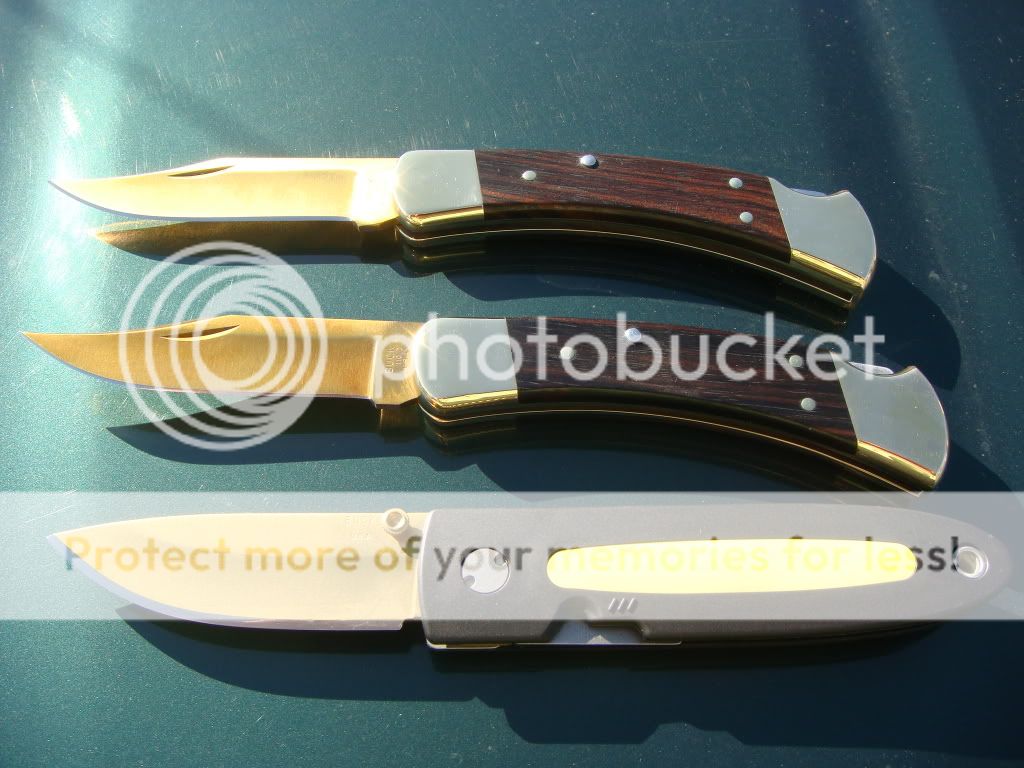

All three of these Buck's are left side chisel grind.
- Joined
- Aug 27, 2004
- Messages
- 12,957
Or I could cut a 3D model and show the dimensions! That's a lot cheaper.
I susppose so. I don't know though. I mean those programs are always off by just a bit too. I use a Waterjet service to cut out things I use and even close as they are things still come sometimes off just enough to notice when copying something else, IE, undersized or oversized by various degrees compared to the original. They are close though no doubt.
I assume the program he uses at the Waterjet service to cut out and copy things is similar to what you talk of but don't know that.
Also, there is no substitute for what you can physically see and measure. There does appear to be a difference in the amount of blade left above each line as you measure upward comparing the angles of one vs the other. Note the amount of blade left just past each far right line just above the point you mark as .100 and .153. Perhaps this is what Ernest refers to I really don't know. I only know his knives are among some of the most effortless slicers on the market in those chisel grinds. The problem I've always had with them is they are so impractical for everyday use that I can't justify using one since you can't even control the direction of the cut very well for any detail work or even just trying to slice a straight line in paper. I often times pull out my pocket folder to slice off the part of the label I keep for when I print my mailing labels. If I happen to have a chisel grind on me I may as well just get the scissors out though. Thats a great way to prevent cutting into the part of the label you need to tape on the box not meaning to.
Your posts and particularly your diagram are interesting. Too bad we will never hear from an Emerson Rep to reply to them. :thumbup:
STR
I mean those programs are always off by just a bit too.
Well, I checked the drawing, and even though it is not shown in my picture here, the dimensions for the thicknesses are exactly the same out to 8 decimal places (that's the farthest I checked).
As for variation in your water jet parts, I would suspect that is due to the limits of the machines, not the CAD program. In my short work at a machine shop as a quality control assistant, I learned that engineers (which I am studying to be as a senior in college) sometimes demand tolerances that are too small for the machines to meet. From personal experience, I saw that it is difficult to get sheet metal parts to small tolerances using a laser cutter. Sometimes the machines just can't be that precise. That's ok though, because a lot of the time, the machines are more precise than they need to be. As for water jet or laser cut knife blanks, I don't think they need to be cut with precision to five decimal places.
There does appear to be a difference in the amount of blade left above each line as you measure upward comparing the angles of one vs the other. Note the amount of blade left just past each far right line just above the point you mark as .100 and .153.
I'm not sure what you mean by this. The dashed lines on each cross section are linear, so the thickness measurements are at the same height on each cross section. Also, the measurements of .100 and .153 are the distances between the points of intersection of the dashed lines and the cross section outlines.
Too bad we will never hear from an Emerson Rep to reply to them. :thumbup:
Yeah, it'd be nice if the man himself would chime in. I understand that he started as a machinist and aerospace engineer, so he should be very familiar with programs like the one I use.
Last edited:
- Joined
- Apr 7, 2006
- Messages
- 5,215
Using AutoCAD (better than SolidWorks any day of the week  ), I drew up a representation of the blade profile as described above. I took a slice 1mm long and computed the mass using AutoCAD's MASSPROP calculator. It can be done with oldschool math as well:
Area of a triangle: 1/2 x Base x Height
.5 x 2 x 5 = 5mm²
Volume of a triangle: Area x Thickness
5mm² x 1mm = 5mm³
Since the Base and Height of both sections is the same, and since material is the same, the mass for any slice is the same.

), I drew up a representation of the blade profile as described above. I took a slice 1mm long and computed the mass using AutoCAD's MASSPROP calculator. It can be done with oldschool math as well:Area of a triangle: 1/2 x Base x Height
.5 x 2 x 5 = 5mm²
Volume of a triangle: Area x Thickness
5mm² x 1mm = 5mm³
Since the Base and Height of both sections is the same, and since material is the same, the mass for any slice is the same.

I've owned just about all the prod. Emerson knives made. As for the chisel grind unless it is sharp it doesn't matter what the grind is on it, the edge ain't gonna cut. A chisel grind like on the 7 series will give a wavy type of cut which will make the cut worse me thinks. Are they any better than other edges? Personally I don't think so. My CS Caledonian will cut with any folder made today imho. I figure it this way, a nice thinly ground edge with bite to it is what I am after. It has always worked for me and that is the kind of edge I like.
For being ground on left vs the right? I don't know if it really makes a whit of difference. Emerson says it is for visual reference and something about parasitic something or other as the chisel blade passes through the medium being cut, I'd have to read it again. Personally I think that might be a bit of hype especially the parasitic part. I don't know what that is. The thing that makes an Americanized tanto knife so special(thanks to Mr Lum as he is the one that first put it on knives or popularized as I have read) no matter chisel grind or not is the juncture of the blade and point. That juncture focuses the maximum amount of force into the medium being cut hence it goes deeper etc etc.
People are fond of saying the chisel grind on and Emerson is made to do one thing and that is cut meat. I don't know about that statement either. I have used my 7's for all manner of cutting stuff including tomatoes, oranges, apples, steak, a carhart barn coat, a leather jacket, fishing line, fish, etc. etc. If the knife is sharp it will cut and the chisel grind makes little difference to me no matter which side it is on although on tomatoes it does tend to chunk them. Ok nough said. keepem sharp
PS the CRKT knives are not chisel round either.
For being ground on left vs the right? I don't know if it really makes a whit of difference. Emerson says it is for visual reference and something about parasitic something or other as the chisel blade passes through the medium being cut, I'd have to read it again. Personally I think that might be a bit of hype especially the parasitic part. I don't know what that is. The thing that makes an Americanized tanto knife so special(thanks to Mr Lum as he is the one that first put it on knives or popularized as I have read) no matter chisel grind or not is the juncture of the blade and point. That juncture focuses the maximum amount of force into the medium being cut hence it goes deeper etc etc.
People are fond of saying the chisel grind on and Emerson is made to do one thing and that is cut meat. I don't know about that statement either. I have used my 7's for all manner of cutting stuff including tomatoes, oranges, apples, steak, a carhart barn coat, a leather jacket, fishing line, fish, etc. etc. If the knife is sharp it will cut and the chisel grind makes little difference to me no matter which side it is on although on tomatoes it does tend to chunk them. Ok nough said. keepem sharp
PS the CRKT knives are not chisel round either.
Last edited: