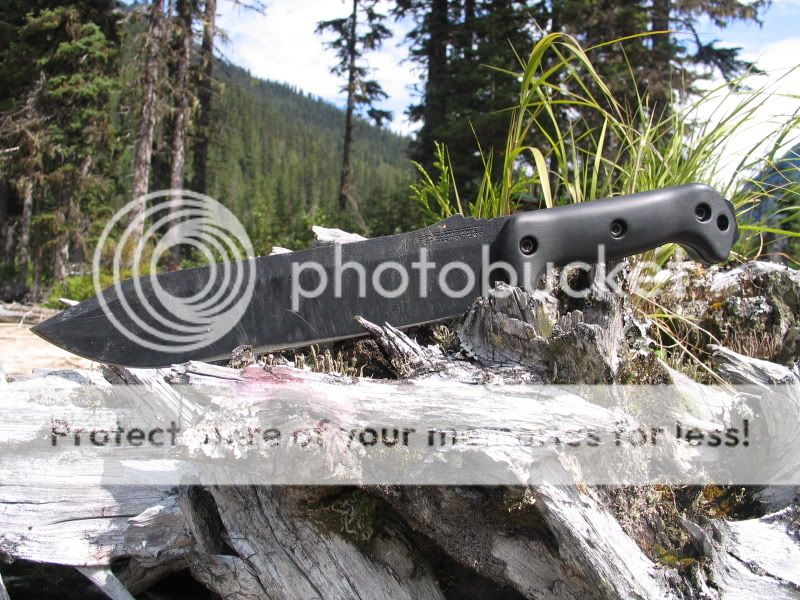
Why do you baton?

I tend to agree with the OP, however location clearly has an impact. My trip on the Mantario trail was after a solid week of rain, everything was soaked, even all tine small twigs, but getting them lit was no problem with a bit of birch bark.

There was some birch logs left behind, which would have needed splitting because they soaked through like a sponge, but all of the pine, even stuff that was right on the ground would burn without being split. Just needed to use more medium sized branches that you could kick off a fallen tree to get the fire hot enough for wet, unsplit wood. Smoked a bit more, but I figure it would be no faster to get a roaring fire by splitting wood than doing it the way I described, though it would use a lot more energy.

But like I said, this might not be possible with different combinations of wood. If my only firewood was wet birch, it'd have to be split. If I had no birch bark or fat wood (and still using only a firesteel), again I'd probably end up having to split something.
 
not sure i would define it as splitting........sure the blade is being forced thru the wood, and the result is "spliting " the wood apart, but the actual ACT of batoning is the brutal impact of a rock or piece of wood on a very small section of the top of a tool, creating stress, metal grain compaction and fatigue.

why would a knife user refrain from splitting wood this way as oppossed to an ax user?

lets look at the WIDTH of an ax for starters, it is a very large wedge shape (9/16" - 2" wide) , whereas a knife is much thinner (2mm - 1/4" (sometimes a bit thicker). Axe are DESIGNED for such repeated impact and shearing actions, knives are designed for slicing, stabbing, chopping small stuff. One cannot say that because ax users split wood , that knife users should also use their tools in the same manner. For the record, an ax swinging down on a chunk of wood impacts over 15 tons of pressure on that wood to split it apart. Think about that when your beating on your blades.

have i batoned? yes, I used a ASP baton to strike a knee joint to gain compliance from a person. have i abused my edged tools by creatign stress on one point thru impaction with rock, stick or log? yes. Would i do it again? no, unless the blade was 1/2" or thicker and i HAD NO OTHER CHOICE (this is false, there is ALWAYS another choice, Adapt Improvise Overcome)


just saying. my 2 cents.

:D

A few things i disagree on here-

first, I NEVER use a rock to baton. Second, There are a lot of ways to hit things, and you don't have to really go all out with the baton stick most of the time- it's sorta like a hammer, you can tap lightly or take a full swing and all points in between.

Third- a lot of bushcraft knives ARE designed for baton work. It is a design consideration many knifemakers take into account. I know several of the makers who are WSS denizens do.

Fourth- I'd rather have a well tempered thinner and broader blade than a 1/2 inch thick - or even 1/4 inch thick, KSA (knife shaped axe). I think tonym was the one who watched a thicker spine blade snap doing what he was doing with a nearly machete thickness large cmap blade.

Fifth- edge geometry is more important than thickness. (so is temper)


My mainstay bushcrafter design is .095 inches thick with a differential temper and a straight spine for better contact when doing baton work (and it's ever so much nicer for draw knifing). I've put a LOT of attention to batonning, chopping, and slicing in the knives. Much more than the blade finish itself :D

Now that I don't carry a hawk or GB forester, or a saw with me most of the time, I'm obviously not stating that a knife designed for baton work is some kind of one true tool. But it's a useful thing to do for a lot of people, so there's no reason not to do it! (with the right knives)
 
I don't baton to split firewood or anything else I could do with an axe or hawk. I do however use the batonning method for making deep controlled cuts into wood. This way I can easily control the depth and placement of the cut, unlike the somewhat randomness of an axe or hawk.

An example:
In the Spring, while on a trip, I decided to make a container out of bark. I picked a felled tree and used my Ranger RD-9 and a baton to make the cuts through the outer and inner bark of the tree. Then I removed the section I needed, scored and folded it accordingly, and lashed it with some cordage. Using the baton method allowed for really clean, good lines which made the final product look really nice.
 
I like to think of a good hiking (or bushcraft) knife as a jack of all trades. It's nice to know that, while your knife is designed to slice, cut, and chop, it can also serve as a striker to start a fire, or be batonned through larger pieces of wood.

Call it peace of mind.

Of course, an axe is the preferred tool for wood splitting, and I pack an axe when I'm on a serious outing. My hiking knife, on the other hand, is always with me, regardless of the nature or intended duration of the outing. Over the years, this has led to a handful of situations where I find myself wanting to split some wood (for the reasons discussed throughout this thread), but without an axe. In such situations, I know I can rely on my hiking knife to do the job.

All that aside, it's also fun, which is reason enough.

All the best,

- Mike
 
Well...most of the reasons have been already cited; dry wood, notching poles etc. I have camped in places where collecting wood is allowed and other places that are tamer, like State Parks, where you have to purchase wood or are allowed to bring in your own in some instances but not collect it, making splitting necessary for kindling. I can certainly split wood with a hatchet, but that is extra weight and gear to have to carry. My 5-inch blade Mora splits wood with a baton very well. Oh, and it's also fun.

Natural-Outlaw
 
Of course, an axe is the preferred tool for wood splitting, and I pack an axe when I'm on a serious outing. My hiking knife, on the other hand, is always with me, regardless of the nature or intended duration of the outing. Over the years, this has led to a handful of situations where I find myself wanting to split some wood (for the reasons discussed throughout this thread), but without an axe. In such situations, I know I can rely on my hiking knife to do the job.

It sounds like you just need an excuse to build some more confidence in your use of your knife for axe like purposes - or maybe you don't (it is your choice). I know I was in the same mindset as yourself for several years. Then last year I sort of made this little contest with myself to bring the axe but leave it in the truck for a whole summer's worth of car camping. I actually found that I didn't miss the axe very much at all. It turns out that those times where I actually needed to chop wood or split things were pretty few in number and that my knife could handle such chores with relative ease.

Now I wouldn't want to build a log cabin without an axe and great saw. I wouldn't want to fell a bunch of trees with a buck 119. But I also built this false impression in my head of why I needed to carry an ax and buck saw on trips when they really weren't used very much. There are certainly still times when I want that axe with me, but it is becoming less and less included in my 'essentials' list for camping whether it be car camping or backwoods.

Batoning - and learning that skill helped me to liberate myself of my perceived need for an axe. Before coming to the forums, I never heard of batoning. I survived and did very well at camping for 35 years, never seeing batoning being performed. But learning how to do it myself along with other skills like making wedges, suddenly gave me the confidence to forgoe another piece of equipment.

So in thinking about it, I probably don't really baton all that often. But knowing how to baton comes in handy when it comes to planning each and every new trip. Thus, I conclude that it is a skill that I use a lot.
 
Batoning is one more skill that can be handy to know. In a pinch, it lets you use a knife to do jobs that might be easier with an axe.

I'm always happy to learn an outdoors skill I don't yet have - you never know when it might come in handy!
 
I have PLENTY of confidence in my knives.......I just choose to use the right tool for the job. I mean seriously, an ax is NOT heavy to carry. If your find an ax heavy to carry maybe cutback on the donuts and work on the cardio eh? (its a joke, everyone chill)

Our soldiers carry 60+ lbs all day, the fur traders often carried 100+ lbs on portages., hunters often carry out 100+ lb packs with dressed meat etc etc etc etc.

3 lousy pounds for an ax is nothing.
 
Fourth- I'd rather have a well tempered thinner and broader blade than a 1/2 inch thick - or even 1/4 inch thick, KSA (knife shaped axe). I think tonym was the one who watched a thicker spine blade snap doing what he was doing with a nearly machete thickness large cmap blade.


I agree with everything you said, but the larger blade I was using didn't snap, it just got wedged so bad and couldn't go any further. But the thinner 1/8 spine went through.:thumbup:
 
I'd like to add that batoning is a very safe technique to split wood, especially for the novice woodsman.
 
It sounds like you just need an excuse to build some more confidence in your use of your knife for axe like purposes - or maybe you don't (it is your choice).

I'm plenty confident! It's just a matter of preference. A few years ago I took a two-week canoe trip in Wells Gray Provincial Park, BC, and my only chopping tool was my BK-9. It certainly did the job, though I fear the pristine black blade coating will never be the same. :D

IMG_1692.jpg


These days I like to carry a smaller knife along with an axe when I'm out for extended periods. Again, just a preference thing.

But I like the sounds of your voluntary axe-deprivation contest. It's the sort of thing that challenges one to think outside the box and build new skills.

All the best,

- Mike
 
I agree with everything you said, but the larger blade I was using didn't snap, it just got wedged so bad and couldn't go any further. But the thinner 1/8 spine went through.:thumbup:

Ah, cool. Memory plays tricks sometimes.
 
Batoning isn't usually needed for firewood, though as stated I've done it if the wood was wet. But I mainly baton to get flat planks, like for fireboards or making things.
 
I don't baton anything. Closest I've come is using an axe as a wedge on split logs. I use a hatchet to split my wood if I need to look for the dry side.
 
I don't have to baton, I bring excellent choppers with me when I'm in the woods.
 
To the OP

In over 30 years of outdoors life, I haven't had the need to batton my knife for any task.

If you want to do it, then by all means do it.


Kind regards
Mick
 
In over 30 years of outdoors life, I haven't had the need to batton my knife for any task.

Point taken. But as a few counter points:

1) Have you ever needed to make a solar still to collect water?

2) Have you ever needed to make a figure four trap or set a wire snare to catch food?

3) Have you ever needed to start a fire without matches?

4) Have you ever needed to make an improvised shelter in an emergency?

5) Have you ever needed to evade capture by hostile forces?

I haven't. ;) But I'm glad I have some training to do all of the above. Batonning is just another technique. It's one that I've actually found useful, if not actually "necessary."

Cheers,

Jack
 
i do alot of building basic camp benches and tables and stuff. an axe is not as precise at splitting, but with battoning, i can get much more precise with my cuts.
 
Back
Top