Why do you baton?

G'day Jack

Point taken. But as a few counter points:

1) Have you ever needed to make a solar still to collect water?

2) Have you ever needed to make a figure four trap or set a wire snare to catch food?

3) Have you ever needed to start a fire without matches?

4) Have you ever needed to make an improvised shelter in an emergency?

5) Have you ever needed to evade capture by hostile forces?

I haven't. ;) But I'm glad I have some training to do all of the above. Batonning is just another technique. It's one that I've actually found useful, if not actually "necessary."

Cheers,

Jack

1. No I haven't. I generally find a transpiration bag to be more effective.
2. I prefer my meat to be untainted by intestinal juices that can occur when the animal is pinned by the weight of the dead fall. I have certainly set my fair share of snares over the years. Again I don't need to batton inorder to carve the trap triggers.
3. Yes as a matter of fact I have. Used a hand drill for that (but then again, considering how dry our climate typically is, the friction method does work :thumbup:)
4. Yes. typically leanto's. The nature of our dominate species of native trees means that there is usually abundant deadfall lying around to provide limbs for the frame and bark for the walls. I use the fork in a tree to roughly trim the limbs to size. To be honest, I'm more interested in how effective the improvised shelter is in protecting me from the elements (sun, wind or rain), rather than how neatly trimmed the ends are :D
5. No I haven't. Could you enlighten me on how making a noise (like the sound of striking a knife with a piece of wood), will help evade capture by hostile forces?


Kind regards
Mick
 
Last edited:
My bad mate. Didn't mean to imply that batonning was recomended during E&E.

In fact, any fire is a bad idea during E&E.

My point was merely that batonning is a useful trick to have up your sleeve like some of the other bushcraft/survival skills one picks up after 30 years playing in the woods. Most of this crap falls in the 'neat to know' category, and splitting wood for a little camp fire may fall into the same category. However, here in the Rockies, being able to find a little dry wood is much easier if you think about batonning. It really is useful at times. Just not during E&E :D.
 
2. I prefer my meat to be untainted by intestinal juices that can occur when the animal is pinned by the weight of the dead fall. I have certainly set my fair share of snares over the years. Again I don't need to batton inorder to carve the trap triggers.

Interesting point.
 
batoning is a poor excuse for forgetting your axe (and saw). Some people just like giving their blades a thumping cause they can

Most times I've gathered firewood there's been enough variety around that I didn't need to split any - then there was the time I picked up a Red-Belly Black Snake by mistake and I was the one that split - aaaaarghhhh!
 
here another perspective on the whole baton issue:

how many cords of wood can your knife "split" in a day?

me and my Iltis Oxhead can split about 2 - 3 cords a day.
 
batoning is a poor excuse for forgetting your axe (and saw). Some people just like giving their blades a thumping cause they can

Most times I've gathered firewood there's been enough variety around that I didn't need to split any - then there was the time I picked up a Red-Belly Black Snake by mistake and I was the one that split - aaaaarghhhh!

i wouldnt qualify it as a "poor excuse", as it is more of an alternative. plus, it is quite a bit more difficult to split wood with an axe in the wilderness. if you sre splitting with an axe, you need a flat surface either a third hand or some means of proping the log in order to split it safely and effectivly, and even then, you will need quite a bit of force to actually split the log, especially if you are using a light-weight hatchet, like on would typically carry in the woods. with knife battoning, you just need some sort of surface other than rock or dirt, and you can effectivly and safely split somthing.
 
I have been going out in the bush for over 35 years myself, and I have never used my knife like that. I guess it will work, and I guess it is a good skill to know. I think it is still pretty safe to say I will never do it, because I never have needed it and I hate splitting wood.

I grew up on a farm and the house was not much better than a corn crib, so we went through many cords of wood every year to heat it.

My father ran the chain saw, and dropped trees, and I used an ax to limb the smaller branches while he used the saw on the larger ones. I would pile brush, then he would come back and then block up the tree and I loaded the truck.

Since most of the wood was green, we let it freeze, and once it got down to -10 F or colder, I used a MAUL to split it. One swing with a maul and it split like glass. I never split wood smaller than needed to fit through the fire box door. Then we let the wood sit for a year or so and dry out.

If my father ever caught me screwing around with the ax to split wood, he would have killed me. An ax is for cutting across the grain, and a maul or a sledge with wedges is for splitting with the grain. An ax is not the best tool for splitting wood if you ask me, but what do I know.


Another thing that gets me is those heat recovery things that sucks all the heat out before it goes up your chimney and blows it into your room. I would never use those as your chimney has to run hot enough to prevent creosote build up. If your chimney is to cold, creosote will condensate in a cold chimney, kind of like moisture condensates on your cold mirror from a hot shower. You get enough of that over the winter, you can get a chimney fire. A chimney should run about 400 degrees or so to keep that from forming. Wet or green wood and cold chimneys are a bad combo. Your chimney has all that heat going up it for a reason, so let it go. A lot of people do not really know how to heat their homes with wood, and it comes back to bite them. Sorry for the high jack here, but winter is coming and I just thought I would throw that out there.
 
No one on this thread has said that splitting wood with a knife is superior to splitting wood with an axe (although with smaller pieces of wood 2" to 4" I would say it definitely is as an axe would likely be overkill). The point is that lacking an alternative, which many on this post seems to have had the luxury of having in all circumstances, batoning with a knife is a very useful and sometimes necessary skill.
 
That is...it may sometimes be necessary to split smaller pieces of wood, and a knife is much more proficient and safe when it comes to medium sized wood. ie. a hatchet won't split it and you better have damn good aim using a heavier axe!
 
Batoning is just another skill which comes in very handy when equiped with only a knife. It is much easier to produce a good fireboard for a bowdrill kit by batoning than through the use of an axe.

As for point #5 someone brought up above. I have beenin that situation and did use batoning. The use of a green stick lightly on a knifes spine produces practicaly no noise.

It would be great to always travel with all the basic equipment needed, however in some cases that is not possible and skillfull use of what is available becomes neccessary.
 
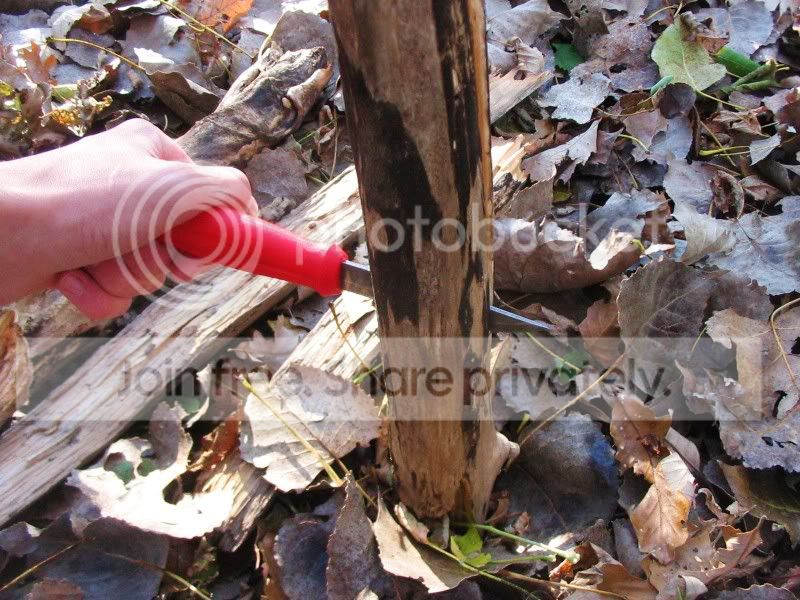
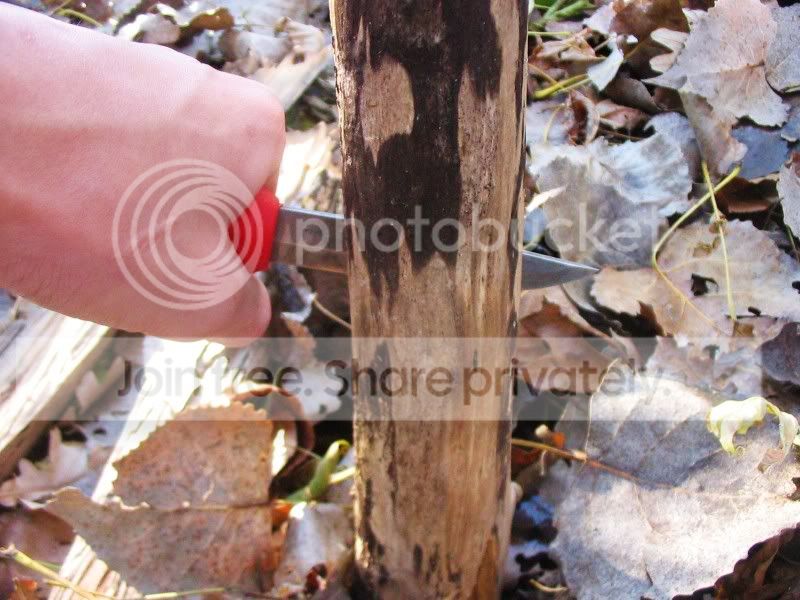
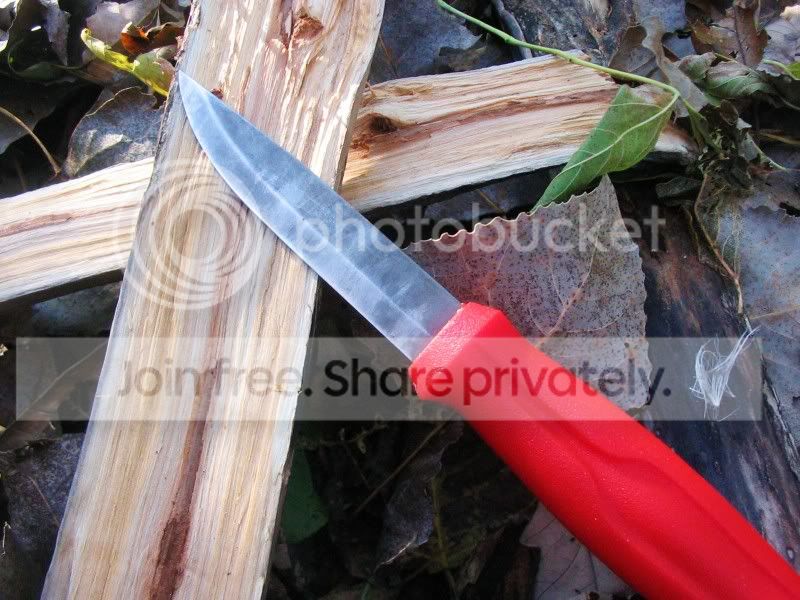
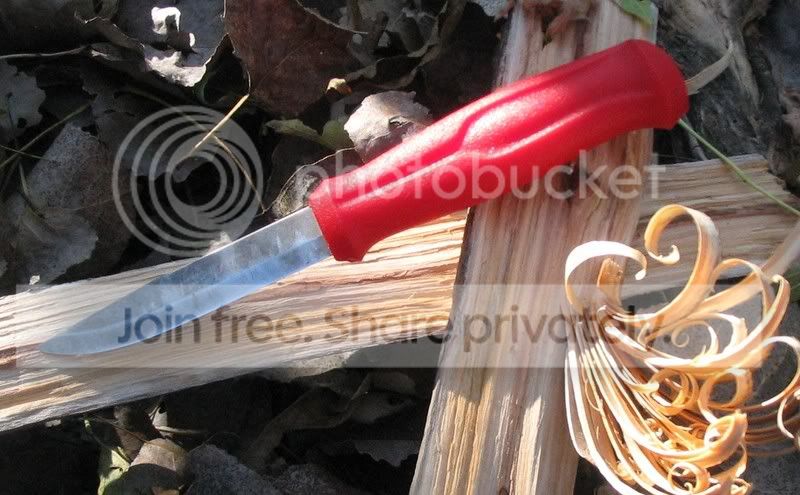
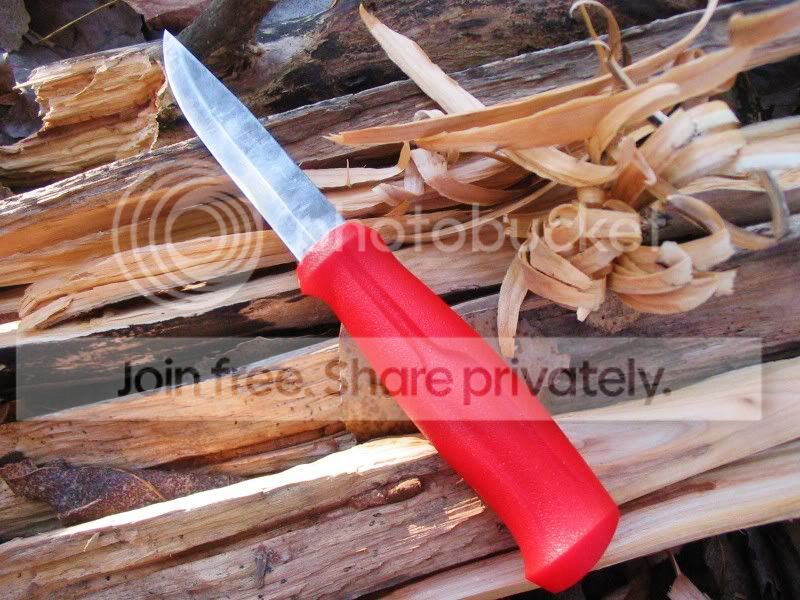
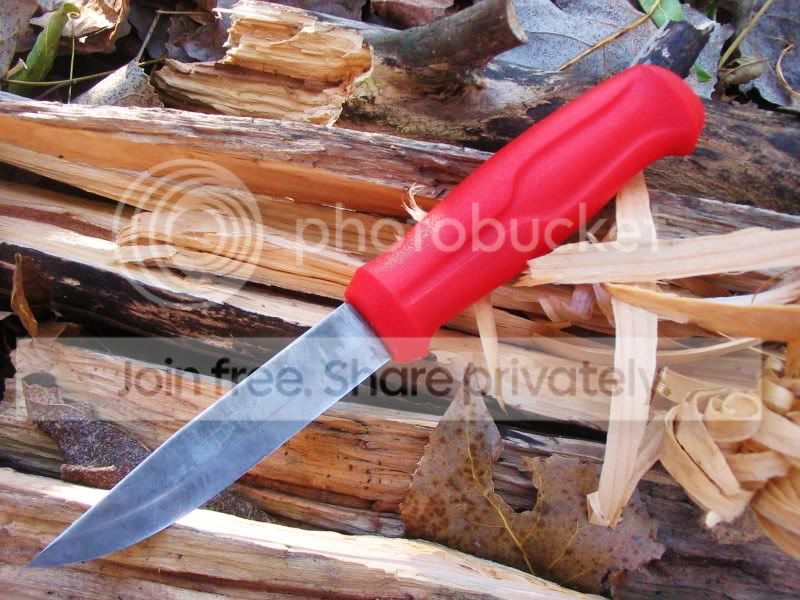
I've never needed to baton, but I do it to test (read: play with) a new knife, like:

Mora005.jpg


Mora007.jpg


Mora009.jpg


Mora011.jpg


Mora014.jpg


Mora016.jpg


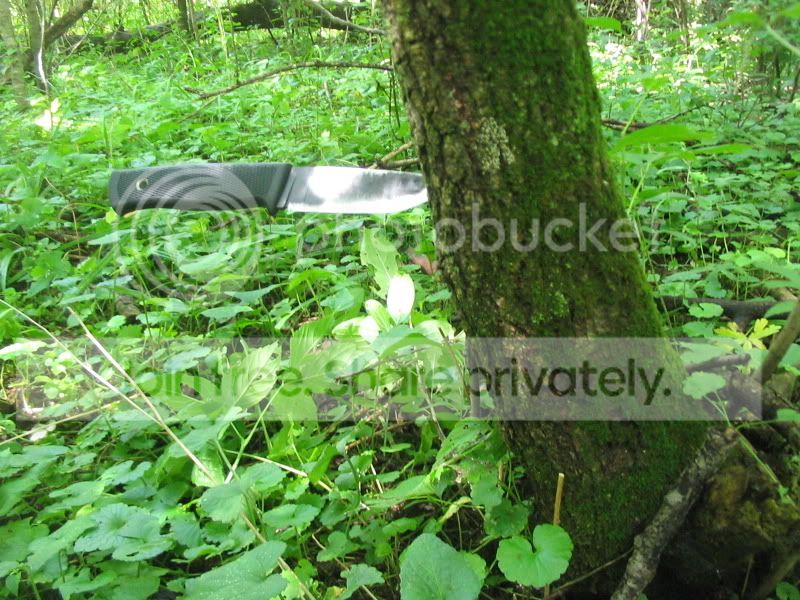
This tree below was batoned down with the F1:

BWP064-1.jpg
 
A question\comment came up regarding axe\hatchet technique and alluded to the idea that they are more dangerous because they are harder to control etc.

I realized that some people may be unaware of a simple technique to safely split wood using a hand axe or hatchet. I will try and explain, and if I can I'll post some pics later.

The basic idea is to use the momentum of the hatchet head to get it started WHILE holding the log\branch in your hand with the hatchet head CONTACTING the surface you want to start at. You pick up the log\stick with the hatchet head in place and drop it down onto the ground or solid surface. This will usually be enough to get the head started without having to swing the hatchet. When done properly, you can safely embed the edge of the axe\hatchet head far enough into the wood so that it will 'hold' the log\branch and you can pick the whole thing up and begin the process over again.

Done properly this method will enable you to split\baton without endangering your hand or fingers. I will caution you that the edge must be sharp and not the typical 'garden hatchet sharp', but knife-knut sharp!
 
If there is one thing that Noss's tests have made clear it's that almost all hard use knives, high end or low end, can be batoned with a 3 lb. hammer through wood with little or no damage. Even with a Mora the only thing that failed was the handle. Perhaps batoning with your fixed blade was a no no 35 years ago, but that perspective should probably be re-examined in light of advances in metallurgy and heat treating. Given the efficiency, accuracy and safety of batoning with a sturdy fixed blade, it seems to me that batoning a knife to split kindling or chop wood is in fact using the right tool for the job.
 
Back
Top