- Joined
- Mar 12, 2013
- Messages
- 1,167
Hey guys!
So as you may know over the last few months I bought and then partially rebuilt a Vertical Machining Center (large CNC milling machine). I captured this process on video here:
[video=youtube;bP158y03VxQ]https://www.youtube.com/watch?v=bP158y03VxQ[/video]
I realized last night that I hadn't done a WIP thread in a long time so I figured I should start one covering the process of designing and building the new version of my Resolute knife with the help of the machine!
After the machine itself was finished I had to bide my time while saving up money for a compressor and other tooling to get the machine running. Toolholders, pullstuds, cutting tools, a vise and so on... Lots of accessories needed to get a machine like this actually turning out work! (Thanks god for tax returns!)
About 2 weeks half ago I finally got everything setup at the shop, then it was time to get the design side of things setup!
A machine like this isn't terribly useful without CAM (Computer Aided Manufacture) software to tell it what to do. You can hand-program simple shapes but anything beyond that really requires the use of CAD/CAM to be efficient. In the past I've used a friends copy of Solidworks for CAD along with HSMexpress for CAM. I looked into buying a full license for myself but it is incredibly expensive ($5,000+ initially, plus $1500/yr maintenance fees).
While looking for alternatives I came across a program called Fusion 360. Their base price is $120/month for the 'pro' version ($30 for the basic version) but they have a deal where if you're working on an un-released product they give you 12 months free.
I downloaded it and started to learn it, and amazingly I actually like it better than Solidworks! I then spent about a week re-drawing all my designs in Fusion. Progress was actually much quicker than I anticipated:

Using this program is a massive plus for me as I can actually recommend it to others when I show it in my videos, it's not some unobtainable piece of software that no-one can afford.
After getting the shape of the blade/tang/scales modelled up in CAD I started working on how the parts were actually going to be machined. I think this part of the process is going to undergo a lot of revisions over the next little while to get things as efficient and effective as possible, but first I wanted to give each part a complete run-through just to make sure I understood exactly what was involved and to highlight any weak points in the process.
First I setup a toolpath that would drill the pin/lanyard holes in a blank, then skeletonize the tang:
[video=youtube;0_H9F7opiQU]https://www.youtube.com/watch?v=0_H9F7opiQU[/video]
This produced a bar of steel shaped like so:

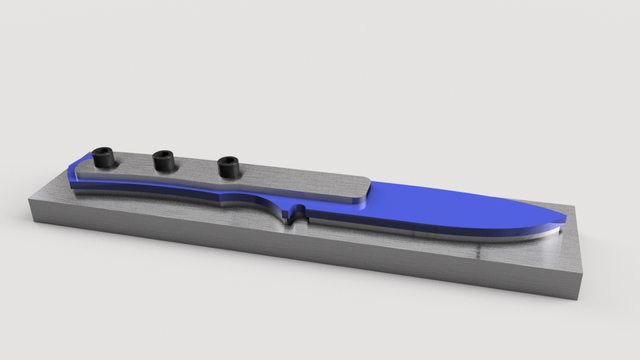
The idea was then to use the pin holes as locators for the next operation, cutting the outside of the blade blank. I can't hold the bar in the vise for the next operation because I need access to the edges of the stock, so I had to make a fixture to locate the bar using the pin holes and to hold it firmly in place using a clamp that's recessed so it doesn't get in the way. Here's the design I came up with for that purpose. The blue part is the blade blank, everything else is the fixture:
I then had to machine the base of the fixture. I made a mistake in the programming of this and tried to drill a 0.625" deep hole without pecking (it was late and I was tired). Ended up breaking my only #7 carbide drill:
https://instagram.com/p/29DEV5CKAF
Once I'd replaced the drill with a regular jobber length HSS #7 drill I drilled the holes like I was supposed to, with pecks! I then machined the ends of the steel bar square and relieved the top surface to the rough profile of the knife to provide clearance when the fixture is in use:
[video=youtube;FVcMKdxVF8U]https://www.youtube.com/watch?v=FVcMKdxVF8U[/video]
This was a bit scary because it was the first time I'd attempted a big cut on the machine. In this case I was using a 3/8" solid carbide endmill to take a cut 0.625" deep and 0.15" wide on the ends of the bar. It's taking me a while to adjust to the idea that the machine is actually fine with taking cuts of this size and even bigger!
I'm not using coolant or cutting oil because I'm used coated carbide tools that are designed to be run dry.
The fixture came out well! I had to sand down some 0.1255" dowel pins to 0.1249" to get them to fit snugly in my drilled holes, but that didn't take too long:
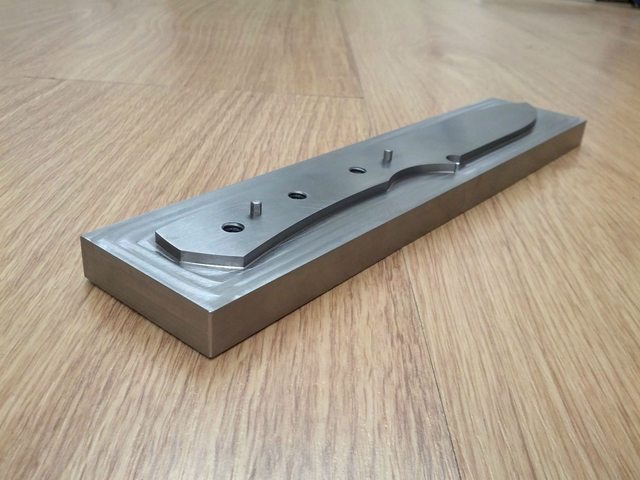
I then machined the clamp that goes at the top of the fixture. This took 3 separate setups because of it's shape, but it wasn't a particularly demanding part in terms of how close the tolerances had to be.
I then clamped everything together with my bar of steel in the middle of the fixture 'sandwich' and setup to start machining the profile of the blade! I was worried about chatter near the tip of the blank as it's relatively unsupported there, but it worked fine in the end! The blank came out well!

This is the first actual prototype for the Resolute 4.5, so it's exciting to finally have it in hand! Pleased with it so far!
The plan over the next few weeks is to go through the process of making each of the parts for the knife, then assemble them in real life to see how everything fits together. I'll then be going back over my process and refining it as I go, making changes to get everything to work better together.
For instance I think it may be better to setup my fixtures so I'm able to mill the periphery of the blade blank in the same setup that I drill the pin/lanyard holes. The relationship between the pin holes and the edge of the blank needs to be perfect to ensure there won't be any 'step' felt around the edge when the tang and scales are glued together... Lots of little things to iron out still!
I also still have some work I need to do on the machine: it needs an enclosure so that I can run an air blast to clear chips away from the cutting area, also need to setup a vacuum system for machining G10 and a vacuum clamping system for holding various fixtures and so on.
I will be updating this thread as I progress, let me know if you guys have any feedback, questions or requests!
-Aaron
So as you may know over the last few months I bought and then partially rebuilt a Vertical Machining Center (large CNC milling machine). I captured this process on video here:
[video=youtube;bP158y03VxQ]https://www.youtube.com/watch?v=bP158y03VxQ[/video]
I realized last night that I hadn't done a WIP thread in a long time so I figured I should start one covering the process of designing and building the new version of my Resolute knife with the help of the machine!
After the machine itself was finished I had to bide my time while saving up money for a compressor and other tooling to get the machine running. Toolholders, pullstuds, cutting tools, a vise and so on... Lots of accessories needed to get a machine like this actually turning out work! (Thanks god for tax returns!)
About 2 weeks half ago I finally got everything setup at the shop, then it was time to get the design side of things setup!
A machine like this isn't terribly useful without CAM (Computer Aided Manufacture) software to tell it what to do. You can hand-program simple shapes but anything beyond that really requires the use of CAD/CAM to be efficient. In the past I've used a friends copy of Solidworks for CAD along with HSMexpress for CAM. I looked into buying a full license for myself but it is incredibly expensive ($5,000+ initially, plus $1500/yr maintenance fees).
While looking for alternatives I came across a program called Fusion 360. Their base price is $120/month for the 'pro' version ($30 for the basic version) but they have a deal where if you're working on an un-released product they give you 12 months free.
I downloaded it and started to learn it, and amazingly I actually like it better than Solidworks! I then spent about a week re-drawing all my designs in Fusion. Progress was actually much quicker than I anticipated:
Using this program is a massive plus for me as I can actually recommend it to others when I show it in my videos, it's not some unobtainable piece of software that no-one can afford.
After getting the shape of the blade/tang/scales modelled up in CAD I started working on how the parts were actually going to be machined. I think this part of the process is going to undergo a lot of revisions over the next little while to get things as efficient and effective as possible, but first I wanted to give each part a complete run-through just to make sure I understood exactly what was involved and to highlight any weak points in the process.
First I setup a toolpath that would drill the pin/lanyard holes in a blank, then skeletonize the tang:
[video=youtube;0_H9F7opiQU]https://www.youtube.com/watch?v=0_H9F7opiQU[/video]
This produced a bar of steel shaped like so:
The idea was then to use the pin holes as locators for the next operation, cutting the outside of the blade blank. I can't hold the bar in the vise for the next operation because I need access to the edges of the stock, so I had to make a fixture to locate the bar using the pin holes and to hold it firmly in place using a clamp that's recessed so it doesn't get in the way. Here's the design I came up with for that purpose. The blue part is the blade blank, everything else is the fixture:
I then had to machine the base of the fixture. I made a mistake in the programming of this and tried to drill a 0.625" deep hole without pecking (it was late and I was tired). Ended up breaking my only #7 carbide drill:
https://instagram.com/p/29DEV5CKAF
Once I'd replaced the drill with a regular jobber length HSS #7 drill I drilled the holes like I was supposed to, with pecks! I then machined the ends of the steel bar square and relieved the top surface to the rough profile of the knife to provide clearance when the fixture is in use:
[video=youtube;FVcMKdxVF8U]https://www.youtube.com/watch?v=FVcMKdxVF8U[/video]
This was a bit scary because it was the first time I'd attempted a big cut on the machine. In this case I was using a 3/8" solid carbide endmill to take a cut 0.625" deep and 0.15" wide on the ends of the bar. It's taking me a while to adjust to the idea that the machine is actually fine with taking cuts of this size and even bigger!
I'm not using coolant or cutting oil because I'm used coated carbide tools that are designed to be run dry.
The fixture came out well! I had to sand down some 0.1255" dowel pins to 0.1249" to get them to fit snugly in my drilled holes, but that didn't take too long:
I then machined the clamp that goes at the top of the fixture. This took 3 separate setups because of it's shape, but it wasn't a particularly demanding part in terms of how close the tolerances had to be.
I then clamped everything together with my bar of steel in the middle of the fixture 'sandwich' and setup to start machining the profile of the blade! I was worried about chatter near the tip of the blank as it's relatively unsupported there, but it worked fine in the end! The blank came out well!
This is the first actual prototype for the Resolute 4.5, so it's exciting to finally have it in hand! Pleased with it so far!
The plan over the next few weeks is to go through the process of making each of the parts for the knife, then assemble them in real life to see how everything fits together. I'll then be going back over my process and refining it as I go, making changes to get everything to work better together.
For instance I think it may be better to setup my fixtures so I'm able to mill the periphery of the blade blank in the same setup that I drill the pin/lanyard holes. The relationship between the pin holes and the edge of the blank needs to be perfect to ensure there won't be any 'step' felt around the edge when the tang and scales are glued together... Lots of little things to iron out still!
I also still have some work I need to do on the machine: it needs an enclosure so that I can run an air blast to clear chips away from the cutting area, also need to setup a vacuum system for machining G10 and a vacuum clamping system for holding various fixtures and so on.
I will be updating this thread as I progress, let me know if you guys have any feedback, questions or requests!
-Aaron
Last edited: