WIP: Designing and building the new Resolute with the help of CNC.

Aaron, I see in one of your pics that you have a Haimer 3D analog probe in the tool changer. If I could make a suggestion: Don't use the tool changer with the probe. Unless your tool changer has Magic Fingers. Because those probes are somewhat sensitive to shock and using the tool changer will shorten the life of the probe quite a bit. You can always have Haimer rebuild it, but that cost money and if you put them probe in the spindle by hand, it will last a lot longer.
 
Aaron, I see in one of your pics that you have a Haimer 3D analog probe in the tool changer. If I could make a suggestion: Don't use the tool changer with the probe. Unless your tool changer has Magic Fingers. Because those probes are somewhat sensitive to shock and using the tool changer will shorten the life of the probe quite a bit. You can always have Haimer rebuild it, but that cost money and if you put them probe in the spindle by hand, it will last a lot longer.

Thanks Kevin, I'll keep that in mind!
 
Very cool! Are you planning on using the CNC to mill your bevels? Or are you going to grind them?

I think I'm planning to partially mill the bevels, basically machine the plunge line and the flat portion of the bevel, then grind the tip on the belt grinder.
 
Aaron I'm curious do you have any machining or programming background at all or are you completely self taught? Very impressive either way.

-Clint
 
I've been pretty sick for the last 4 days, but in between sleeping and feeling like death I've been working on the toolpaths for the handle scales. Took quite a while as they're fairly complicated.

The work paid off though and on the second shot I'm getting very close!

Here's the first attempt:
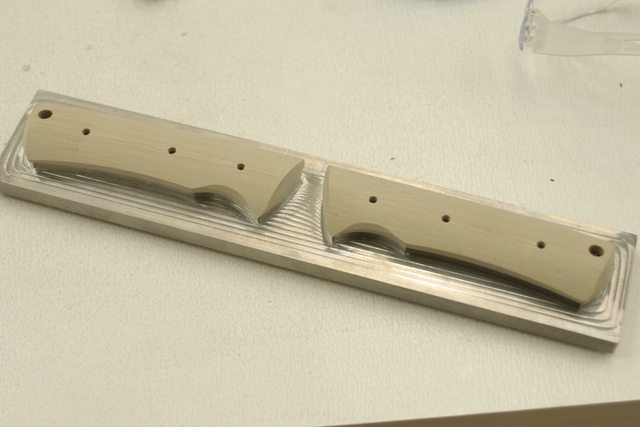


The main problem with this one is that the contour over the top of the scales is way off, the speeds and feeds also needed tweaking as some surfaces were far too coarse. The drill paths were also way too conservative and took quite a while to run.

The second attempt was much better overall even though it only took about half as long to run!:


The diameter of the radiusing tool is very slightly off which left a ridge in the middle, the chamfer path was also accidentally set to 'roll around corners' instead of 'keep corners sharp' which rounded off one corner that it should not have. The depth of the chamfer toolpath and radiusing toolpath also need to be tweaked slightly, but then I should be pretty much good to go!

I'm really pleased with how close these look to the ones I make by hand! Pretty much identical except more consistent!

Watching the machine rip through the G10 is actually a bit scary! The tools are taking big cuts because G10 is a fairly soft material, but it's also very abrasive so you want to minimize the number of cuts each tool has to make (thanks to Nathan for his wisdom on that front!). The profile of the scales is cut with a 1/4" solid carbide 2 flute endmill at 7500RPM and 120 inches per minute!

My plan is to use the Haimer 3D sensor for in-process inspection to keep my tolerances on the handle scales pretty tight. Basically there will be a toolpath to move the probe to a couple of key points where it should read zero, the actual reading will then be entered into a macro in the program which will comp the finishing tool diameter and length, then the finishing passes will be run. Should be fun!

 
Last edited:
Aaron I'm curious do you have any machining or programming background at all or are you completely self taught? Very impressive either way.

-Clint

Hey Clint!
I'm self taught (well internet-taught I guess!), I learnt the basics on a inexpensive CNC router kit... The CNCZone and PracticalMachinist forums were very helpful!

-Aaron
 
I got some video of the handle scales being made on the weekend, finally got the chance to upload it and thought you guys might like it!

[video=youtube;5tpa66031S0]https://www.youtube.com/watch?v=5tpa66031S0[/video]

I'm pretty proud of this actually, even without much optimization it's turned out to be very efficient and quick! The programming took just a bit over 3 days, if I had to do it again though it would be much quicker as I had to learn a lot during the process.

The handle scales are a fairly complicated shape so it's amazing to see the machine making them so quickly and accurately!

There are obviously some flaws with the scales as shown above, but fixing those issues should not be an issue...

One road-block is that I've officially used up all my G10 now, so I need to order some more material so I can continue prototyping!
 
That's pretty impressive that you're already where you are. I think the repairs to your mill have worked out well. You tool paths are pretty cool.
 
That's pretty impressive that you're already where you are. I think the repairs to your mill have worked out well. You tool paths are pretty cool.

Thanks mate! That means a lot to me!

The toolpaths definitely still have a lot of room for improvement. Fusion outputs non-engagement point-to-point moves as G1 most of the time because the Fadal does not do synchronized G0 moves (it will dog-leg instead), and I keep forgetting to setup those feed moves to be at a higher feedrate, I think they're still set down at less than 100IPM (slower than the actual cutting moves in this case which is silly).

With a bit of optimization I can probably shave another 30+ seconds off this program... Probably won't worry about it in the near term though as I think this fixture will be getting replaced soon anyway so I'll just end up having to program it all again! Shouldn't take anywhere near as long next time though as I'm getting a lot more familiar with Fusion (and its quirks).

I've run a few small CNC routers in the past so luckily I'd already learnt most of the basic stuff I needed to come to grips with the Fadal!
 
Very cool. What I found interesting was your use of the "table edge" rounder router bit to do the shaping of instead of many diagonal passes with a small round nose mill like you see so often. Does it move fast enough to do hardwoods without splintering/chipping? Also, how many scales could you do on your machine at one time?
 
I got some video of the handle scales being made on the weekend, finally got the chance to upload it and thought you guys might like it!

[video=youtube;5tpa66031S0]https://www.youtube.com/watch?v=5tpa66031S0[/video]

I'm pretty proud of this actually, even without much optimization it's turned out to be very efficient and quick! The programming took just a bit over 3 days, if I had to do it again though it would be much quicker as I had to learn a lot during the process.

The handle scales are a fairly complicated shape so it's amazing to see the machine making them so quickly and accurately!

There are obviously some flaws with the scales as shown above, but fixing those issues should not be an issue...

One road-block is that I've officially used up all my G10 now, so I need to order some more material so I can continue prototyping!

That looks great! You videos are also really clear and well done. I have one question though, is that a large radius router bit you are facing off the top surface with? looks like it might be that or a slitting saw?
 
That looks great! You videos are also really clear and well done. I have one question though, is that a large radius router bit you are facing off the top surface with? looks like it might be that or a slitting saw?

Thanks mate!

It's a modified router bit, a 1" diameter round-over with the bottom ground off... I posted some pics on the first page of the thread.
 
Very cool. What I found interesting was your use of the "table edge" rounder router bit to do the shaping of instead of many diagonal passes with a small round nose mill like you see so often. Does it move fast enough to do hardwoods without splintering/chipping? Also, how many scales could you do on your machine at one time?

Thanks!

It should be fine to do hardwoods with similar tooling, might have to use fresh tools though as G10 dulls them pretty quick.

If I had the fixtures for it I could basically do as many scales as would fit on the table, max number is probably 16 sets at once if I built 16 fixtures or a large fixture plate, I probably won't go quite that far though.
 
very cool work. coming from industrial robot programming (which is also 3d progamming but with another use case) you have my respect.
 
Cool, I thought that must be cutter you were using in the video but it was hard to tell when it was spinning. I use a lot of router bits, always with brazed on carbide cutting surfaces. I have found the best ones come from Festo. If they sell Festo tools in Canada check them out. They can also be resharpened many times.
 
How are you holding the scales to the fixture? great job on the videos!!!
DR...

Thanks mate!

The blocks of G10 are drilled/tapped on the rear face so they can be bolted to the fixture. Only takes a minute as the machine is setup to do that operation as well.
 
Thanks!

It should be fine to do hardwoods with similar tooling, might have to use fresh tools though as G10 dulls them pretty quick.

That is what we've found. We've tried using our G10 tools for wood and they tear out more and leave a rougher finish. So now we have two separate sets.

Cool thread by the way! Good job on the mill repair. I know the process you're going through with the learning of CAD/CAM/CNC, I'm "internet" taught too :D

cheers,
mike
 
Glad to see your progressing so well Aaron!!
Keep pushing buddy...
 
Back
Top