WIP, Setting up and milling a few blades. Picts, machining, CNC.

Looks good Nathan. I was coming back from N. Wikesboro last Friday afternoon and was going to call you, but I was running late.
BB


Well, I was looking for you at Blade, but you were out...
 
The number of lines of code to profile the belly is quite a bit. There is not a true radius arc anywhere in the profile of the knife. Hands don't draw in true arcs, people don't forge or grind in true arcs, eyes don't like to see true arcs (or perfectly straight lines) so it isn't programmed in true arcs, which would only require a couple dozen lines of code. The knife was designed on paper and traced and tweaked in the computer. I used Non Uniform Rational B Splines (NURBS) type geometry to create the profile for smooth curves with constantly changing curvature. The profile of the entire blade is basically just two splines.

Long winded huh..
QUOTE]


Not long winded at all. I wouldn't know a NURBS spline if I tripped over it though but that is my problem, not yours. You answered the questions quite well. Could you please explain in a bit more detail how you get from your paper design and "trace"" it into the computer? Do you have a stylus and tablet or is this accomplished in a different way? How long does it take to go from a paper design to a ready to mill computer program?

Thanks for going through the effort to do this thread, it is very interesting.

Brad,
www.AndersonKnives.ca
 
Looks great so far Nathan :thumbup: I had a few questions about the geometry you created at the tip of your knife but I'll wait until you get to the perfect tip part of your thread. It might be answered for me there.

Edit to add: Ahhhh, I just had "one of those moments" :D I have a feeling this blade will magically turn into a drop point ;) .......... with a "perfect tip" ;)

Watching your demo makes me realize how bad I need to get back to school and catch up to what I've missed after leaving the shop :) Everytime you do something like this you make me feel like a first year apprentice again.

I'm curious about the cycle time for milling the bevels on this knife. I know at this point its not a fair estimate being a first part and all. After you got everything running well and the speeds and feeds tweaked, what would be the average cycle time ?

Thanks Nathan for taking the time to post this :thumbup:
 
Last edited:
Brad,

This is a good question. I'm itching to talk about the knife and my design process.

My posts are getting ahead of my WIP. Perhaps I can answer your question tomorrow and that will let me get ahead of my posts a bit.
 
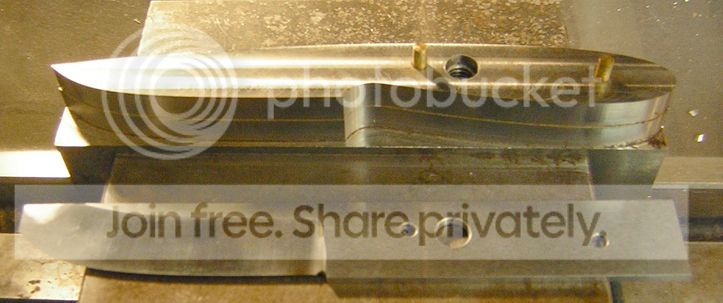
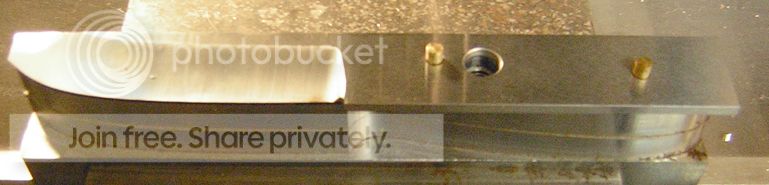
Back to the profiling fixture

11.jpg


12.jpg


13.jpg


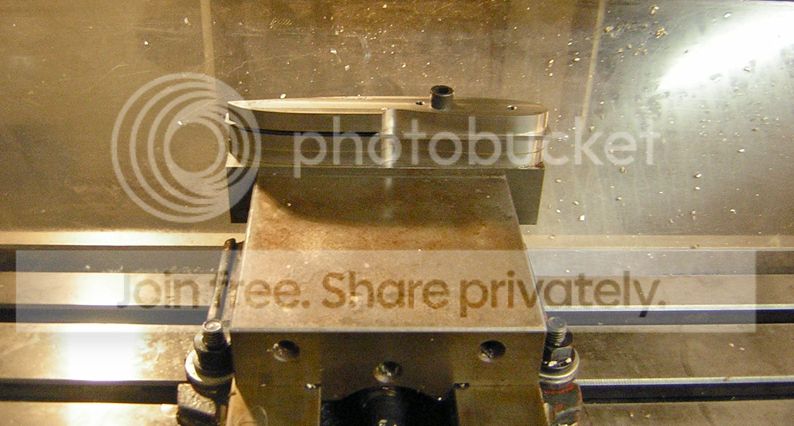
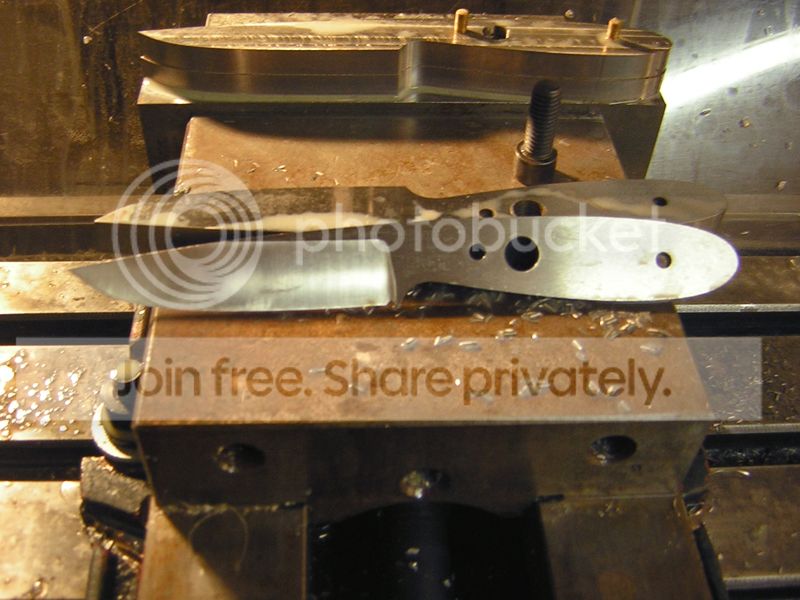
Let me go into a bit more detail what I'm doing here. This is a fixture where I can sandwich a blade blank between two chunks of steel to hold it while it is being profile cut. If you're cutting more than a few, it is worth makeing one. The top piece is thick like that for stiffness, it is pretty long, the ends are cantilevered pretty far away from that one bolt, thus it needed to be thick to work right. TIP: flexibility and play are your enemy, especially when cutting with carbide.

Also, the entire fixture stands up pretty high. Or higher than you might think it needs to. The reason for this is so I can run the cutter much deeper than just the tip of the cutter. BIG TIP: This allows me to use old dull cutters that are still sharp 1/4" up from the tip. Or 1/2" up. Or 3/4"... You get the idea. This reduces my hard costs for profile cutting to about nothing. Otherwise, carbide endmills aren't cheep, and D2 can be pretty brutal on cutters. Most of us have a lot of old used cutters laying around, this is a good use for them.

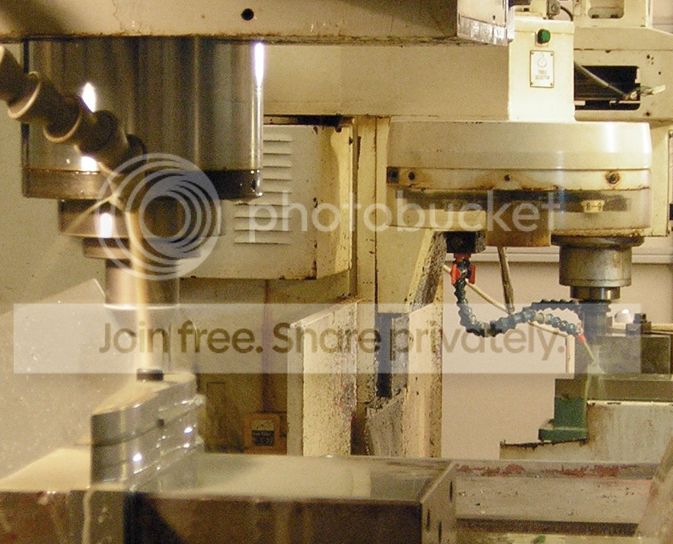
I love this next pict:

14.jpg


I've got two mills working for me at the same time. *GRIN*. The work flow is efficient. I'm in one room grinding a roughed out blank to go onto the big mill to be profiled while the little mill is roughing out the bevels on the next blank for me.

A blade that has been profiled, fresh off the mill:

15.jpg


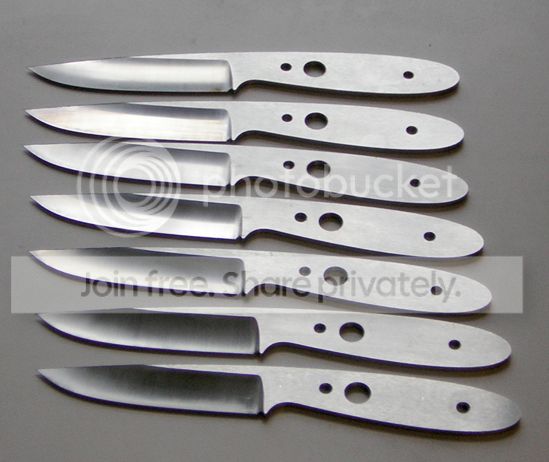
A day's work:

16.jpg


Next post: time to start thinking about scales
 
Last edited:
Watching your demo makes me realize how bad I need to get back to school and catch up to what I've missed after leaving the shop :) Everytime you do something like this you make me feel like a first year apprentice again.

I'm curious about the cycle time for milling the bevels on this knife. I know at this point its not a fair estimate being a first part and all. After you got everything running well and the speeds and feeds tweaked, what would be the average cycle time ?

Thanks Nathan for taking the time to post this :thumbup:


David,

I'm pretty sure that if you and I spent a weekend working together, I'd learn more from you than you could learn from me. Experienced mold makers have forgotten more than most hack machinists will ever know about the metal trade.

The cycle time is set to coincide with my grinding time because I did it all in a nice smooth flow from mill to me to mill, so it is currently about 15 min. I could cut that in half with a simple tweak to the programmed feedrate and double the RPM. I'm running nowhere near the limits. But there is no need to rush the machine if my grinding it the bottleneck. Machine wear is nonlinear...
 
Hack Machinist ?????? HA ! ROTFLMAO !!! :D :D

Hardly !

Nathan, I'm not trying to blow smoke up your a** .......but you're much, much too humble !

Your blades look excellent ! Very well done :thumbup: :thumbup: :thumbup:

And look at that, they did indeed turn into drop points ;)
 
I never made it to Blade. I had a family emergency a few days before.
I still want to come up for a visit one weekend.

Do you put the large hole in each different style blade?

BB

No, I don't put a hole in everything, but this fixed blade lent itself to it.

Let me be clear and not misleading anyone. I'm not a big time knife maker like you are. I'm a hack machinist that makes a few knives. So I don't have lots of "models" or anything like that, just a couple. I've been tinkering with this since I was a boy (about 20 years) and most everything I've ever cobbled up was made in my two hands. The last few years I've started doing a little of this in my shop.

A part needs a way to be fixtured. Being a fixed blade I took advantage of the fact that you can put holes in the handle under the scale. I considered adding more to reduce weight.

Other one-off stuff, or parts that shouldn't have a hole in them require a different approach. This is the way most of the blades I've made get born and a good approach for you and your mill:

folder1.jpg


folder2.jpg


folder3.jpg


I've described this once before, but I have a hell of a time being understood by folks, so picts help.

In this case I profiled most of the way through, leaving a skin on the bottom that the finished part can be popped through. A variation I do now is leaving a finishing cut allowance and stopping shy on the edge part of the knife. Then I put a finishing cut that goes all the way through on most of the blade, the rest of it supported by the land left between the stock and the edge. That way everything gets a good finish. Then I cut the edge part of the blade most of the way through and pop the blade out by hand (I never intentionally cut a part free - good way to break stuff). The nasty burr that is left on the blade is in an area that gets removed when the bevels (and in this case, swedge) get ground. Do that make any sense?

That approach is much slower than using a fixture, and it uses up cutters where a fixture does not.

There is a higher volume approach that doesn't require a hole, but relys on clamps from one side of the blade or the other and the geometry nests into the fixture. But that is more complex. I have a folder I'm working on that I'll WIP when it is ready.
 
interesting work nathan,

it looks like you should be opening a knife factory because producing just a few blades looks like it take you more time then it would someone by hand,

its pretty funny how you can go from end of the spectrum to the other,

some knifemakers I have seen Never measure, and I mean never unless someone is asking how long it is

then others measure everything
 
Hey Nathan, I think you better define "hack machinist" for us! :D Cuz from what I see you sure don't fit what I think of when I hear that. :thumbup:

This is awesome! :cool: :D

One thing I was a little unclear on... so you mill the bevels first just so you can establish the grind and have less trouble on the final clean-up? I was just thinking it would be easier to grind the whole thing... But like you mentioned, this is what works best for you in your shop. Just curious about it. :)
 
Frankly I'm offended. I'm a hack machinist and I never see Nathan at the meeting...nor has he paid his member fees for HMU (Hack Machinist Union)!
 
Before moving on to the next step on the blade, it was time to start thinking about scales. The epoxy I use takes a long time to cure, so I needed to cut scales and get them glued to a liner so they can sit a day before more work can be done on them.

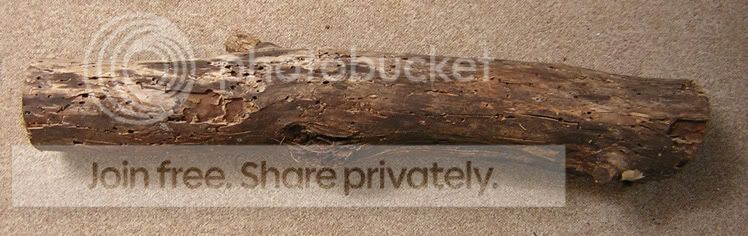
I'm using osage orange for these knives. This ugly old log contains some pretty nice wood inside:

17.jpg


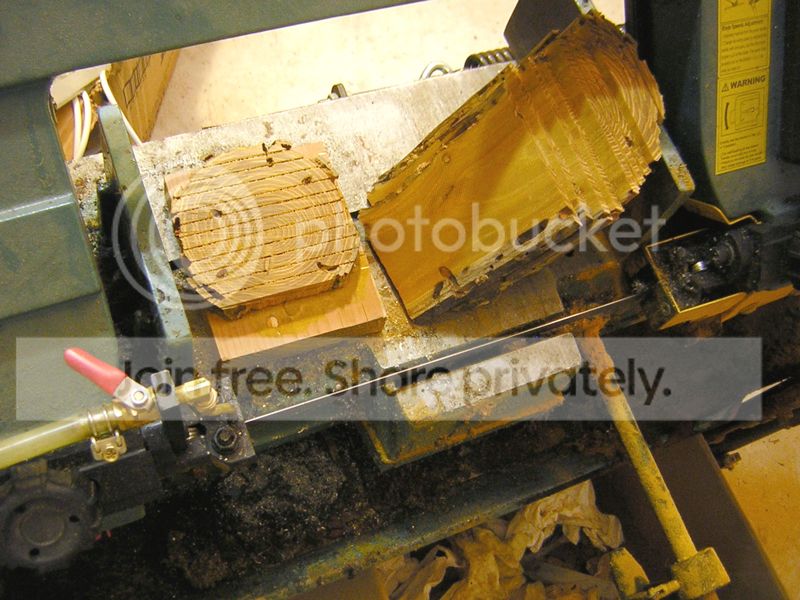
I had sawn off a chunk and epoxyied it to a 2X6. TIP: The 2X6 holds the work piece in place so I can feed it through and slice it up like a loaf of bread in a horizontal bandsaw. I’ve even used this technique for 6-6-4 titanium (6-4’s big brother)

18.jpg


I set the feed to cut fairly slow. The finished result is fairly smooth and very flat and straight. Next I trimmed them into rectilinear slabs on the worlds most clapped out radial arm saw (which has cut a lot more aluminum and plastic than wood). I then match them up to mates and epoxy some of them to some liner stock.

19.jpg


Some of the grain in the osage orange will turn a little bit more of a chocolate brown with age, but for now the color clashes with the liner colors I have except white and black. In fact I'm not convinced it wouldn't look better without a liner, so I'm doing a couple in white (which I'll probably regret because anything white is a PITA in this dusty old shop) and black, and I'll attach the rest directly to the blade without a liner.

These will need to cure a while so I'll go ahead and engrave the blades with my name and the steel type and get them into the tumbler while the epoxy cures.

I know, today’s post was weak... I had a wedding reception to go to...

I’ll get to 3D machining the scales soon, that will be cool.

Next post: Engraving
 
Last edited:
The number of lines of code to profile the belly is quite a bit. There is not a true radius arc anywhere in the profile of the knife. Hands don't draw in true arcs, people don't forge or grind in true arcs, eyes don't like to see true arcs (or perfectly straight lines) so it isn't programmed in true arcs, which would only require a couple dozen lines of code. The knife was designed on paper and traced and tweaked in the computer. I used Non Uniform Rational B Splines (NURBS) type geometry to create the profile for smooth curves with constantly changing curvature. The profile of the entire blade is basically just two splines.

Long winded huh..
QUOTE]


Not long winded at all. I wouldn't know a NURBS spline if I tripped over it though but that is my problem, not yours. You answered the questions quite well. Could you please explain in a bit more detail how you get from your paper design and "trace"" it into the computer? Do you have a stylus and tablet or is this accomplished in a different way? How long does it take to go from a paper design to a ready to mill computer program?

Thanks for going through the effort to do this thread, it is very interesting.

Brad,
www.AndersonKnives.ca


Brad, to answer your question (and then some):


Warning, the following post is not machining related and will bore most people to tears…

If it is something very simple and I have a picture of what I'm going to do in my mind I'll just go directly to the computer and do it. A basic machete for a weekend chore for example. In that case I didn't use a fixture, but just clamped some A2 between two vices and cut my profile with a 1/8" cutter, taking care not to cut it out all the way, but leave .010" at the bottom around the edge and pop it out by hand (the burr gets cut off later anyway). Then it goes edge up and gets "sharpened" in the mill before grinding. In that case from sitting down to start and cutting chips takes about 30 min, mostly mill setup. While it is cutting the profile I'll program the edge cut, so that starts as soon as the profile cut is done. So it is in HT pretty soon after I decide I need a machete.

Something like this skinning knife is different. I designed it for the way I process a deer. I like my venison tasty, tender and well aged, which means I like it rare and not gamey. Every hunter has different opinions, but to me the best venison is very clean, which allows you to eat it safely while still pretty rare. So the way you process it is important. To start, I generally take a head shot if given the opportunity, to avoid disturbing anything in the body cavity and to prevent a long run, and tracking it. Also, I don't field dress a deer, I put it on a tractor and get it up to my skinning area pretty quickly where I process it the way my step father taught me (and the way a farmer taught him to butcher pigs). I skin it down leaving a little around the genitals and anus. I pull that out a short ways and tie that stuff off. That way there is no danger of feces or urine contaminating anything. Then I open it up a little bit taking care not to cut anything I don't mean to. I don't split the pelvis like most folks. I do reach up in and disconnect all the stuff connecting the reproductive and excretory stuff to the pelvis, then pull that stuff down. Then I finish opening it up and let all that stuff fall into a chum bucket under the deer. Sometimes I'll split the ribcage, sometimes I won't. I won't go into more detail because I've found that some people get squeamish (and would prefer not to contemplate where meat comes from, which is their prerogative) but the tools you use dictate to some extent how smoothly this all goes. When I'm done I have a neat clean carcass without nicks and without bacteria in the meat. Nicks through the fascia can introduce bacteria into the meat, leading to smells and unhealthy food (if eaten rare).

All of this is where knife design comes in. My old buck clip point was too long and the clip point tip nicked meat. Another popular shape is kind of leaf shaped and short with a gut hook. That doesn't nick meat so bad, but it doesn't fit up into the pelvis or handle well either. An area with belly is important, but you don't need much, and making the blade that fat for skinning? If you're skinning by carving with that giant belly, you're doing it wrong...

I personally think gut hooks are inelegant. I think their often ugly, when they bunch up they can get hair on the meat, they weaken the blade and a blade that fat handles poorly (for me) and they're unnecessary. With about one deer of skinning experience a hunter using a drop point design, with the edge out, can unzip a deer fast, exactly where you want it, and without nicking anything. You lay it flat against the deer and control the depth of cut with the angle. Once the hide gets started over the edge it stays there during the cut. It is just my personal opinion here.

For the way I process a deer I need something with moderate length, a narrow tip with a good belly at the very end. The handle needs to allow me to put the bottom into the palm of my hand and extend the blade out like an addition to my index finger. D2 doesn't rust much and holds up to hide and a thin hollow grind makes shallow cuts in flesh better than anything. I never dangle a *sharp* knife off my wrist or anything else, so a lanyard hole is of no use to me, I just set it down next to the bone saw on a table. I need a decent index finger indent or a guard, because hands get slippery, and I like my skinner sharp like a scalpel. Those requirements drove this design.

So, there you have the thought process behind the knife design. For something like that, I draw it out several times. Come back to it later and tweak it again. Sometimes I can't decide what I want unless I see it, so I draw quite a bit. When I have what I think I want I scan the drawing into the computer on a regular old flat bed scanner. I bring it into photoshop and adjust the angle to be level and crop it tight against the design. I create a feature in the CAD system the basic size of the blade. I import the jpg image into the CAD system and position and scale it until it fits that basic scaling feature (generally just a square). Once it is correct I trace it with nurb splines, using as few control points as possible to prevent weird undulations. This tends to iron out waviness and help keep a sleek elegant shape, while still being true to the design intent. Then I save the file and start playing around with the proportions a bit, trying slightly different angles etc until it is as perfect as I can make it. Then I "grind" it in the system, playing with all of the variations there. Then I do the scales. I'm sure it takes me longer to design a knife this way than it would take me to just sit down and grind one, but I like to think the extra attention given to the design shows.

But this is getting seriously long winded and some serious thread drift, and I'm sure you folks looking for cool shop stuff are bored, so I'll get back to the good stuff and weird techniques tomorrow.

 
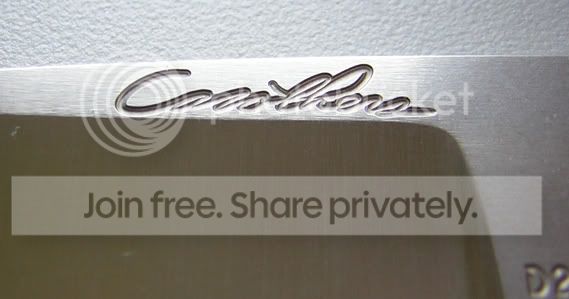
Okay, today’s post was going to be engraving. That didn’t turn out so well.

20.jpg


The engraving cutter I chose didn’t leave a good finish. I’ll have to order something different.

So here is a pict of an older blade (slightly different design) where I simply used a very small endmill

21.jpg


I forgo a stamp for a couple reasons. A: this is *generally* more fool proof. B: I can set the size and location exactly how I want it in the computer and see what I'm going to get before committing it to the steel. Stamping would be simpler, but (when it works right) I feel this is a nice touch and is worth the extra effort.

I milled that with a .031" ball endmill. I had to squint to be sure the cutter I picked out was actually a ball end. I used a high speed air spindle attachment to get the RPM up there, otherwise I'd be limited to a 5,000 RPM spindle, which would reduce my feed per minute to a painfully slow 1.5 IPM.

After engraving, the blades will receive some hand finishing, then they’ll be tumbled before HT.

A vibratory tumbler is a good way to apply a smooth even edge break to an otherwise sharp edged machined part. It also creates a nice even scratch resistant bright frost finish which I will keep on the flats. This is the finish I see on some of the Chris Reeves knives. D2 doesn't respond like 1018 etc, I guess due to the carbides. I might normally use a light ceramic media for a part like this, but because it is D2 I'll use a heavier aluminum oxide.


Since I didn’t work on engraving I went ahead and cut scales.
 
Last edited:
Osage orange is dense, stable, and fine grained. You just about can’t mark it with your fingernail, and a well seasoned piece like this doesn’t move around after you cut it. Other than wearing HSS cutters quickly, it machines well.

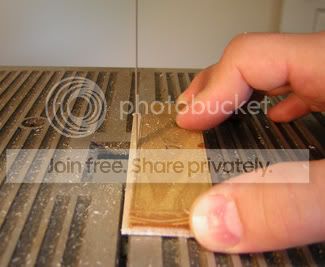
The first thing I do is cut the blocks from the liner stock

22.jpg


Then I square up any blocks that are not reasonably parallel so they’ll fit well in a vice. I'm using a fly cutter with a bit ground to cut wood. It is literally shaving sharp and ground almost like a chisel to prevent the wood from tearing.

23.jpg


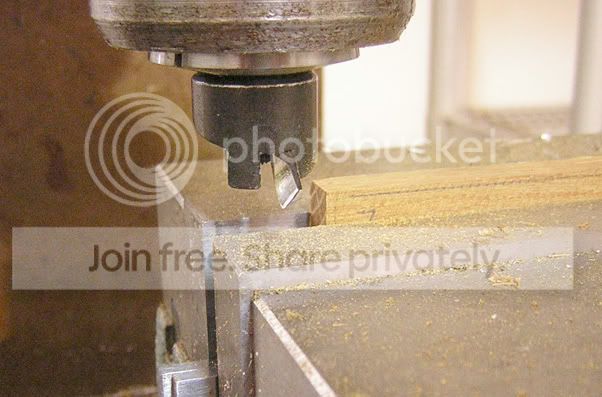
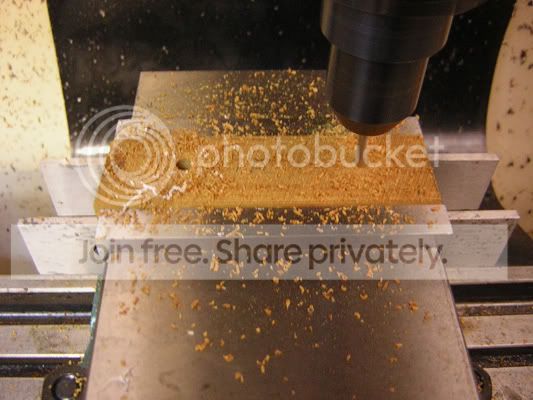
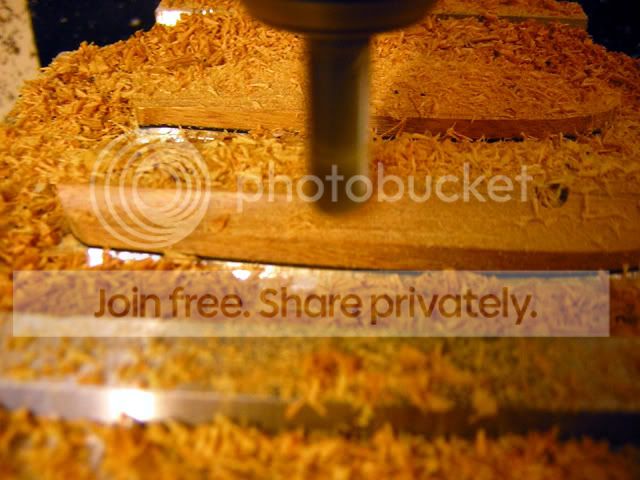
The next thing I do is cut my pin holes. This is not a straight hole, it has a step in it. I am using an Onsrud o-flute router bit, again to reduce risk of wood tearing. Note: the carbide used in good router bits does not need to be as tough as metal cutting tools, so they can use less cobalt binder (thus higher tungsten carbide content). This leads to a harder, longer lasting, carbide that would chip in metal, but cuts abrasive wood like this without dulling quickly. You run it at the highest speed you have and feed fast enough to prevent burning. Ideally 25,000 RPM and 100 IPM, but I'm going a *lot* slower than that.

24.jpg


The difference is subtle, but there is a left and a right here. I mated up matching pairs earlier, and I'm being careful about which side and which direction these will go on the finished knife.

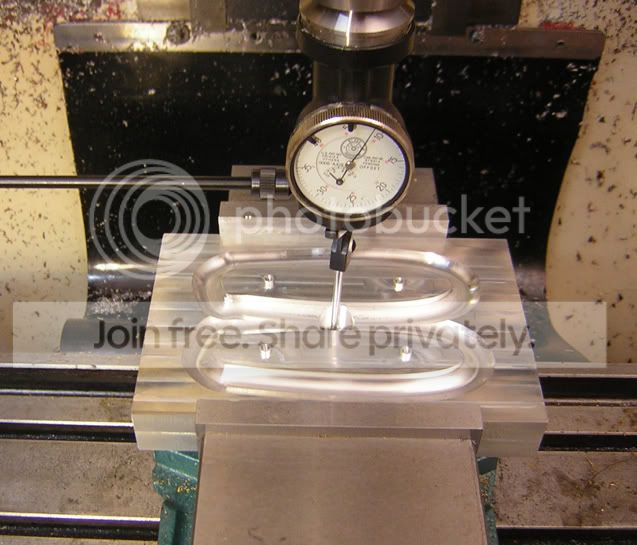
The next step is to load my fixture and zero it out. Similar to the other fixture earlier

25.jpg


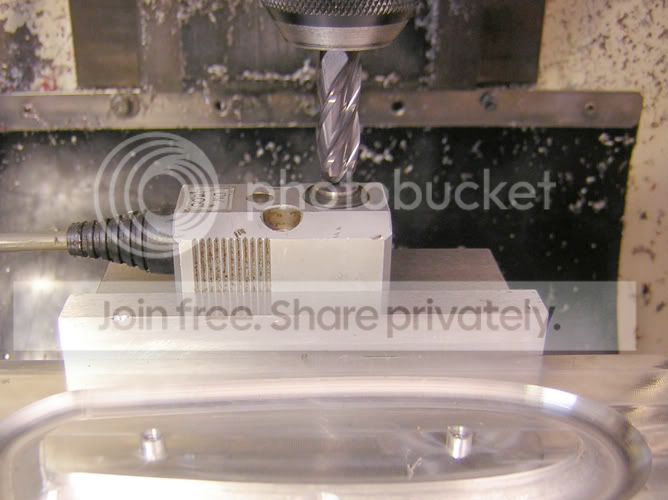
The program is going to require a tool change, so I need to zero my cutters out in a way where I can call out a cutter length offset compensation. If anybody is interested in how this is done, I’ll describe the process, otherwise I’ll try to keep focus.

26.jpg


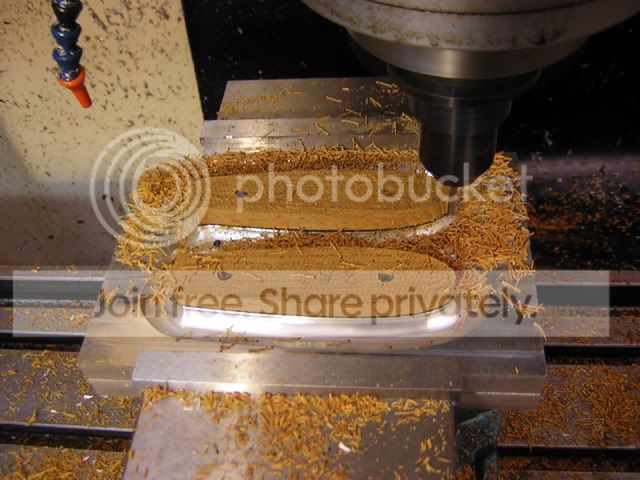
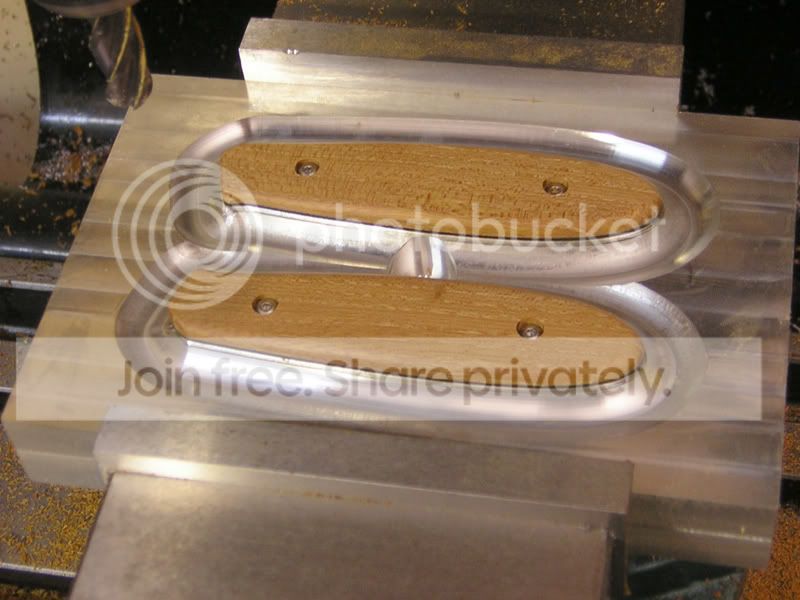
With my tools and fixture zeroed out I'm ready to cut scales. The blanks fit tightly into place over the posts on the fixture and are held in down with a couple 4-40 BHCS.

Cutter one cuts the profile.

27.jpg


Cutter two is a larger ball end that roughs then finished the scales

28.jpg


Scales are done.

29.jpg


The finished scales are not flat sided slabs but are subtly contoured and rounded (without being blob like). There is some palm swell and it necks down for a pinch grip before widening up again at the “guard”.

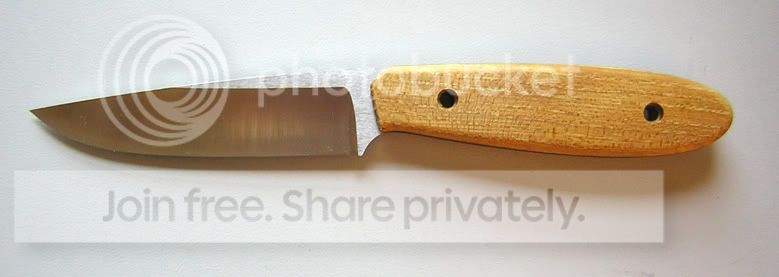
Here is a pict of an "as machined" scale set on an "as machined" blade.

30.jpg


They’ll both need some hand finishing touches, the blade needs engraving, tumbling and HT, but you get the general idea of the basic look.

The purpose of this thread was to detail areas of knifemakeing that I approach differently than most. I hope some of you picked up some ideas on fixturing and order of operations and machining strategies.

I’m going to end this WIP here because this concludes the aspects of knifemaking that I do differently than most. These knives will be finished conventionally from here. I’ll be happy to answer any questions. Thanks for participating.

Nathan
 
Last edited:
Great thread Nathan. It should be an eye opener for those who think a CNC mills does ALL the work for you. As you mentioned there is a ton of handwork still to go to come out with the final product.

Any chance of getting a few full size pics of your mill??
 
Great thread Nathan. It should be an eye opener for those who think a CNC mills does ALL the work for you. As you mentioned there is a ton of handwork still to go to come out with the final product.

Any chance of getting a few full size pics of your mill??


CNC certainly doesn't do everything for you. There is a lot of work that goes into it.


dyna.jpg


This is the little Dyna. It was new in 1990. I got it a few years ago and put a PC retrofit on it. Works really well. I've worked the hell out of this little mill. Yes, that is a vice grip hanging on the coolant flow valve, and yes the paint is pealing down to bare metal all over it. It has paid for itself many times over.


vetrax.jpg


This is the other mill. No, it isn't 12 feet tall, I steadied the camera on a bench stool which made a weird angle. It was new in 98. I got it about seven years ago with low hours on it. It has not paid for itself many times over. It has 17 X 38 in travels, which used to be very handy when I used to make a lot of fixtures and tooling. I don't use it much anymore.

Not pictured is a 12" Yang lathe. It was new in 2000. Those are the three CNC machines in my little CNC machine shop. I use manual stuff too, but it isn't worth writing about...
 
Back
Top