WIP, Setting up and milling a few blades. Picts, machining, CNC.

Nathan-

I'm going to totally disagree with you on that last part!

While I find the CNC aspect fascinating and really appreciate the insight to your application of it... I think whatever you cared to share about manual milling and or machines would be VERY welcome.

The CNC work is probably not ever going to happen in my shop (cost prohibitive, I have no other issues with it at all) but manual work is something I try to do but suck at.

Even simple stuff like work-holding and making sure everything is square and true is really great for me to see (unlike you, I REALLY am a hack at this stuff).

As per the CNC doing it all... lol... It may do some pretty handy work that saves you from some other approach, but you have to know how to run the damn machine to even get started! I don't know why so many people seem to overlook that!

Thanks again Nathan! :) :thumbup:
 
Nathan-

I'm going to totally disagree with you on that last part!

While I find the CNC aspect fascinating and really appreciate the insight to your application of it... I think whatever you cared to share about manual milling and or machines would be VERY welcome.

The CNC work is probably not ever going to happen in my shop (cost prohibitive, I have no other issues with it at all) but manual work is something I try to do but suck at.

Even simple stuff like work-holding and making sure everything is square and true is really great for me to see (unlike you, I REALLY am a hack at this stuff).

As per the CNC doing it all... lol... It may do some pretty handy work that saves you from some other approach, but you have to know how to run the damn machine to even get started! I don't know why so many people seem to overlook that!

Thanks again Nathan! :) :thumbup:


Its my pleasure Nick.

All the same principals apply. Getting things square and flat, cleaning chips and burrs from parts and fixtures and feeling to see if your parts fit right. Feed rates, chip loads, finishing allowance. Machining manually or with CNC, the principals are the same (until you get to "high speed machining", another story all together). I hope the cool and relevant examples help illustrate some of it. This was never intended to be a "knife build along".

There was a thread a while back about doing a machining DVD. That planted a seed in my head that I should do a WIP like this. I've been pretty busy in the shop this year (non-knife), but I got an opening here to make some knives, so I decided to document it. Obviously I couldn't do a full instructional video, but I hope this was more than just a neat show. I tried to point out handy tips along the way and gave actual specifics about the strategies I was using.

There are several makers here using CNC. There is a hurdle to get over before you're comfortable fully utilizing your machine. Any maker facing that hurdle has at least now seen what it looks like, with screen dumps and everything.
 
Brad, to answer your question (and then some):


Warning, the following post is not machining related and will bore most people to tears…

If it is something very simple and I have a picture of what I'm going to do in my mind I'll just go directly to the computer and do it. A basic machete for a weekend chore for example. In that case I didn't use a fixture, but just clamped some A2 between two vices and cut my profile with a 1/8" cutter, taking care not to cut it out all the way, but leave .010" at the bottom around the edge and pop it out by hand (the burr gets cut off later anyway). Then it goes edge up and gets "sharpened" in the mill before grinding. In that case from sitting down to start and cutting chips takes about 30 min, mostly mill setup. While it is cutting the profile I'll program the edge cut, so that starts as soon as the profile cut is done. So it is in HT pretty soon after I decide I need a machete.

Something like this skinning knife is different. I designed it for the way I process a deer. I like my venison tasty, tender and well aged, which means I like it rare and not gamey. Every hunter has different opinions, but to me the best venison is very clean, which allows you to eat it safely while still pretty rare. So the way you process it is important. To start, I generally take a head shot if given the opportunity, to avoid disturbing anything in the body cavity and to prevent a long run, and tracking it. Also, I don't field dress a deer, I put it on a tractor and get it up to my skinning area pretty quickly where I process it the way my step father taught me (and the way a farmer taught him to butcher pigs). I skin it down leaving a little around the genitals and anus. I pull that out a short ways and tie that stuff off. That way there is no danger of feces or urine contaminating anything. Then I open it up a little bit taking care not to cut anything I don't mean to. I don't split the pelvis like most folks. I do reach up in and disconnect all the stuff connecting the reproductive and excretory stuff to the pelvis, then pull that stuff down. Then I finish opening it up and let all that stuff fall into a chum bucket under the deer. Sometimes I'll split the ribcage, sometimes I won't. I won't go into more detail because I've found that some people get squeamish (and would prefer not to contemplate where meat comes from, which is their prerogative) but the tools you use dictate to some extent how smoothly this all goes. When I'm done I have a neat clean carcass without nicks and without bacteria in the meat. Nicks through the fascia can introduce bacteria into the meat, leading to smells and unhealthy food (if eaten rare).

All of this is where knife design comes in. My old buck clip point was too long and the clip point tip nicked meat. Another popular shape is kind of leaf shaped and short with a gut hook. That doesn't nick meat so bad, but it doesn't fit up into the pelvis or handle well either. An area with belly is important, but you don't need much, and making the blade that fat for skinning? If you're skinning by carving with that giant belly, you're doing it wrong...

I personally think gut hooks are inelegant. I think their often ugly, when they bunch up they can get hair on the meat, they weaken the blade and a blade that fat handles poorly (for me) and they're unnecessary. With about one deer of skinning experience a hunter using a drop point design, with the edge out, can unzip a deer fast, exactly where you want it, and without nicking anything. You lay it flat against the deer and control the depth of cut with the angle. Once the hide gets started over the edge it stays there during the cut. It is just my personal opinion here.

For the way I process a deer I need something with moderate length, a narrow tip with a good belly at the very end. The handle needs to allow me to put the bottom into the palm of my hand and extend the blade out like an addition to my index finger. D2 doesn't rust much and holds up to hide and a thin hollow grind makes shallow cuts in flesh better than anything. I never dangle a *sharp* knife off my wrist or anything else, so a lanyard hole is of no use to me, I just set it down next to the bone saw on a table. I need a decent index finger indent or a guard, because hands get slippery, and I like my skinner sharp like a scalpel. Those requirements drove this design.

So, there you have the thought process behind the knife design. For something like that, I draw it out several times. Come back to it later and tweak it again. Sometimes I can't decide what I want unless I see it, so I draw quite a bit. When I have what I think I want I scan the drawing into the computer on a regular old flat bed scanner. I bring it into photoshop and adjust the angle to be level and crop it tight against the design. I create a feature in the CAD system the basic size of the blade. I import the jpg image into the CAD system and position and scale it until it fits that basic scaling feature (generally just a square). Once it is correct I trace it with nurb splines, using as few control points as possible to prevent weird undulations. This tends to iron out waviness and help keep a sleek elegant shape, while still being true to the design intent. Then I save the file and start playing around with the proportions a bit, trying slightly different angles etc until it is as perfect as I can make it. Then I "grind" it in the system, playing with all of the variations there. Then I do the scales. I'm sure it takes me longer to design a knife this way than it would take me to just sit down and grind one, but I like to think the extra attention given to the design shows.

But this is getting seriously long winded and some serious thread drift, and I'm sure you folks looking for cool shop stuff are bored, so I'll get back to the good stuff and weird techniques tomorrow.


Thanks for sharing your design thoughts as well as answering the question of how it gets from paper to the computer. It may take longer to design the knife than if you just ground one out, but if you want to make 50 of them, I think there are definate advantages to the CNC way of doing things. Please post pics of the finished knife after all the hand work is done.
 
Great thread Nathan :thumbup: Thank you very, very much !

Speaking of the hurdle?, mine is the CAD/CAM software........and at this point in time it's much higher than I can jump :) I'm fluent in all aspects of operating my little CNC (and any manual machine tool made). I can come up with almost any 2D program required on my machine, right at the control, its adding that simultaneous Z axis movement for profiling (through CAD/CAM) that has me in a quagmire. And I know........ its all about taking the time to learn it ;), that of which, I just can't seem to come up with at the moment :(
 
I just programmed my first blade in Master Cam last week. I'll do a small WIP in my forum tonight. I'll show how I do my fixtures. I'm cutting blades and handles today.


David did you see the pics in the link that I sent you??
BB
 
The purpose of this WIP was to illustrate my different approaches to knife making from the perspective of a jobbing shop and a jack machinist and not to show off knives (when Bruce Bump etc is in the room, I feel silly showing off my stuff). But, since I've never actually shown a finished knife on this forum before, this is probably the time to do that.

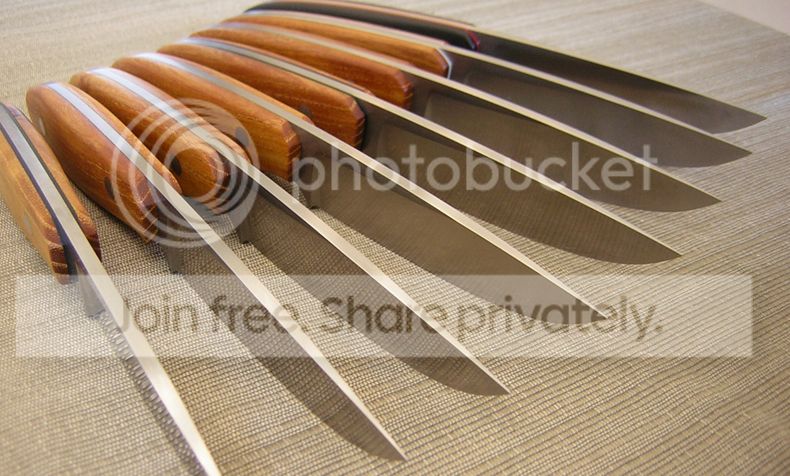
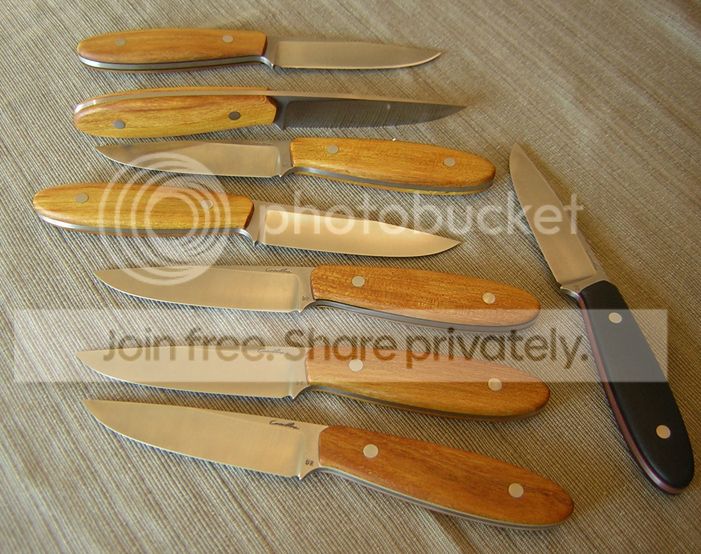
The finished knife is a very basic drop point skinner. A few are ground down to .010, most were left at .020. Most were hardened to HRC 60-62. One is .030 and HRC 58 and will be going to a non-knife friend of mine where ease of sharpening and ability to withstand abuse were more important than edge holding and cutting performance. It is interesting because that one took more of a mat finish from the scotchbrite and tumbling. I also put black canvas micarta on one.


finished1.jpg


finished2.jpg


Thanks again for following along.

Nathan
 
Last edited:
they look great nathan....i appreciate the thread....i don't know much if anything about these types of procedures and it helps alot with the pics seeing it....pretty cool way to make a knife....ryan
 
Nathan, those are sweet!
I so impressed with your machining abilities. I dont think I could do it that way even with you standing here showing me how. I can stumble through some minor manual operations but the cnc would stop me dead. I wish my son would put in more hours with me. He's smart.
 
I have been reading this thread with my mouth hanging open. For someone who can hardly operate his drill press correctly, this is absolutely amazing to me. I suppose having parts fit together so precisely is second hat to you, but it astounds me. I cut everything large and grind it down to meet the steel. You make everything from blade to pins to handle and it all fits together like a glove. Awesome work. (nice looking knives in general too, CNC aside!)
 
Thank you for the compliments.

Bruce, don't ya know? All ya got to do is press the green button? :p

Matthew, for the record, I made the scales a few thou over and sanded to flush after installation.Your eye can see, and your hand can feel a mismatch down to .001". With tolerance stackups and Murphy, I'm not that good, so I still have to sand to fit.
 
Nathan, Thanks for the great thread and I really like the knives. Great design, execution and finish. Really nice. Now tell me how you plan to CNC the sheaths, your the type that is probably working on that. Jim
 
Nathan, Thanks for the great thread and I really like the knives. Great design, execution and finish. Really nice. Now tell me how you plan to CNC the sheaths, your the type that is probably working on that. Jim


Thanks Jim.

"Now tell me how you plan to CNC the sheaths, your the type that is probably working on that"

Well yeah. Why, is there another way to do it?

Actually, if I were using Kydex I would probably make a thermoform mold out of MDF to form the sheaths and to hold them as a vacuum fixture to trim them out with (you guessed it) CNC. But I'm using leather. I was considering making a stamp tool to shear the leather flats out in a press, but that would take the better part of a day to make, so I'm mangling them out the old fashioned way. Sigh...
 
I think you could cnc a sheath out of antler or wood.

Beautiful knives, Nathan. The engraved maker's mark is really nice.
 
sweet knives, and you pumped out those blanks in one day too, hell, it takes me a few days to make one knife. awesome.
 
Dave I have a die I am working on to make leather sheaths, I cut the profile for the piece from a piece of 1/4" mild steel with a plasma torch. I am going to smooth it up a bit and then place the pattern back inside the parent plate then take a porta-band blade and sharpen it on a belt while the blade is turning. Then I will place that blade in the slot formed between the template and the parent plate and then turn it over into a pan with enough water to keep the band saw blade cool and skip weld the slot up from the back side. Presto a cookie cutter with a 1/4" of blade sticking out. Lay the leather on some plywood and then hammer the cookie cutter on to it.
 
Nathan, when you get tired of that old technology here's something new ! The photo shows holes drilled in stainless steel with a pulsed fiber laser , 500,000 pulses/sec. It takes 50 pulses to drill each hole . Kun Li/ U of Cambridge
 

Attachments

  • array_gallery.jpg
    array_gallery.jpg
    77.6 KB · Views: 191
Nathan, when you get tired of that old technology here's something new ! The photo shows holes drilled in stainless steel with a pulsed fiber laser , 500,000 pulses/sec. It takes 50 pulses to drill each hole . Kun Li/ U of Cambridge

Neat stuff mete :thumbup:

Speaking of new technology, Chicago's "McCormick Place" will host the IMTS on Sept. 8-13 (international manufacturing technology show). If you're interested in seeing state of the art machine tools, this is the place to be. I've hit the show a couple times in years past and to say it will blow you away is a complete understatement. There's really a lot more to see than a one day visit allows, and always, functioning, fully set-up machine tools, actually making chips at the show. Every type and style of CNC machine tool you can imagine. Even cooler are the ones that you can't imagine, they're everywhere at this show !! Even if "CNC stuff" doesn't interest you, I promise ........ you will not be disappointed if you go :thumbup: :thumbup: You will leave the show with your mouth (and your mind) open in amazement ;)
 
Mete,

Ya know, that is really cool. I think I'll mortgage the house some more and get me one of those.

Actually, I think this is even better:

laser.jpg


This is 3D laser machining from a company we work with in my other life (I don't just machine knives ya know). Folks have been laser engraving with lasers for a long time. But these folks are accurately machining to 3D data, in this case a piece of A2. He told me it was like machining with a .002" endmill and claimed accuracy capable of being used for a mold shutoff. Very cool laser stuff, but might bump up the price of a knife a bit though...

Dave, I haven't been to one in years, but yes, that is the "Blade show" of manufacturing and is quite amazing.
 
Back
Top