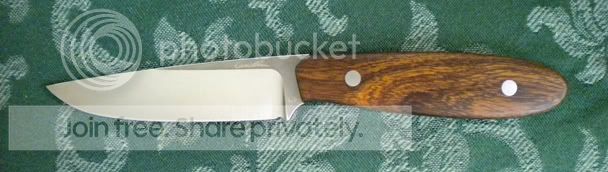
WIP, Setting up and milling a few blades. Picts, machining, CNC.

Nathan, i too am absolutely blown away. i spoke for one of these knives right after you posted them in "for Sale" forum.
i had NO IDEA of how much knowledge and skill, and i'd like to say "mastery", went into making that knife.
i am humbled and feel very fortunate to have one of these (the super thin "guy") coming to me. roland
 
Nathan, excellent work,, Ive been in and out for a few, but mostly gone, if you ever make these again please let me know, Id love one.
 
Gonna drag this one up from the dead. I've practiced sharpening on my belt sander utilizing proper belts but I could never get even results so I'd like to try my mill and see what happens.

Nathan, beautiful work, sir! Can you expand a little bit on how you're milling the main bevels. If I understand you it appears you're not tilting the blade or mill, right? You're basically stepping the end mill in small bites or.....?
 
Splat,

Yeah, that's right, I'm cutting the bevels in descending steps. I then do the final finish on a grinder. There are other approaches, including the tilting the blade, using a cutter with side angle and laying the blade over on its side and using a big facemill or a CBN wheel. There are pros and cons to each approach.
 
I know I´m 4 years late here but I just read the thread and have to express my gratitude to Nathan. Awesome and informative WIP. Though I dont have either the knowledge nor the equipment to do CNC-work, there is still a lot for me to pick up here in terms of fixtures and procedures.

Thanks.

Brian
 
Love the thread resurrection. Insane amounts of good knowledge here.

Nathan, how long does it take to cut in the bevels, setup and everything?
 
Love the thread resurrection. Insane amounts of good knowledge here.

Nathan, how long does it take to cut in the bevels, setup and everything?

To load a fixture, touch off tooling, open the manufacturing file in CAM, post fresh code and start making chips takes between 10 and 20 minutes. So, setup for a particular operation isn't too bad. Overall there are a few different operations. Make the blank, profile the edge, mill the bevels, finish the profile, machine the scales etc. I also have to saw the wood, glue the liners, turn the shoulder pins etc. Then heat treat, fit up and finishing is done conventionally.

It's interesting to see this old thread revived. Some things have changed and some things are done a little differently. If I ever get a free moment I'll have do an updated WIP.

I still make this pattern regularly, though I've stopped using osage orange as much as I once did. While I like the wood quite a bit because it works so well, I've found that more upscale wood sells better. Here is what this pattern looks like today:

1.jpg
 
I get why the machinist types do this - because they can!...... but.....

Many folks with a good grinder could profile it in 2-3 minutes, and grind the bevels in 5 more. After a second grind with 120 grit it will be ready for HT. About 10 minutes, max......because they can :)
 
It takes me about 15 minutes to finish it to 400 grit off the machine, but I work pretty slowly. It also takes similar time for the two mills to cut the profile and cut the bevels (they work pretty slow too). So, between me and my two old mills working simultaneously (a non-trivial monetary investment BTW) I can pop out a blade in about the same amount of time as a very experienced grinder (a more reasonable monetary investment). So I certainly can't say it is the best way for folks to make a knife. But it is the best way for me to make a knife.

The long and the short of it is, a lot of makers here have these tools and don't use them for this and I think they should give it a try. The costs for tooling rather than abrasives are a wash and I like not having all the dust in the shop.

And, coming from the point of view of a machinist, I've looked at a lot of other makers work and I see a lot of minor errors in the geometry that I wouldn't want in my own work ( I make enough errors as it is). These things are probably invisible to most folks, but they bother me. For example, I picked up a very nice handmade piece at the last Blade Show made by a highly skilled ABS Mastersmith and discovered, while sharpening it, that the center of the edge wasn't centered in the meat of the blade. While flawlessly finished, there was more meat on one side of the edge near the ricasso where the entire blade was too thick in one area on one side. I know a lot of folks see that as part of the charm of a hand forged work of art. I see it as a flaw that I wouldn't want in my own work and my approach (precision machining) prevents flaws of that nature 100% of the time.

It is my opinion that a semiskilled machinist on an old manual mill would still be ahead working out a way to at least rough on a mill in order to get things centered and straight. Different people's idea of "good enough" varies, obviously, but I'll wager the blade profiled and ground by hand in 10 minutes is less likely to be "good enough" than the work done on a mill. And a competent machinist can rough in a knife on a mill without a lot of drama. It only looks complicated to the uninitiated.

I like the way it works. So, as they say, different strokes for different folks.
 
I'm in agreement with you.

It is all about the enjoyment of the work process.
Machinists enjoy programing and operating mills and running all sorts of sophisticated machines.
Forgers enjoy shaping hot steel.
Grinders enjoy turning a bar int a knife right before their eyes.
 
incredible stuff Nathan... i wish i knew the first thing about milling machines, i could retire the table top drill press for good.
 
Machinists enjoy programing and operating mills and running all sorts of sophisticated machines.

No, not all machinists. I personally love CNC'ing for its own merit, but I'd rather manually operate my machines. I always hated math anyways. :p

Nathan, thanks for replying. FWIW, I know I'd love to see how you're doing things today on the mill.
 
Nathan. I know you said that you still have a fair amount of grinding/finishing to do after the mill op. but I'm wondering just how much chatter you get when surfacing that blade. To me it seems like a tuning fork!

I've considered trying roughing in bevels with my mill but I have a couple problems. One is I have a basic cad/cam that doesn't support surfacing. I've considered fixturing the blade so that I can just mill the bevels flat but that would involve moving the blade and I think I would lose some symmetry/precision.

Have you ever milled the bevels with angled fixturing rather than surfacing? If so I'd love to see how you do it.

Also thank you for this thread. I'm a machinist and just a beginner knife maker so I've put a lot of thought into milling and fixturing blades and this thread was great to see!

Nick
 
You guys should try a tapered end mill for that kind of thing...When I use to work in the machine shop we would use tapered end mills so we did not have to use a sine bar to set the angle. That gives it a GREAT surface finish!
 
Not sure how I missed this WIP before Nathan but glad it got dragged back up, thanks for sharing.
 
You see a lot of makers, Busse and Tighe for example, that lay the blade completely flat and use profile cuts. In my mind, my approach is fundamentally similar to that, except I'm pointing it edge up so I can reach both sides at the same time.

You're correct of course that chatter is a concern any time you're cutting on a tall thin rib like that. Work piece deflection is another problem, particularly if the cutter dwells anywhere in the cut. This is one reason tapered cutters and leaning the work don't always work so well because you end up with a lot of the cutter engaged in the work piece which can lead to chatter.

Shallow descending cuts like this have very low cutting forces which reduce chatter, however you still need a pretty healthy feed rate to keep your cut stable. In the end, I still like to finish grind to get the best surface finish.

There are other approaches, obviously. For example, you can cut with the side of a cutter without chatter with a little bit of fiddling. A 1/2" variable flute endmill fed at 5 IPM and turned 500 RPM gives a good finish and is pretty stable if the work piece is reasonably well supported. Or, if you lay the blade mostly flat, but tipped point down and edge up a hair (done on a single axis tilt table by tilting the blade and turning the work) you can use a facemill to cut your bevels. But it is a complex three axis interpolated move and you have to use a tooling ball to indicate your fixture, so it is a relatively complex operation to setup. I would be lost doing that without CAD/CAM. I'm experimenting with these approaches. However, at the end of the day, nothing will give you the control and the accuracy of surface milling the geometry. Part of the reason for this is you usually want your bevel profile to remain perpendicular to the edge.
 
So I have a not so fancy 85 bridgeport with a original anilam crusader II CNC controler on it. I dont much use the CNC side of the mill, but I do cut bevels with it a fair amount.

I use it a lot when I would normally need to remove a large amount of steel ie... my "choppa" or "Meat" fixed blades as they are thick and sometimes long blades 10" .300 thick:O

I am not as set up as you are Nathan but Im learning as I go. I have a 1.5" thick alum jig set up for ea blade profile I do.

I side mill all my bevels with a 5/8ths carbide 4 flute endmill. it is fairy fast, but I cant mill the tips as I do every thing manually.

Maybe you can tell me if Im going at this the wrong way?

I locate the blade with the 2 .250 handle bolt holes with 2 .250 hardened dowels press fit to the alum jig, then I clam the clamp out of it.
I tilt the head of the mill out to what ever deg I need for ea dif knife, then I side mill the first bevel. Flip the knife, and SLOWLY side mil the other side as there is not half as much support since there is no meat on the other side now. I leave the last 1-2" of the tip unmilled or I tab the knife.

Then off to the grinder to grind the tip into it and finish grind it.

I think I need to find a way to support the other side of the blade when I flip it so I dont get chatter? What do you recommend?

Right now I can mill a 10" blade x .250 chopper in 3v in about 15-25 min then another 10min to grind the tip and take it to 220. It takes me about an 1.5 hours to grind a 10" blade to 220 grit on the grinder.

So Im saving time, but I would like to do better:)

Any tips would be great!
Sorry for the highjack!

 
Dave I have a die I am working on to make leather sheaths, I cut the profile for the piece from a piece of 1/4" mild steel with a plasma torch. I am going to smooth it up a bit and then place the pattern back inside the parent plate then take a porta-band blade and sharpen it on a belt while the blade is turning. Then I will place that blade in the slot formed between the template and the parent plate and then turn it over into a pan with enough water to keep the band saw blade cool and skip weld the slot up from the back side. Presto a cookie cutter with a 1/4" of blade sticking out. Lay the leather on some plywood and then hammer the cookie cutter on to it.

That is a very clever idea . . . I might have to borrow . . . :-)

Steve
 
Back
Top