
deltablade
Gold Member
- Joined
- Jul 29, 2006
- Messages
- 2,049
I would appreciate comments on whether a 10" blade of 1/4 carbon steel would be noticeably stronger if forged rather than made by stock removal?

The BladeForums.com 2024 Traditional Knife is available! Price is $250 ea (shipped within CONUS).
Order here: https://www.bladeforums.com/help/2024-traditional/


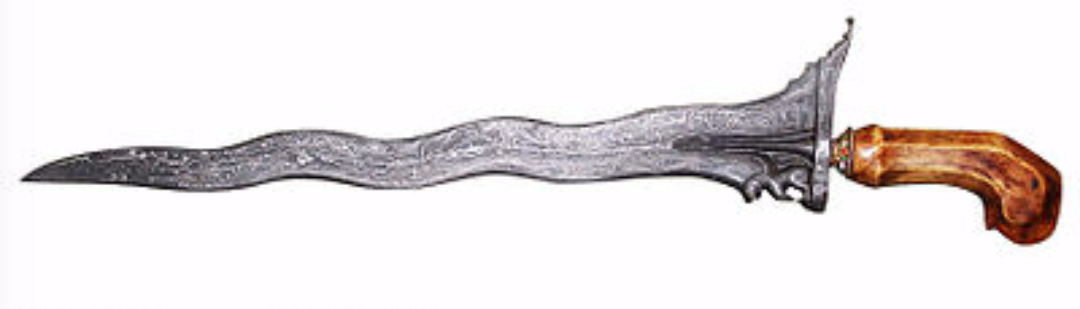
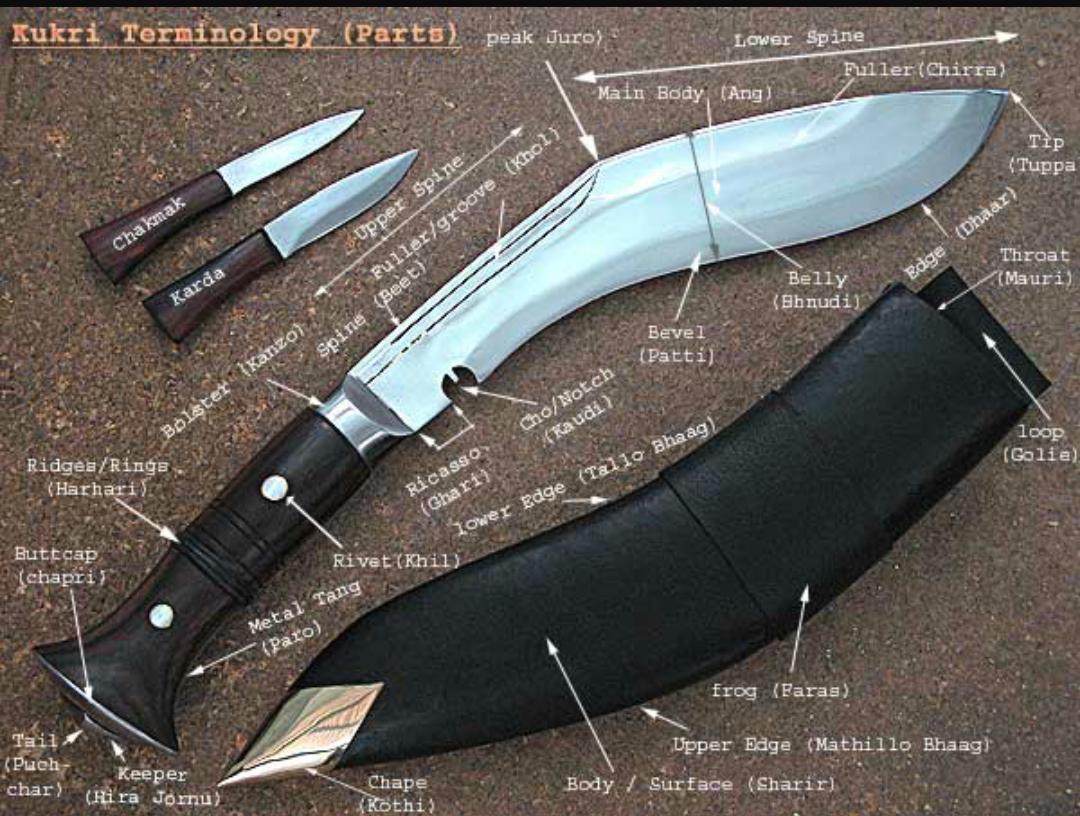
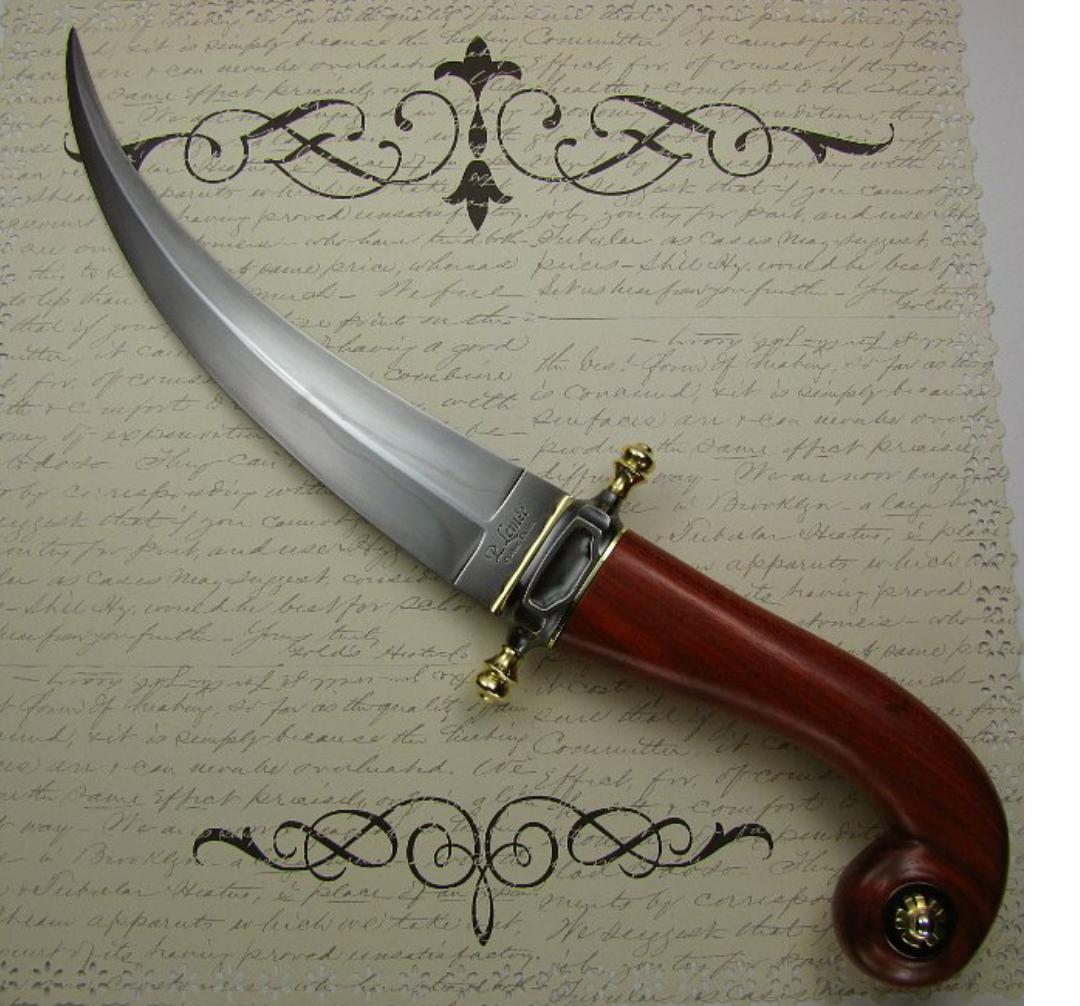
Are grains that big and elongated?Are we talking about regular straight-ish blades or blades with any kind of curve, like a kukhri or some kind of Persian style blade or some kind of exaggerated trailing point? If we're talking about the latter, then I'd say forged because you can keep the grain running in line with the curves of the blade.
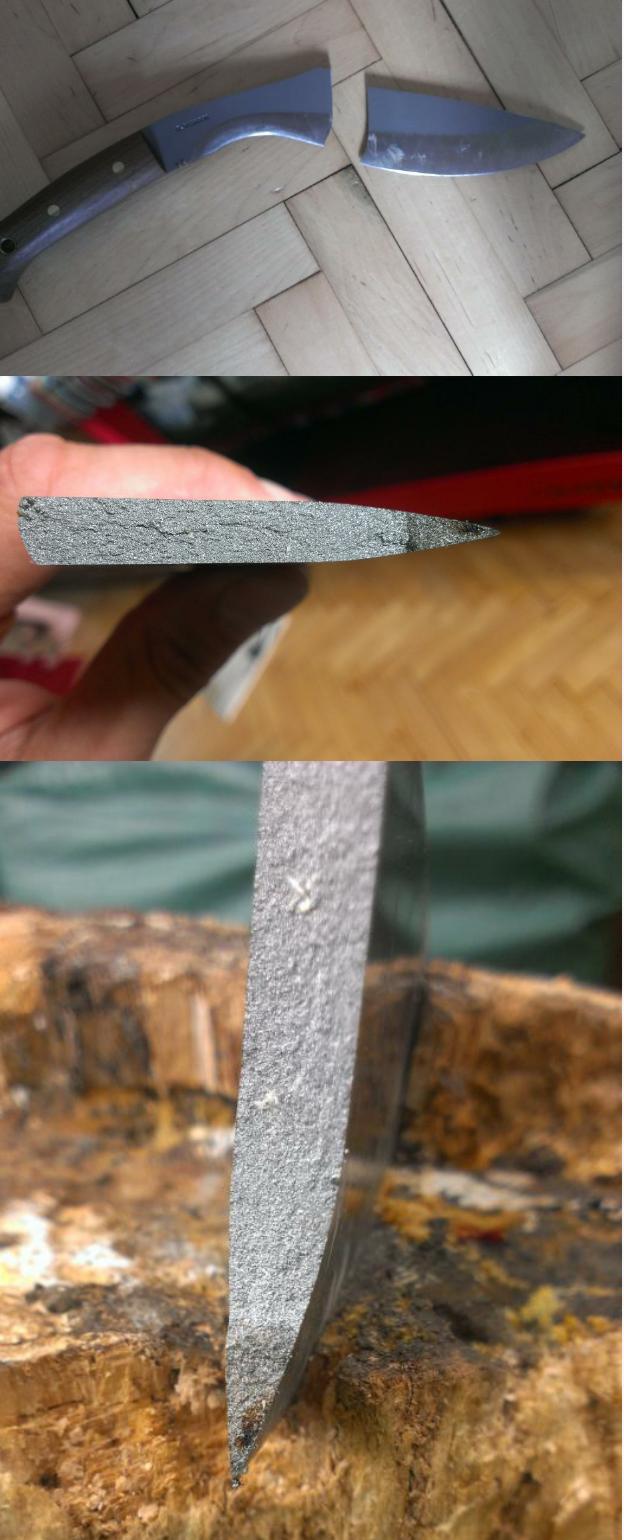
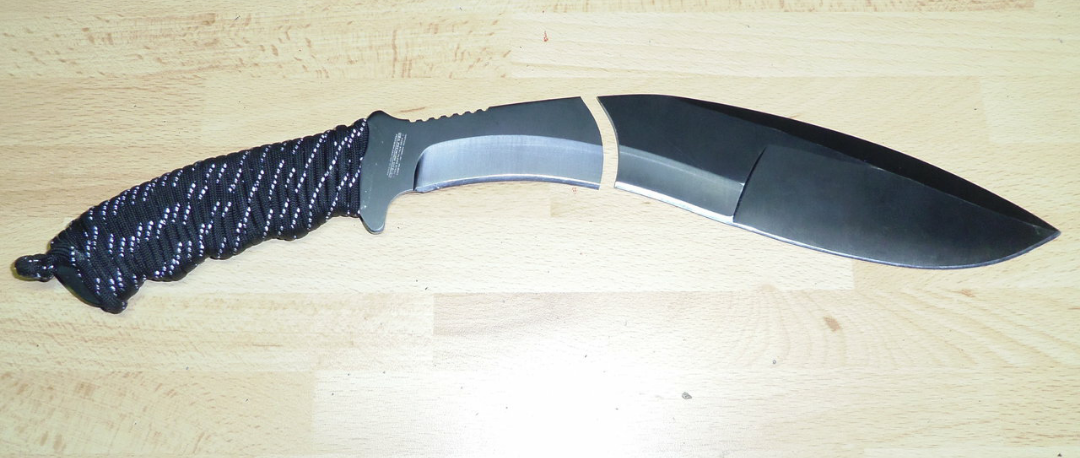


Thank you bodog for this picture and the other information. Pretty impressive how the grain flows there.

Are we talking about regular straight-ish blades or blades with any kind of curve, like a kukhri or some kind of Persian style blade or some kind of exaggerated trailing point? If we're talking about the latter, then I'd say forged because you can keep the grain running in line with the curves of the blade.
Let's get the multipost issue under control.
Forging damages the steel. That damage has to be undone through normalization cycles to return the steel grain to a refined state.
Ask any ABS guy why they normalize after forging and if they would ever forgo that step.
What forging really allows for is a way to make much more elaborate shapes without grinding / cutting away a lot of steel.
At the end of the day, if both heat treated correctly there shouldn't be any difference in the quality of the steel itself between something forged and somethign stock removal.
The CPM process also doesn't inherently make a steel better...it is in it's most basic sense for high carbide steels as it creates a more uniform distribution of the carbides (and thus eliminates clumping that can weaken the structure). In other words, it's not a process to make steels better perse so much as a process to allow certain types of steels to actually be made with consistent quality. Steels like 5160, AEB-L are not CPM'd and not because they are inferior, but because they wouldnt' be significantly improved by the CPM process. They already have small well distributed structure.
Actually, when I discussed this with Bailey Bradshaw (ABS master smith) he stated that he thought that there probably were some small benefits to be gained from forging 3V. Here are his comments on the possible improvements that forging 3V could have. In the first quote he is talking about a 3V hunter that he forged. Notice that in one example in the second quote he clearly emphasizes the words could and might.
Quote(Bailey Bradshaw):
I will say that this blade was more difficult to grind and finish at the same hardness than any of the hundreds of other 3-V blades I have made.
Quote:
If I had to guess at the forging improving the steel in any way, it would be twofold. One would be aligning the grain flow with the blade's shape. Another MIGHT be the increased time at sub critical heat COULD have aided in forming more carbide structure. 3-V is an air hardening steel, and requires 30 min. or more soak time at 1975 degrees. More soak time on these steels usually equates to higher hardness due to more carbide formation. It's the only explanation I can come up with to give reason for the difficulty in grinding and finishing.
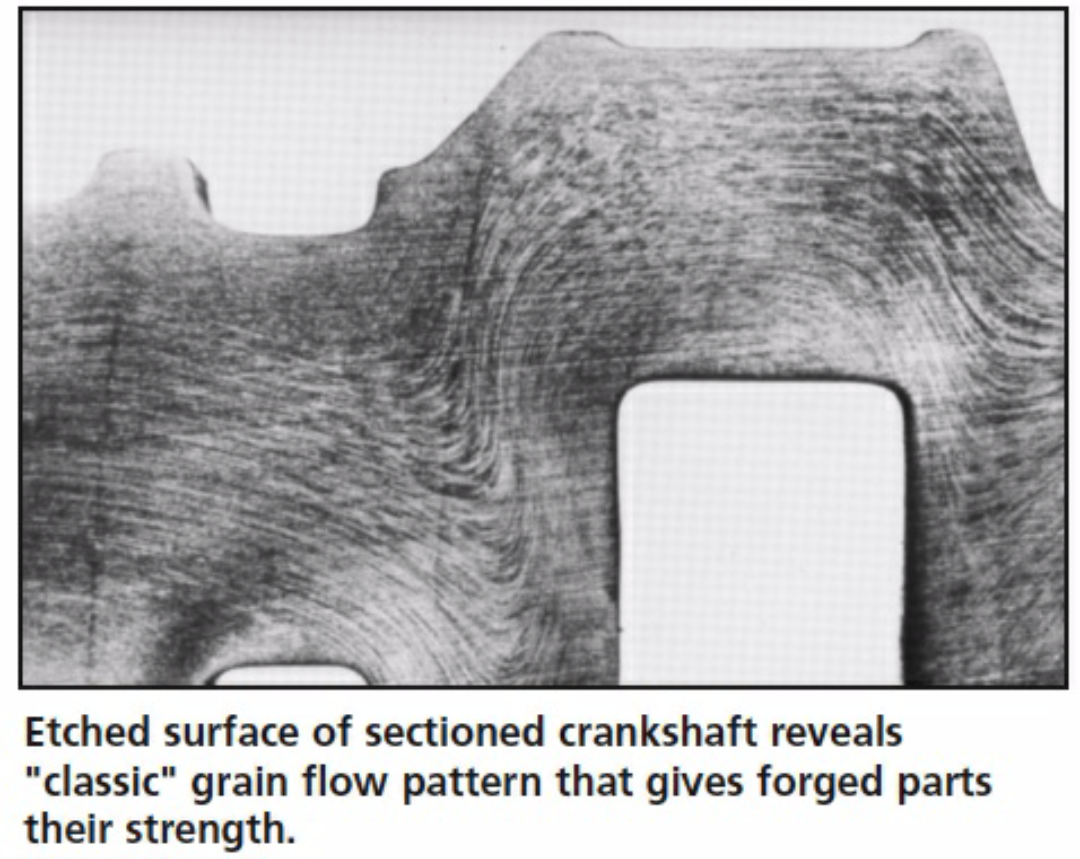
Grain flow is one of the major benefits cited for the use of forgings. Unfortunately, there are misconceptions on the topic, which include the underlying causes of grain flow, the benefits that can be accrued from grain flow and how to achieve an optimum grain flow. In the best case, grain flow results in a delighted customer and aforging that thrives in a critical service application.
To begin, let us provide a definition of grain flow in forgings. Grain flow is a directional orientation of metal grains and any inclusions that have been deformed by forging. Individual grains are elongated in the direction of the metal flow or plastic deformation. More importantly, nonmetallic inclusions, particles and other imperfections inherited from the casting process are elongated in the direction of grain flow. It should be noted that grain flow occurs to some degree in all metal-forming processes, not just forging...
Effect on Mechanical Properties
The important implication about grain flow is that some mechanical properties vary with respect to orientation relative to grain flow. This fact is one of the major benefits ascribed to forgings. This variation in mechanical properties can be exploited so that the actual product has superior properties in a critical direction relative to those expected from the alloy composition itself.
However, we should be clear that not all of the mechanical properties will vary significantly with the grain flow. For example, strength and hardness are primarily controlled by the alloy chemistry and the heat treatment that is given to the forging. Grain flow will not have a major effect on the strength or the hardness of the alloy. In contrast, desirable properties associated with retarding crack propagation can see significant differences depending on the grain flow and the direction of the moving crack. So, properties like fatigue strength, impact toughness and ductility, which are measures of a materials resistance to cracking (measured after fracture), can be significantly improved if the crack propagation direction and the grain flow are properly aligned. The optimum alignment occurs when the maximum principal stress (perpendicular to a potential crack or fracture) is aligned with the grain-flow lines...
Content for this paper was primarily developed by Scientific Forming Technologies Corporation in partnership with SCRA Applied R&D and FIA. The material was initially developed as a Forging Design Seminar under the FAST program, a multi-year, industry cost-shared program sponsored by the Defense Supply Center Philadelphia and Defense Logistics Agency Research and Development.
It somewhat smacks of hubris to take a piece of steel that has already been reduced from feet to fractions of an inch in thickness, hammer a bevel down one side and then proudly claim we have made the steel superior by our forging.
All the answers you could want are probably in this article. http://cashenblades.com/images/articles/lowdown.html
Most of the benefits of forging are already present in anything but cast barstock, since virtually all barstock is rolled at the factory.
From the article:
All the answers you could want are probably in this article. http://cashenblades.com/images/articles/lowdown.html
Most of the benefits of forging are already present in anything but cast barstock, since virtually all barstock is rolled at the factory.
From the article:
Going against the grain
One undeniable aspect of forging things to shape, that we can get out of the way immediately, deals with the directional structure of steel from the aforementioned milling process. This condition is the result of the elongation of impurities, voids and inclusions in the direction of the rolling operation resulting in a wood grain type effect, such that the material will have slightly different properties in one direction than in another.
In order to avoid a very common confusion, it must be heavily stressed that the term grain in this case has nothing to do with the crystalline structure of the metal, such as an austenite grain, but instead refers to this directional property, as in going against the grain, and is not affected by annealing and other heat treatments. The condition where a property of a material is different in one direction than it is in another is known as anisotropy, and we will examine it again later in this discussion.
The quickest and easiest way to demonstrate how forging can affect the properties of a tool via this directional nature is in the classic crank shaft example
Content for this paper was primarily developed by Scientific Forming Technologies Corporation in partnership with SCRA Applied R&D and FIA. The material was initially developed as a Forging Design Seminar under the FAST program, a multi-year, industry cost-shared program sponsored by the Defense Supply Center Philadelphia and Defense Logistics Agency Research and Development.
Randall say they forge their blades, does that mean they forge on top of barstock already rolled, or that they work from cast stock?
They are also just about the only ones to forge 440 stainless steel, because they have the industrial size machine to do it, which almost all custom makers can't afford due to the extra difficulty of forging stainless, particularly this one.
I also heard they used to go to Army bases and do live demonstrations, putting a forged blade in a wrench, and bend it in a half circle 180° without breakage...
Gaston
We should give something a pass just because it's sponsored by the Defense Department?
Can anyone say F-22?
A crankshaft is a complex shape, modeled in three dimensions and subjected to a variety of loads.
A blade is not a complex shape, however curved it might be.
