Would 1/4" thick 10" blade be stronger of forged vs stock removal?

bodog, the entire point of the cashen article is that in something as simple as a knife forging is not making much of a difference in steel of high quality that came hot or cold rolled.

As for the articles you posted, I have seen the forges used to make hi cyclic rate parts. These forges are massive, 25 tons force. There is no knife maker that has a forge like that. These forges shake the building when they hammer. A big building. Again, the forging articles discuss massively large forges. The positive effects from the small forges used in knifemaking will not make that much of a difference in an already high quality hot/cold rolled steel. IMO.
 
We should give something a pass just because it's sponsored by the Defense Department?

Can anyone say F-22?

A crankshaft is a complex shape, modeled in three dimensions and subjected to a variety of loads.

A blade is not a complex shape, however curved it might be.

You're thinking about the F-35.
 
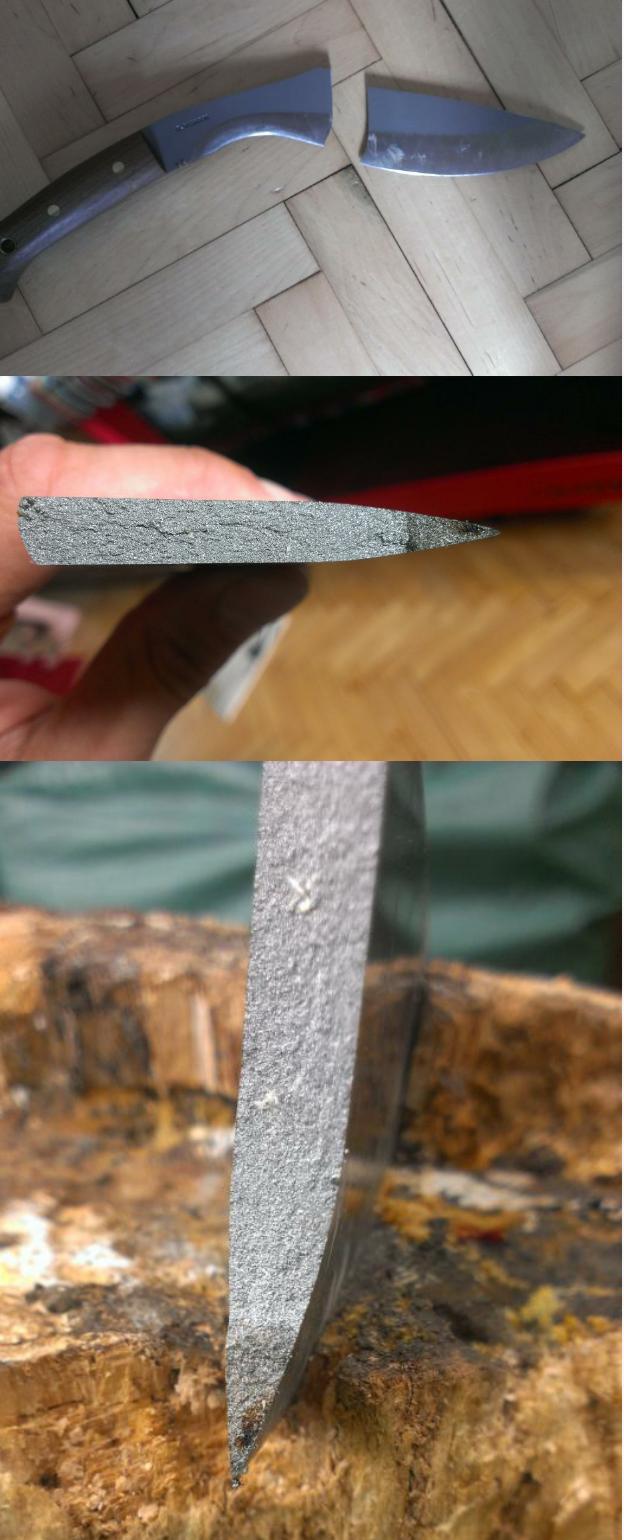
http://www.bladeforums.com/forums/s...-failure-on-8mm-thick-Condor-Heavy-Duty-Kukri!

Now obviously there's some other stuff going on with that blade, but take a look at where it snapped. It's right where the heavy impact meets the wrong grain pattern. In that case I don't think forging would've helped much because I think they blew the heat treat but it shows where the real weakness is in that kind of blade and how forging would reduce the weakness.

qezxmmW.jpg

From the original post of that thread and said knife owner:

Well i never thought this could happen with such a think blade made from a respectable material good for the tasks it would find itself being used for but here i am. The knife is only 4 weeks old and i have been using it for chopping wood, as its intended for. Struck a chopped log to split it and SNAP!

No heat treat technique would have helped this user.
 
And already oriented correctly in barstock.

To get it wrong you would basically have to slice the side off a really thick shaft and make a knife out of that.

When you have a knife that has angles where impact forces are not perpendicular to the grain flow, the knife will break.
 
18369546440_0268e9f47b_b.jpg


In this Cold Steel Kukri machete, the grain of the steel can run in line with the hilt (red), in line with the tip (green), or sort of half way between them (yellow). It doesn't matter which, because the force applied (blue) is always perpendicular enough to the grain of the steel. That Cold Steel's 1055, taken to about 54HRC is as tough as old boots doesn't hurt its case. It's unlikely that blade would break.

On the other hand, in the thread about the broken kukri linked above, people commented that they've broken Nepalize kukris in the same way as pictured. Kukris are forged by hand from 5160 steel. In the pictured Condor kukri it was accepted that the breakage was the result of an inclusion and a faulty heat treatment. Those things can happen with forged knives as well.
 
A crankshaft is a complex shape, modeled in three dimensions and subjected to a variety of loads.

A blade is not a complex shape, however curved it might be.


What Freman has posted has been my basic findings in knife making.
While forging could help with the stress's of say Airplane landing gear or our crankshaft example, a knife is a simple tool and a human being is unable to generate the stress needed to make the forging a knife or sword, superior to stock removal, keeping our heat treating process correct for all steels.

While I enjoy the artistry and the fun of forging a knife. I prefer using modern stainless steels and make my knives by stock removal.
There is always more to learn about steels and knife making so I to keep an open mind and enjoy all knowledgeable and polite discussions on these topics. :)
 
18369546440_0268e9f47b_b.jpg


In this Cold Steel Kukri machete, the grain of the steel can run in line with the hilt (red), in line with the tip (green), or sort of half way between them (yellow). It doesn't matter which, because the force applied (blue) is always perpendicular enough to the grain of the steel. That Cold Steel's 1055, taken to about 54HRC is as tough as old boots doesn't hurt its case. It's unlikely that blade would break.

On the other hand, in the thread about the broken kukri linked above, people commented that they've broken Nepalize kukris in the same way as pictured. Kukris are forged by hand from 5160 steel. In the pictured Condor kukri it was accepted that the breakage was the result of an inclusion and a faulty heat treatment. Those things can happen with forged knives as well.

Ah, but you're not seeing that if the grain flow was optimal, it could be made several points harder, several ounces lighter, or with a steel that doesn't need to be quite as tough as 5160.

And with any hand forged knife and your example of the Nepalese kukris, who's to say that they formed the grain flow in the right direction or didn't botch the heat treat the same way as the sample kukri with photos? It's an impact tool subject to various rotational stresses. Aren't we all on the hunt for the thinnest, strongest, lightest blade that keeps an edge forever? If working a steel, even in a relatively simple shape, where it makes it even a little stronger, and little more capable of handling various stresses, and allows for an increase in performance, even if it's a little, then it should be accepted. People will pay a LOT more for M390 over elmax and the performance increase is slight, at best, and will only show itself after an amount of cutting most people never see. The same thing goes for a correctly forged blade when considering crack mitigation during stressful impacts.

I think finding slight increases in edge retention is simply more popular and can be understood a little more readily and can be marketed more fully than can the somewhat esoteric nature of what only a small group of people are doing with knives. Almost anyone can take a piece of whatever steel they can get ahold of and grind off enough steel to reveal the blade awaiting inside and then send it to Peters or Bos facilities for heat treatment, it takes a master smith to understand the science and underlying art in forging a piece of steel to enhance and showcase a piece of steel at its climactic capabilities. While edge packing and all that nonsense is just that, nonsense, things such as grain flow ARE a consideration that most don't care to worry about and will spend money on more and more expensive steel to eek out a slight higher amount of cardboard cut into small pieces. What a lot of people want is a combination of high edge retention coupled with toughness and strength. If forging a blade to shape with proper grain flows can increase the strength and toughness of, say, M4, wouldn't you want to try it? Wouldn't you rather have a kukri made out of thin 3V stock at 57-58 HRC over thick 5160 at 54?
 
Last edited:
Really, with a 10 lb hammer over a fire? Doubtful. As I said in my previous post. You will not find a knife maker with a forge that equals the forges from the article you quoted. Those forges are used to make parts that withstand millions of hi load cycles, like a crankshaft or a crank rod. Those forges are in the order of high tonnage. No knife maker has that forge in their shop. You are comparing apples(aerospace forges) to oranges(knife maker forge). Your article does not make a case for forged knives.
 
Really, with a 10 lb hammer over a fire? Doubtful. As I said in my previous post. You will not find a knife maker with a forge that equals the forges from the article you quoted. Those forges are used to make parts that withstand millions of hi load cycles, like a crankshaft or a crank rod. Those forges are in the order of high tonnage. No knife maker has that forge in their shop. You are comparing apples(aerospace forges) to oranges(knife maker forge). Your article does not make a case for forged knives.

Which article, there's been several
 
Which article, there's been several

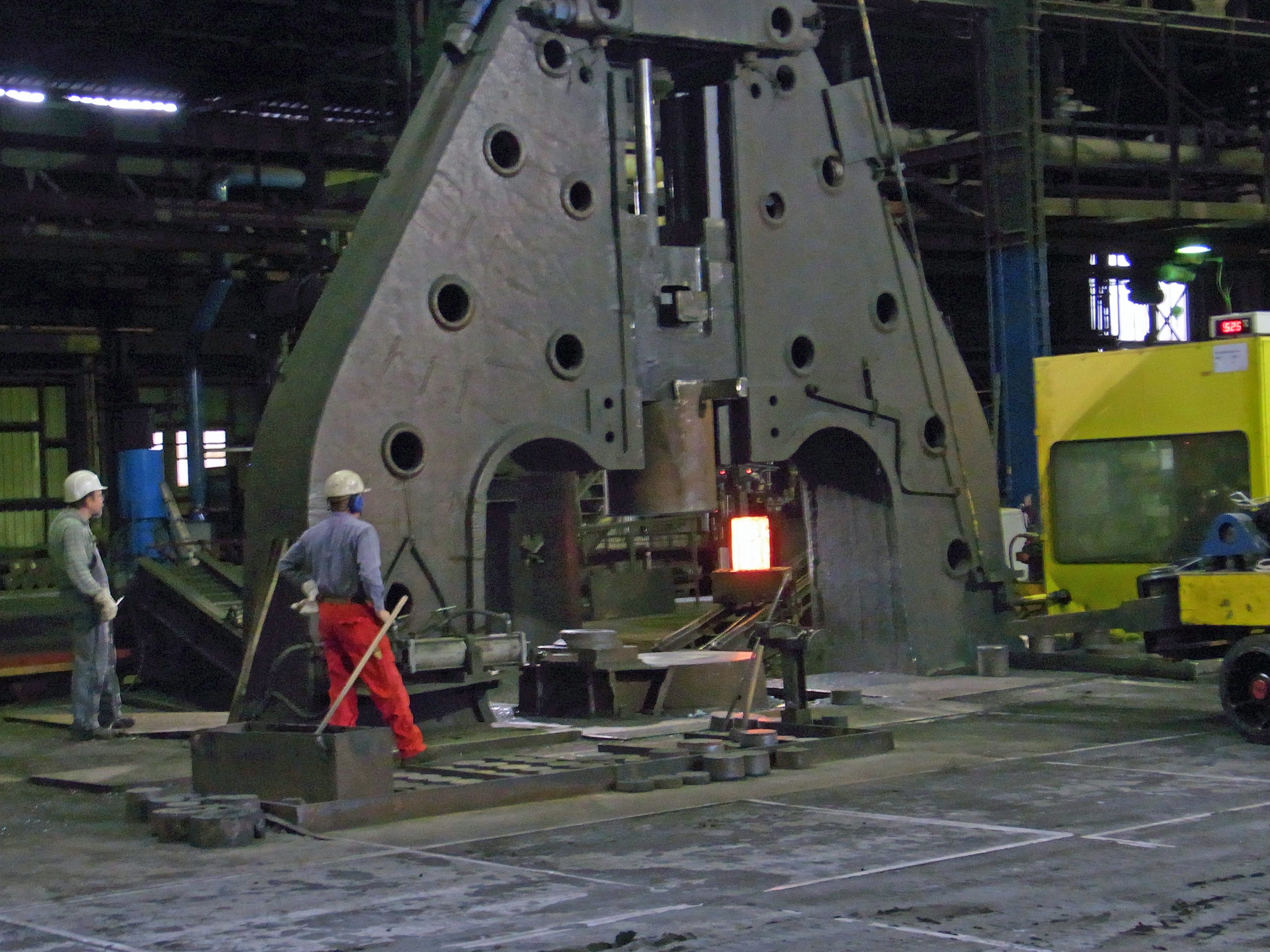
you pick it. Any article talking about aerospace or automotive forging is not comparable to knife forging. Show me what knife maker has a forge like this(the forge that does engine crankshafts and rods)?

Bochumer_Verein-03-50142.jpg
 
you pick it. Any article talking about aerospace or automotive forging is not comparable to knife forging. Show me what knife maker has a forge like this(the forge that does engine crankshafts and rods)?

Bochumer_Verein-03-50142.jpg

Youre only presenting straw arguments. I've provided several references. Just because one article MAY be discussing the advantages of forged steel in a setting outside of knife making does not preclude the fact that it can also help those in the knife industry. And just because they are operating on a massive scale with massive pieces of steel does not mean a knife forger cannot properly forge a knife, nor does it mean it's not beneficial.

It's hard to debate when the other side says " the aerospace industry uses huge hammers therefore forging a knife is useless" and sticks to it.
 
No one said forging a knife is useless. The point is that forging a knife to assure that any inclusions or voids in the steel are not there is a good thing. The mechanical advantages over quality rolled steel are non existent. Which is the question listed above. A quality rolled stock steel blade with excellent heat treat will not be any less tough than a hammer forged knife, plain and simple. Quality steel and quality heat treat is the most important factor. Now a laminated steel or folded steel blade can be tougher and those are hammer forged. But now we are talking about a whole different process. My 2 cents anyway.
 
No one said forging a knife is useless. The point is that forging a knife to assure that any inclusions or voids in the steel are not there is a good thing. The mechanical advantages over quality rolled steel are non existent. A quality rolled stock steel blade with excellent heat treat will not be any less tough than a hammer forged knife, plain and simple. Quality steel and quality heat treat is the most important factor. My 2 cents anyway.

Cool, my two cents, based on science, is that while quality steel appropriate for the job with optimal heat treatments, also appropriate for the job, are the primary considerations, the OP asked which was best, and I said forging, as long as the smith knows what he's doing in shaping anything more than a regular straight knife. Take away any kind of special or funky design and you're right, normal stock removal is probably the best, given the correct steel and production of the blade and price. How it can be argued given even just the presented evidence is honestly beyond me, but to each his own. You think it's useless for a quality steel, I know it would enhance a quality steel if done right.
 

Already did earlier in the thread and showed where he says grain flow direction is real and that he still prefers forging a blade. I even quoted part of his essay because it's saying the same thing I am. That whole paper was about there being no real benefit to forging EXCEPT GRAIN FLOW PATTERNS.

And in another post mentioned ANOTHER master blade smith who says it's real. Don't know why it's even being argued at this point.
 
Last edited:
Already did earlier in the thread and showed where he says grain flow direction is real and that he still prefers forging a blade. I even quoted part of his essay because it's saying the same thing I am. That whole paper was about there being no real benefit to forging EXCEPT GRAIN FLOW PATTERNS.

He also mentions it not making a lot of difference in knives, and that a lot of what a forger has to do is intended to correct the flaws/stresses they introduce during forging.

"Too often the reason bladesmiths need extra ways to refine the steel is in order to fix all the extra abuse they heap upon it in forging it, another one of many odd “Catch-22’s” in the business."

And in another post mentioned ANOTHER master blade smith who says it's real. Don't know why it's even being argued at this point.

What's being argued is the amount of difference it makes, and many, many makers and users feel that the difference is not much.
 
Here's an opinion:

I've got another favorite one that will scare you a little!
It's an old blacksmith saying, but it applies to us rather well:
"The most a blacksmith can hope for is to end up with as good a piece of steel as he started out with."
We have FAR more opportunities to screw up what we do than we have opportunities to make things right.
Don't screw up those important ones!

http://www.bladeforums.com/forums/showthread.php/490664-Tempering-talk/page3
 
Back
Top