You're saying that wrong...

One that always gets to me is "reticent", rather than "reluctant". A lot of amateur authors seem to do that.
 
"Benchmade vs. Spyderco" reads as "Benchmade versus Spyderco", not "Benchmade verse Spyderco", and "versus" is a preposition, not a verb.
 
Have heard kids ask "who are we/they versing?" instead of "who are we/they playing?"
 
Yeah, they hear "X versus Y" and they think "verse" is a verb that X is performing against Y: "X verses Y".
 
Violent verses versus!
 
"But language changes!"

But just because an overwhelmingly large segment of the English speaking population commonly makes certain mistakes doesn't mean that those mistakes become "correct".

Here are common "mistakes" that have persisted for decades or centuries and never became standard English, even though lots of people use them in casual speech. These remain nonstandard, informal, or incorrect in formal writing.

Here are common "mistakes" that have persisted for decades or centuries and never became standard English, even though lots of people use them in casual speech.

  • Double negatives — “I don’t know nothing” instead of “I don’t know anything.”
    Once common in early English, double negatives now contradict grammar rules in Standard English.
  • Subject–verb disagreement — “They was going” instead of “They were going.”
    Dialects often preserve this form, but it’s nonstandard in writing.
  • Using “seen” without “have” — “I seen it yesterday” instead of “I saw it yesterday.”
    This past tense confusion is widespread in regional speech but not accepted in formal usage.
  • Confusing “less” and “fewer” — “There were less people at the concert” instead of “There were fewer people.”
    Despite common use, “fewer” is preferred for countable nouns in standard grammar.
  • Wrong comparative forms — “More better” instead of “better.”
    English dropped double comparatives centuries ago, though they still appear in everyday talk.
  • “Ain’t” — “I ain’t got time” instead of “I don’t have time.”
    Though efficient and common across dialects, “ain’t” is rarely accepted in formal writing.
  • “Me and John went”
    Starting a subject with “me and John” instead of “John and I” is normal in many people’s casual speech, but most style and grammar references still mark it as incorrect in formal contexts, especially in writing. A simple blunder check for this is, would you start a sentence with "Me went..."? Not correctly, you wouldn't.
  • “Between you and I” instead of “Between you and me.”
    This hypercorrection happens when speakers try to sound formal but apply the rule for subjects incorrectly.
  • “Your” and “you’re”
    “Your” is the possessive form (your book), while “you’re” is a contraction of “you are,” so mixing them up on signs or online stays a basic spelling/grammar error in standard English.
  • “Should of / could of / would of”
    These come from mishearing the spoken contraction “should’ve / could’ve / would’ve,” but in writing only “should have / could have / would have” are considered standard forms.
  • Using “less” with count nouns
    Phrases like “less people,” “less choices,” and “less cars” remain common in everyday speech, but formal writing prescribes “fewer” for things you can count (fewer people, fewer choices, fewer cars). Conversely, “less” is properly used with uncountable nouns or mass nouns that you cannot count individually, such as “less water,” “less salt,” or abstract concepts like “less time.”
  • “Irregardless”
    “Irregardless” has been used for over a century and appears in some dictionaries with a usage note, but style guides and editors overwhelmingly treat it as nonstandard and recommend “regardless” in formal prose.
  • “Anyways”
    “Anyways” is widespread in casual conversation and regional dialects, yet most guides label it informal or colloquial and advise using “anyway” in edited writing.
  • “Literally” used to mean “figuratively”
    Saying things like “I was literally dying” for emphasis is so common that dictionaries now record this figurative sense, but many teachers and editors still flag it as incorrect or at least too informal for serious writing.
  • “Their / there / they’re”
    Mixing these homophones (“their going,” “over they’re,” etc.) is one of the most visible spelling errors online and in student writing, and it remains firmly nonstandard because each word has a distinct role in standard grammar.

Why should I care?

Preserving correctness ensures clarity and precision in communication, which builds credibility and avoids misunderstandings, especially in professional or global contexts. This allows future generations to cooperate effectively, sharing ideas accurately to innovate and improve the world without the barriers of sloppy language.

1764610659879.png
 
I wasn't singling anyone out. I have had this conversation with many people, and there is a common theme of blanket acceptance of error on the premise that error inevitably becomes standard, and thus no longer error, "so why fight it?". But I have always felt that this is a gross oversimplification of the issue, and not always accurate. It's only recently that I looked more into it, and I'm glad I did, because it is more nuanced than that, as the examples above illustrate.
 
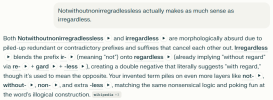
Notwithoutnonirregradlessless actually makes as much sense as irregardless and the Terminator agrees.

1764959505255.png

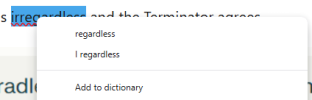
Spell check also likes them both about the same.

1764959549035.png

1764959538643.png
 
Back
Top