You're saying that wrong...

However, I think she just pronounced it incorrectly.

That is what really makes it worse. If it was an "innocent" mistake.... from an educator? 🤦‍♂️
 
In a perfect world, a principal became so after years — decades — of teaching. In my opinion.
 
That is what really makes it worse. If it was an "innocent" mistake.... from an educator? 🤦‍♂️

Our Psych teacher in high school would always pronounce Walter Cronkite's name as Conkrite. Can't remember how/why his name would come up, but will never forget her pronunciation.
 
I had a high school science teacher who pronounced "larynx" as "lar-nix". :rolleyes:
 
About 10 years in to my teaching career, I was encouraged to join a "leadership group" which could eventually offer a position in administration. I went to one meeting. That was all it took for me to know I wouldn't be going that route. In 30 years I worked for 6 principals. Only one, in my opinion, deserved to be called an educator.
 
"Lady" in youtube bodycam video I watched kept insisting this, about the car she was pulled over in: "They never reported it stolden!"
 
My neighbor is a teacher and she also wishes to avoid any position in administration. She does get roped into being group leader due to her organizational skills.
 
I was taught in my early adult life about the 80/20 rule, which posits that 80% of the work is done by 20% of the people.
 
I'm with Dr. Lightman.

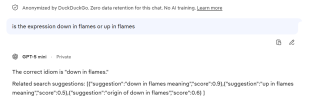
1776604977712.png

Flames go up, but the building goes down. The smoke goes up. I won't argue with the fizix.
 
**Providing idiom confirmation**

I need to be concise in my answer since it’s regarding idiom validity, not a web search. I’ll give a confirmation along with a brief explanation and some usage examples. I also need to invoke RelatedSearchTerms at the end, which should include up to three suggestions: "up in flames meaning," "go up in flames idiom," and "burn to the ground phrase." I’ll use functions.RelatedSearchTerms for that!
Yes — "up in flames" (often "go up in flames") is a valid English idiom meaning to be destroyed by fire or to fail disastrously.

Examples:
- "The old barn went up in flames last night."
- "Their plans went up in flames after the funding fell through."
ChatGPT 5 mini
 
Never heard of it, looked it up just now, and apparently there are a lot of words in that I would not like.
 
My mother-in-law said "warsh" meaning wash.

Moderator edit: no posts that can be seen as celebrating someone’s death please. It is not fortunate she stopped saying it this way by dying.
 
Last edited by a moderator:
Isn’t that more of a regional accent thing? Like “draw” for drawer or “aboot” for about?
 
Back
Top