Blade steel, it's all good.

I'm not sure but I think the OP has not chimed in since he started the thread. Hope he wasn't trolling though it wouldn't really matter, we have had a civil, reasoned convo. That can happen a lot here, even with the occasional egos.

I've said this before and I'll say it again. I'm an unrepentant AUS-8 lover myself. Aus-8, good carbon steel, 12c27, and the like are good for me to get in an inexpensive knife to drop in my back pocket and use at work. I really don't like the 440A or whatever mystery steel is in a lot of cheaper knives.

People I work with have called me a steel snob.

It's all a matter of degree.

If someone else's needs, tastes, or budget are different than mine, that's all good too. They are usually pretty knowledgable and help me with my higher end purchases.
 
Gatorflash, your "bit of insurance" statement is something I can agree with you on. I've seen with my own eyes that a 14" Tramontina bush machete will do everything I need in a big outdoor blade (Central/South Texas), but I would take my Junglas for that "bit of insurance". But I will say that extremely cheap machete performance made me re-evaluate my plan for any future purchases. As I told a friend, I'm going to become a Tramontina fanboy. I can have the complete collection for like $50!

In my case, I collect mostly antique knives. It is hard to look at knives that were made 100-300 years ago, many of which have been used and abused throughout their lifetime, to see that they have held up well and can still function as intended, and to argue that the latest steels are meaningfully superior to what has been commonly used even a few months before. The new steels may be superior, but what more can we ask of a knife? Perhaps sometime down the road, a distant descendent will pick up an old knife and say wow the 21th century super steel used in this 500-year-old knife has caused it to look shiny new even today. At what point does all this become meaningless, and wouln't we be better served by focusing more on the design, fit and finish and de-emphasizing the basic blade chemistry?

n2s
 
Quote Originally Posted by BePrepared View Post
Just go buy an INFI blade and forget about it... once you go INFI, you never go back... unless you suck, then you go back, but who here wants to admit to sucking?

(that's known as "the argument from intimidation", for the philosophy students in the audience)

Or, to be more technical, ad hominem. Yep, that's right. I went there. :P

Not to be a nit-picker, but it's not technically an ad hominem. Ad hominem is attacking the person to invalidate the person. IE. "you are stupid, so your argument is invalid"

The argument from intimidation is a separate form of fallacy. It takes this form " 'A' is a stupid argument. No one would be dumb enough to believe 'A', so there's no way you really agree with 'A' right?"
 
In my case, I collect mostly antique knives. It is hard to look at knives that were made 100-300 years ago, many of which have been used and abused throughout their lifetime, to see that they have held up well and can still function as intended, and to argue that the latest steels are meaningfully superior to what has been commonly used even a few months before. The new steels may be superior, but what more can we ask of a knife? Perhaps sometime down the road, a distant descendent will pick up an old knife and say wow the 21th century super steel used in this 500-year-old knife has caused it to look shiny new even today. At what point does all this become meaningless, and wouln't we be better served by focusing more on the design, fit and finish and de-emphasizing the basic blade chemistry?

n2s

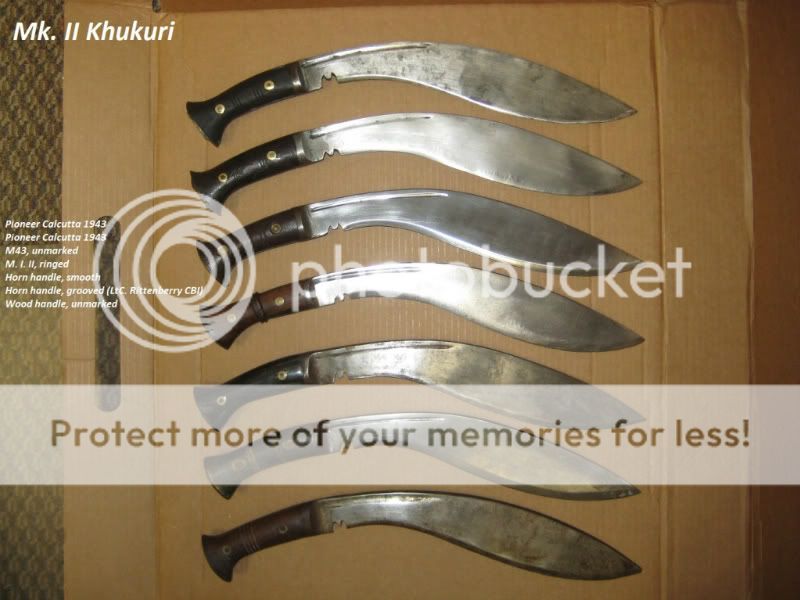
I'm into the oldies a well and they seemed to work well enough as these WWI-WWII beasties illustrate;)
MkIIgrouppic.jpg


This reminds me of a story I recently read on a historic khukuri website. The story goes that the Wilkinson Sword company recieved orders to produce some khukuri in the late 40s or early 50s. They were extremely well made and heat treated. The Gurkas received them and soon they tried to return them. The main reason being that once they dulled, they could not be sharpened in the field with the traditional tool or chakma. The Gurkhas preferred their old "lesser" steel because it did everything they needed BETTER than the high grade and better heat treated steel.
 
wouln't we be better served by focusing more on the design, fit and finish and de-emphasizing the basic blade chemistry?

Yes. The blade chemistry is still important, but it's less important than the overall design, geometry, heat treatment, and fit/finish. But those areas aren't as easy to hype up. ;):thumbup:
 
Not to be a nit-picker, but it's not technically an ad hominem. Ad hominem is attacking the person to invalidate the person. IE. "you are stupid, so your argument is invalid"

The argument from intimidation is a separate form of fallacy. It takes this form " 'A' is a stupid argument. No one would be dumb enough to believe 'A', so there's no way you really agree with 'A' right?"

Uh oh... See, in your original post you mentioned "unless you suck," which is an attack on the person, not an argument. Ergo, ad hominem :D

With regards to those older knives though, you will likely note that they still chose their steel to fit the tasks. I wager those khuks are high carbon, not 440. Which indicates even then that all steels are not equal.
 
Uh oh... See, in your original post you mentioned "unless you suck," which is an attack on the person, not an argument. Ergo, ad hominem :D

With regards to those older knives though, you will likely note that they still chose their steel to fit the tasks. I wager those khuks are high carbon, not 440. Which indicates even then that all steels are not equal.

No doubt:D During WWII many/most were made with old rail road "carriage" springs, so carbon it is. My point was that they were basic or simple. There's no denying certain steels are better for different things.
 
I was thinking I needed a good utility knife for my garage workbench. Before I managed to buy something I found an old hunting knife in some stuff that my father gave me. This knife is a good style, somewhat traditional, and is marked "Winchester" on the blade and also stamped "surgical steel". (We've had other threads about just what "surgical steel" means.) I sharpened it up and did a little testing with it. At first it cut pretty well but about 24" through cardboard dulled it. It stays at that slightly dull level and still cuts cardboard but you have to put some effort into it. I'm guessing that this knife is well below the level of 440C, and may not have very good heat treat either. I'm guessing from other reading that my M390 PM2 wouldn't be nearly this dull after cutting 40 feet or so of cardboard, but I'm not going to test it just to find out. I need some good test knives to beat up on, problem is that good knives that have been beat up on so you can buy them cheap are hard to find, and I'm not going to buy one in good shape just to intentionally mess up the blade.
 
I had to break down 348 cardboard boxes today (big shipment, usually its only around 200), I used a Para 2 in CTS-20CP, why? Because I didn't have the extra time (or a sharpener set up at work) to sharpen something in 8Cr13 or AUS-8 3 or 4 times before finishing.
 
This steel-of-the-week selling point was started by Benchmade, when ATS-34 was the super steel. BM made a point to advertise, and stamp the blades with "ATS-34." Prior to that, no one really cared.

Add the internet availability of information, Youtube, and companies riding the steel-of-the-week bandwagon(s), you then have Hype Creation; people arguing over grain structure, heat treat, the amount of cardboard sliced, etc. There isn't a lot of difference between the high end steel in normal day-to-day usage.

There's been a few instances of "accidental" marking of blades saying they were one type of steel, when they were really another. No one could tell the difference, from a performance stand point.

We've been cutting stuff for thousands of years, and those in the distant, and not too distant past, cut everything just fine, and were probably harder on their blades than any modern user. And, guess what, they did it without the steel-of-the-week.

Quoted for truth.

I have no doubt in my mind that super steel holds an edge many, many times better then a older steel. However, with regular use, even super steel dulls within a few days. It not like super steel holds an edge indefinitely. We hunt with our butcher a few times a year. I have yet to see a commercial butcher use a super steel knife at work. I never seen him discuss the merit of one steel to another.

I can say with confidence that all you guys who have learned to sharpen pocket knifes in the past 10-15 years will be pleasantly surprised how easy it is to sharpen some older steel knifes and how usable they are.
 
I had to break down 348 cardboard boxes today (big shipment, usually its only around 200), I used a Para 2 in CTS-20CP, why? Because I didn't have the extra time (or a sharpener set up at work) to sharpen something in 8Cr13 or AUS-8 3 or 4 times before finishing.

So no one carry's a SAK at your work?
 
Once you get into custom knives you'll find that many makers will use high end steels as readily as low end steels and not charge you any extra. Seems the height of foolishness to me to choose a low end steel when you can get a super steel for the same price.

I found this out also. Demko's upcharge from CPM154 to M390 was $15.......easy decision:D
 
At what point does all this become meaningless, and wouln't we be better served by focusing more on the design, fit and finish and de-emphasizing the basic blade chemistry?

n2s

Continuous improvement is natural to humans, otherwise we would still be shooting muskets.

I want fit and finish AND improved blade chemistry.

And I wouldn't be interested in a knife without a great design.
 
Last edited:
:thumbup::thumbup::thumbup:

For the most part, I can agree with this. Snobbery is rampant in any hobby, especially ones where obsession gets out of hand. No matter knife forums, gun forums, car forums, motorcycle forums, whatever. Companies love to come out with an "improved" material to lure you into b using a brand new whatever in spite of the fact there is nothing wrong with the old one. The truth is for most of you here on this forum, you wouldn't know one steel from another in day to day use. Unless you have a job slicing uniform thickness cardboard from the same manufacturer everyday, you spend way more time fondling and admiring your knives than you do cutting things with them. For knife nuts on a blade forum, the knife is part toy, part status symbol, part cult worship. Very little to do with real world cutting.

We account for maybe 1% of the knife buying public. Maybe, on a good day. The rest of the world don't give a holy crap about what the knife is made out of, they just want to cut up their dinner. And they get by very well with knives that most of you wouldn't touch out of snobbery. You have guys in Kenya hacking up hippos's with panga's made out of an old truck spring, and Okapi's made out of some very cheap plain carb on steel. Yet the hippo gets cut up and carried off. Same thing in China, Brazil, and lots of other parts of the world where there's way more important things in life than what kind of knife you have, like living through the day.

It's easy to loose real world perspective when you get obsessed. The truth is, most of us could walk out the door with a just an old pen knife in our pocket, and get through the day very well. Just like driving a Toyota or Honda to work instead of a an over priced Benz. But then you won't have bragging rights. How many of you carry a Mont Blanc pen vs a Bic, Zebra, Papermate or other cheap pen?

Carl.

I think you nailed it.:thumbup:
 
New knife steels offer something fresh and exciting to the hobby. Sure, we might not cut a mile of card board everyday but having a knife with good steel makes me feel all warm and fuzzy inside :D. Having a knife with better edge retention is a pretty good investment, better edge retention means less sharpening and the blade will last longer over years of use.
 
So no one carry's a SAK at your work?
Actually no one else carries a knife besides me, I'm the shipment manager though, so no one has to go through 100's of boxes per week, the first 2-3 weeks I did use Benchmade Vex, but it just didn't cut it, switched to a ZDP-189 Delica (didn't like the saber grind that much, but there was a very noticeable edge holding difference, even though the Vex had the better geometry). When they need to cut something/a lot of something they struggle with cheap wal-mart scissors that are they can really only "chew" through string/cardboard other people use their keys to open things sometimes, although they're cutting (breaking/ripping actually) tape just to open the box not break it down. I do carry a SAK as well, but its mostly for the screwdriver and smaller blade for use in front of customers or loner for lighter jobs like cutting wrapping/tissue paper off of items.
 
Because you can, and because you enjoy it. If I gave you an Audemars Piguet Royal Oak right now, (hypothetical situation of course) with a Jaeger le coultre in house movement, and told you that you could never sell it, would you still wear the other watch just because it got the job done, or would you relish in knowing you have a superior product, even if it did the same job...?

If I can have a knife with s30v instead of a knife with aus 8, I'm taking s30v every single time. Maybe it's only a little bit better than a mid level old timey steel, it's still better.

If you can have better, you should have better, why short yourself in life.

For me to get away with owning a fancy watch without destroying it I would probably have to not wear it a lot. If you gave me a Ferrari I would have to not drive it a lot (especially winter) and it would greatly limit my mobility. When I owned a lot of high end knives, I often carried them but used a secondary "beater" knife instead to avoid edge damage.
If the ideal tool only performs better under ideal circumstances then anything designed to function in less than ideal circumstances actually performs better overall.

That's not to say that I don't still like high end knives. I am still actively seeking the best that the industry has to offer, but my sense of practicality finally overtook my sense of enthusiasm and I would rather use something that's an order of magnitude more cost effective and easier to maintain than something that is the ultimate at doing what it does.
 
but used a secondary "beater" knife instead to avoid edge damage.
If the ideal tool only performs better under ideal circumstances then anything designed to function in less than ideal circumstances actually performs better overall.

That's not to say that I don't still like high end knives. I am still actively seeking the best that the industry has to offer, but my sense of practicality finally overtook my sense of enthusiasm and I would rather use something that's an order of magnitude more cost effective and easier to maintain than something that is the ultimate at doing what it does.
That's more or less related with my vision of the matter, If we have a super steel in the pocket is likely to end up not being used that much, because every time you damage the edge a little bit, It means half an evening of putting it back. So, the consecuence is a lot of people with the most advance on cutlery industry in their pockets actually cut the hard use stuff with a SAK or similar not to beat up the $100+ jewel that was actually designed for exactly that chores.
Nonsense or what??;);)
 
Back
Top