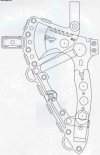
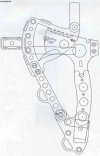
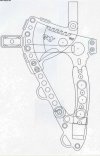
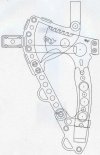
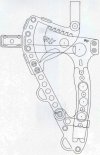
Combatchet Proto WIP

This has been very interesting to watch and the suggestions you incorporate into your design, I have a design for a combat axe myself, although I went in an entirely different direction. However my axe is also a combat usable design. Thank you for posting, I will post mine when its finished.
Del
 
Man looks like you have put in a lot of thinking on this. The design looks awsome, I cant wait to see one. :thumbup:

Adam
 
Delbert,Thanks.When I started this thread,I didn't expect so many great suggestions.
I'm looking forward to seeing your combat axe.

Adam,It's turned into quite a complicated design.Hopefully soon I will post progress pics.:D
 
wow it's cool to watch the progress as this one moves along.
I like theidea of the saw but have been thinking what if it were moved to the underside of the hatchet head. this way you just have to hook it around limb or whatever youre sawing and pull towards yourself as you rotate the handle downa and up sawing. just my .02cents
 
Edmonton hunter,The design has progressed nicely.Your idea about locating the saw on the underside presents some space issues,No room +You have the beard edge on the underside.And if you want to use the finger ring,The saw would negate that.Your idea would work if only there was ample room to do that.Thanks for your input.:D

I'm looking at the complexity of the articulating sheath,I did this to address the using the pry bar with the head blade secure.

My question is,Is it important to have the head secure in the sheath when using the pry bar?Would'nt someone use the pry bar after they unsheathed it?:confused:
Input welcome.
 
One more question.I visualize using the finger ring,The wire cutter notch looks to make that uncomfortable to use effectively.At one time I relocated the cutter notch near the end of the handle,Would it be less effective in that area?
 
I did a little relocating work.I was concerned that the wire cutter notch location would be uncomfortable while using the finger ring,I relocated it to the top of the head.That afforded me to add some mild traction grooves underside of hammer attachment,Also orientated the oxygen wrench slot vertically.:D
 

Attachments

  • Combatchet Proto Pics #3 003.jpg
    Combatchet Proto Pics #3 003.jpg
    36.4 KB · Views: 51
If it was me, I would take the hatchet out of the sheath to use it as a prybar. I dont see how that saw could work very efficiently because of the weight, length of handle, shortness of blade and thickness of stock. I missed what it was that the saw would be used for.
 
I would want to be able to use the prybar while sheathed because who knows what position you would be in, how stable your balance, how sure your grip, when you're in need to do some prying with a combat hatchet. Holding it at the sharp end and applying a lot of lateral pressure to move something heavy or stuck makes me want to have a barrier between me and the cutting edge and saw.
 
Hey Rick,

I think it is looking great! As for the reposition of the wire notch, there is going to need to be alot of force brought to bear in order to twist the wire enough to snap it... don't know if that can be done with where it is now

As for needing to be sheathed in order to use the pry bar, I would be griping it just under the Axe Head, so I don't see a need for it.

Frank B
 
hardheart,Thanks for your explanation for having head sheath covered while using pry bar,The articulating sheath feature is a complicated affair.I wanted to way my options,I have a different approach on the spine.I'll post it soon,Get feedback on the design.

Frank,Could I relocate the wire cutter notch near the end of the handle?On the outside of the profile,Trying to visualize the twisting action needed to break a wire.
 
This is a redesign based on my concerns regarding the wear on the kydex at the pivot on the stop pin & slot,This configuration uses a titanium spine bar.The stop pin could be press fit to the bar,Thus reducing wear in the area.Also you could remove the spine by removing the 2 fasteners attached to the head if you didn,t want to use pry bar sheath.I will use a stainless pivot so you could tighten the pivot to keep the pry bar section from flopping around.
 

Attachments

  • Combatchet Proto Pics #4.jpg
    Combatchet Proto Pics #4.jpg
    35.1 KB · Views: 27
Hey Rick,

I have a big request... May I use your design to make a prototype on my end and do some field trials??

A whole bunch of people are really interested in this on my end. They would be more than happy to take it out and see what works....

This would definately help find the ideal position for the Wire Breaker notch. I even have some SERE guys around who could take it out for a spin! (Survival Evasion Rescue Escape).

What do you think??

Frank B
 
Last edited:
Frank,I'd be glad to send a prototype to you soon as me & my waterjet guy work on getting the CAD drawing right & produce a workable proto.:D We are still discussing the details concerning manufacturing this concept,I definately want some field testing performed before I go further in manufacturing a weapon/tool such as this.That's where you and fellow soldiers will be my field & real world testers.

Worked on scale.Decided that the handle would be subjected to hard abuse,I thought using 8-32 stainless buttonhead screws would be durable enough for this application.For grip & index, I incorporated a milled groove in the scale material.

Increased head & beard edge slightly.
 

Attachments

  • Combatchet Proto Pics #4 001.jpg
    Combatchet Proto Pics #4 001.jpg
    34.1 KB · Views: 19
Few real small changes.Moved cutout logo on head sheath in a more centered spot,Moved etch logo out from under the head sheath.Lessened the point on one side of the wire cutter slot,That should make it more comfortable when using the finger ring.Little details.
 

Attachments

  • Combatchet Proto Pics #4 002.jpg
    Combatchet Proto Pics #4 002.jpg
    34.5 KB · Views: 27
Just a few opinions from someone who goes outside the wire frequently, While the axe itself is a pretty nice design, I think the sheath might be over engineered. I wouldn't worry so much about the dual retention issue, as the last combat airborne op was in WWII. As long as the axe will stay put fairly well and the sharp points are covered you should be alright. You have to remember that space is at a premium when it comes to personal gear. If you make your sheath too big and cumbersome, it won't matter how great of a tool you've made because no one will have room to carry it. I would keep the sheath simple in a way which allows me to attach it to molle gear. regularly spaced holes and slots make this easy using 550 cord, but if you really want to be highspeed, find out a way to attach Molle attachments to the back. Also, a retention strap in the back is ok. I personally wouldn't worry too much about covering the prybar, as it shouldn't be super sharp anyway. If you're looking for a place to put the wirecutter notch, I think a good spot for it would be to set it up as a split in the prybar. This way you could also use it for pulling nails or something along those lines (although I'm not really sure when I'd need to pull nails in combat) As for the saw, it's nice and all, but I'm not sure how I would get decent leverage on it without cutting my hands. Oh, I also think the G10 scales are a MUCH better idea than cord wrap. I think it's important to note that an Axe is more likely to be used as a tool than a weapon outside the wire, so a steel which is strong enough to, say, cut open a vehicle or something along those lines would be best. Just my two cents as someone who spends a decent amount of time on the ground.

Oh, by the way, what CAD program do you use?

 
Rick---This "Machine" is getting a lot of Press!! :eek: :thumbup:
Don't give up on knife making, though. :p
 
Just a few opinions from someone who goes outside the wire frequently, While the axe itself is a pretty nice design, I think the sheath might be over engineered. I wouldn't worry so much about the dual retention issue, as the last combat airborne op was in WWII. As long as the axe will stay put fairly well and the sharp points are covered you should be alright. You have to remember that space is at a premium when it comes to personal gear. If you make your sheath too big and cumbersome, it won't matter how great of a tool you've made because no one will have room to carry it. I would keep the sheath simple in a way which allows me to attach it to molle gear. regularly spaced holes and slots make this easy using 550 cord, but if you really want to be highspeed, find out a way to attach Molle attachments to the back. Also, a retention strap in the back is ok. I personally wouldn't worry too much about covering the prybar, as it shouldn't be super sharp anyway. If you're looking for a place to put the wirecutter notch, I think a good spot for it would be to set it up as a split in the prybar. This way you could also use it for pulling nails or something along those lines (although I'm not really sure when I'd need to pull nails in combat) As for the saw, it's nice and all, but I'm not sure how I would get decent leverage on it without cutting my hands. Oh, I also think the G10 scales are a MUCH better idea than cord wrap. I think it's important to note that an Axe is more likely to be used as a tool than a weapon outside the wire, so a steel which is strong enough to, say, cut open a vehicle or something along those lines would be best. Just my two cents as someone who spends a decent amount of time on the ground.

Oh, by the way, what CAD program do you use?

MJF,The sheath design addresses covering any dangerous point or edge.The overall footprint of the design would not change much if I eliminated the pry bar sheath section,The articulating pry bar sheath feature is not absolutely neccesary.As far as the dual retention,I've done some research on current available products.8 times out of 10,They incorporate some type of redundant safety retention system.You brought up the Molle system,I need to do some further research on that system.That might be something I can incorporate in this design.I like your take on effective location of wire breaker.
My thought was on utilizing the saw,The finger ring would provide a secure means of purchase while using the saw.Using G-10 for handle material on this design seemed the most durable material to use,And the fact you could easily interchange different color scales using screws instead of permanately pinning the scales.I decided 1/4" S-7 would be the logical choice of steel for a tool subjected to impact stress,Going with 1/4" would give the design the neccesary strength while keeping the weight managable.With the small size,I want it to be quickly manipulated.I use Omax CAD software,My waterjet guy sent me a disk to download,This software is what his waterjet machine operates on.Based on AutoCad.Thanks for your input.:D

Rolf,I think you should have meant MONSTER instead of machine!;)Thanks.
 
I thought the saw teeth needed to be exposed slightly.
MJF suggested locating the wire breaker at the pry bar end,It acts as a pry bar/nail remover.:D
 

Attachments

  • Combatchet Proto Pics #5.jpg
    Combatchet Proto Pics #5.jpg
    36.2 KB · Views: 28
Back
Top