
-
The BladeForums.com 2024 Traditional Knife is available! Price is $250 ea (shipped within CONUS).
Order here: https://www.bladeforums.com/help/2024-traditional/
You are using an out of date browser. It may not display this or other websites correctly.
You should upgrade or use an alternative browser.
You should upgrade or use an alternative browser.
I'd like to make a sword.
- Thread starter Daniel Fairly Knives
- Start date

- Joined
- May 4, 2001
- Messages
- 1,553
Never played a sword maker, not even on a medieval soap opera. Made a few knives tho - but I know it isn't the same ;~)'
Back to your original question: For an air hardening steel it seems that S7 would work well but I don't know where you would find a reasonable priced source for it.
Back to your original question: For an air hardening steel it seems that S7 would work well but I don't know where you would find a reasonable priced source for it.

- Joined
- Feb 5, 2010
- Messages
- 3,911
I'd summarize Kevin's comments with "abandon hope all who think you're making a sword." Apparently, most folks that claim to make a sword are actually making sword shaped objects instead, suitable for hanging on walls or burying with the deceased that tried to use it to defend themself.
I recall seeing a web site or document that described the patterned steels used in old swords. It was made from several types of rods that were forged together in a specific way. Clearly not done that way JUST for the visual effect that damascus offers today, though the pattern was visible on some swords.
After reading Kevin's comment it occurs to me to wonder if this is what he's referring to about the games old western sword makers played with mass distrubtion on double edged swords and their complex cross sections and longitudinal geometries.
I recall seeing a web site or document that described the patterned steels used in old swords. It was made from several types of rods that were forged together in a specific way. Clearly not done that way JUST for the visual effect that damascus offers today, though the pattern was visible on some swords.
After reading Kevin's comment it occurs to me to wonder if this is what he's referring to about the games old western sword makers played with mass distrubtion on double edged swords and their complex cross sections and longitudinal geometries.
- Joined
- Sep 9, 2003
- Messages
- 2,361
What would you say a good balance point would be?
Unfortunately that is also one of the common misconceptions when dealing with swords, there is no singular ideal balance point. Each sword matches the stature and fighting style of the user. Example, a longsword will not balance the same as a rapier, nor a Norman piece or Viking blade. And it will even vary among similar swords. Although not a great analogy, there are all different weights and sizes of baseball bats or pool cues, and each will find its best use in different hands. One of the most common errors I see in first sword attempts is to focus solely on a single point of balance and then make the blade any weight while using a overly heavy pommel to achieve that rigid balance point. I have had the pleasure of handling original unhilted blades and they felt wonderful all by themselves.
The swords vs. SSO thing always seems to ruffle feathers in a general knifemaking environment, sorry guys but it is common terminology among sword makers. Guys who have devoted themselves to swords long enough to grasp the differences realize how oversimplified swords are often perceived as, as they themselves once did until they began to scratch the surface. The term SSO is not necessarily meant as derogatory, but is an attempt to illustrate with words, when words really cannot suffice, the stark contrast between many modern replicas and the original pieces. They look alike, have a similar shape, but dont feel even remotely similar in the hand, hence a sword shaped object. Nothing wrong with SSOs I have made a few myself, just they are a different item than actual swords.
I am not always comfortable with being paraphrased, it more often reflects others opinions instead of my own. The particular problem with attempting it with my previous post is that even typos can lend to the confusion. Thus, in this case, I am capable of miscommunication quite well on my own without any help. The sentence It is to darned hard to make a real sword because a real sword is for killing people, so there is no legitimate way to test if you got it right was completely changed by the mistyping of one singular letter- t, the word to was not meant to be too it was meant to be so. Correcting it conveys my meaning from- it is impossible to do, to- it is difficult to do, but not impossible.
Also realize that I approach swords from a more universal perspective of all swords from many cultures and historical periods. Many people tend to have a very Japanese centric vision when using the word sword. In my opinion Japanese swords are easier to approach accuracy with since there are so many well preserved and accessible originals, as well as practitioners in their use.
The assembling of differing materials in early blades was a manufacturing necessity due to the technological limitations at the time, to be overcome within the next 500 years or so (not much time in sword history). It had little bearing on the actual geometry and mass distributions of the blade which were in response to the demands of use. There are, however, many instances in history where the materials allowed changes in shape and battle tactics.
I do not mean to discourage anybody from trying their hand at swords, just as Stacy or others are not trying to discourage by suggesting 100 or so smaller blades before taking in such a challenge. I am just trying to help by suggesting a total change in the approach which could make things easier. It is quite the same thing I drive home in my ABS dagger classes- they are not more difficult as much as they are very different, try to make a dagger like you would a bowie and it is going to defeat you, try to make a sword as if it were just a big knife and you will probably get neither, but perhaps a nice SSO.

Although I want to help with as much insight about old swords as I can, I should just refrain from these discussions due to the way the frank input is so often received. People love to get the ugly truth about how to make better heat treating choices, perhaps I am in error in assuming that it is the same with swords.

- Joined
- Dec 6, 2010
- Messages
- 1,154
Thanks for the response. Just to clarify I am making a D2 SSSO(Short Sword Shaped Object).
The balance point I have is about 2.2" into the blade.
The balance point I have is about 2.2" into the blade.

- Joined
- Sep 5, 2010
- Messages
- 2,691
There's a similarity to guitars. I find that lots of GSO's exist, Guitar Shaped Object.
Many chain stores are full of them.
A wood worker could build a great looking guitar, but how does it play and sound to a guitarist?
A novice guitar player can't tell if a guitar is a good one or a bad one, and the chain stores know it.
A GSO makes for a good wall hanger, and that's it. To learn how to play on a POS, makes playing more difficult. A real guitar sings, is balanced in hand, has dynamics, and plays well up and down the neck.
Sorry to get off topic, but I think it adds to Kevin's perspective. And it's difficult to tell someone their guitar is just shaped like a guitar.
Many chain stores are full of them.
A wood worker could build a great looking guitar, but how does it play and sound to a guitarist?
A novice guitar player can't tell if a guitar is a good one or a bad one, and the chain stores know it.
A GSO makes for a good wall hanger, and that's it. To learn how to play on a POS, makes playing more difficult. A real guitar sings, is balanced in hand, has dynamics, and plays well up and down the neck.
Sorry to get off topic, but I think it adds to Kevin's perspective. And it's difficult to tell someone their guitar is just shaped like a guitar.

- Joined
- Jan 9, 2011
- Messages
- 16,589
I think I have a grip on what some of you are saying.
A guy I know is a swordsmith, he makes some cool stuff. His swords are his own style, he likes big heavy viking style gear and his fit and finish are impressive. The first thing I noticed when I felt his swords was they felt dead in the hands, I don't know a better way to describe it.
My Dad on the other hand used to have a small collection of Japanese swords, Katanas I presume. He had a couple of older replicas (I guess 100-200 years old) as well as a WW1 Officers Sword (I think that is the name, they have a molded brass handle that looks like a cord wrap)) and one very nice "real" Katana. The swords were all OK but the nice one felt alive in your hands. I want to go for that!
A guy I know is a swordsmith, he makes some cool stuff. His swords are his own style, he likes big heavy viking style gear and his fit and finish are impressive. The first thing I noticed when I felt his swords was they felt dead in the hands, I don't know a better way to describe it.
My Dad on the other hand used to have a small collection of Japanese swords, Katanas I presume. He had a couple of older replicas (I guess 100-200 years old) as well as a WW1 Officers Sword (I think that is the name, they have a molded brass handle that looks like a cord wrap)) and one very nice "real" Katana. The swords were all OK but the nice one felt alive in your hands. I want to go for that!
Last edited:
- Joined
- Jan 9, 2011
- Messages
- 16,589
There's a similarity to guitars. I find that lots of GSO's exist, Guitar Shaped Object.
Many chain stores are full of them.
A wood worker could build a great looking guitar, but how does it play and sound to a guitarist?
A novice guitar player can't tell if a guitar is a good one or a bad one, and the chain stores know it.
A GSO makes for a good wall hanger, and that's it. To learn how to play on a POS, makes playing more difficult. A real guitar sings, is balanced in hand, has dynamics, and plays well up and down the neck.
Sorry to get off topic, but I think it adds to Kevin's perspective. And it's difficult to tell someone their guitar is just shaped like a guitar.
I own over 30 guitars from a 100 year old solid flame maple with a mother of pearl fretboard and ivory trim to a $30 Ibanez I restored. I know what you mean!
The difference between a PRS and a POS is very subtle!


- Joined
- Jan 6, 2005
- Messages
- 9,680
I know Kevin is off to the show soon... I may have missed my window but perhaps one of the swordsmart folks could comment.
I know from stick/staff fighting that when a long straight implement is struck (in the case of a sword, lateral impact) it vibrates and there are two(2) pivot nodes(for lack of the proper term) that have less transmission of energy to the holder. Here is a crappy drawing to illustrate...
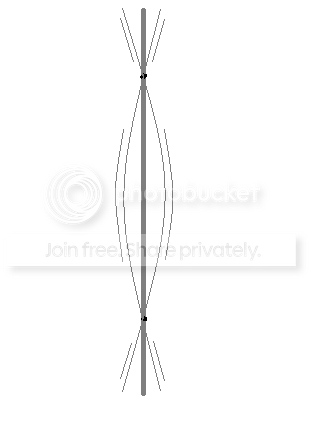
I would strongly suspect these come into play with regard to sword design... atleast it would if I were designing one... having experienced these vibrations, first hand (no pun intended)
Rick
I know from stick/staff fighting that when a long straight implement is struck (in the case of a sword, lateral impact) it vibrates and there are two(2) pivot nodes(for lack of the proper term) that have less transmission of energy to the holder. Here is a crappy drawing to illustrate...
I would strongly suspect these come into play with regard to sword design... atleast it would if I were designing one... having experienced these vibrations, first hand (no pun intended)
Rick

- Joined
- Jun 28, 2010
- Messages
- 219
If you are going to make a sword out of 3V, I would be happy to share what I know.
I am not well known but I have been making swords with cpm 3v since 05.
Dan Keffeler
I am not well known but I have been making swords with cpm 3v since 05.
Dan Keffeler

Erin Burke
KnifeMaker...ish
- Joined
- May 19, 2003
- Messages
- 1,330
I know Kevin is off to the show soon... I may have missed my window but perhaps one of the swordsmart folks could comment.
I know from stick/staff fighting that when a long straight implement is struck (in the case of a sword, lateral impact) it vibrates and there are two(2) pivot nodes(for lack of the proper term) that have less transmission of energy to the holder. Here is a crappy drawing to illustrate...
I would strongly suspect these come into play with regard to sword design... atleast it would if I were designing one... having experienced these vibrations, first hand (no pun intended)
Rick
Rick,
You are absolutely correct.

In sword circles I believe these are often called the primary and secondary nodes. Years back, when I was more excited about swords, nodes were one of the hot topics. We used to go over to Gus Trim's shop and cut up all kinds of stuff... and I remember doing a lot of "pommel bumping" to see these vibrational nodes.
- Joined
- Jan 9, 2011
- Messages
- 16,589
If you are going to make a sword out of 3V, I would be happy to share what I know.
I am not well known but I have been making swords with cpm 3v since 05.
Dan Keffeler
I'm thinking 3v will be the way to go. Fire away!
Thanks Dan!
Rick, Thanks for posting the diagram!
Thanks everyone!
Last edited:

- Joined
- Dec 6, 2004
- Messages
- 6,212
i too hate the "razor sharp" anything thats not a razor or to have some one find out i make razors adn then ask me to sharpen there knife to "razor" sharpI hate, loathe and despise the expression the sword had a razor sharp edge, it is perhaps one of the most retarded things I have ever heard! First the speaker obviously has never worked with a razor or a sword before. Secondly a sword with a razor edge would be about as useful as a razor with a sword edge.
im getting ready to make my first sword
its W2 and i am braking most the rules and making a truly razor sharp sword
at the fish markets they have "tuna swords"
24+ inch blades that are single beveled and used only for this one job of braking down large tuna there is a smaller stiff one and also a real monster that is super flexible and used by 2 men at a time liek a old logging saw
back to the thread tho i love 3v and know how tuff it is even at Rc61 in the 55Rc range it must me dam near indestructible
- Joined
- Jan 6, 2005
- Messages
- 9,680
Couldn't resist... I made this for another thread where he was directly mentioned as a wizard...One thing I absolutely LOVE about this forum is the way experts freely chime in. ... Keep it up, Kevin... please!

james terrio
Sharpest Knife in the Light Socket
- Joined
- Apr 15, 2010
- Messages
- 22,618
Couldn't resist... I made this for another thread where he was directly mentioned as a wizard...
Overnight that to me and I'll present it to him at the Badger Show.
Oh wait, it's just a photoshop deal...
 . Not a kit doll, by any chance, is it?!?
- Joined
- Jun 17, 2001
- Messages
- 5,705
I'm not sure if Rob is still making swords but I do know he used A-2. You might try contacting him through his web site: http://www.criswellswords.com/
- Joined
- Jan 6, 2005
- Messages
- 9,680
Overnight that to me and I'll present it to him at the Badger Show.
Oh wait, it's just a photoshop deal...
No questions please. Refer to website. That is all.
Simple Rick
- Joined
- Jan 9, 2011
- Messages
- 16,589
I bought the Wally Hayes Tactical Katana video and have to say, it was well worth it. Honestly, it was a bit much for me to spend on a video. I was apprehensive but within a few minutes I feel it payed for itself!
Thanks for recommending it and I would do the same.
When he explained how the sword makes a whooshing sound... I knew it was paid for. I felt undecided but now I really, really want to make a Katana. I'll probably use 1050 like he does and treat it myself. After watching this I realize how much I needed to see someone else work, it was so helpful.
Thanks for recommending it and I would do the same.
When he explained how the sword makes a whooshing sound...
I knew it was paid for. I felt undecided but now I really, really want to make a Katana. I'll probably use 1050 like he does and treat it myself. After watching this I realize how much I needed to see someone else work, it was so helpful.
Last edited:
- Joined
- Jan 6, 2005
- Messages
- 9,680
Good stuff, Daniel. Wally will love to hear that. It is one of the best "Katana for Dummies" I have seen. You learn several different components of the sword, without having to get into too much detail. Definately not traditional... but functional and a whole lotta fun.
Rick
Rick