
I'd like to make a sword.

Does his video cover the aspects of balance, mass distribution, and the vibrations from impacts?
I'm not thinking of making a sword, but from a buyer's perspective. I like the idea of the modern sword, but want it to "work" as well as an example from the past.
I'm sure I could get a SSO, and go hack through the forest. But, that doesn't meant it's made to perform the same.
 
Good stuff, Daniel. Wally will love to hear that. It is one of the best "Katana for Dummies" I have seen. You learn several different components of the sword, without having to get into too much detail. Definately not traditional... but functional and a whole lotta fun.

Rick

I feel he has changed my whole perspective on the craft.

I like his laid back approach. I now feel like I was in too much of a hurry with things; I thought I was too slow.

I have a few books on swords that explain what the components are called but to see them on video changes everything.
 
Does his video cover the aspects of balance, mass distribution, and the vibrations from impacts?
I'm not thinking of making a sword, but from a buyer's perspective. I like the idea of the modern sword, but want it to "work" as well as an example from the past.
I'm sure I could get a SSO, and go hack through the forest. But, that doesn't meant it's made to perform the same.

He explains everything with good detail, the video is two hours long so he has a chance to cover a lot. He explains how the sword must be shaped for performance and in a traditional manner.

The sword itself is simplified in ways, he uses a mild steel gaurd, kydex handle underlay, modern cord wrap, that type of thing. He uses better glue and more modern readily available materials, but you could use rice glue, silk, and rayskin on the same sword, as well as traditional tsuba material. He uses 1050 steel which is top notch material for a traditional or modern katana.

As an ABS Mastersmith I feel he compromises nothing as far as making a fully functional sword. You should see the video, I was floored! I had no idea what a real sword would do.


I have to say, no video will make anyone a good swordsmith, but it was a good start for this beginner.
 
Does his video cover the aspects of balance, mass distribution, and the vibrations from impacts?
I'm not thinking of making a sword, but from a buyer's perspective. I like the idea of the modern sword, but want it to "work" as well as an example from the past.
I'm sure I could get a SSO, and go hack through the forest. But, that doesn't meant it's made to perform the same.
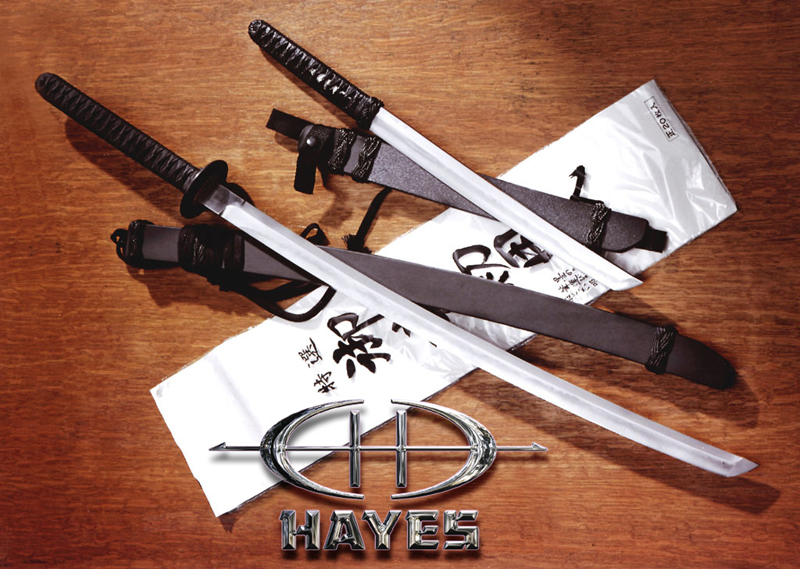
What type of "work" do you want it to do? If you are a traditional martial artist and would like a high-end traditional working sword... the Katana Tac might not be for you. He uses all the traditional geometry of the Katana... his "allowances" are in the handle. Rather than having it mount into a Tsuka, he goes full tang with a wrap(adding lightening holes). The ricasso is filed to "suggest" a habaki. It is definately lacking most of the fittings of a traditional katana. It is what it is... there is no marketing hype... Wally is a straight shooter.

blade4.jpg
 
Last edited:
On the sharp topic,
I had a custom order for a Scottish short sword. It ended up really nice. The customer loved it when he picked it up. The next week he brought it back and said it was not sharp. I checked and said it was just right for a sword of this type. He said that any good sword should be able to slice paper easily, and it would not cut paper cleanly. I told him he had watched too many movies. He said that he was the customer, and wanted me to re-grind the blade with a hollow grind edge. I responded that such an edge would fail quickly, and was not proper for a short sword, which should have a fairly steep edge angle..... and offered to refund his money if he was dissatisfied with the sword. He said that he still wanted it and left. I found out a few weeks later that he took it home and ground the edge down very sharp. He then went to the woods and did some "cutting practise"......and broke the blade in half.
He never mentioned it to me, even though he bought another sword later that year.
 
What type of "work" do you want it to do? If you are a traditional martial artist and would like a traditional working sword... the Katana Tak might not be for you. He uses all the traditional geometry of the Katana... his "allowances" are in the handle. Rather than having it mount into a Tsuka, he goes full tang with a wrap(adding lightening holes). The ricasso is filed to "suggest" a habaki. It is definately lacking all the fittings of a traditional katana. It is what it is... there is no marketing hype... Wally is a straight shooter.

Rick explained it better than me.

On the sharp topic,
I had a custom order for a Scottish short sword. It ended up really nice. The customer loved it when he picked it up. The next week he brought it back and said it was not sharp. I checked and said it was just right for a sword of this type. He said that any good sword should be able to slice paper easily, and it would not cut paper cleanly. I told him he had watched too many movies. He said that he was the customer, and wanted me to re-grind the blade with a hollow grind edge. I responded that such an edge would fail quickly, and was not proper for a short sword, which should have a fairly steep edge angle..... and offered to refund his money if he was dissatisfied with the sword. He said that he still wanted it and left. I found out a few weeks later that he took it home and ground the edge down very sharp. He then went to the woods and did some "cutting practise"......and broke the blade in half.
He never mentioned it to me, even though he bought another sword later that year.

:eek: The things people do... he probably ground it to red hot and quinced it too. :D

I feel the same way about my choppers, If I ground them like a slicer they wouldn't be good for anything.

On a side note my Dad told me he has seen a lot of nice Tsubas turned into belt buckles. :eek:
 
Last edited:
Movies and myths have destorted the use, abilities, and limitations of knives and swords.

Rick, the Hayes swords seem to be what I have in mind. I'm all for improving the handle, doing a full tang length, all the while keeping the blade traditonal. Hundreds of years of war has led to a design that works, I don't think I could improve on that myself.
I'd like to own a fully functional katana, without all the parts to the handle. Why, I like them, I'm not a swordsman, nor would I go chopping trees with it. I would like to cut tami, soft targets, pumpkins, and "safe" taragets. Maybe Zombies, if the need arises.
 
I don't mean to interrupt or take away from the great info here but I have been toying around in my head. I want to play with the idea of making an "Egyptian" style Khopesh. More of a short sword, as I understand they weren't that long. Originally they were bronze and I am sure the handle materials were different. I think, in my head at least, this changes the balance. They originally descended from a hand axe type weapon and looking at the pictures of older ones, they would have balanced much the same. Though most pictures are of decorative pieces from tombs.

Anyway, my idea is to make one, 24 inches in length. The idea is more of a machete or branch hacker. Because of the design, I am thinking the balance will be off. More like an axe, but more balanced. For those who have done swords, or studied them, does this sound about right?

I'll admit I'm young and just study these thing as a hobby, I am working on my 5th knife, and two were just KSO's. I don't expect to be doing this anytime soon. I figure if I plan it out right and practice by working on knives I can learn enough and understand what needs to be done. Thank you, and sorry for telling my life story :P
 
I have never made a sword and I probably won't for a long time yet, but I have studied various styles over the years. (Yes, I know how that sounds hehe) Different styles of swords were used in different ways; medieval swords (2 hand or hand and a half type) were mostly bludgeon tools designed to defeat the steel armour of the time, samurai swords were for slicing and chopping, while scimitars were made for cutting from horseback. Can you imagine what would be left of the edge of a razor sharp bastard sword after a battle? How people think about swords can sometimes be amusing and at other times, scary. There is even a guy who writes articles (for a magazine I'm sure most of us read) who routinely "evaluates" swords and takes pictures of his fight against bushes and stuff. I do wonder sometimes if he has ever taken sword lessons of any kind.
 
Blackfeather,
The Khopesh was the origional Smachette. Different shape, but same utilitarian functions.
 
A large, front heavy, hacking weapon. I understand that. That's why I want to make one. I feel most modern reproductions are just the ideal copies of the more ornate ones found in tombs.
 
In reading about the history of the katana, I was reminded as to how many people were involved. Like any other industry, each process has it's specialists. By comparison, lots of modern smiths seem to do most, if not all, of the process themselves.
Sword making, by oneself, seems to be quite the undertaking. One must be multi-talented to excel at each step of the process.
 
In reading about the history of the katana, I was reminded as to how many people were involved. Like any other industry, each process has it's specialists. By comparison, lots of modern smiths seem to do most, if not all, of the process themselves.
Sword making, by oneself, seems to be quite the undertaking. One must be multi-talented to excel at each step of the process.

I was telling my parents about my interest in sword making. They remarked that they saw a show in which it took a week to make one and how much work that was. All I could think was... a week, that dude must be fast!

I'm researching everything still, Aldo was very helpful and I'll likely go with his 1075 steel in 5/16 thickness for a nice katana. I'm going to make some smaller swords in 5160 to start since I can send them off and I think smaller will be a bit easier.

Now I need to find a good vice for swordmaking since I only have a smaller one. The flea markets start soon, sometimes they have some nice older tools there.
 
Last edited:
You inspired me to go back and watch Wally's DVD again. He gave it to me when I first started to visit his shop. Years later... I see and understand the simplicity he tried to achieve with it. I have seen what goes into the traditional Katana and it is mind boggling to think that one person can do it all, nowadays. I can easily see why the swords of old are such treasured pieces. In this day and age, you can't realistically put the time in and specialize to the degree that the ancient craftsmen did. That is not to say we are incapable of achieving total mastery... the scientific understanding we have now far exceeds that of the past. IMO, society as a whole, doesn't hold specialized craftsmen in the high regard that they once did. Cheap, quick, convenient have become the new benchmarks in the age of the "Big Box".
 
Walter Sorrells has some super DVDs on this subjects,too. I think they may be some of the best out there. I would suggest anyone thinking of making a Japanese sword buying the whole set. You could sell them for nearly what you paid....but I bet you will never let them go.

http://waltersorrellsblades.com/videos/
 
I'm currently working on a 24" blade, my first at that lenght. I won't go much further, other than to say it's been HT'ed and quenched twice now, each time it ended up warped. I can do it, I can do it, well....if I can get past this warp issue. I may end up just straightening it and sending it out for HT, although I'd hate to do that.

Daniel, I will say one thing, it is a lot of fun, despite my current problem. I say go for it!

Dave
 
David,
Why don't you just straighten the warp right out of the quench. You should have plenty of time before the Ms. I stick the blade's tang in a vise and use a slotted piece of wood to twist/bend as needed. A few quick smacks with a wooden mallet on the anvil takes care of the rest.
 
Stacy, The blade looks fine out of the quench. It's only when I have the scale off that I see a slight warp. Guess part of my problem is I need to develop the "eye" to see a warp in a long blade.

Dave
 
Back
Top