Queen purchase finalized!

GEC has a traditionalist on their team, and consults with antique knife enthusiasts (some who are antiques themselves!):D

I may be wrong but it seems GEC uses a bit of artistic license with "Traditional" patterns. They looks nothing like my old Camillus, Case, Schrade or other old makers patterns.
 
I may be wrong but it seems GEC uses a bit of artistic license with "Traditional" patterns. They looks nothing like my old Camillus, Case, Schrade or other old makers patterns.

That can be good or bad, imho, but often the ones that I see don't quite ring my bell. Some do, however, at least from the images I've seen here on the forum. Different strokes and all that.
 
I may be wrong but it seems GEC uses a bit of artistic license with "Traditional" patterns. They looks nothing like my old Camillus, Case, Schrade or other old makers patterns.

Interesting observation Dave (is it Dave?). I think you are right in some cases. But I also think that GEC is leaning more and more toward knives that reflect the oldies. Their bone jigging has been getting more and more sophisticated. And make no mistake, jigging bone like the "old timers" did it, is a nearly lost art. I've been looking at jigging, which is one of the main visual features of a pocket knife, for 20-30 years, and I am very interested in watching GEC's evolution.
Remember, they started from scratch just a few years ago!!
And old companies like Queen, have the dies for old patterns - some from before the world wars!!
GEC has to make them which is an expensive operation! But their developing repertoire is impressive.
Needless to say, I have enjoyed watching them struggle up toward success. I hope they tough it out. I suggest we all keep watching!
I for one try to buy an example of their most successful models. Ones that have that certain something that brings back history.

 
Quote: " I hope they tough it out."
Wow, so do i and i'm sure everyone here. It's safe to say we are all thrilled to have the opportunity to buy the knives GEC has been making. The loss of GEC would be most disappointing.
Am i reading too much into this quote ? i hope so.

roland
 
They are doing OK, Roland, especially considering the financial situation in the world, let alone North America.
As a side note, I detected a real "caring" attitude, for all the people who work at GEC. In my chats with the owner, he feels a responsibilty toward his employees that is heartwarming. No one gets rich working there, (including the owner), but they learn skills, and they have a job!
Buying their knives keeps some Americans in a depressed area, working!
 
Interesting observation Dave (is it Dave?). I think you are right in some cases. But I also think that GEC is leaning more and more toward knives that reflect the oldies. Their bone jigging has been getting more and more sophisticated. And make no mistake, jigging bone like the "old timers" did it, is a nearly lost art. I've been looking at jigging, which is one of the main visual features of a pocket knife, for 20-30 years, and I am very interested in watching GEC's evolution.
Remember, they started from scratch just a few years ago!!
And old companies like Queen, have the dies for old patterns - some from before the world wars!!
GEC has to make them which is an expensive operation! But their developing repertoire is impressive.
Needless to say, I have enjoyed watching them struggle up toward success. I hope they tough it out. I suggest we all keep watching!
I for one try to buy an example of their most successful models. Ones that have that certain something that brings back history.

Charlie, with guys like you guiding them along the way they should have a great future. IMO the Real Harness jack is the closest knife to a real old timer that they have produced. I too find many of their knives just a little off and some a bit chunky for my taste. It's great that they listen. BUT why do they sink their pins :o

Best regards

Robin
 
That can be good or bad, imho, but often the ones that I see don't quite ring my bell. Some do, however, at least from the images I've seen here on the forum. Different strokes and all that.

Perhaps they need to hear from you. You may just be that voice that needs to be heard to push them from very good to great.
 
I've talked to them about the pins, Robin! Keep watching their knives!!;)
 
Perhaps they need to hear from you. You may just be that voice that needs to be heard to push them from very good to great.

Mack, when they've got Charlie as a friend and adviser the last thing they need is my input. (But I appreciate your vote of confidence, brother. :cool:)
 
What is wrong with recessed pins?

Is it historically off? Is it not as strong? Purely aesthetic preference?

I'm a peened pin kinda guy so aesthetcics has a lot to do with it. I have to wonder if a pin that sits half way through the handle is 1/2 as strong as one that fills the hole. There is no head so I worry about a scale that warps and slides up the pin. Basically it looks like a mistake to me.

Best regards

Robin
 
I'm a peened pin kinda guy so aesthetcics has a lot to do with it. I have to wonder if a pin that sits half way through the handle is 1/2 as strong as one that fills the hole. There is no head so I worry about a scale that warps and slides up the pin. Basically it looks like a mistake to me.

Best regards

Robin

Robin, thanks for your reasoning :)

I still hope to hear Charlie's take on it as well.

Kevin
 
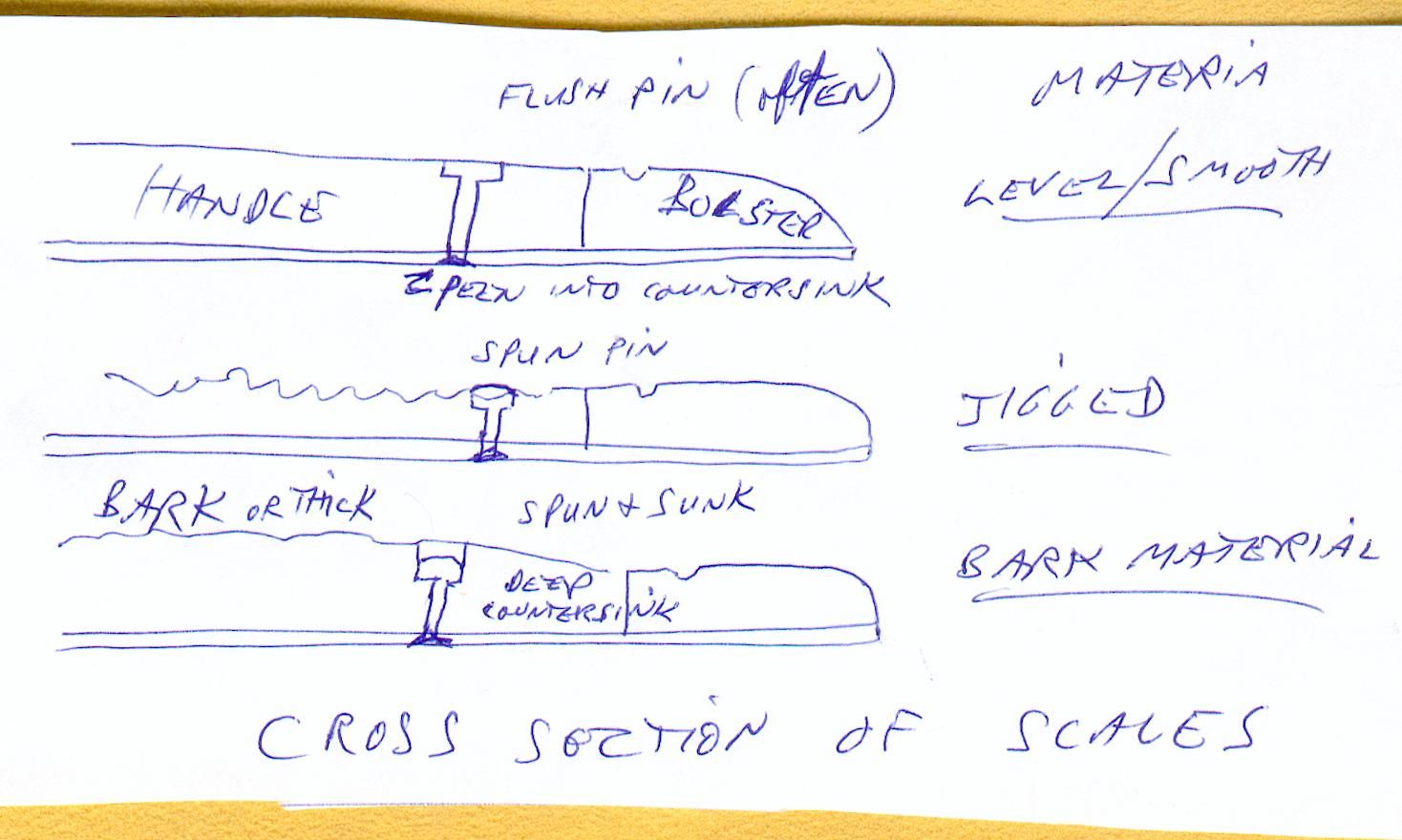
On recessed pins; there is still a "shoulder" for the pin to "pinch" against because the holes are usually countersunk, so material sliding up is not an issue, IMO. Here are crude cross sections of various handle types:

Pincountersinks.jpg


The type of material usually determines how deep the countersink winds up to be.
If the cutler is trying to preserve the "bark" sometimes the countersink needs to be much deeper than the surface.
 
On recessed pins; there is still a "shoulder" for the pin to "pinch" against because the holes are usually countersunk, so material sliding up is not an issue, IMO. Here are crude cross sections of various handle types:

Pincountersinks.jpg


The type of material usually determines how deep the countersink winds up to be.
If the cutler is trying to preserve the "bark" sometimes the countersink needs to be much deeper than the surface.

Makes perfect sense to me, thanks.
 
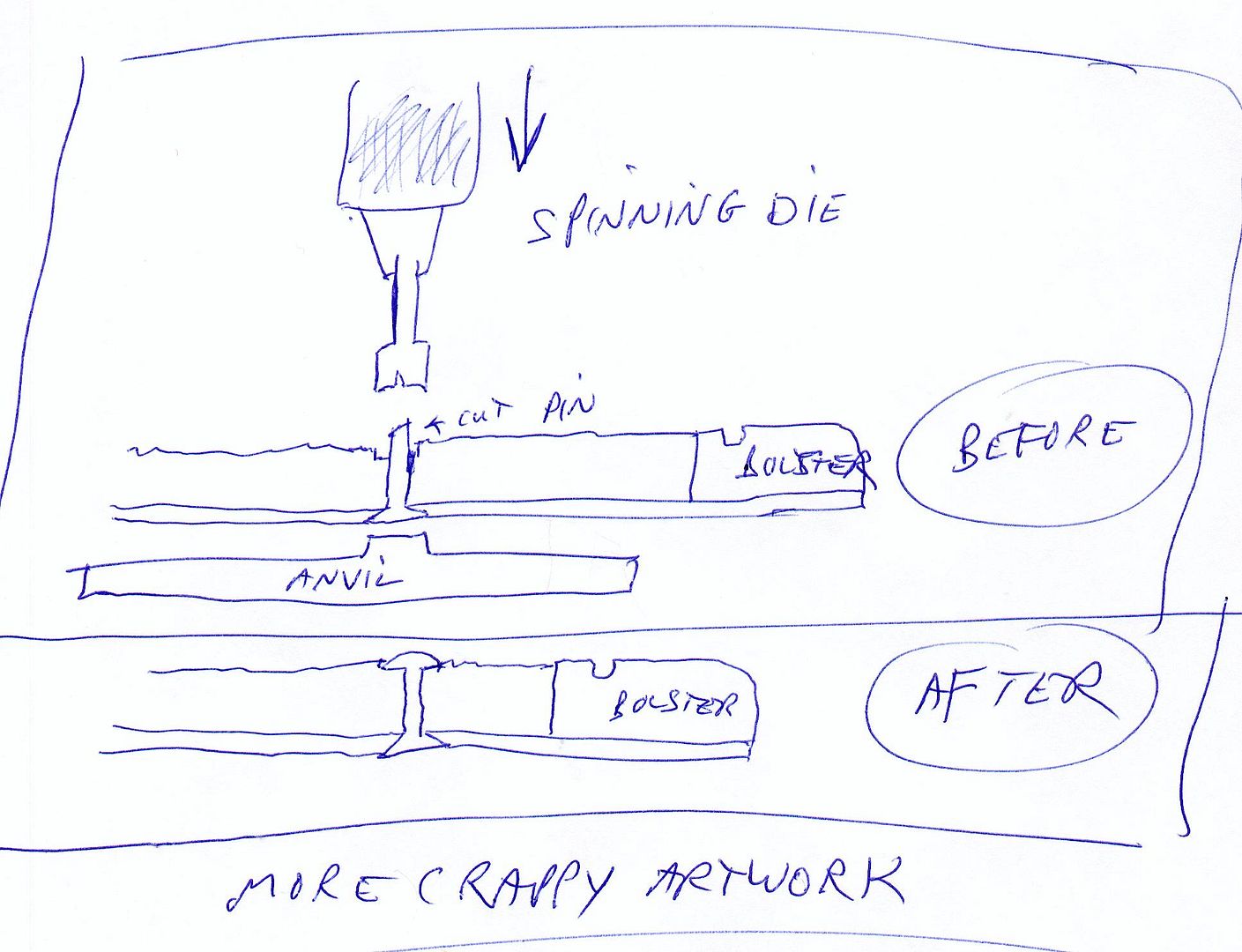
Neal, basically, a spinning die is brought down on the cut-off end of a pin. The die is shaped to form the pin into a cap with a smooth surface. It sort of "smears" the metal down snug against handle material, tightening the handle to the liner.
Pincountersinks2.jpg

Hope this pic helps.
 
Thanks, Charlie.

I'm loving your illustrations-- straight from your hand, and explaining the information clearly.

~ P.
 
Thanks, Charlie.

I'm loving your illustrations-- straight from your hand, and explaining the information clearly.

~ P.
So you're saying my picture is worth a thousand words? :rolleyes:
Saves a lot of two-finger typing I'll tell you! ;)
 
Back
Top