Re-examining the steel snobs.

Status
Not open for further replies.
Rody,
Bearings are a very good option, however, all bearings are not 52100. I offer myself at your service to assist in identifying bearing steel. Just email me or PM here with the manufacturer and part number, and I'll be glad to let you know the steel chemistry of a bearing. scottickesknives@gmail.com

Thanks for the kind offer! Next time I intend to use a bearing (I use the races BTW, not the balls/rollers) I will certainly take you up on it. Funny thing, I went to our local bearing shop to ask for any old bearings they might have expecting funny looks. None of that, they just heaved a box full of old bearings (including some honkin big ones) onto the counter and wished me luck!

Cheers rody
 
There are good sources in Europe. I buy most of my non D2 stock from Nordell Knives from Sweden. The steel section has a good selection of steel: like RWL34, 15N20, UHB20C (similar to 1095)...
I didn't order anything from Steigerwald e-shop but it is also a e-shop run by a German knife maker, who is also a distributor of Bohler steel.

Thanks for the links! The Swedish shop looks promising...

Cheers rody
 
Kevin, well put and I really hope people other than "experienced" makers read your thoughtful post.

When I started making knives I used 1095 barstock for stock removal. I started forging and started using "5160" leaf springs, after making 10 or so knives to get a decent heat treat, I started working on a nice bowie. Heat treat, start polishing..... cracks in the blade. Never again.

I can't remember who the old time maker was that said he helps people because 90% won't listen and the other 10% would figure it out. Well this applies to listening to advice..... 90% won't listen
 
You made an important point about a maker's first knife. It is special.

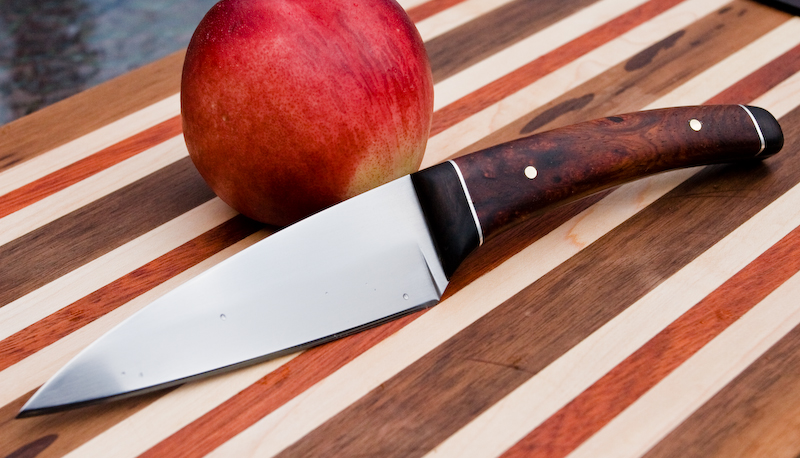
I knew that I wanted my first knife to be something I use every day for a long time. I chose to make a kitchen knife because I would use it every time I cook. I used CPM 154 and a choice piece of cocobolo burl for the handle.

I now have a beautiful, unique, and high-performance knife that happened to be my first blade, too.

2825998780_a737794fee_o.jpg


Phillip
 
Beyond this forum, many well known books recommend using scrap steel, especially for beginners, which contradicts the concept of using known steel presented by many knife makers on this forum...

I have to confess to wincing every time the “$50 Knife Shop” is recommended instead of Wayne’s other book “The Wonders of Knifemaking”, which I feel would be of far more benefit to the beginner. I was very pleasantly surprised when I looked through a friend’s copy of the latter and saw a lot of really solid information, of course the section on “goo” quenching disappointed me. But I would be much quicker to recommend it before the other book which is not bad in itself but needs heavier emphasis on the idea that it is a very basic guide to get the total newbie started to see if knifemaking is their thing or not. Reading too much into it has not done it any favors, in much the same way reading far too much into the ABS bending test has done more harm than good.

Not too long ago on another forum one of those awkward moments came about when a poster requested advice and when it was given, it was summarily dismissed out of hand because the information did not concur with what other makers had told them or they may have read in the well known writings. The next post was not as civil as the previous and although it was harsh I completely understood, since I felt the same frustration that so many experienced makers feel when they get this response. And it took me a bit of self control not to fire back that the ingratitude topped with a generous helping insulting salt to the wound. Most of us see these forums as the only free outlet for some solid counter information to the unchallenged writings in the magazines, which is littered with really shaky information. One of the most erroneous concepts in our society is that publishers review or even care about whether what they print is factual. One can write anything and get it published and the idea that it creates authority, should be disturbing to us all in light of this. That is certainly not to say that every article or book in the knife business is as bad as some of the nonsense I have seen in the magazines, and I am not applying the concept specifically to Wayne’s books, what I am saying is that Wayne’s authority rests in his skills as a knifemaker and the blades he produces, not simply in the fact that he is published.

With a book you get one guys, ideas, tips and pointers, on an internet forum you get the benefit of dozens of experienced makers along with a healthy dose of peer review, that is a very valuable thing if you know how to use it and the forum is a good one. This one tends to be good, so much so that I would put many posts up against much that is in print without a problem.
 
Making knives to some is about more than just making a knife. I know a maker who has made knives (over 2,000) from mostly recovered steel and sells them as quickly as they are finished. Maybe they are not perfect in every scientific way, but he enjoys it and folks have been buying his knives for many years. His finish is far from perfect but folks seem to accept that as “just his style”. I have used a lot of known new steel myself and reclaimed steel as well; however, part of the enjoyment of making knives for me is being on the lookout for some good carbon steel to make a knife, same as looking for new tools and handle materials. I have several things that have family history involved in their use that will make good knives. I have learned to recognize what makes a good knife and to do some testing if I have any questions. I have one piece of bar that was a very old tool and it appears to be shear steel and to me that is something unique to make a knife from. I personally feel that knife making should be something that you enjoy and if using reclaimed steel is fun and what you like then do it. If it is about “time” then maybe one shouldn’t even make a knife, after all there are millions of them out there that will serve all of our cutting purposes. Perhaps we could be doing something more everlasting that would serve society and mankind in a far greater way. After all who can prove everything they do is the best that can be done. The end result can vary regardless of who does it even with similar or known (?) facts especially when it is handmade. Something is only unknown when we haven’t been introduced to it, but once we have then we recognize it when we see it. All steel might not be exactly as introduced, but instead just a “cousin” that is related, even from the factory.
Ramsey
 
not to stir the pot too much... but just cause a steel doesn't come with papers doesn't mean its junk..

-- what bout damacus..( patternweld and mosaic ) theres several metals involved there.. no specific heat treat... ( just throw it out... its junk )

- or crucible steel... if you make up your own.. ... ( ok.. not beginner stuff but still )

with a little bit of skill ( and a pyrometer) ... some okay knives can be made..

I think what is getting blurred here is the boundary of a person having fun with a backyard hobby and a more regular knife maker with blades for sale.. I'd hope that if you sell blades that you'd have a good grasp of what is going on and inform the client of your process..

i'm just not seeing the reason why some folks fuss or panic if your not using the best of the best trendy steel when starting out...
- i have made a couple rebar/file/sawblade knives with fat edges and hammer marks from aways back. ... they were fun to make... even though they're clunky and unsightly

then with more confidence ... you get to the point of buying steel and not worrying about wasting it..

i think with abit of patience ... people will go through this process and grow as knifemakers, experiencing and learning from interacting with the metal..


:o
 
I think recycled steels will be the wave of the future. It's all going to come from recycled anyway...

I really don't care where it comes from,... as long as it's good. :)
 
There's a difference between an experienced maker and a neophyte using unknown steels or recycled steels.

We just want people to be sucessful at the start of their journey, nothing is more discouraging than to work on a knife and then have it fail. Especially when you consider it takes a beggining maker a lot longer to do the things an experienced maker can do.

Why put in hard work and fail because you'd rather not spend $15.
 
True, but just because you didn't spend $15, doesn't necessarily mean you'll fail or that it will be any harder.

I really think taking private lessons with an experienced smith is a valid alternative to some of the larger schools and organizations. At any rate, taking some lessons and getting some training, somewhere, is always a good idea. :)
 
not to stir the pot too much... but just cause a steel doesn't come with papers doesn't mean its junk..

-- what bout damacus..( patternweld and mosaic ) theres several metals involved there.. no specific heat treat... ( just throw it out... its junk )

- or crucible steel... if you make up your own.. ... ( ok.. not beginner stuff but still )

with a little bit of skill ( and a pyrometer) ... some okay knives can be made..


:o

sorry but from my point of view on damascus steel i will not buy for my use (on blades)any damascus that the maker cant tell me whats in the mix. if its mostly unknown steel but looks cool i ll maybe get it for but caps and guards

i also have to pass on a lot of Damascus as a lot of makers use straight nickel sheet in the mix for contrast. mind you i love the look of it but for a razor i can not have soft edge bits in the steel

i would use scrap steel is it all was the same lot (DJ5160 ) and i could get enough to do some testing on and fail a few times

i got a computer controlled kiln before i stepped away from my delta 1x42 so that i could at least know i had a dam good chance at getting the heat treat right (or close to right ) from the get go. i could also trouble shoot problems in the heat treat better and faster

not knowing what steel i was working back then was not even an option.
the first 4 knives i made were file knives and now im tring to get them all back (they were just gifts so im working on trades for new knives)
 
Reminds me of the old Idiom, "You can't make a silk purse out of a sow's ear"
But I'm sure you could make someting.
 
i wonder how many big name makers started out on a rail road spikes and rebar to make a knife when they started out.. and went through the process to become what they are now..... when you think of it... it worked out fine for them..

now how many started out with those papered, 25 dollars pieces of flats stock and pyrometer... hmm

just a guess... but i'd bet there were alot more people starting out on scrap...


hey.. with the economy going belly up... scrap steel might be the norm... :eek:


;)
 
not to stir the pot too much... but just cause a steel doesn't come with papers doesn't mean its junk..

-- what bout damacus..( patternweld and mosaic ) theres several metals involved there.. no specific heat treat... ( just throw it out... its junk )

- or crucible steel... if you make up your own.. ... ( ok.. not beginner stuff but still )

with a little bit of skill ( and a pyrometer) ... some okay knives can be made..

I think what is getting blurred here is the boundary of a person having fun with a backyard hobby and a more regular knife maker with blades for sale.. I'd hope that if you sell blades that you'd have a good grasp of what is going on and inform the client of your process..

i'm just not seeing the reason why some folks fuss or panic if your not using the best of the best trendy steel when starting out...
- i have made a couple rebar/file/sawblade knives with fat edges and hammer marks from aways back. ... they were fun to make... even though they're clunky and unsightly

then with more confidence ... you get to the point of buying steel and not worrying about wasting it..

i think with abit of patience ... people will go through this process and grow as knifemakers, experiencing and learning from interacting with the metal..


:o

Greg,
While it is true that damascus is made up of several steels; it is not true that there can be no specific heat treatment with the mix. This is why steel selection for damascus is so critical. Temperatures for heat treating are given in ranges and with careful selection you can have a mix that is within the same heat treatment parameters.
This is why I abandoned chainsaw chain damascus long ago; I found it facinating, the patterns I got were cool, but no matter what I did I could not get a proper HT for it. When you are dealing with 4 alloy types it is often difficult.
Del
 
sorry but from my point of view on damascus steel i will not buy for my use (on blades)any damascus that the maker cant tell me whats in the mix. if its mostly unknown steel but looks cool i ll maybe get it for but caps and guards

i also have to pass on a lot of Damascus as a lot of makers use straight nickel sheet in the mix for contrast. mind you i love the look of it but for a razor i can not have soft edge bits in the steel

i would use scrap steel is it all was the same lot (DJ5160 ) and i could get enough to do some testing on and fail a few times

i got a computer controlled kiln before i stepped away from my delta 1x42 so that i could at least know i had a dam good chance at getting the heat treat right (or close to right ) from the get go. i could also trouble shoot problems in the heat treat better and faster

not knowing what steel i was working back then was not even an option.
the first 4 knives i made were file knives and now im tring to get them all back (they were just gifts so im working on trades for new knives)

Butch,
I have to agree with you here, I would not use damascus for razors that contained pure nickel. I have a friend that is currently involved with making damascus razors and he uses the same mix I would O-1 & L-6.
I am currently on contract for making 250lbs of finished damascus of the same mix.
Having said that I sell alot of damascus that contains pure nickel, why? The customers like it. I make knives out of it myself. I have put a lot of time effort and thought into making damascus that looks great and that performs well in knives. I have also made a lot of damascus out of steels that would not be good for knives, but was well suited to the function the finished product was to be used for.

I do not use any unknown steels in my damascus because, like you said, if I can't tell you exactly what my damascus contains, then how are you supposed to know how to heat treat it. Actually there is one exception, and that is meteorite damascus, but even then I know which meteorite it is and the elements it contains, so I am really not working with an unknown quantity there.
Thanks,
Del
 
If you're a steel snob because you only use known store bought alloys...Are you, then, a steel slob because you enjoy recycling, you're not pursuing a knife making career nor the path of hard science??? Frankly, I don't wish to be either, but like working with both.

Hi, I'm Phil, and I'm a slob about being a snob. Or is the other way around?
 
Last edited:
I may be part of the group that is made up of the ultimate steel snobs. That being the people who run around and find hidden caches of steel which is no longer readily available like W2 or 1084 or specific formulations like John Deere load shaft 5160:D
 
I understand and agree with this philosophy to a large extent, but I also feel there are valid uses for scrap steel by beginners that sometimes aren't pointed out in these forums.

For example, when I started in this hobby last year, I was unofficially off of work for a few days to 'evaluate my life', so to speak. I really wanted to do something, anything, with this hobby during those few days I had off, and I had zero tools, materials, know-how, or prior experience with anything metal related. I came here asking about something, anything, that I could source easily at a hardware store, that could be used to just allow me to get a feel for filing, sanding, sawing, etc. that would potentially give reasonable but not necessarily perfect results if/when I ever finished it into something. I was happy to pay more than necessary at the time, just to get something fast...with hindsight, I think something like a brand new file from Home Depot annealed in a BBQ or tempered in my oven would have been perfect, but I was implored not to use anything unknown and that I must order new, known steel. It was and is good advice, but not necessarily for the circumstances I was in at that time.

The second case where it makes sense to me is for someone who just wants lots of forging and/or grinding practice, and may not care necessarily that this practice will allow a perfectly heat treated blade.

Again, I agree in large part with those that recommend new, known steel for those wanting to make a knife, but I also feel that there are times when the other route makes sense depending on a person's goals and/or circumstances.
 
Status
Not open for further replies.
Back
Top