Sharpening high hardness and wear resistant steels

My hypothesis is a bit different already.

I theorize that non-super abrasives cannot cleanly cut the carbides and they glaze. Resulting edge can be sharp, but will not perform at same level for a given type of cutting at a comparable edge finish. The tear out isn't a result of use so much as the process of sharpening to begin with.

I totally understand that you have something slightly different in mind. To clarify, do you mean that non-super abrasives cannot produce an edge with equal initial sharpness? After that "not perform at the same level" has to be translated into testable, objectively measurable criteria.

If we can agree on comparable abrasives across media, specifically what AlumOx stones to stand opposite their DMT counterpart, then a couple of tests should suffice. I have the full set of Kings, Nortons, we could even run this with SiC wet/dry.

I've already mentioned that I believe the Spyderco M (which I believe is available for guided system) is the closest AlOx analogue for the DMT EEF. I don't think you can use a waterstone for the comparison because waterstones inherently (in my experience) tend to round over the apex slightly compared to non-friable abrasives, and I believe this would introduce a confounding factor into a comparison test. I'd be happy if some other people would chime in on this question, however.

I will note that because the Spyderco stones are quite slow, I've been using a ~3-4k waterstone before I use a Spyderco M just to save time while still getting a crisp apex off the Spyderco stone.

From my POV we don't agree on a common phenomena to study, so that needs to be pinned down first. The only real hypothesis I have based on my own experience is that the differences will become increasingly apparent as the finish becomes more fine.

That's what I understood proponents of not using AlOx or SiC on high VC steels to believe. Still, I don't think there is a diamond plate option (from a reputable maker) finer than the DMT EEF, so that would seem to set the max grit at which the comparison can be done.

If there is no appreciable difference to start with from one abrasive to the next, then a retention test makes sense as a next step, otherwise is not really needed.

Now here is an issue I have to raise about testing edges for this experiment: Even 10V is only ~10% vanadium. Even if we assume that all of that vanadium ends up forming VC in the finished blade, and we assume that the distribution of VC within the steel is such that exactly 10% of the apex line is formed by VC, does that not still mean there are many portions along the apex that don't contain VC and thus would not reveal any evidence of the phenomea being studied here?

In the set of tests I did on pine, I was using as much of the apex as possible in the cutting and testing randomly at points along that apex to try and account for the random distribution of VC on the apex line. I'm not sure how this issue can be mitigated using an edge tester like the BESS?

There is still some variable as I'd be the only person prepping the knife (knives) and I may very well be a better hand on one abrasive type than the other. I'd be using a guided system, so angle and to a large extent pressure variation won't be an issue.

I don't think that's likely to be much of an issue, particularly as long as you do your best to equalize initial sharpness as you've already said you intend to do.
 
I'll go a bit further with my speculation. I personally can "feel" a difference on cut tests, namely the high VC edge sharpened on superabrasives is able to make more consistent shallow angle cuts on a rolled sheet or the surface of flat hanging sheet of newsprint. I haven't done a ton of testing specific to high carbide steel, but have noted even on HSS there is a difference between AlumOx and SiC. Again, I haven't done enough testing across a wide enough range of steels and abrasives to declare anything, but I have observed this on two HSS knives relative to 52100 and 1095.

My guess is that if both abrasives generate comparable numbers on a given pressure cut, the superabrasive edge will either:

- require less load to make a draw cut at that same finish.

- make notably more draw cuts before failing at a given load, at that same finish.

The test equipment has proven to detect differences I can barley make out, so any change should be apparent.

Limitations:

- I can do pressure cuts with a dynamic load - increase the level of force till the cut is made.

- for draw cuts I can only apply a static load and make the cut, pass or fail.
 
I don't think a Spyderco Medium is comparable to a DMT EEF. I'd say the Spyderco M is somewhere in the range of a DMT EF, and a Spyderco Fine is close to or just under the DMT EEF, with the Spyderco EF just above the DMT EEF.

I'll have an issue here, as my Spyderco Fine has been heavily lapped on both sides. The plus to using the ceramics is it excludes the abrasive mobility inherent in waterstones. On the other hand, everybody's lapped 4k waterstone from a given maker will be the same from one to another. The DMT will just have to be a bit of a wildcard, but mine hasn't been used a ton and has never been used for anything but finish work. Using diamond lapping film adds too many other variables.

As far as carbide distribution, shouldn't be a huge issue. I'm cutting 3/8" Manila rope, so a good sized area even on a push cut, and for a draw I usually do a 2" pull. And...at least to my way of thinking a big part of what we are testing for is the effect the carbides have on the sharpening media, not so much on the cut media. We intend to infer the one, based on performance on the other.

Edit to add: the gear I'm using is not much like a BESS, though I was inspired to make it based on using a BESS unit. I've made some mods to it since this video, but is pretty much the same.

[video=youtube;2pxtGRaJT2I]https://www.youtube.com/watch?v=2pxtGRaJT2I[/video]

Also, the guided rig I'll be using can make use of any benchstone, so no limitations there save for what I have on my shelf, which is a bunch - I'm not buying anything for this test except a new coil of rope...
 
Last edited:
I don't think a Spyderco Medium is comparable to a DMT EEF. I'd say the Spyderco M is somewhere in the range of a DMT EF, and a Spyderco Fine is close to or just under the DMT EEF, with the Spyderco EF just above the DMT EEF.

I'll have an issue here, as my Spyderco Fine has been heavily lapped on both sides. The plus to using the ceramics is it excludes the abrasive mobility inherent in waterstones. On the other hand, everybody's lapped 4k waterstone from a given maker will be the same from one to another. The DMT will just have to be a bit of a wildcard, but mine hasn't been used a ton and has never been used for anything but finish work. Using diamond lapping film adds too many other variables.

This is always going to be a tricky subject because our DMT plates and Spyderco hones will have differing effective grits depending on how much they've been used. My Spyderco M produces an apex which will easily do crossgrain pushcuts on newsprint at any angle of the scratch pattern relative to the newsprint, whereas my DMT EF will only do them if you align the scratch pattern with the newsprint. Conversely, I get similarly easy crossgrain pushcuts at any orientation to the newsprint off my DMT EEF to what I get off my Spyderco M.

If your Spyderco F produces a similar initial sharpness to your DMT EEF, then those should be fine for comparison purposes. Really my only concern here is that since you will be conducting an edge retention test by slicing soft abrasive media, its important to try and match the effective grits of the two finishes since finer polished apexes wear faster in that type of test, so any disparity in effective grit one way or the other could introduce a confounding factor.

For a slicing edge retention test, it should be fine to also add a ~4k waterstone if you would like to, since initial sharpness is less of an issue in that type of test assuming you plan to measure the stopping point relative to the starting point (i.e. its okay if the waterstone apex isn't as crisp to start since you'd be measuring the change in sharpness relative to the starting point rather than by an absolute standard).

Does your test methodology generally give data that can distinguish between whether the apex off one abrasive pulls ahead of the other early or late into the test? I'd be curious to see when the difference emerges, if it does, since if it happens after the initial loss of the "razor sharpness" then I would never have noticed it in use (since I touch up my knives frequently). No big deal if it doesn't, this is just a curiosity on my part.

As far as carbide distribution, shouldn't be a huge issue.

Agreed. I misunderstood your tester to be like the BESS in using fishing line type media to test sharpness. Seeing your rig, it doesn't seem to present the same concern of missing the VC. That's a really neat widget, by the way.
 
Thanks, not too often my napkin sketch works out into something useful on the first try, but this was a nice exception.

Initially I'm thinking the differences between the push and draw will yield some good info right off the bat. In that case it doesn't really matter what grit we use as long as its fine enough to induce the theorized glazing or carbide knock off - it needn't be a good match for the rope as long as its the same theoretical finish level across board. I'm hoping it doesn't turn into a drawn out retention test, but if it does that would lead to some conclusions right there. In reality, the test unit measures changes in edge among blades that all still might shave arm hair, so a "failure" is really a failure only on this test and the edge might still be very functional.

I normally load it to 10 lbs with a 2" travel, I might set it to 8 or 9 lbs to make it more difficult, not only on the sharpening media but myself as well - the edge has to be pretty darn sharp to make that cut initially let alone hold it for any length of time.


In my experience anything above 800 grit ANSI will start and it becomes more apparent as we go. In theory, the 4k King, DMT EEF and Spyderco lapped EF make a good series.
 
...
Now here is an issue I have to raise about testing edges for this experiment: Even 10V is only ~10% vanadium. Even if we assume that all of that vanadium ends up forming VC in the finished blade, and we assume that the distribution of VC within the steel is such that exactly 10% of the apex line is formed by VC, does that not still mean there are many portions along the apex that don't contain VC and thus would not reveal any evidence of the phenomea being studied here?
.....

+1


Even with simple carbon steel you won't have 100% uniformity along the apex directly off the stone.
 
In 3D spatial perspective -

A cube with volume of 100 cubic micron, thus edge/side length 4.64um (cuberoot of 100). Map to 10V 25% carbide volume equate to 25um^3, so this carbide cube has side ~ 2.92um.

Now, in a 800 cubic micron (8 cubes) - the minimum gap between carbide is zero, maximum is 2 * (sqrt(2* 4.64^2) - sqrt(2*2.92^2)) = 4.86um <= this is where carbide cubes are placed at far side of 100um^3 cube.

It means the gap between carbide in 10V be around 3um on average. Which translate to about 50% of apex is carbide...unless my calculation is off - heheh

10V has about 25% carbide volume. 10%V is mass fraction.
 
May want to double check that number, Luong. https://www.google.com/patents/US4249945. Looks to be in the 15%-17% range. CPM 10V.

Good thread and topic, gentlemen. Very interesting. I have no experience with anything higher alloy than CPM M4 (and not a whole lot of that) so all of this is very interesting and foreign territory.
 
My # was extrapolated from (although article didn't has k390, which is similar to 10V): https://www5.kau.se/sites/default/files/Dokument/subpage/2010/02/39_533_547_pdf_17397.pdf

Do you have a source for that number? That's about double what I estimate.

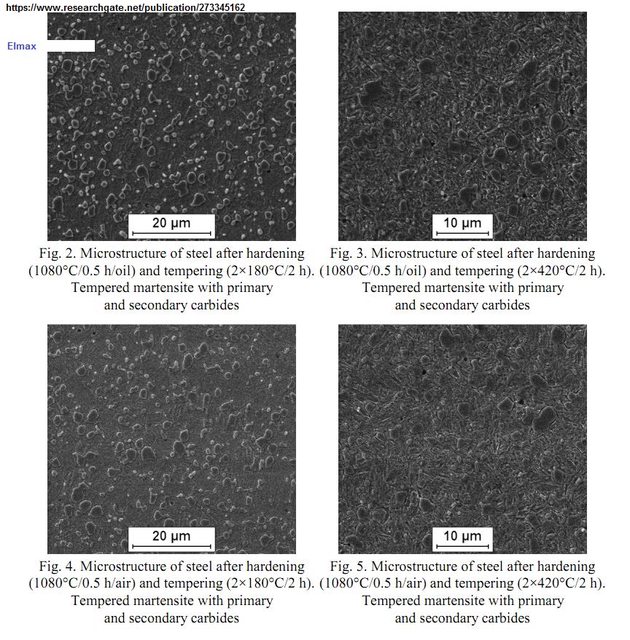
MC + precip carbide would be more than listed in patent - probably in the range I extrapolated. If you re-look at those micrographs in the Elmax article (you posted a week ago), you would see CrxCy precip carbides easily double cv of Elmax. Spyderco K2 10V blade would easily be ~25+% cv.

May want to double check that number, Luong. https://www.google.com/patents/US4249945. Looks to be in the 15%-17% range. CPM 10V.

Good thread and topic, gentlemen. Very interesting. I have no experience with anything higher alloy than CPM M4 (and not a whole lot of that) so all of this is very interesting and foreign territory.

ok here is the micrograph of elmax in that article
BS551Wjl.jpg
 
Last edited:
10V has about 25% carbide volume. 10%V is mass fraction.

I'll have to take your word for it, I'm not particularly knowledgeable about metallurgy. It wouldn't have changed my underlying point that one of the tricky aspects of testing the hypothesis that glazed VC degrade apex performance is that it's possible to just not hit any (or evidence of carbide tear out where they were) if you test the sharpness in a single spot on the apex.

In any case, the footage from my latest round of tests has finished uploading.=:

[video=youtube;GBgVQLc9R6g]http://www.youtube.com/watch?v=GBgVQLc9R6g[/video]
[video=youtube;6FhWZsO3ef4]http://www.youtube.com/watch?v=6FhWZsO3ef4[/video]

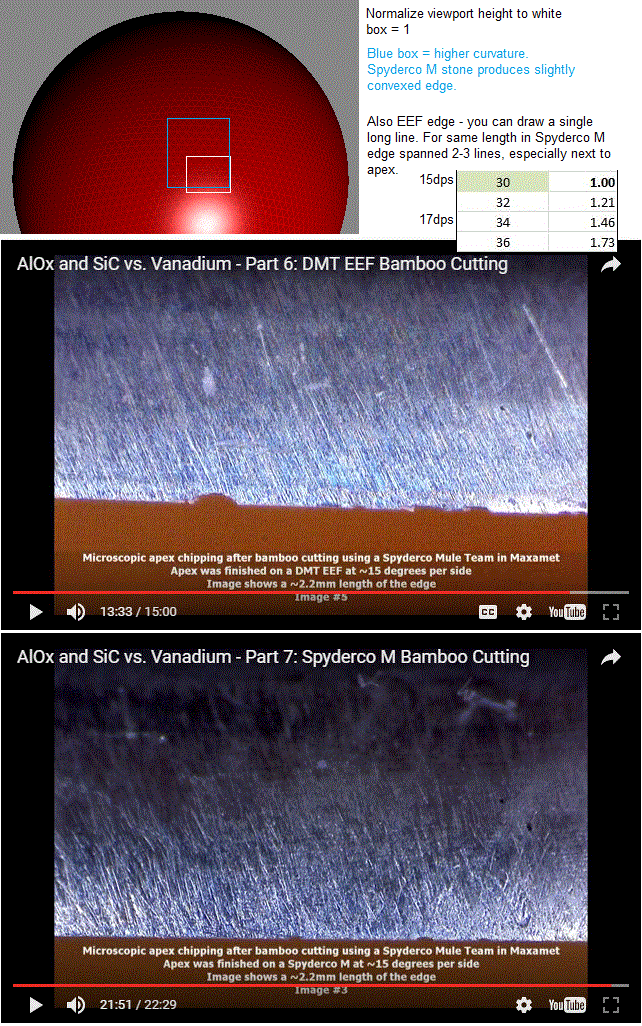
These videos were made in response to criticisms of the earlier tests I conducted on pine and cardboard. In these tests I made hard cuts on bamboo choptsticks (which I attempted to do in a manner as similar as I could muster to the techniques used in Luong's video posted up-thread) using my Spyderco Mule Team in Maxamet as finished on a DMT EEF and a Spyderco M.

The results of comparing apexes set on a DMT EEF and Spyderco M in bamboo cutting were as follows:

There was no noticeable difference in the initial sharpness obtained off either abrasive. Both apexes were able to cleanly and easily do crossgrain pushcuts on newsprint at all points along the apex.

Surprisingly, the apex set on the Spyderco M resisted microscopic apex chipping dramatically and noticeably better than the apex set on the DMT EEF. Even assuming that the result obtained with the apex set on the DMT EEF was an outlier, this test still failed to produce any evidence to support the hypothesis that any noticeable negative side effects are produced on high hardness, high vanadium content steels from being sharpened on aluminium oxide or silicon carbide abrasives.

I will note that USB microscope images of the microscopic apex chipping found in the section of edge used for the test are included towards the end of both videos. The images graphically demonstrate that in these two tests, the microscopic chipping was dramatically worse on the apex set on the DMT EEF.

I will also note again, for clarity, that I have never argued and am not arguing now that AlOx or SiC are able to abrade vanadium carbides. My argument is only that, even assuming that AlOx and SiC cannot abrade VC, there does not appear to be any noticeable effect on the apex in use, at least so far as my empirical testing has been able to find.
 
Steel-Drake, Excellent testing & logical assertion :thumbup:

However test results went off the test premise/objective, showed something else. What you have shown have very real practical value but for wrong reason (IMHO). Whatever reasons (below) don't matter that much beside knowledge we seek. Which to say, in real life - Spyderco Mule Maxamet edge off Spyderco M stone is beyond avg sharpener & most users expectation of edge usability:thumbup:

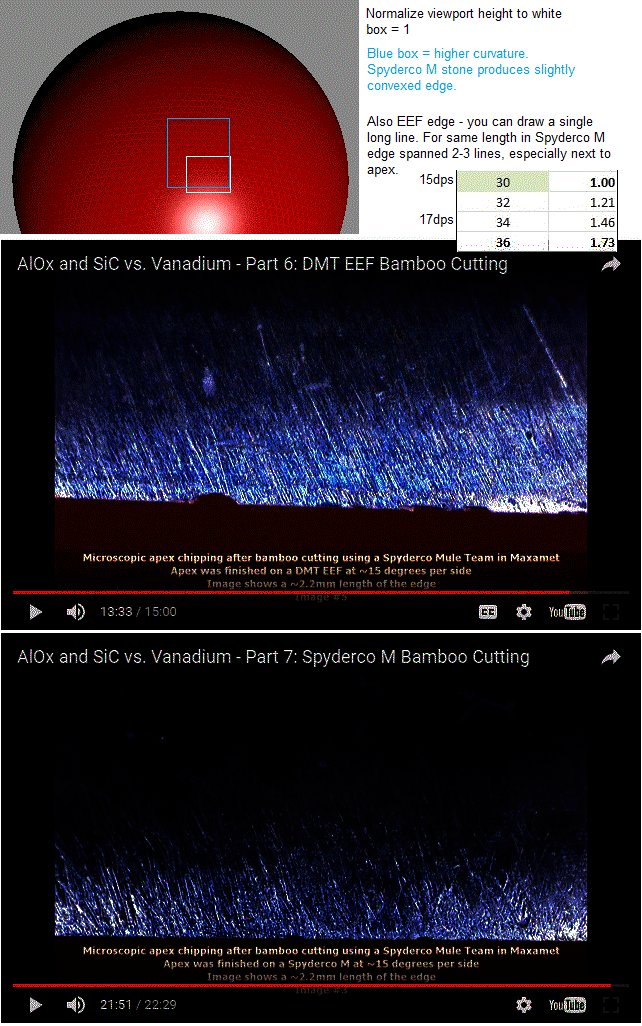
OK, people, I am not nitpicking here... just point out what look like to me - which could be just an optical tricks in my eyes. My assertion: edge off spyderco M stone is effectively around 17.5 dps (conveniently rounded to this number to reflect the cutting edge gained 50% strength by steel volume). Therefore test videos have good value but not for intended test objective.

XBJIggp.gif
 
My assertion: edge off spyderco M stone is effectively around 17.5 dps (conveniently rounded to this number to reflect the cutting edge gained 50% strength by steel volume).

Can you please give a much more detailed explanation as to how to you are coming to infer that this is the case? I am not even agreeing or disagreeing at this point, I literally have no idea how you arrived at the conclusion that the Spyderco M apex is at a different angle?

Furthermore, assuming I was to retest an apex off the DMT EEF on these same chopsticks, if I deliberately raise the angle slightly to ~17 degrees per side, would you then accept the results as comparable to the Spyderco M test?
 
Since you are quite good at keeping decent sharpening angle, so 17.5dps was derived from shading technique (Phong in this case).

Sure, please raise EEF angle to 17-17.5dps and re-test. Appreciated.
Can you please give a much more detailed explanation as to how to you are coming to infer that this is the case? I am not even agreeing or disagreeing at this point, I literally have no idea how you arrived at the conclusion that the Spyderco M apex is at a different angle?

Furthermore, assuming I was to retest an apex off the DMT EEF on these same chopsticks, if I deliberately raise the angle slightly to ~17 degrees per side, would you then accept the results as comparable to the Spyderco M test?
 
Since you are quite good at keeping decent sharpening angle, so 17.5dps was derived from shading technique (Phong in this case)

I'm sorry, I still don't understand what you mean. What shading technique? How was it applied? Where would I be able to find out how to apply the same test?
 
I guessed the curvature by how much light reflected back from single light source. Look like the camera angle is about the same for both pics - so for same bevel angle, similar amount of light should reflected back and similar gradient (shifting shade from bright to darker). But here I changed contrast - easier to spot the difference. Notice - how much more drastic gradient in edge off spyderdo M stone. Normalize right hand corner light as pendicular reflectant (max light reflected back). Sure, this would be much simpler with a SEM but all I can do is guess via how light reflect back.

Imagine you are standing on apex and only a few micron tall, how far up the bevel you see? The further you can see, the lower the curvature... So map to EEF edge, you can certainly see further, right (because your eyes or flash light clearly show that)? Frankly, if you don't see what I am talking about ... Well , let's agree to disagreed.

myvDvNC.jpg
 
I'm glad I have a guide for this.

Is there a preferred angle for this steel? This more of a comparison rather than a steel performance test, so as long as all other factors are apples to apples I'm not thinking a lot of thought needs to go into the specifics
I was planning on 28-30° with no microbevel and stropped only on paper to reveal any burring.

I'm not going to be doing any destructive testing like lateral loading on bamboo.

Current plan is:

- DMT EEF, set up on DMT stones.

- King 4k, set up on King stones.

- Spyderco EF (estimate), set up on Spyderco M/F, hopefully won't need to go any further down the progression than that.

All edges get tested with dynamic load pressure cut, average of three cuts.

Then draw cut test starting with 7lbs and working up by lbs to a load that reliably cuts three in a row.

If the numbers are comparable*, I go back and hit each media a second time, verifying the initial pressure cut number, then draw to failure on three in a row, with identical static load.

If the initial pressure cut number is not within 15% > the original number, I resharpen and then retest. If it lower than the original, I keep the lower number, retest for the lowest static draw load to three cuts and then proceed with the retention test.

* If the numbers are not comparable the test stops there. I resharpen to verify any trend - if it still exists, the test is over - no retention phase.
 
Further speculation:
what if one of the edges is consistently higher on pressure cut and lower on draw cut

- tentative conclusion might be that it is creating a more coarse scratch pattern.

Likewise if one is consistently lower on the pressure cut and higher on the draw

- tentative conclusion is a finer scratch pattern.

Only if one of the samples is better on both modes would I tentatively claim a better abrasive outcome.

Continuing issues to be considered - if the beginning values for pressure cut are off by more than about 15% (eg 20lb to 23 lbs) of each other, I would fully expect the draw cut retention to be biased in favor of the pressure cut edge that had the most resistance/highest amount of inherent friction. We'll have some numbers either way.
 
I would like to add to this if I can.
I posted earlier (#171) that i wanted to remove those scratch path to microchip marks if I could.
I sprung for a new stone 1500 grit diamond for my wicked edge. https://goo.gl/photos/NAJaM3FhMJEJ1fzS8
My understanding is that 1500 grit is 9 micron.
I used the new stone to raise a burr on each side of the blade,then followed with 6u diamond strop,3u diamond grit on mylar,
3u strop,1u strop.
Results is no micro chips and no scratch path,and one very sharp knife.
This is all at 15deg/side.
 
Back
Top