Sharpening high hardness and wear resistant steels

Slice cuts and edge at about 60* from paper plane (slight increase in affective paper thickness)
https://youtu.be/IxLwfyu0A3Y?t=8m28s

I'm sorry, I still do not understand what you mean. With the number of testing cuts made in each of those videos, some individual test cuts may not have been done with perfect form, but in each case a minimum of dozens and dozens of test cuts were made. Are you talking about the specific test cuts made at the time of the individual video you linked, or are you trying to say that most or all of the many hundreds of sharpness testing pushcuts made across all five videos were actually slices?
 
Does the sintering process make the Spyderco stones harder than the AlOx in a waterstone?

Unlikely, but by bonding them in an extremely hard binder at very high abrasive density, whatever they cannot grind you are liable to see some burnishing.

Are the ceramic edges better than the waterstone edges or just 'as good'?
 
Look at your validation cuts in slow mode (as-sharpened and afterward). When a cut used more than 1cm draw/horiz-movement, well that is a short slice. 2cm draw definite a slice.

* unlisted and maybe remove later on *
[video=youtube_share;jsPQ097PaAE]http://youtu.be/jsPQ097PaAE[/video]
I'm sorry, I still do not understand what you mean. With the number of testing cuts made in each of those videos, some individual test cuts may not have been done with perfect form, but in each case a minimum of dozens and dozens of test cuts were made. Are you talking about the specific test cuts made at the time of the individual video you linked, or are you trying to say that most or all of the many hundreds of sharpness testing pushcuts made across all five videos were actually slices?
 
Unlikely, but by bonding them in an extremely hard binder at very high abrasive density, whatever they cannot grind you are liable to see some burnishing.

Are the ceramic edges better than the waterstone edges or just 'as good'?

The apexes set on the solid sintered ceramics are better in the sense of having a thinner apex due to not being subject to the slight apex rounding that occurs when making edge leading passes on a friable abrasive with a slurry (i.e. due to the apex ploughing through the slurry), but that is unrelated to the vanadium content of the steel being sharpened.

What I'm referring to instead is this: In the images Jason posted of 10V vs carbon steel sharpened on a Shapton Glass stone, it is obvious that the Shapton Glass stone had severe difficulties grinding the 10V, yet when Jason repeated the process with a muddy King 1000, the scratch pattern on 10V appeared functionally identical to that on VG-10. This matches my own results where soft and muddy waterstones have no trouble fully applying their scratch pattern to high hardness, high vanadium content steels.

Both those results appear to suggest that waterstones that expose fresh abrasive rapidly in use can grind high hardness, high vanadium steels, but that waterstones which do not expose fresh abrasive rapidly in use will struggle to do the same. And, that would make sense, of course, since fresh abrasive should grind better than heavily worn abrasive.

Now the contradiction is that sintered ceramic abrasives do not release fresh abrasive at all, and yet I found no trouble in getting a Spyderco M to grind Maxamet:
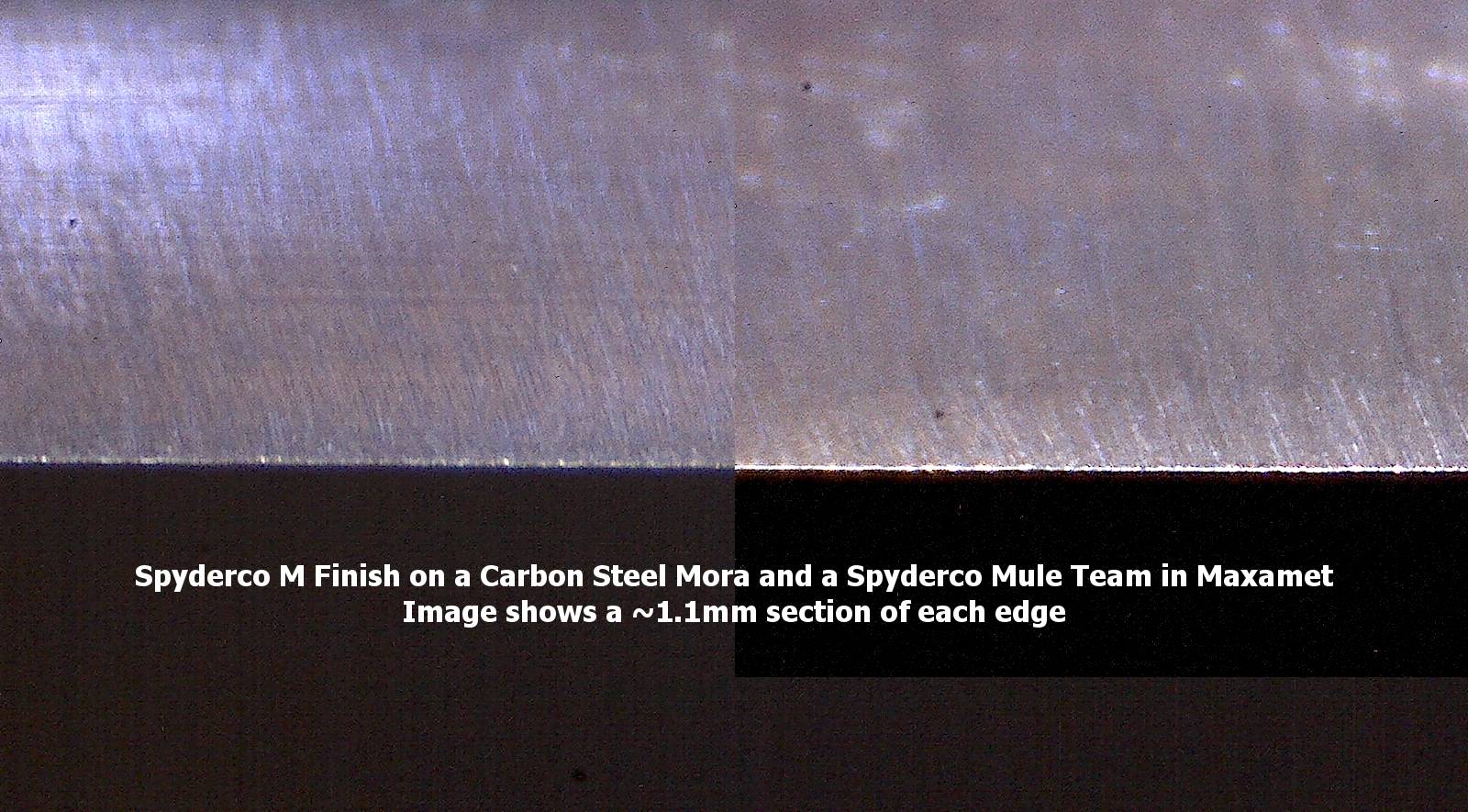


What I am trying to understand is how it can simultaneously be the case that strongly bonded waterstones can struggle to abrade high hardness, high vanadium steels while solid sintered alumina benchstones appear not to.

 
Look at your validation cuts in slow mode (as-sharpened and afterward). When a cut used more than 1cm draw/horiz-movement, well that is a short slice. 2cm draw definite a slice.

Luong,

Sorry, but I am still not understanding you. Are you talking about the test cuts made at a particular time in a particular video, or are you trying to suggest that in most or all of the hundreds of test cuts I made across all five tests that I was making a slice rather than a pushcut?

I don't think it is particularly plausible to suggest that I was actually making a slice rather than a pushcut in anything like the majority of the hundreds of test cuts made across five separate videos, and in particular to suggest that that were was any systematic difference between the test cuts made to check the initial sharpness vs. those made after cutting pine.

I will also note that a large number of the cuts made into the pine in the Spyderco M test very closely mimic many of the testing cuts you made in that video.

Nonetheless, I have no problem buying some wood chopsticks to cut up in the precise manner shown in your video. I will start by doing that test with a Spyderco M sometime next week.
 
The apexes set on the solid sintered ceramics are better in the sense of having a thinner apex due to not being subject to the slight apex rounding that occurs when making edge leading passes on a friable abrasive with a slurry (i.e. due to the apex ploughing through the slurry), but that is unrelated to the vanadium content of the steel being sharpened.

What I'm referring to instead is this: In the images Jason posted of 10V vs carbon steel sharpened on a Shapton Glass stone, it is obvious that the Shapton Glass stone had severe difficulties grinding the 10V, yet when Jason repeated the process with a muddy King 1000, the scratch pattern on 10V appeared functionally identical to that on VG-10. This matches my own results where soft and muddy waterstones have no trouble fully applying their scratch pattern to high hardness, high vanadium content steels.

Both those results appear to suggest that waterstones that expose fresh abrasive rapidly in use can grind high hardness, high vanadium steels, but that waterstones which do not expose fresh abrasive rapidly in use will struggle to do the same. And, that would make sense, of course, since fresh abrasive should grind better than heavily worn abrasive.

Now the contradiction is that sintered ceramic abrasives do not release fresh abrasive at all, and yet I found no trouble in getting a Spyderco M to grind Maxamet:


What I am trying to understand is how it can simultaneously be the case that strongly bonded waterstones can struggle to abrade high hardness, high vanadium steels while solid sintered alumina benchstones appear not to.

I think a big part of the problem is the magnification level you are using as a benchmark is misleading. 400x is scraping the bottom of what is needed to see the edge for this sort of study, and that just for speculation. 1000x is the start of useful range. Anything under 400x optical is not really useful in my experience and is just as often misleading.

From there, with or without high powered optics, all we have is cut tests. You seem to be getting good results with your selection, this is not a universal finding by any means.

When I use non-super abrasives I find an upper limit to how clean I can get the apex - in the range of the carbide size - I've tried to buck this with AlumOx and SiC but have been unable to do so, verified at 400 and 1000x respectively. Doesn't mean it won't cut acceptably - I managed to get a hair-whittling edge and a BESS score in the teens with silicon carbide on s100v. Done with diamonds I find I get a better cutting edge and it lasts longer too, this effect really kicking in at ANSI 800 or higher.

If you are finding you don't need super abrasives on high VC steel you're doing well. Personally I don't recommend it based on my experience, though can certainly be employed to effect.

I'm no longer clear on where this conversation is heading - Vanadium carbides at anything but the very lowest end of what is possible to manufacture are much harder than any common abrasive, only CbN and diamond can accurately cut them.

In my opinion, if the carbides were 20-30 micron like D2 you probably wouldn't be able to touch them even at lower grit levels. Only the fact they are < 3 micron makes it possible to sharpen them with common abrasives. If the carbides were .25 micron and not too high a percentage, you could probably sharpen them all day long on common abrasives to excellent effect.

Again, you're doing well and that's some nice work on your part. I don't think we're going to be able to conclude anything beyond that.
 
I think a big part of the problem is the magnification level you are using as a benchmark is misleading. 400x is scraping the bottom of what is needed to see the edge for this sort of study, and that just for speculation. 1000x is the start of useful range. Anything under 400x optical is not really useful in my experience and is just as often misleading.

The images I was referring to Jason having taken which show an apparent struggle for a Shapton Glass 1000 to abrade 10V while a King 1000 appeared not to were taken at similar magnification to my own USB microscope images. I was also wondering about the scratch patterns left on the edge bevels, which appear to be plainly visible in the USB microscope images I am referencing, rather than anything occurring at the apex (where I agree much higher magnification would be required).

I will see if I can reproduce the results Jason got on the edge bevel of a blade in 10V off his Shapton Glass 1000 by using my King 4000 without any slurry at all, and without re-cutting the surface prior to use. For clarity, this is an offshoot question from the main topic of this thread that I'm curious about, and I did not mean to imply that the microscopic images taken by myself or Jason could tell you what was occurring at the apex specifically.

From there, with or without high powered optics, all we have is cut tests. You seem to be getting good results with your selection, this is not a universal finding by any means.

When I use non-super abrasives I find an upper limit to how clean I can get the apex - in the range of the carbide size - I've tried to buck this with AlumOx and SiC but have been unable to do so, verified at 400 and 1000x respectively. Doesn't mean it won't cut acceptably - I managed to get a hair-whittling edge and a BESS score in the teens with silicon carbide on s100v. Done with diamonds I find I get a better cutting edge and it lasts longer too, this effect really kicking in at ANSI 800 or higher.

If you have or know of any microscopic imagery relevant to this topic taken at 400x or 1000x magnification, could you please post it in the thread or link to it? I would very much be interested in taking a look at it.

Again, you're doing well and that's some nice work on your part. I don't think we're going to be able to conclude anything beyond that.

If you have or are aware of any systematically collected empirical data testing for any noticeable negative effects on the initial sharpness, apex strength and high-sharpness edge retention on high hardness, high vanadium steels from sharpening them on AlOx or SiC abrasives (other than the videos I created for this thread), could you please post it in the thread or link to it? I would also be very much be interested in taking a look at it.
 
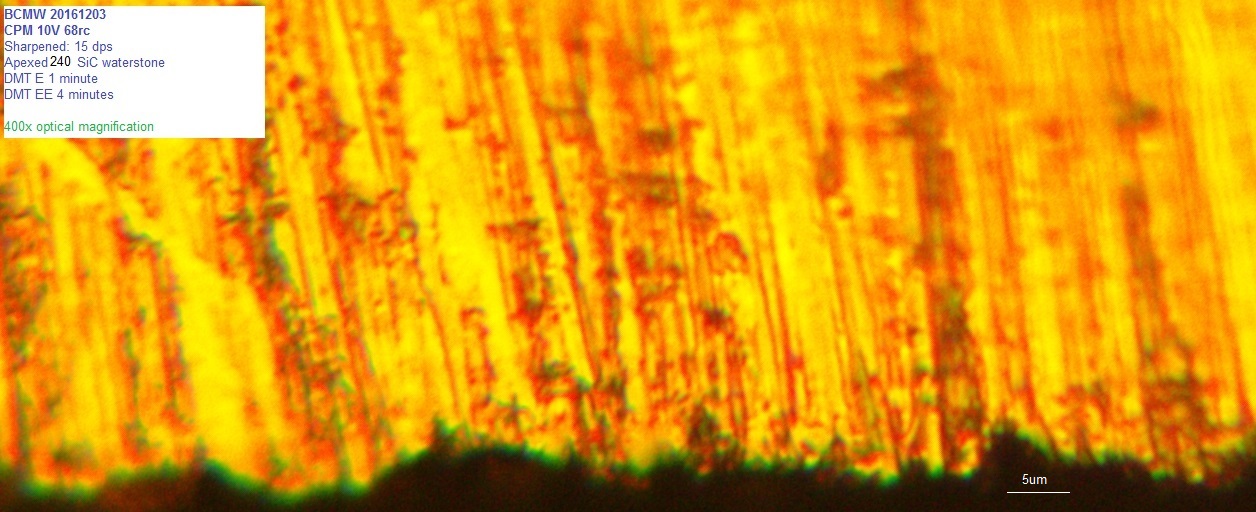
Found my calibration ruler for my metallurgical microscope. Added scale to to Pic above.
299cMMR.jpg
 
If you have or know of any microscopic imagery relevant to this topic taken at 400x or 1000x magnification, could you please post it in the thread or link to it? I would very much be interested in taking a look at it.


If you have or are aware of any systematically collected empirical data testing for any noticeable negative effects on the initial sharpness, apex strength and high-sharpness edge retention on high hardness, high vanadium steels from sharpening them on AlOx or SiC abrasives (other than the videos I created for this thread), could you please post it in the thread or link to it? I would also be very much be interested in taking a look at it.


This sounds like a job for the Edge Inquisitor 3000 with an assist by the Multi Angle Universal Knife Clamp with guide rod...

We'd have to come up with some fairly simple parameters, some way to pin this down in the fewest steps. I do not have much spare time these days.

Will think about it and see what I can come up with.
 
This sounds like a job for the Edge Inquisitor 3000 with an assist by the Multi Angle Universal Knife Clamp with guide rod...

We'd have to come up with some fairly simple parameters, some way to pin this down in the fewest steps. I do not have much spare time these days.

Will think about it and see what I can come up with.

Knowing first hand how much work goes into conducting such testing, I apologize in advance for having suggested it! Still, no matter how long it takes given your schedule, it would be nice to have some more, and independently collected, empirical data on whether there is a detectable difference in use between using AlOx and SiC vs diamonds on these type of steels.
 
Umm... do you have time to fasten a handle? I could send you that blade used in my unlisted video above.
This sounds like a job for the Edge Inquisitor 3000 with an assist by the Multi Angle Universal Knife Clamp with guide rod...

We'd have to come up with some fairly simple parameters, some way to pin this down in the fewest steps. I do not have much spare time these days.

Will think about it and see what I can come up with.


Steel-Drake, For push cutting = tape 2 folded plastic or soda-can aluminum over the edge, leaving 1-2mm edge expose.
 
Last edited:
I think a big part of the problem is the magnification level you are using as a benchmark is misleading. 400x is scraping the bottom of what is needed to see the edge for this sort of study, and that just for speculation. 1000x is the start of useful range. Anything under 400x optical is not really useful in my experience and is just as often misleading.

From there, with or without high powered optics, all we have is cut tests. You seem to be getting good results with your selection, this is not a universal finding by any means.

When I use non-super abrasives I find an upper limit to how clean I can get the apex - in the range of the carbide size - I've tried to buck this with AlumOx and SiC but have been unable to do so, verified at 400 and 1000x respectively. Doesn't mean it won't cut acceptably - I managed to get a hair-whittling edge and a BESS score in the teens with silicon carbide on s100v. Done with diamonds I find I get a better cutting edge and it lasts longer too, this effect really kicking in at ANSI 800 or higher.

If you are finding you don't need super abrasives on high VC steel you're doing well. Personally I don't recommend it based on my experience, though can certainly be employed to effect.

I'm no longer clear on where this conversation is heading - Vanadium carbides at anything but the very lowest end of what is possible to manufacture are much harder than any common abrasive, only CbN and diamond can accurately cut them.

In my opinion, if the carbides were 20-30 micron like D2 you probably wouldn't be able to touch them even at lower grit levels. Only the fact they are < 3 micron makes it possible to sharpen them with common abrasives. If the carbides were .25 micron and not too high a percentage, you could probably sharpen them all day long on common abrasives to excellent effect.

Again, you're doing well and that's some nice work on your part. I don't think we're going to be able to conclude anything beyond that.

This guy was told that a long time ago, both here and on the spyderco forum. He doesn't want to listen.
 
What I am trying to understand is how it can simultaneously be the case that strongly bonded waterstones can struggle to abrade high hardness, high vanadium steels while solid sintered alumina benchstones appear not to.

essentially amounts to claiming it is a matter of faith rather than scientific inquiry

:) :p Oh that's easy . . . you are merely experiencing the paradoxes of quantum phenomena . . . you know . . . Schrödinger's Cat etc.

While working in this micro world of wonder your expectations and brain wave fields are effecting the out come. Alternative wave forms are collapsing leaving the paradoxical ones you are experiencing. :)

Now you know what I have to put up with . . . all the time. Interesting but disconcerting to say the least.
 
As I see it you'd need minimum 4 tests, and could be arranged in at least two ways.

------

First would be comparison testing between a carbon or low alloy stainless and a high VC steel.

Medium hone and fine or extra fine hones in ALumOx and diamond. Compare load values for pressure cut and draw cut. No need for a retention test. The purpose would be to compare the values off the same hone and see if both steels react the same in terms of cut quality.

The speculation would be the high VC steel will perform differently if sharpened with ALumOx than diamond, and the plain steel would be a control of sorts.

------

Second possibility would be a retention test of just the high VC steel done on the same four sharpening media options.

This would give info at a medium finish and extra fine finish, speculation that even if the initial values were comparable, the diamond ground edge would outlast the AlumOx ground edge.

-------

Problems with pinning this down - the hones have to produce a comparable starting edge finish on either both steels, or on the high VC steel initially. I am not sure how one would nail this with enough precision to make the test valid, unless the results were so far weighted a conclusion was impossible to ignore. Eg, the abrasives needed to get comparable load values were too far out of whack in terms of size/grit value.

The other issue is, for the first test we need to run 8 individual tests, possibly discarding any outliers.

The second test requires 4 individual runs, but also has no initial values to compare across steels. You almost have to run both sets, and that's a lot of testing.

You could also punt, and just run 4 tests comparing carbon and high VC steel off of an extrafine hone in both AlumOx and diamond, taking initial values and retention numbers after some nominal number of cycles. This approach assumes that any differences will be more pronounced at the higher finish levels, so no need to even test with larger abrasives. There is also the same issue with determining what hones are comparable, and then having a strong enough interest in pursuing the results, which I'm not sure I do...
 
Somehow from UKC look, I thought - it would be difficult to clamp without a handle. Alright then - 10v blade is on its way to you.

If its an issue I can whip up something simple. Have tested it on skeleton handle BK11 OK.

We are going to need some parameters.
 
As I see it you'd need minimum 4 tests, and could be arranged in at least two ways.

I'm not sure so many would be necessary.

As far as I understand it, the hypothesis that is to be tested is that sharpening high hardness, high vanadium steels on AlOx/SiC rather than diamond will result in an inferior quality of apex that is prone to apex tear out and this would be detectable by initial sharpness, and/or by a reduction in apex stability, and/or a reduction in edge retention.

By contrast, the null hypothesis would be that while it may take longer to apex a high hardness, high vanadium steel on AlOx/SiC hones, once it has been apexed, there is no noticeable difference between the initial sharpness, apex stability or edge retention in use.

Now, the proponents of the hypothesis above have already advocated that hones in the ~3000-5000 JIS equivalent grit range are the most likely to produce a noticeable difference, so time can be saved by doing the test in that grit range alone.

Since this hypothesis concerns different outcomes on high hardness, high vanadium steels depending on the type of hone used, I don't think it is strictly necessary to do a comparison to a simple carbon steel.

Really I think the comparison can be simplified to a high hardness, high VC content blade comparing a DMT EEF (or similar) finish to a non-friable AlOx or SiC abrasive in a similar effective grit range. I used a Spyderco M for that, but I'm not sure what other options might be available in that effective grit range. I agree with you that initial sharpness should be as similar as possible before beginning, that why I was demonstrating that the DMT EEF and Spyderco M produce apexes with similar initial pushcutting sharpness in my videos.

Then the question becomes whether to test for apex stability or edge retention?

I can tell you from being part way through recording some apex stability testing on bamboo chopsticks that Luong wasn't kidding when he said they were much harder on an edge than pine. My Mule Team in Maxamet with a DMT EEF apex finish made it though ~10-20 cuts on one chopstick before the apex in area tested was too microchipped to continue the test, whereas every apex finish made it through pine with flying colors.

Edge retention should be easier to test, though I would suggest a high stopping point be chosen since, as I understand the argument, carbide tear out should happen early in the edge retention testing if it is going to happen at all.
 
My hypothesis is a bit different already.

I theorize that non-super abrasives cannot cleanly cut the carbides and they glaze. Resulting edge can be sharp, but will not perform at same level for a given type of cutting at a comparable edge finish. The tear out isn't a result of use so much as the process of sharpening to begin with.

If we can agree on comparable abrasives across media, specifically what AlumOx stones to stand opposite their DMT counterpart, then a couple of tests should suffice. I have the full set of Kings, Nortons, we could even run this with SiC wet/dry.

From my POV we don't agree on a common phenomena to study, so that needs to be pinned down first. The only real hypothesis I have based on my own experience is that the differences will become increasingly apparent as the finish becomes more fine.

If there is no appreciable difference to start with from one abrasive to the next, then a retention test makes sense as a next step, otherwise is not really needed.

There is still some variable as I'd be the only person prepping the knife (knives) and I may very well be a better hand on one abrasive type than the other. I'd be using a guided system, so angle and to a large extent pressure variation won't be an issue.
 
Back
Top