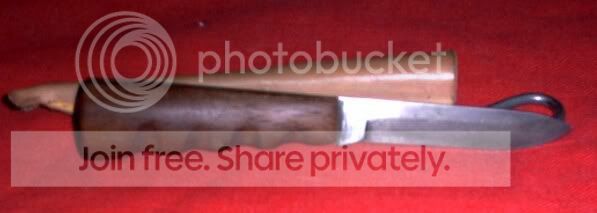
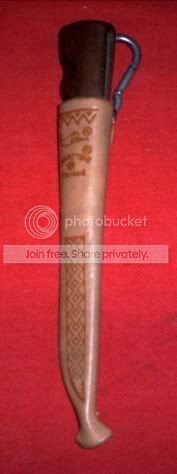
Skookum Bush Tool

I may be over cynical , but it seems to me to be odd that in countries where natives live in the bush with very little in the way of dedicated survival knives ... yet their subsistance life style is what many survivalists would consider to be doing it really really hard

westerners put a hell of a lot of faith in kit over skills IMHO

Westerners also live a lot longer, especially when they have both skills and kit. Primitive people tend to live really short, hard lives. Ever seen a kid slip with a machete while barefoot in the tropics? Even if you sew his foot up and treat the wound, unless he has a really good supply of antibiotics his chances are dicey. They die from stuff that people in comfy America don't even think about, like dysentery, common infections, parasites, etc.

BTW, I hear this a lot, "But the primitive natives in 'x' tropical country only use homemade junk and they are just fine." Hey, you offer some of them a decent knife in a few of these places, like a Buck 110, and you'll wind up sleeping with someone's sister if that's what your price is. Good knives are often hard to find and quite prized.

*************
 
BTW, I hear this a lot, "But the primitive natives in 'x' tropical country only use homemade junk and they are just fine." Hey, you offer some of them a decent knife in a few of these places, like a Buck 110, and you'll wind up sleeping with someone's sister if that's what your price is. Good knives are often hard to find and quite prized.

*************

LOL
some people have funny customs and values on their women . not just "primitive" people either , ever really thought about what the goods and chattels are that used to be sold up when someone couldnt pay their debt ?

the goods are self explanatory , but who were the chattels ?

anyway , I wasnt talking of some tribe in a remote land I know nothing first hand about , but I was talking of people I lived with , and am distantly related to . Its not lightly that I write about this stuff .
 
I’m sure the guard less mora/bushcraft style of knife works well. Many people have used such knives for centuries. It must be a practical design. I believe in Scandinavia it is a coming of age ritual when a boy’s guard-equipped knife is replaced by a guard less one.

But I wonder. When everything is lovely and the goose hangs high, using a bushcraft knife is safe enough. When you can give your work full attention. On the other hand, Murphy never sleeps.

Suppose that your canoe overturns in icy rapids. You’ve got to cut yourself free of the tangle, with hands that have turned into lumps of ice. The last thing you want in that situation is to slice open your fingers. Suddenly a guard looks pretty good.

Suppose you’re injured, and in shock, and functioning at 50% of your normal capacity. Do you want to risk severe lacerations on your hand?

Suppose you’re suffering from hypothermia and not tracking at all well. Me, I’d rather not add blood loss and severed tendons to my pre-existing problems.

Suppose you have a concussion, complicated by blood loss. Are you functioning at your peak performance? Maybe you are, but I’m sure I wouldn’t be. I’d like a guard to protect my hand from the consequences of my situational stupidity.

I’ve spent years working with hand tools and power tools. Any of which could have crippled or killed me. I avoided disaster by thinking about worst case scenarios and keeping my body parts away from possible skill saw kickbacks or similar accidents.

I trust the attitude that worked for me on the job will work for me in an emergency. Survival thinking must consider the worst case scenario. If that emergency never happens, so much the better. If it does, I want my knife’s guard to help protect me from Murphy’s sense of humor.
 
With regard to the guard. The only knife my hand has slipped forward onto the blade with was a Bark River Northstar when it was about 95 degrees outside and my hand was swimming in sweat. Besides the lack of guard the handle tapers toward the blade and is pretty slick. However I love the Northstar and in all but that time it's been a great knife.

I took my Skookum Bush Tool Backpacking for 4 days last weekend.

I thought it was a great knife. It was hot as hell and I was covered with sweat and my hand never slipped on it. I think this is because of the contouring of the handle, the handle is fairly long, and the scales are left rough so there is some traction.

We had to climb some really steep hills and it was in the 90s and humid as hell and a couple nights I was so exhausted that I used it to cut wood for the fire instead of my hatchet, carving a notch in wood to the point to where I could crack it by stomping on it.

Mine is a power cutter. The design is such that you can cut thru fairly thick stuff with one swipe.

I used it 4 days every day and it was still shaving. The temper is really good.

The blade is 1/8 so it is way better than the thicker British Bushcraft knives for slicing and food prep IM).

Comparing it to my Nessmuk, which I usually take it sliced NEARLY as good. Was a bit heavier than the Nessmuk, which has a wood handle and is 3/32.
Cut maybe 20% more efficiently. I missed the ability to eat off the blade and to use for stirring stuff like the Nessmuk. The fatter wider Nessmuk holds the edge for that. Also it seemed like the Nessmuk was a bit easier to reach down into my bowl with and cut up food because of the more rounded tip. Although the Nessmuk would yeild to the Skookum in stuff needing a fine point. But on this trip I didn't need a fine point for anything.

My main complaint with the Skookum is the sheath. While I think the sheath is beautiful and loved it around my woods here at home, I found that I had to continually be conscious putting my pack on and off to leave the knife cord over the breast strap on my pack. Also when cooking and filtering water or tying your shoes it gets in the way. Anything where you have to bend down and that's a lot really.:thumbdn: Also it is fairly heavy and the sheath is fairly big and when it is really hot it is just one more thing against you that feels hot:( Plus when we were climbing knobs so much sweat was coming off of me it actually corroded the but cap to where after cleaning the worst of it off you can barely read the etch:grumpy:

So my assessment is excellent knife overall. Aggressive cutter. Excellent ergonomics. Because of the thin blade better than a British Bushcraft for food prep and camp chores but not quite as good as a Nessmuk for that. Outstanding temper. However I'd like a pouch belt sheath better.

It also pops in and out of the neck sheath like a kydex sheath so you really need 2 hands to get it out. I prefer a loose pouch sheath so you can get the knife in and out easy.:thumbup:
 
"As Pict mentioned, a guard may be a good idea for children, or people who are not that experienced using knives."

I wasn't trying to imply that people who use guards on their knives are inexperienced children. I just think that a guardless knife isn't the right tool to start someone out on in the wilderness, especially when the learning curve is near vertical for all the skills they are trying to develop.

Processing large game is really only bloody at the start when you open them up and dump their guts. Blades get slippery from fat when skinning but I've never done anything all that forceful with a knife when skinning. Often I'll hold the knife with my index finger way up the blade and work most with the point.

Guards get in the way when doing woodwork and often when sharpening on flat stones. I think it is much easier to sharpen a guardless scandi than one with a guard.

What is nice about the SBT is that the edge has a slightly curved belly all the way to the base. Sharpening it you can get a good angle on a flat stone for lack of a guard to get in the way. If it had a guard you would have to hold the blade perpendicular to the stone to sharpen all the way to the base. I can never quite get it right when I do this and the practical outcome is that the base of the edge is less than perfect. On a guardless knife I can get it razor sharp all the way to the bottom of the blade. When you only have a 4 inch knife it helps that all four inches of it are actually useful.

Your mileage may vary but I did most of my gutting in life with a Buck 110 or similar folder with no real guard and blood/fat slick smooth wood. I got plenty of blood up to my elbows but don't recall ever having to do anything forcefull (I tend to wait until the animal is dead before I take a knife to it). For all the bone seperation we always used a saw or chopper of some sort. I personally use a 12 inch Ontario for such tasks (it's just so un-Pennsylvania).

On the poor natives and their knife choices... My experience of native life being limited to Brazil and Paraguay the knives they use are whatever cheap affordable kitchen and butcher knives are made available in their areas. Economics is the primary consideration and I have yet to meet a native that knew how to sharpen a knife. Their main technique being to grind the knife against whatever local rock is commonly used for the purpose or to have some well meaning individual burn the steel up on a grinding wheel.

If you give them a modern knife of high quality steel when it is dull they will not think twice about rubbing it against the local rock or handing it to grinder guy and the result is an expensive version of a Tramontina butcher knife rubbed on a river rock. When they ask me to sharpen their knives like mine the first thing I do is to file the edge perpendicular to the spine so they will actually lay flat on a stone. Sometimes you would swear they handed you a Kris!

When it comes to natives it is the man himself that is impressive for what he has in his head, the stuff in their hands is very common. Mac
 
On a different note.....

Has anyone gotten the Skookum in the CPM 3V yet?

I've seen that people have gotten the O1 and A2 versions but I must have missed the 3V. I'm going to e-mail Rod soon to get placed on the wait list and I'm debating which steel I should get.
 
As for processing game...when I first started as a serious hunter I'd be covered in gore. I'd need to wash my boots. pants, coat, hair ect when returning home.
322702.JPG


For a five year period I was collecting 5-10 caribou at a go and can now cut up game with very little gore splatter. In fact one paper towel is about all I need after a five caribou dismembering. We use the inuit method of cutting up boo and moose and skin, de-leg and then gut. Never have to really handle the gut pile except for the liver and some tasty bits of fat.

You come home with this......
428692.JPG


Thing is I have used all kind of knives and even in my beginning phase never felt the need for a guard. I have become less choosy about what knife I need for hunting and more choosy about what I need for everything else. I can use my garcia Skookum for game processing but I would never use a hunting knife for wood work if I can help it. In survival building fire and shelter are of maximum importance for that I want something that I can build with. A scandi-edged, guardless, stout knife is the best choice for me. I have apprenticed myself to Kochanski and have done many courses with him. Lads always come to the course with their favourite convexed super pooper guarded whiz knife and when the work begins sooner or later pick up and begin using a 10.00 Mora. It might take an hour or if they spent enough money on their knife a couple of days but they eventually all come around.

Why? Because of efficiency. When the guy next to you is doing stuff in half the time with his 10.00 knife you eventually experience a paridigm shift.

Rod Garcia's Skookum is a highly evolved version of the Mora with good steel and is hell for stout. I can process a moose with it and if need be I can make curly stcks with 7-8 curls and build a shelter by cutting down 3" trees using Mors can-opener technique. Don't try doing that with the typical gee-whiz knife some folks favour.

I will admit that if I am going hunting I have one of these in my pocket because they are perfect for the job.

322683.JPG
[/url]

The Garcia knife is perfect in it's and far more versatile than any other tool I have used.
 
Intereting to note that many have refered to the trusty Pukko design and how it has survived the ages as well it shoud it is a tried and true method. As for a guard though few have mentioned that the same culture the "Scandinavians" have seen fit to design in set barries for the forefinger seperating it from the edge, either a guard or finger groove, as seen in the frosts models 600 series through to the 800 series the M2K as well and other Erikson models along with numerous others like Issaci Jarva model 495 ibelieve has a guard,Martini and Rappela, Helle, Brisletto(sp).


I have never used a SBT but the concerns that an individual might have over a feature desinged for safety are always legitimate since you can never be too safe think that is a principle we can all agree on safety should be and always is a concern.
 
I’m sure the guard less mora/bushcraft style of knife works well. Many people have used such knives for centuries. It must be a practical design. I believe in Scandinavia it is a coming of age ritual when a boy’s guard-equipped knife is replaced by a guard less one.

But I wonder. When everything is lovely and the goose hangs high, using a bushcraft knife is safe enough. When you can give your work full attention. On the other hand, Murphy never sleeps.

Suppose that your canoe overturns in icy rapids. You’ve got to cut yourself free of the tangle, with hands that have turned into lumps of ice. The last thing you want in that situation is to slice open your fingers. Suddenly a guard looks pretty good.

Suppose you’re injured, and in shock, and functioning at 50% of your normal capacity. Do you want to risk severe lacerations on your hand?

Suppose you’re suffering from hypothermia and not tracking at all well. Me, I’d rather not add blood loss and severed tendons to my pre-existing problems.

Suppose you have a concussion, complicated by blood loss. Are you functioning at your peak performance? Maybe you are, but I’m sure I wouldn’t be. I’d like a guard to protect my hand from the consequences of my situational stupidity.

I’ve spent years working with hand tools and power tools. Any of which could have crippled or killed me. I avoided disaster by thinking about worst case scenarios and keeping my body parts away from possible skill saw kickbacks or similar accidents.

I trust the attitude that worked for me on the job will work for me in an emergency. Survival thinking must consider the worst case scenario. If that emergency never happens, so much the better. If it does, I want my knife’s guard to help protect me from Murphy’s sense of humor.

Well stated and pretty much my point also.

I have apprenticed myself to Kochanski and have done many courses with him. Lads always come to the course with their favourite convexed super pooper guarded whiz knife and when the work begins sooner or later pick up and begin using a 10.00 Mora. It might take an hour or if they spent enough money on their knife a couple of days but they eventually all come around.

Why? Because of efficiency. When the guy next to you is doing stuff in half the time with his 10.00 knife you eventually experience a paridigm shift.

This has more to do with the Mora's blade and ease of sharpening than the fact that it doesn't have a guard. Mora handles, by and large, suck. The Mora Clipper handle is OK, but it only has a 1/3 length tang and I prefer the strength of a full length tang. What you have in the Mora is a fantastic blade at a low price with the cost trade-off being the cheapest handle they can produce.

If you'll notice, many of the injection molded Mora handles, which are bought in bulk by Scandinavian outfits like fisheries, etc, all tend to have fingerguards molded into the handle

Too many people buy expensive knives and the blades are too thick, ground at the wrong angle, hard to sharpen, etc. These are knives designed to try and do everything, while a Mora's blade is designed to cut, first and foremost.

Some of the more traditional knives used in previous generations in the US, like those make by Western out of Boulder, CO, can hold their own against a Mora, because the blades are built along similar intentions. That is because their pre-Rambo blades were thiner with extremely good steel, hence they cut extremely well.

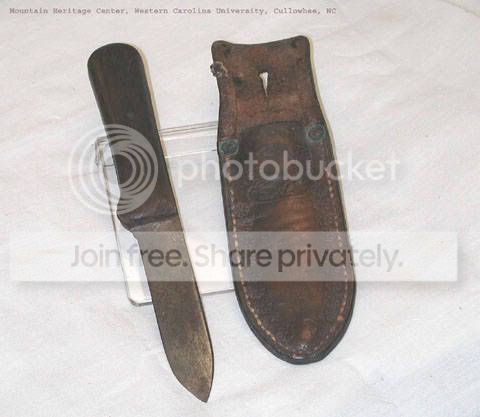
Here's a couple of pics to illustrate my point. This is an original Kephart knife made popular by Horace Kephart and it's about 90 to 100 years old. Notice the basic finger protection.

OriginalKephartKnife.jpg


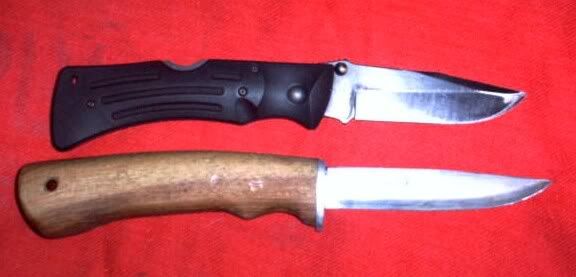
Here's a couple of my favorite knives I use the most. The fixed blade is built on a laminated Mora blade blank, and it is an awesome cutting tool. The folder is a Kabar Mule with a 3-3/4" blade. I have found this folder to be an extremely rugged knife, and because it's a folder, I tend to have it with me in a lot more varied situations than I would a fixed blade.

One point that I think that some are missing is that I and some others aren't saying that you must have the handguard off of Excalibur, but some fingerguard can be highly beneficial. I think it's not wise to leave it off. Especially a knife that will be used in adverse situations.

Rostov_Mora_9.jpg


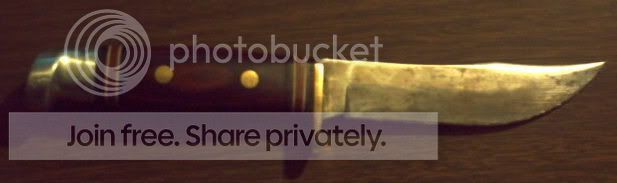
Here's a knife I've used a lot. It's a Western W66, probably made in the 1950's or early 60's and it's shows the typical Western lines to their knives. The blade is made of 0170-6C tool steel and it's 4-3/8" long. I'd stack this knife against a Mora or any other Scandi blade any day of the week as a general purpose wilderness blade. This blade design was also popularized by Horace Kephart and is based upon earlier knives from 19th Century America.

w66.jpg


Yes, I know how to use a knife without a guard. For example, here's one of my other favorite knives. It's a puukko style that I built off of a bare, 1987 vintage Western L66 blade I salvaged from someone else's abandoned project. I shaped the blade to be 3-3/4" with a Kephart style.

Western_Puukko_4.jpg

Western_Puukko_5.jpg

Western_Puukko_1.jpg


**************
 
Poor design. Hope you never have to use that in the dark. Hope you never have to gut big game with it. Hope you never have to jab anything solid. Just say goodbye to index finger.

I agree with you. I don't find the "if you are experienced with a knife then you don't need a guard" argument to be persuasive at all. There are many times I've been cold and wet, and fumbling around with a guardless knife is the last thing I want to do. While Mors might disagree, I do know that Ed Fowler also advocates guards on knives. I'll take Ed's side in this one...
 
Why? Because of efficiency. When the guy next to you is doing stuff in half the time with his 10.00 knife you eventually experience a paridigm shift.

The guy next to me might be more experienced, resulting in better cutting.

I've tried the $10 Moras, they don't even come close to some of my thin, full or high flat ground cutters. The Moras are sturdier, given their thicker edges, but not even close when comparing cutting efficiency.

Having said all that, this looks like a really nice knife. If he would offer it in a full flat grind with O1 at a nice high hardness, I'd order one.
 
Wilderness & Survival threads that contain the word "suppose" always make me smile.
One could "suppose" circumstances & conditions to fit any point of view.
"Suppose" one was raised using guardless slip joints that not only offer no protection for one's hand, but offer the added risk of closing on one's fingers as well.
One could "suppose" that the person raised on guardless slip joints would intuitivley use cuts that keep his hand safe.
Or "suppose" he happened to be wearing kevlar gloves. :D
Just supposin' :D

There is no right and wrong here.
Some knives have guards and some don't.
Buy the type of knife that you prefer, but don't presume to think that your way is the only way, for everyone.
 
Holy fence post, Batman, what a controversy. :eek: Enough has been said about the Skookum Bush Tool so that I don't have much to add, so I'll just concentrate on some of the stranger arguments seen here.

If you notice what the American frontiersmen used, the designs often look a tad different, and for various good reasons - they were used by a highly adaptive people who crossed and conquered a real frontier.

I have a feeling American frontiersmen used what they used largely because they felt they needed a knife that could easily double as a defensive sword-like weapon in case of trouble. Traditionally, Scandinavians have used axes instead of knives for that role.

Some of these guardless, pointy designs touted as the 'ultimate survival knife' seem to be worshiped by those who think 'bushcraft' is one giant wood carving session, but have killed game animals of any real size animals only infrequently, if ever. Yet, I've even seen some people who seem to smugly hold the opinion that you really don't 'know what you're doing' unless your knife has not even a finger guard.

Fresh blood is about as slippery as motor oil. I tell people to do this: Go buy a whole, raw chicken, cover it liberally with olive oil, then, with olive oil all over your hands, take your 'bushcraft' knife and skin it, then butcher it. That's only a small animal that's already been gutted and cleaned. Yeah, in a pinch, you might get it done just fine with that 'bushcraft' knife, especially if you work slow enough and are careful. However, do it on a regular basis for weeks or months under much more rugged conditions on animals that are not pre-cleaned from the supermarket and those espousing those types of knives will be singing a different tune.

Real 'bushcraft' is about sustainable living in the bush, and without the support of some form of agriculture, you simply don't do that without regularly killing and disassembling animals for food and useful materials.

You know, I'm writing this as a person who's done a lot of hunting, moose, bear, hare, birds, pretty much anything you can hunt in this here land, and I come from a family of hunting lovers. And I, like most hunters in Finland, have nearly always used a guardless, simple puukko for hunting purposes, and done very well indeed. Somehow, in my experience, blood doesn't get all over the place unless you make it so, and blood, while slippery, is hardly so slippery that you couldn't securely grip your knife, assuming the handle isn't made of olive oil, too.

I don't particularly mean to offend, but people in Scandinavia were living in the "bush", off the land, using guardless puukkos for all purposes including hunting before the white man ever stepped foot on the American continent. Men were hunting bears here when the American natives had never even seen a white man. The Scandinavian, guardless knife design works very well for nearly all purposes, including skinning dead things. It was designed to do so, since steel wasn't available in great quantities, limiting the availability of dedicated tools. And indeed Scandinavians didn't just appear here - this land had to be conquered by man also, and that was done using the previously mentioned Scandinavian-styled blades.

'Almost'? FYI, the last time I saw a real Scandinavian take apart a caribou, do you know what he used???

He used a Fallkniven Thor, which has a 10" bowie style blade and a full handguard.

Sounds like you met a Scandinavian that was either a show-off, stupid, or just in love with big blades. I don't know about you, but a 10" knife wouldn't be my first choice for taking apart anything except another human being.

Many of those 'bushcraft' practitioners in their crowded, little European countries, by an large, don't practice really living off the land. They go out and have themselves a smoke filled arts and crafts session. Some are quite good at it, but lets call it what it is.

Ouch, I can just feel the hate for crowded, little European countries all the way over here. Yes, many European "bushcraft practitioners" are just into it for having some relaxing time ten minutes away from the city. But you can't honestly claim that it is any different over there. American "bushcraft practitioners" in general are hardly living off the land, either...

Have you noticed something common with the real puukko design that almost all of these 'bushcraft' knives don't have? Look at the handle. While most of these 'bushcraft' knives, like the Mears design, have a conventional, western style handle with no handguard, these puukko knives have a tell tell flare, a bulb, at the back of the handle and you tend to hold it far differently, especially under slippery conditions.

I've also seen a lot of Scandinavian knives with handguards and fingerguards. Not putting in a handguard or fingerguard greatly simplifies the construction of a knife, especially if you have limited tooling, hence one of the reasons for the way some traditional designs evolved. So that doesn't make it the best just because some use it out of habit. The puukko's greatest advantage is that it is very convenient to carry.

The Sami leukus have a larger handle butt than other puukko-styled knives simply because the sheaths are particularly deep (for retention, of course), and if the end of the handle wasn't fat, there would be no way to get the knife out of the sheath easily.

The reason fingerguards are omitted from most Scandinavian knives is because they get in the way of proper holds for precise work, with wood working in particular, period. And the greatest advantage of the puukko, at least as understood by Scandinavians, is its flexibility for multiple purposes.

Look at it this way, our early frontier had a lot of Scandinavians arrive here. Yet, the puukko knife style kind of vanished when it hit the US frontier.

And that couldn't possibly be because the puukkosmiths stayed in Scandinavia, and in America no-one was all that good at making puukkos, but many American smiths offered their own designs and readily sold them to Scandinavians as well? :D

As Ebbtide put it: use whatever you like, with all the fingerguards you could possibly desire, but do realize there are other designs that also do in fact work very well.

 
Wilderness & Survival threads that contain the word "suppose" always make me smile.
One could "suppose" circumstances & conditions to fit any point of view.
"Suppose" one was raised using guardless slip joints that not only offer no protection for one's hand, but offer the added risk of closing on one's fingers as well.
One could "suppose" that the person raised on guardless slip joints would intuitivley use cuts that keep his hand safe.
Or "suppose" he happened to be wearing kevlar gloves. :D
Just supposin' :D

There is no right and wrong here.
Some knives have guards and some don't.
Buy the type of knife that you prefer, but don't presume to think that your way is the only way, for everyone.

Well said, Ebbtide!

More and more I see people on this forum looking for arguments. Too much, "my knife is better than yours, and here's why..........." I think the forum would be a lot better off if there were more 'how-to' threads and less how-not-tos"!

Doc
 
Hey Doc I think this is because we spend a lot of money on our knives and then try and justify our purchases !!!
 
Hey Doc I think this is because we spend a lot of money on our knives and then try and justify our purchases !!!

The only justification you need, is that you want it and you like it!

Case in point: A lot of people on this forum love Leatherman Waves. I bought one a couple of months back ($30 or so off at Canadian Tire). I took it home, played with it for an hour or so, and then returned it. I just didn't see the attraction. On the flip side, I went to a local outdoor store today to look at the Vic Spirit. As soon as the salesguy dropped it in my hand, I knew I was hooked. So, the point is that, to me, the Vic Spirit kicks the Wave's ass. Other people disagree. Who cares? Buy what you want, and enjoy it.

It just seems to me that way too much time is wasted promoting one position, and denigrating others . What that the hell does that accomplish?

This is a Wilderness and Survival Skills forum, and I like toys as much as the next guy (hell, since I joined this forum, I have bought 2 Buck Alpha Dorados, I BK-7, 3 Linders machetes, 1 Victorinox Spirit, and I have an RC-3 on order.) So you see, I'm not knocking toys, I love them, but I don't need somebody else telling me if I buy his particular selection, I'm a wise man, and if not, I'm an idiot. (No, this has not happened to me, so it's not why I'm soapboxing.)

Cordage, firemaking, traps and snares, shelters, wild foods, wild medicines, net making, survival fishing, primitive navigation, primitive containers, knots, power aids (windlasses, etc.) (whew!). These are the things I would expect to see in a Wilderness and Survival forum, not BOB's etc. ad nauseum.

I apologize for getting on my soap box and also to anyone I may have offended, but it's how I feel. Now, I'll take my opionated self and fade back into the woodwork.

Doc
 
Yeah I know what your saying Doc and I do agree, however I try and start a post about animal tracks or medicinal plants and I get 3 responses, I wake the following morning and my post is on page 4 !
I post a pic of my latest knife and get 20 responses, wake up the following morning and my post is still near the top of page 1....it just kinda puts you off starting threads about other topics !!!!!

Now you have me on my soapbox as well eh !!!!!
 
Yeah I know what your saying Doc and I do agree, however I try and start a post about animal tracks or medicinal plants and I get 3 responses, I wake the following morning and my post is on page 4 !
I post a pic of my latest knife and get 20 responses, wake up the following morning and my post is still near the top of page 1....it just kinda puts you off starting threads about other topics !!!!!

Now you have me on my soapbox as well eh !!!!!

No kidding, people approach knives too much like a religion sometimes, and often with a strange level of snobbery. It's as bad as the gun community in debates as to what is the best cartridge, etc.


I have a feeling American frontiersmen used what they used largely because they felt they needed a knife that could easily double as a defensive sword-like weapon in case of trouble. Traditionally, Scandinavians have used axes instead of knives for that role.

Depends. They weren't 'swordlike', just knives that were also good in a fight. For killing someone and fighting, smaller blades can work and a smallish folder is generally what you have on you, but a lot experienced knife fighters prefer a larger weapon if they have it on them at the time. Large knives like that also did the same duty on larger game much the same as a butcher knife does in your kitchen or at the meat market.

You know, I'm writing this as a person who's done a lot of hunting......

Done a lot of hunting myself.

You can get buy with a minimum of blood, yes, but you still get blood, and other body fluids, on your hands, and that can vary from time to time, the type of animal, weather conditions, temperature, etc.

My point that I already expressed was that this can vary a lot, especially here in N. America where our climate is much more varied than yours. It's also very pertinent to this thread because the main topic is 'survival' and that means that you are often not at your peak level of performance and under adverse conditions. Your knife may also be pressed into duties other than carving up game or wood working. However, even if you don't feel a fingerguard necessary, it's extra insurance for when you're tired and not at your best.

Sounds like you met a Scandinavian that was either a show-off, stupid, or just in love with big blades.

No, actually he ran a reindeer farm and lived a lot off of the caribou meat. You'll find that in amongst many hunters and rural folk in places like Montana prefer larger knives also.

Here we have a good example of how someone who uses a larger knife is automatically labeled as potentially a show-off or stupid. I've heard this a lot from many different people.

Just remember, a larger knife is like having a big butcher knife and sometimes a hatchet. They can save a person a lot of effort in skilled hands.

Ouch, I can just feel the hate for crowded, little European countries all the way over here.

No hatred offered for Europeans in this thread, not even for the French (just kidding). Just a clinical discussion.

However, I have seen over and over how people in Europe often don't really grasp just how small and, in most cases, 'tame' their countries are compared to much of North America. Germany, for example IIRC is only about the size of Oregon.

And that couldn't possibly be because the puukkosmiths stayed in Scandinavia, and in America no-one was all that good at making puukkos, but many American smiths offered their own designs and readily sold them to Scandinavians as well? :D

It's just a style of knife, nothing rocket science or magical about it. I'm sure quite a few Scandinavian blacksmiths made it over here. The number of Scandinavians in the US is quite large. The main difference between a puukko and many N. American knives is just the sheath and handle.

As Ebbtide put it: use whatever you like, with all the fingerguards you could possibly desire, but do realize there are other designs that also do in fact work very well.

You're missing the point here. This started off because there is a theme amongst some that if you have a fingerguard on your knife you simply 'don't know anything' because you aren't showing the proper reverence for the teachngs of certain gurus. This attitude also transcends into the realm that if it is a classic American design, it just isn't as wonderful as some other design, and that is just plain silly.

This didn't start off as slamming Scandi style knives, quite the opposite. It was because there is a faddish attitude that seems to occasionally surface nowadays that just because you like a fingerguard on your knife, then you are some sort of inexperienced newbie simply because Mors Kochanski and Ray Mears don't like fingerguards.

**************
 
This didn't start off as slamming Scandi style knives, quite the opposite. It was because there is a faddish attitude that seems to occasionally surface nowadays that just because you like a fingerguard on your knife, then you are some sort of inexperienced newbie simply because Mors Kochanski and Ray Mears don't like fingerguards.


**************

Kind of on a tangent to the main thrust of the debate .. but related none the less ..

I happen to know a number of folk in the meat working industry , they mostly all prefer a guard . These guys use a knife one of their main tools of trade , admittedly tho , they dont do a lot of woodcraft with their knives ...

for me , for carving , a knife with no guard is good , for field dressing , I do like a bit of a guard , when my hands get greasy and bloody and the day is hot slipping is for me a real worry , but this is me , I may well be inexperienced and not know what I am doing when compared to others of greater expertise ...
 
mrostov: I checked out those knives you listed earlier and they are ok, but I was really asking if there is a knife out there like the Garcia which headlines this thread, except with a small guard. I haven't seen a decent one yet but I'm new at the search.

That old Kephart knife is charming simplicity.
 
Back
Top