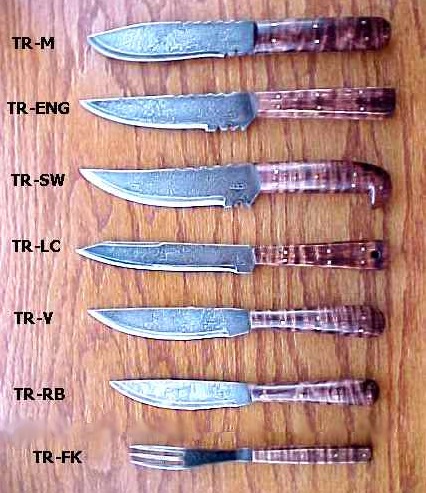
Depends. They weren't 'swordlike', just knives that were also good in a fight. For killing someone and fighting, smaller blades can work and a smallish folder is generally what you have on you, but a lot experienced knife fighters prefer a larger weapon if they have it on them at the time. Large knives like that also did the same duty on larger game much the same as a butcher knife does in your kitchen or at the meat market.
Yeah, puukkos have been used in combat, too, but a larger blade would in many ways be preferable in that use, and for some other uses as well, for the reasons you stated. Of course, a large knife is somewhat useless in some of the more delicate tasks, which is why the most popular designs in Scandinavia were not so large, due to the need of spending as little steel as possible to make a tool as multi-use as possible.
Done a lot of hunting myself.
You can get buy with a minimum of blood, yes, but you still get blood, and other body fluids, on your hands, and that can vary from time to time, the type of animal, weather conditions, temperature, etc.
My point that I already expressed was that this can vary a lot, especially here in N. America where our climate is much more varied than yours. It's also very pertinent to this thread because the main topic is 'survival' and that means that you are often not at your peak level of performance and under adverse conditions. Your knife may also be pressed into duties other than carving up game or wood working. However, even if you don't feel a fingerguard necessary, it's extra insurance for when you're tired and not at your best.
Your climate is much more varied, yes, but we do have quite varied weather here. For example, there may be +30 Celcius degrees in the summer, and -40 Celcius in the winter. Blizzards, heavy rain, dense fog, or summery sunshine - the humidity and temperature conditions do vary a great deal. I can't think of a much more challenging environment for survival than Arctic semitundra at -40 Celcius and heavy winds. And I've been there, and I've hunted there, and done just fine with a guardless knife, even though I wasn't feeling very warm at all.
Fingerguards are a tradeoff: you trade the ability to take the best holds for precise work for the ability to avoid slicing your hand if you screw up. That's pretty much a question of skill and confidence: if you feel like you need the security, and don't need or want the advantage a guardless design brings for precise work, woodworking in particular, then it's a simple choice to go for the fingerguard. If the reverse is true, one can leave the guards home. Personally, I don't mind fingerguards in typical use, but I do prefer using a knife that does not have one, or has a very small one at most.
No, actually he ran a reindeer farm and lived a lot off of the caribou meat. You'll find that in amongst many hunters and rural folk in places like Montana prefer larger knives also.
Here we have a good example of how someone who uses a larger knife is automatically labeled as potentially a show-off or stupid. I've heard this a lot from many different people.
Just remember, a larger knife is like having a big butcher knife and sometimes a hatchet. They can save a person a lot of effort in skilled hands.
Yes, it's, I understand, very common in America to prefer large knives. You don't see many 10-inchers used here, even by the Sami reindeer herders. Though the Sami use the long leuku, it's mostly used as a machete and for chopping firewood. That's because in Lapland the environment is very different from the rest of Finland - very little trees, and few of them, so a machete-kind long blade is more effective to cut branches with than an axe one would normally use in the southern areas.
I tend to label everyone, including myself,
potentially many things, including stupid, by default. People, including myself, have to prove they're not any of the things before I'll believe it.

I like some big knives myself, and that doesn't make me stupid (although other things might), but if I was trying to work a small boney fish with a 22" machete, I might be acting stupid, at the very least. I don't have anything against big knives in particular, but I have a lot against the people who think big knives are at least as good as smaller knives for absolutely everything, and better for some uses - as that's just plain not true. Both types of knife have their advantages.
A larger knife is handy at times, but at most times, a small knife and an axe are more handy, and still take somewhat less metal to make (as I've said, an important consideration over here, traditionally). That's what I'd go with, unless I was going "industrial" about the butchering thing.
No hatred offered for Europeans in this thread, not even for the French (just kidding). Just a clinical discussion.
However, I have seen over and over how people in Europe often don't really grasp just how small and, in most cases, 'tame' their countries are compared to much of North America. Germany, for example IIRC is only about the size of Oregon.
No, I think the French do have it coming.

Personally, I find your experience odd, since all the Europeans I know do very much realize how small and tightly packed with humans their countries are. Of course, much of North America stops feeling huge once you spend some time in Russia, as I have. Amusingly enough, Scandinavian style knives have always been somewhat popular in Russia, even without the guards... But yes, I'm sure there are many Europeans who haven't thought about their countries being small and tame in wildlife, that's true. On the other hand, I've met a lot of Americans who think the USA, or Canada, is the world's largest country by land area, so perhaps Europeans can be excused their illusions.
It's just a style of knife, nothing rocket science or magical about it. I'm sure quite a few Scandinavian blacksmiths made it over here. The number of Scandinavians in the US is quite large. The main difference between a puukko and many N. American knives is just the sheath and handle.
True, nothing magical about it. But, Scandinavians are somewhat bad immigrants from the multiculturality perspective - they don't typically haul their own culture with them everywhere they go, except the sauna of course, but rather try to adapt to their surroundings. And I'm quite sure this is also what happened there. And besides, since steel wasn't so expensive over there as it was here traditionally, Scandinavians could start using multiple knives instead of having just one tool for all jobs. That's always better. The puukko isn't the best knife in anything except perhaps woodworking, but if you could have just one knife for doing everything, then it's pretty darn close to being the ideal design.
As for the differences of puukkos and American designs, wouldn't you consider the typical grind any different? I would.
You're missing the point here. This started off because there is a theme amongst some that if you have a fingerguard on your knife you simply 'don't know anything' because you aren't showing the proper reverence for the teachngs of certain gurus. This attitude also transcends into the realm that if it is a classic American design, it just isn't as wonderful as some other design, and that is just plain silly.
This didn't start off as slamming Scandi style knives, quite the opposite. It was because there is a faddish attitude that seems to occasionally surface nowadays that just because you like a fingerguard on your knife, then you are some sort of inexperienced newbie simply because Mors Kochanski and Ray Mears don't like fingerguards.
Yes, I see your point. I do strongly disagree with the idea that you don't know anything if you have a guard on your knife. But I also agree with the idea that you really do not know anything if you think a guard is
necessary on a knife, because in fact guardless knives have been used very successfully for thousands of years in highly varied work. So, in my view having a fingerguard on a knife does not make one a newbie - it's believing that a fingerguard is
necessary to have that makes one a newbie. Now, it seems to me that you do not think them necessary, just very useful, and I certainly have no trouble with that, and even if I did, I doubt it should matter.
I recognize the attitude you describe, and it's quite common everywhere: people view their own culture's works and designs as somehow mystically inferior as those of more alien or foreign cultures. I agree, it is quite silly. It's of course healthy to observe what others have thought up, but when it passes to the realm of xenomania it stops being healthy. It's nice to have gurus, but it's even nicer to figure out for yourself and by yourself exactly what works best for you.