Survival/Bushcraft/camp hard work blade. Too much HRC?

Hi guys, recently i have decided to buy a new blade for my travels in the woods, my max budget it's around 300-350 € (318$-372$).
I decided to buy a craft knife for a better quality.

Initially i was oriented towards this : https://www.coltelleriacollini.it/w...rk-burgundy-micarta-coltello-artigianale.html, the Wander Tactical Dimorphodon, is a big blade made of D2.
(I want a big blade cause i take with me only one knife, so i need minimum 7 inches and max an 8 inches)

But before to see the wander tactical, i saw some Japanese craft blades of Takeshi Saji.
- https://www.coltelleriacollini.it/takeshi-saji-mikaduki-180-black-coltello-artigianale.html
- https://www.coltelleriacollini.it/takeshi-saji-musashi-140-coltello-artigianale.html (there is a version of this whit a 7 inch blade)

Some of my friend in Italy however told me that 64 HRC are too many, because whith so high hardness the blade edge probably chipping when shock whit rocks in the ground, and it is known that an inox whit so high hardness probably would break without damascus.

Many people however buy this knife for hard work on the camp, because the blade is in damascus.
So i would ask to you,for a damask toughness are okay? Or it would break during hard work and stress?

Thanks very much at all, greetings from Italy!
P.S. Just a 2° question, is D2 Steel a good steel for big knives?
Cause in a YouTube comment i read that isn't!
But i think that the Wander Tactical are good knives!

I believe this knife

the dimorphodon

would be an EXCELLENT field knife for you. The D2 they are using is listed at an RC hardness of 59/60 which is very low for most D2 finished blades I have seen. That could be something very good because D2 tends to be almost overly hard to the point of being brittle.

The one thing I would do - immediately - is to use a file to make the false edge on the spine of the knife rounded. A false edge like that on a field knife is useless. If you use a baton the false edge will chew it up after only a few strikes.

I have Cold Steel Trailmaster that had a false edge near the tip just like the knife you referenced. I filed it down so it is nice and round and no longer chews up my batons.
 
Wow, I looked at a couple sources including one from Alpha knife supply that all seemed to agree with the above numbers. Had no idea D2 could get anywhere near that hard. Unless maybe a powdered variety like CPM-D2 which I think that particular company only did one run of. Thanks for the info.

I agree 64 is too hard for a knife that will be used hard enough it could hit a stray rock. Though I think 3V is being pushed close to that and able to take some serious abuse. Even chopping cinder blocks in half that has serious edge damage but not huge chip outs or cracked blades. I think that was Carrothers (sp?) custom knives or Nathan the Machinist that's a member here and maybe one in the same?

I think some of the makers that apply to be a master smith make knives that have an edge near that hardness with a spine that is tempered softer that has to ultimately be bent to at least 90 deg without breaking.

Though it's been a while since I've read on those things and might be off a few points on the hardness.
 
Too many HRC for a outdoor knives.
I don't need 64 HRC, so 59/60 of a D2 steel is perfetc for me, furthermore i think that for a large blade an excessive hard steel would make the knife failing. In fact many constructor prefer carbon steel for large knife instead of stainless.

if the maker knows what they are doing and is using the right blade geometry, alloy and is achieving the proper micro structure in the steel then its not a problem.

The HRC is not the only factor in how the steel performs, we can have everything the same but have different microstructures in the steel both achieving the same HRC but one will fail and the other won't and it all has to do with the heat treatment.

but that a rabbit hole of a subject we'll just keep it simple and stop there.


One of biggest problems is user error and a lot of us want toughness to compensate for that.

The softer steel is more forgiving when you hit the ground; it still dulls the knife, but its less dramatic and easier to fix.

If you give a more experienced user a softer steel then they have to stop and sharpen more often which takes more time and can be annoying something needs to get done.

So it depends on the User which is better and that depends on what is killing the edge faster, using it on what your're cutting, or attempting to cut something and hitting hard things that dull the edge.

Everything's a trade off so you just have to choose what suits your style of use.

Thats why its nice to have more then one knife :D

I prefer the harder steel but its nice being care free with the softer stuff and the latter is much cheaper. So I think that could be a win win for you.
 
I second the skrama, it's a great choice! Also, that hell razor is a sexy beast, but the time you got it shipped to Italy and got a sheath for it you'd surpass your budget. If you don't need the knife right away then you should definitely look into Survive! knives. If you can get an order in with Guy the maker, then you'll get a phenomenal blade at a great price (but you'll have to wait a tic), and they just came out with an 8inch model which is exactly the "do-it-all" knife you're looking for. Also check out Ken from BlackRoc Knives here on BF and also on FB. Ken should be able to make you the exact knife youre looking for with a blade from 5160, 80crv2 (which is what the skrama is made from), or any other great hard use steels. He's a great guy and should be able to make you the perfect knife and sheath and do it inside your budget. Hope this helps! Good luck and farewell on all your adventures!
 
For example?

It can be a bit tricky speaking in generalities, but assuming sort of a standard production heat treat, I'd expect all of the following to be tougher than D2.

In no particular order: 1055, 1075, 5160, A2, O1, L6, M2, M4, W2, AUS-8, 12C27, 154-CM, 80Cr2V, 52100, 3V, 4V, Cruwear, INFI.

These are not exhaustive and range from inexpensive to expensive, with different wear resistance and hrc ranges. Also, I'm just a layman and not a bladesmith or metallurgist, so I may be off somewhere and I'm happy to be called out if that's the case.
 
I believe this knife

the dimorphodon

would be an EXCELLENT field knife for you. The D2 they are using is listed at an RC hardness of 59/60 which is very low for most D2 finished blades I have seen. That could be something very good because D2 tends to be almost overly hard to the point of being brittle.

The one thing I would do - immediately - is to use a file to make the false edge on the spine of the knife rounded. A false edge like that on a field knife is useless. If you use a baton the false edge will chew it up after only a few strikes.

I have Cold Steel Trailmaster that had a false edge near the tip just like the knife you referenced. I filed it down so it is nice and round and no longer chews up my batons.

Thanks to think so too as well, but why the model with the false edge and not the others?
Is annoying on the field, u can't use the edge to spin in precision work on the wood.
How a false edge can be useless in batoning? And chew it up after only a few strikes if the false edge is up, and i just hit it with a piece of wood?
And also, the false edge don't makes knife more breakable?
 
Last edited:
if the maker knows what they are doing and is using the right blade geometry, alloy and is achieving the proper micro structure in the steel then its not a problem.

The HRC is not the only factor in how the steel performs, we can have everything the same but have different microstructures in the steel both achieving the same HRC but one will fail and the other won't and it all has to do with the heat treatment.

but that a rabbit hole of a subject we'll just keep it simple and stop there.


One of biggest problems is user error and a lot of us want toughness to compensate for that.

The softer steel is more forgiving when you hit the ground; it still dulls the knife, but its less dramatic and easier to fix.

If you give a more experienced user a softer steel then they have to stop and sharpen more often which takes more time and can be annoying something needs to get done.

So it depends on the User which is better and that depends on what is killing the edge faster, using it on what your're cutting, or attempting to cut something and hitting hard things that dull the edge.

Everything's a trade off so you just have to choose what suits your style of use.

Thats why its nice to have more then one knife :D

I prefer the harder steel but its nice being care free with the softer stuff and the latter is much cheaper. So I think that could be a win win for you.

So if know to use hard steel is not a problem? I mean i can use it (takeshi 64hrc) for very hard work on wood and it would not chip or broke, is just important to don't shock it on the ground?
 
It can be a bit tricky speaking in generalities, but assuming sort of a standard production heat treat, I'd expect all of the following to be tougher than D2.

In no particular order: 1055, 1075, 5160, A2, O1, L6, M2, M4, W2, AUS-8, 12C27, 154-CM, 80Cr2V, 52100, 3V, 4V, Cruwear, INFI.

These are not exhaustive and range from inexpensive to expensive, with different wear resistance and hrc ranges. Also, I'm just a layman and not a bladesmith or metallurgist, so I may be off somewhere and I'm happy to be called out if that's the case.

Thanks!
 
Wow, I looked at a couple sources including one from Alpha knife supply that all seemed to agree with the above numbers. Had no idea D2 could get anywhere near that hard. Unless maybe a powdered variety like CPM-D2 which I think that particular company only did one run of. Thanks for the info.

I agree 64 is too hard for a knife that will be used hard enough it could hit a stray rock. Though I think 3V is being pushed close to that and able to take some serious abuse. Even chopping cinder blocks in half that has serious edge damage but not huge chip outs or cracked blades. I think that was Carrothers (sp?) custom knives or Nathan the Machinist that's a member here and maybe one in the same?

I think some of the makers that apply to be a master smith make knives that have an edge near that hardness with a spine that is tempered softer that has to ultimately be bent to at least 90 deg without breaking.

Though it's been a while since I've read on those things and might be off a few points on the hardness.

I think so. Infact i think that depends by makers.
So an hard knife of 3V is ok for field hard work if is made good?
 
I second the skrama, it's a great choice! Also, that hell razor is a sexy beast, but the time you got it shipped to Italy and got a sheath for it you'd surpass your budget. If you don't need the knife right away then you should definitely look into Survive! knives. If you can get an order in with Guy the maker, then you'll get a phenomenal blade at a great price (but you'll have to wait a tic), and they just came out with an 8inch model which is exactly the "do-it-all" knife you're looking for. Also check out Ken from BlackRoc Knives here on BF and also on FB. Ken should be able to make you the exact knife youre looking for with a blade from 5160, 80crv2 (which is what the skrama is made from), or any other great hard use steels. He's a great guy and should be able to make you the perfect knife and sheath and do it inside your budget. Hope this helps! Good luck and farewell on all your adventures!

Yes i'm sad, but the busse knife are too much difficult to find and bring home.
Ur kind man, but if i have to choose for a private maker, i think that i would found one in italy, so it's easier for me talk and buy from him.
We have many artisans that know how to make a good blade, by C70 or 80crv2.
 
A Fallkniven A1 (https://www.coltelleriacollini.it/fallkniven-a1-zytel-coltello.html) or A2 should also fit your use case and be corrosion resistant. I don't think you'll find a busse in Infi at your price range and the SR101 knives are less corrosion resistant.

A delta 3v knife by CPK or Survive Knives would also suit your needs but they are also hard to come by and I don't know if they ship internationally.

A1 is too small, 16cm and i need 18-20 like the Dimorphodon or the takeshi saji.
A2 is ok but it cost 489€. I think 300€ for the Dimorphodon are the max that i can spend on a knife now.

I go to see the products that you suggested, thanks!
 
In general:
D2 is not a good choice of steel for edge activities involve impact & lateral load. It has enough count of large(20-200um) primary carbides to consider as unwanted inclusion, which is a large factor for its known brittleness. However when hardness is below 61rc, there is enough ductility to allow it to support most edge activities (given proper geometry). There are many other PM steels are better for this tasks but none can match D2 low cost in raw material.

In BluntCut MetalWorks's realm:
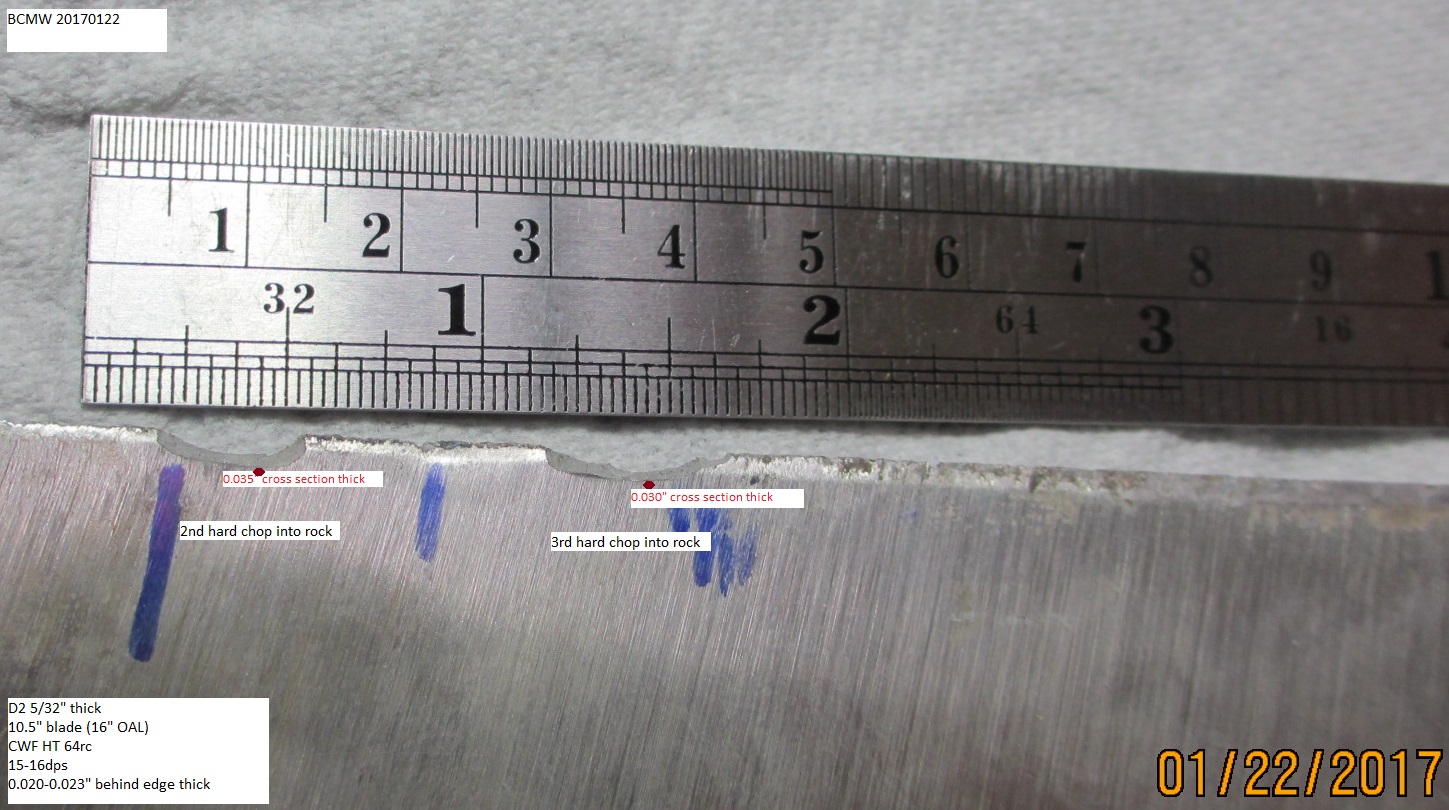
I've a test D2 light chopper 5/32" thick, 10.5" blade (16" OAL). It has been tested with initial hrc at 66, gradual thinning down and softened. It is now at 64rc with edge geometry 0.02-0.023" behind edge thick, 15-16 dps (edge still has a few dings). If you like to see what D2 can do, I am willing to shoot a short video - lmk. e.g. chop oak; katalox; african blackwood using a rock as backing (silly accident will happen to the edge). Keep in mind, chop usually impart higher lateral load than tap/baton through hard materials, such as brick; cinder block; etc...

Point being - with good ht even D2 at 64rc is strong & plenty tough for impact usage.

Hi guys, recently i have decided to buy a new blade for my travels in the woods, my max budget it's around 300-350 € (318$-372$).
I decided to buy a craft knife for a better quality.

Initially i was oriented towards this : https://www.coltelleriacollini.it/w...rk-burgundy-micarta-coltello-artigianale.html, the Wander Tactical Dimorphodon, is a big blade made of D2.
(I want a big blade cause i take with me only one knife, so i need minimum 7 inches and max an 8 inches)

But before to see the wander tactical, i saw some Japanese craft blades of Takeshi Saji.
- https://www.coltelleriacollini.it/takeshi-saji-mikaduki-180-black-coltello-artigianale.html
- https://www.coltelleriacollini.it/takeshi-saji-musashi-140-coltello-artigianale.html (there is a version of this whit a 7 inch blade)

Some of my friend in Italy however told me that 64 HRC are too many, because whith so high hardness the blade edge probably chipping when shock whit rocks in the ground, and it is known that an inox whit so high hardness probably would break without damascus.

Many people however buy this knife for hard work on the camp, because the blade is in damascus.
So i would ask to you,for a damask toughness are okay? Or it would break during hard work and stress?

Thanks very much at all, greetings from Italy!
P.S. Just a 2° question, is D2 Steel a good steel for big knives?
Cause in a YouTube comment i read that isn't!
But i think that the Wander Tactical are good knives!
 
I would be very happy to see a video.
So u think that 59/60 HRC are few for impact usage of a D2 steel?
You told me that the steel D2 has a known weakness cause "It has enough count of large(20-200um) primary carbides to consider as unwanted inclusion", but if has less than 61HRC " there is enough ductility to allow it to support most edge activities (given proper geometry)".

And that "none can match D2 low cost in raw material"

But for the Dimorphodon i will spend 300 € and this for me it's not really "low cost", if i buy this knife i want the safety that does not break in many years despite the hard work.
With your words you scared me about the purchase of this knife..
Could you show me some better product for that amount?Or at least, what you feel superior.
Also what about regarding the Takeshi Saji?

P.S Thanks for your very technical answer.
 
If/when doubts - I wouldn't settle for either knife (D2 or laminated 64rc carbon), since there are better option out there.

I just made this video for you - BCMW 64rc D2 chopper against a rock... Please keep in mind this chopper edge geometry is fairly thin:

[video=youtube_share;ik9fM1UluVk]http://youtu.be/ik9fM1UluVk[/video]

Edge afterward:
hrrxQCe.jpg


edit to add: as for better option, look into proven steels (with similar carbide volume) such as cpm m4, vanadis4e. My 64rc M4 chopper is way tougher this 64rc D2 -http://www.bladeforums.com/forums/showthread.php/1409721-Heat-Treatment-Crystal-Weaving-Foundation?p=16817665#post16817665

I would be very happy to see a video.
So u think that 59/60 HRC are few for impact usage of a D2 steel?
You told me that the steel D2 has a known weakness cause "It has enough count of large(20-200um) primary carbides to consider as unwanted inclusion", but if has less than 61HRC " there is enough ductility to allow it to support most edge activities (given proper geometry)".

And that "none can match D2 low cost in raw material"

But for the Dimorphodon i will spend 300 € and this for me it's not really "low cost", if i buy this knife i want the safety that does not break in many years despite the hard work.
With your words you scared me about the purchase of this knife..
Could you show me some better product for that amount?Or at least, what you feel superior.
Also what about regarding the Takeshi Saji?

P.S Thanks for your very technical answer.
 
Last edited:
If/when doubts - I wouldn't settle for either knife (D2 or laminated 64rc carbon), since there are better option out there.

I just made this video for you - BCMW 64rc D2 chopper against a rock... Please keep in mind this chopper edge geometry is fairly thin:

[video=youtube_share;ik9fM1UluVk]http://youtu.be/ik9fM1UluVk[/video]

Edge afterward:
hrrxQCe.jpg


edit to add: as for better option, look into proven steels (with similar carbide volume) such as cpm m4, vanadis4e. My 64rc M4 chopper is way tougher this 64rc D2 -http://www.bladeforums.com/forums/showthread.php/1409721-Heat-Treatment-Crystal-Weaving-Foundation?p=16817665#post16817665

I'm afraid of not having understood, u told me that there are better option, and after u show me ur D2 chopper, that are incredible, u abuse on a rock and it only chip the edge..
So why ur D2 is better than WT D2?

Ok maybe I begin to understand, correct me if I'm wrong, u have tested for me the D2 chopper 64 HRC and show me the damege of the blade after the test, and after u show me the damage of the same test on your CPM M4 Chopper, and the result is much better, the edge is not chipped.
It's incredible.
I was surprised by the result of the D2 chopper, but ur M4 is incredible.
So i understood the difference by 64 HRC D2 and 64HRC by other steels like cpm m4, vanadis4e.

But i think that D2 of wander tactical might be best of your D2 64 HRC cause the heat treatment.. Or am I wrong?
 
I think the video primarily shows is how well D2 can perform with a very good custom heat treat, but even then it's hard to understand why you would choose it for a large blade where toughness is desired over something that would perform even better given the same level of attention.

Cost is one potential factor, but the Wander isn't an inexpensive knife. At that price point, you should be able to get pretty much whatever you want. Not to even say it's a bad knife, I just don't know as I know nothing about the company. On the other two, just personal preference, but I wouldn't pay that kind on money for a blade with a basic looking paracord-wrap handle and I would have the same concerns about using them for impact work as I do with D2.

Here is a related thread I found that shows sort of the worst case scenario. Bluntcut chimed in there as well. It's hard to draw any conclusions from the example since the failure might have been driven by factors other than the alloy, but you may find it interesting:

http://www.bladeforums.com/forums/showthread.php/1452898-viper-carnera-chipping
 
lol rocks in the ground.... are you buying a shovel or a knife?

[video=youtube;eQsatmsxvdA]https://www.youtube.com/watch?v=eQsatmsxvdA[/video]
 
Yep, exactly why I recommended to OP to look into better option for the money. But have to say, the WT D2 looks like a very nice tactical fighter.
I think the video primarily shows is how well D2 can perform with a very good custom heat treat, but even then it's hard to understand why you would choose it for a large blade where toughness is desired over something that would perform even better given the same level of attention.

Cost is one potential factor, but the Wander isn't an inexpensive knife. At that price point, you should be able to get pretty much whatever you want. Not to even say it's a bad knife, I just don't know as I know nothing about the company. On the other two, just personal preference, but I wouldn't pay that kind on money for a blade with a basic looking paracord-wrap handle and I would have the same concerns about using them for impact work as I do with D2.

Here is a related thread I found that shows sort of the worst case scenario. Bluntcut chimed in there as well. It's hard to draw any conclusions from the example since the failure might have been driven by factors other than the alloy, but you may find it interesting:

http://www.bladeforums.com/forums/showthread.php/1452898-viper-carnera-chipping

WT D2 6.5mm/0.25" thick and good overall heavy fighter, except for a major potential flaw
rjO3Hko.png

Would this thing break in use? Nah, unless you use it as a step ladder. Would it chips out in huge haft-moon shape? Nope, unless hard baton through a large twisty knot, which would mess-up tough blade as well. Would you buy it? Nil.

Beside the super important of design & geometry... Large blade dulling is mainly by deformation (dent,roll,chip,smush) not abrasion/wear. So optimal edge/steel would be sufficient+30% extra toughness and as strong as possible, thereby minimize the deformation size/magnitude when encounter damaging interactions. Wear resistance from carbide effectiveness increase as cutting stroke increase in draw/saw motion.

BCMW/my ht is quite different from normal ht. From demonstrated videos, clearly ht played a big role... Insightful mind would see the performance gap between D2 & M4 is actually not that large, when ht is very good.

When makers/ht-services use normal/industry/mfg-recommend ht protocol, certain steels are designed for easy to get good(not excellent) outcome. Cruwear/zwear/pd1, 4v, vanadis4e, m4, etc around 61rc would be quite strong and plenty of toughness for large blades. Coated low Cr% steels (W2, 52100, 80CrV2, 1084, 1075, ...) are good, plus super easy for field sharpening.

Bottom line - if you are looking for a durable high performing large blade, do a little more research/reading. Otherwise, buy + enjoy (life is short) and just consider first couple big purchases as learning experience...

I'm afraid of not having understood, u told me that there are better option, and after u show me ur D2 chopper, that are incredible, u abuse on a rock and it only chip the edge..
So why ur D2 is better than WT D2?

Ok maybe I begin to understand, correct me if I'm wrong, u have tested for me the D2 chopper 64 HRC and show me the damege of the blade after the test, and after u show me the damage of the same test on your CPM M4 Chopper, and the result is much better, the edge is not chipped.
It's incredible.
I was surprised by the result of the D2 chopper, but ur M4 is incredible.
So i understood the difference by 64 HRC D2 and 64HRC by other steels like cpm m4, vanadis4e.

But i think that D2 of wander tactical might be best of your D2 64 HRC cause the heat treatment.. Or am I wrong?
 
Back
Top