I read this exchange Th232. I am interested in how, specifically, these test are conducted? Let's call a truce for a moment and you can tell us. I do think it is fair to point out that Spyderco started it's knife business producing forward trigger lock-backs when liner-locks were all but unheard of and also that today they currently have liner-locks in their line up. But, no joke, you are a Mechanical Engineer that has written papers on the very topic of lock strength and I'm interested in how specifically you conduct these tests and what the result were.
I never said
I conducted any tests, the first part of my post is regarding Sal's tests. Following on from what Stabman said, they're done on a piece of equipment where the knife is clamped down, and increasing amounts of pressure put on the blade. IIRC, one of the Chinooks maxed out the machine, the only folder they've made that's been able to do so, regardless of lock type. And like a good tester, I'm pretty sure Sal would test multiple knives.
As for me being a mech eng, as I've said before, I'm just a student, and haven't written any papers on this. That said, I do know how to analyse stuff, and have done so with good results. My level of knowledge has indeed grown to the stage where I can happily analyse these locks. So...
Let's start with a little thought experiment. We have a metal bar, say square cross-section, 4x4 mm, and about 150 mm long. If I ask someone to permanently deform it with their hands, will they:
a) Stretch it, creating a normal stress.
b) Compress it (normal stress again, but in the opposite direction)
c) Twist it, creating a torque.
d) Bend it, creating a bending moment.
e) Shear it (not to be confused with bending). This creates shear stress.
The answer will be d. Why? Because of leverage. Of interest will be that a bending moment is actually a combination of tensile and compressive normal stresses, but in cases where the length of the item is much greater than its cross-sectional dimensions, the leverage causes the forces to be magnified. An example would be if you find a door, swing it closed and try to keep it open using the handle (far from the hinge), or try pushing a point a couple of inches from the hinge. A greater force is required closer to the hinge. The relevant formula is torque = force x distance. In this case, torque is constant.
Let's make this a semi-numerical analysis. Some of the numbers I need to do a full quantitative analysis are not available, and thus comparison of certain aspects is moot.
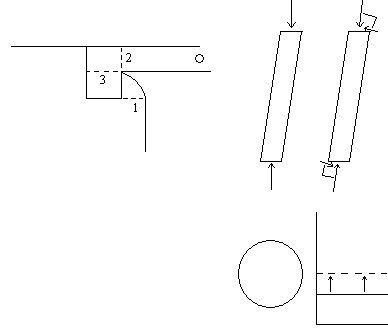
Now on to the knives. I take it nobody will object to me taking two folders, both with 4 mm thick blades, same pivot size, same blade steel and all the rest. Here's a diagram of the relevant components that I'll be referring to:
The well for the lockback is 8 mm wide and 5 deep (although I suspect that several other knives have a larger well, and would thus be stronger). At line 2, the area is 4 (thickness) by 5 (height) mm. For the framelock, the cutout (the weak point) is 1.5 mm, and at that point is 15 mm wide. Length of the cutout about 70 mm. Does everyone agree that these are fair measurements? If not, give some suggestions.
Let's start with the lockback. I've outlined the three most likely lines of failure.
1 and 3 have the same types of stresses, a shear stress and a bending moment. That said, 1 will have a very small bending moment due to location and orientation of the stress that's being exerted by the blade.
Location 3 is in a similar situation, due to the reasons given above.
2 will be a pure bending moment. However, note that the distance from where the blade tang pushes against the lockbar to the centre of 2 is small (centre to centre, 5 mm). We'll compare this with a framelock later.
Some of you may notice that the sharp angles on both the blade tang and the lockbar will create a stress riser. The corner on the left edge of line 1 will have, on a well-designed lockback, some form of round well for various reasons, and will thus multiply the stress by 3. Likewise, the corner indicated by where 2 and 3 meet won't be a sharp corner, but will be rounded. Unfortunately it's rounded by a very small amount. Call it a multiplier by 10. This is probably over the top, but we'll run with it.
So which one will be the most likely to fail first? Location 2 is under a pure bending moment, while 1 and 3 are under mostly shear. Thus, even taking the different distances (hence different net forces), I'd call location 2 as being the weakest.
Another method of failure is if the lockbar pivot shears. Given that it's supported on both sides, only shear force will act. Frankly, given the above, I really don't think this is a weak point if the appropriate size pivot is used.
Now for liner/framelocks. Let's take a framelock. The net stress on the lockbar can be taken just by averaging the max (closest to the pivot) and the min. From the framelocks I've seen and owned, the average stress appears to be higher because of where the lockbar contacts the blade tang. However, let's ignore this and take the pressures exerted as being equal.
In the first drawing of the lockbar, I've drawn the actual forces present, the blade pushing down, and the reaction forces on the other end of the bar to keep it in place. Angles have been exaggerated to make things easier to see.
The second picture has the forces broken down into normal and tangential components (at right angles), so we can look at the stresses. We have a largely normal compressive stress, which we will ignore for now, but keep in mind for later. Of interest is the tangential stress, which, given the lockbar's length will result in a bending moment at the place the lockbar has already been bent.
So how much of the applied force will be transferred? It won't be much, and this, is where liner/framelocks derive most of their strength from. That said, from the diagram above, it's basic trig, let's take the angle as 3 degrees, this gives us about 5.25% of the total force being converted into shear stress. Note that due to the lock cutout, there's (again!) a stress concentration factor. This SCF is rather minor though, and we'll neglect it. But now that we've balanced forces, we need to balance the moments acting on the lockbar. The length of the lockbar means that the relatively small shear stress at the contact end creates a (relatively) large bending moment at the point where the lockbar bends. Recall how the lockbar for the framelock was 150 mm, as opposed to the lockback's 5 mm. That results in a multiplier of 30 for the bending moment on the framelock.