
That, plus isn't it the responsibility of the guy making the positive claim to make the proof, rather than whining that other people can't disprove his claim?
Yep. It's not possible to disprove a negative. It's only possible to prove a positive claim. Even a negative assertion that sounds stupid can't be disproven. For example: "There are no pink unicorns in los angeles" is impossible to prove because those pink unicorns could be magical, invisible, or hiding somewhere. A positive claim would be saying "there are zebras at the zoo". That is a claim that can be proven because if one goes to the zoo and there are zebras, the claim is then shown to be true. You can't disprove a negative because there could always be some other factor that would change the outcome. The best you can do is reduce variables and test as much as possible to reach conclusions.
In the case of knives it becomes rather complicated to prove or disprove anything. "With regard to the 52100, what makes you feel that it is not well suited to prying at 62 RC? What evidence do you have to support this statement?" On the contrary, one would need to provide evidence to support that it is good for prying, rather than try to prove that it is not good for prying. In order to prove anything you'd have to figure out what thickness and geometry are going to be tested. If you make a thick Busse-style knife out of 52100 at 62 HRC and pry with it it's not the same as using one with a design like the Phil Wilson Southfork. The results would only be indicative of similar knives. This is why you cannot disprove a negative. Just because a design like the Southfork might snap from prying doesn't mean a knife made out of 52100 in the same shape as a BK2 would snap, so you cannot conclude that it's not good for prying because there are always more possibilities. You can, however, show instances where 52100 at 62 HRC does pry well.


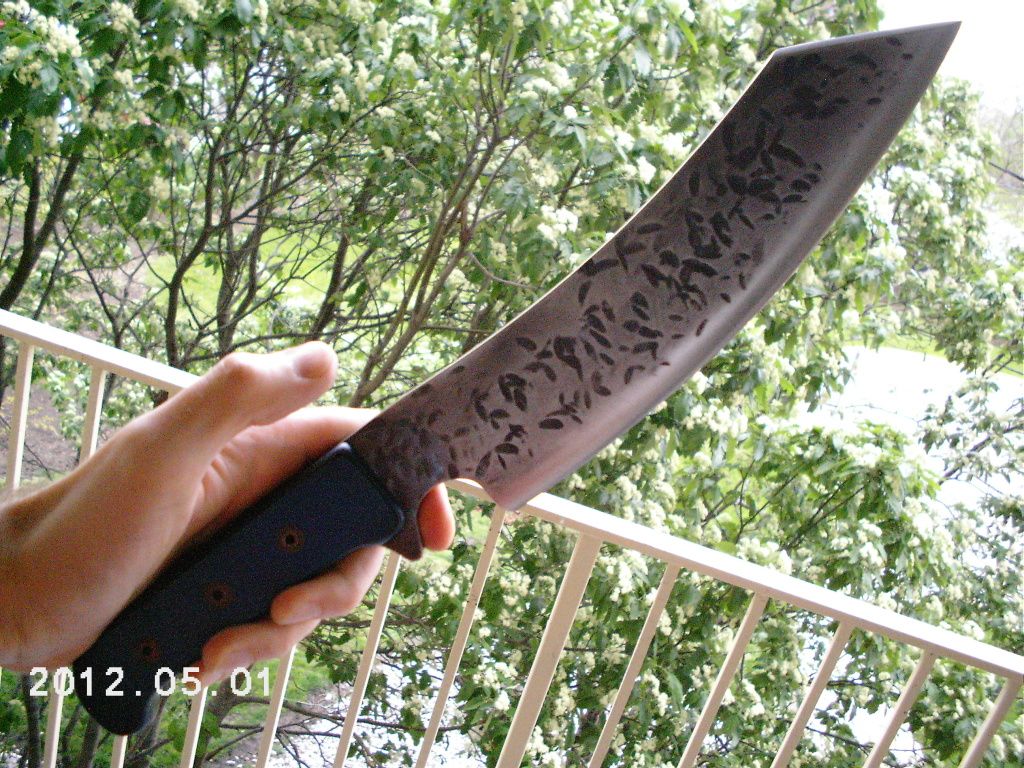


 ) were lucky that night, as the other options were more destructive. Now that I'm older and smarter (questionably) I prefer not to depend so much on luck. Since carrying a tool box doesn't work for me and since Murphy's Law dictates you won't have the crow bar when you need it most, I'll keep my pry-capable knife handy