
-
The BladeForums.com 2024 Traditional Knife is available! Price is $250 ea (shipped within CONUS).
Order here: https://www.bladeforums.com/help/2024-traditional/
You are using an out of date browser. It may not display this or other websites correctly.
You should upgrade or use an alternative browser.
You should upgrade or use an alternative browser.
WIP: Arkansas locking Hunter
- Thread starter ken erickson
- Start date


- Joined
- Dec 21, 2008
- Messages
- 402
Thanks so much for posting this. I've been following and loving every minute of it. I really like these WIP Threads.
This may be a stupid question, but: How is the jigging done? Do you use a pattern, or just eyeball it? The word "jigging" makes me think you use a jig of some sort, but the pattern seems fairly random. Or is it because you dance a jig when you see how pretty the scales turned out?
I've attempted playing around with jigging a little using a dremel. How do the big boys do it?
This may be a stupid question, but: How is the jigging done? Do you use a pattern, or just eyeball it? The word "jigging" makes me think you use a jig of some sort, but the pattern seems fairly random. Or is it because you dance a jig when you see how pretty the scales turned out?
I've attempted playing around with jigging a little using a dremel. How do the big boys do it?

- Joined
- Jan 7, 2009
- Messages
- 443
Thanks so much for posting this. I've been following and loving every minute of it. I really like these WIP Threads.
This may be a stupid question, but: How is the jigging done? Do you use a pattern, or just eyeball it? The word "jigging" makes me think you use a jig of some sort, but the pattern seems fairly random. Or is it because you dance a jig when you see how pretty the scales turned out?
I've attempted playing around with jigging a little using a dremel. How do the big boys do it?
+1 on this question.
Chuck

- Joined
- Aug 27, 2004
- Messages
- 2,701
This may be a stupid question, but: How is the jigging done? Do you use a pattern, or just eyeball it? The word "jigging" makes me think you use a jig of some sort, but the pattern seems fairly random. Or is it because you dance a jig when you see how pretty the scales turned out?
I've attempted playing around with jigging a little using a dremel. How do the big boys do it?
Very good question! I personally use a rotary cutter driven by a Dremel tool. I have a few different cutters but I have found that the most important part of the equation is how you use it. I do not use a pattern to trace or transfer onto the bone. I do have a pattern in my minds eye as I start to jig the bone. Charlie made a very good point when he mentioned that Tony Bose, even after all the years of experience making traditional pocket knives, still spends lots of time looking at old knives. The same thing goes with jigging. After a while you start to get a feel for what looks "right" for a given pattern.
I hope to have scales dyed by Thursday mid-day if things go well and I will then forge ahead. Thanks to everyone that has taken time to read, and or comment.
Ken
Last edited:

Absintheur
Banned
- Joined
- Jan 31, 2008
- Messages
- 3,280
I do think matching the jigging size to the scale of the knife is a very important and often overlooked aspect. I have picked up larger knives that I should like but something nagged at me about them. Some time ago I realized what it was...quite often the jigging pattern or size just didn't go with the knife.
I would have to say watching this knife go from concept to finish is a real treat.
I would have to say watching this knife go from concept to finish is a real treat.


- Joined
- Jun 6, 2009
- Messages
- 2,966
Ken, Thanks for this thread it's been more than helpful to understand the WHOLE process of making a GREAT custom knife!! I've enjoyed every minute of it.
Jason
I agree, this thread has been incredible!
- Joined
- Aug 27, 2004
- Messages
- 2,701
Well, I have been back at work on the hunter. I am real happy with the dye job on the scales. Medium brown with a bit of translucency. Very evenly matched from pile side to mark side with no noticeable color difference.
I emailed Charlie when it came to the shield and we both agreed on this modified bar shield that was used by Empire often in it's early years. I think it fits this large pattern quite well. Charlie, maybe you could post the one picture you sent me of the ebony Jack. I think it comes across as to what I was shooting for , both in shape and in proportions with the knife.
I am on the downhill slide now with this knife. I will be spending the next day doing the finishing touches on, mark the blade, and pound it together!


The scales are still a bit oversize both in profile and thickness.I will thin them out from the backside to prevent loss of jigging

Here you can see that the thickness is just about correct, a bit of thinning from the back and on they go.

I glue my scales on using gorilla glue, spring clamps and a large parallel.

While the glue is curing I will cut out the shield

I use a dial calipers to check my shield. I try and get it as symmetrical as possible. I use .040SS sheet stock.

Lots of ways of cutting the scale for the shield. I have used parser plates, however on this knife I will be using a dental burr in my rotary tool.

I will slightly dome the shield by super gluing the shield to a piece of brass , then over to my belt grinder.

After the glue sets up, I drill the scale pin holes and the holes for the lockbar pivot etc.
I emailed Charlie when it came to the shield and we both agreed on this modified bar shield that was used by Empire often in it's early years. I think it fits this large pattern quite well. Charlie, maybe you could post the one picture you sent me of the ebony Jack. I think it comes across as to what I was shooting for , both in shape and in proportions with the knife.
I am on the downhill slide now with this knife. I will be spending the next day doing the finishing touches on, mark the blade, and pound it together!
The scales are still a bit oversize both in profile and thickness.I will thin them out from the backside to prevent loss of jigging
Here you can see that the thickness is just about correct, a bit of thinning from the back and on they go.
I glue my scales on using gorilla glue, spring clamps and a large parallel.
While the glue is curing I will cut out the shield
I use a dial calipers to check my shield. I try and get it as symmetrical as possible. I use .040SS sheet stock.
Lots of ways of cutting the scale for the shield. I have used parser plates, however on this knife I will be using a dental burr in my rotary tool.
I will slightly dome the shield by super gluing the shield to a piece of brass , then over to my belt grinder.
After the glue sets up, I drill the scale pin holes and the holes for the lockbar pivot etc.
- Joined
- Aug 27, 2004
- Messages
- 2,701

I have the pins spun for the scales, the pins peened for the shield. At this point I have the lions share of the work done. Now comes the final finish work, then final assembly.
Now it's really starting to look like a knife!
I will be finishing up, today, tomorrow perhaps , and then a good set of pictures will be posted here of the finished knife.
Ken

- Joined
- Jan 18, 2007
- Messages
- 34,133
That shield IS the right choice. I'll chill the Champagne!

Campbellclanman
Platinum Member
- Joined
- Mar 10, 2007
- Messages
- 16,309
Ken, I am just a beginner in the folder world-actually ...compared to others a beginner in the whole game of knives.
This thread has been a real eye opener to me-and judging by the comments of even the more experienced knife collectors and such - this is one thread that has taught everyone something...Thank you very much for all of this...a fantastic thread.
I was amazed when I saw the photos come up of the dyed jigged scales...I LOVE that sort of work-and it has been a real pleasure to see this knife come into its own.
This thread has been a real eye opener to me-and judging by the comments of even the more experienced knife collectors and such - this is one thread that has taught everyone something...Thank you very much for all of this...a fantastic thread.
I was amazed when I saw the photos come up of the dyed jigged scales...I LOVE that sort of work-and it has been a real pleasure to see this knife come into its own.
Last edited:
Campbellclanman
Platinum Member
- Joined
- Mar 10, 2007
- Messages
- 16,309
Ken..Im sorry if this sounds a bit silly...I was just looking at the scales-where you can see, and where you state that they are oversized in height and width...so the dye must penetrate the bone quite thouroughly-to enable you the sand back the bone a few millimetres to bring them back slightly to the edge without the need to re-dye?.
Im sorry if this sounds a dumb question-I hope it makes sense.
Im sorry if this sounds a dumb question-I hope it makes sense.
- Joined
- Aug 27, 2004
- Messages
- 2,701
Ken..Im sorry if this sounds a bit silly...I was just looking at the scales-where you can see, and where you state that they are oversized in height and width...so the dye must penetrate the bone quite thouroughly-to enable you the sand back the bone a few millimetres to bring them back slightly to the edge without the need to re-dye?.
Im sorry if this sounds a dumb question-I hope it makes sense.
No such thing as a silly or dumb question if asked in a sincere desire to learn:thumbup:
Dying bone can be a tough one and a art form in its own right. Lots of variables to contend with. I tried to get as close to 100% penetration as possible on this set. I did not have to re-dye the edges on this set. At times it may be beneficial to get a layered affect utilizing different colored dyes. Old Remington bone for example
 eek has a much lighter, almost yellow cast to the underlying surface with a dark , almost black bark. If anyone knows of a surefire way to duplicate it, PM me!!!
Campbellclanman
Platinum Member
- Joined
- Mar 10, 2007
- Messages
- 16,309
Ok...understood, I wasnt aware you could get the dye right through ( or as close too )...thanks for the reply.

- Joined
- Nov 5, 2009
- Messages
- 37
Thank you doing this WIP. It is one of the best that I have ever followed.
When I seen the bone the first thing that hit me was smooth bone, dark honey color, with a slight swell, oh man is that going to look good. That was just in my pumpkin little brain. Then I seen the photo of the jigged scales and my cold little heart sank. I have never like the look of jigged bone, it has always looked cheap. Then I realized that I have always looked at cheap jigging. I must say Sir that your work is Over The Top.
I guess I will start looking at jigged bone knives again now that I know what they are suppose to look like:thumbup:
Maybe a WIP about jigged bone and how you get the dye sooooo deep.
When I seen the bone the first thing that hit me was smooth bone, dark honey color, with a slight swell, oh man is that going to look good. That was just in my pumpkin little brain. Then I seen the photo of the jigged scales and my cold little heart sank. I have never like the look of jigged bone, it has always looked cheap. Then I realized that I have always looked at cheap jigging. I must say Sir that your work is Over The Top.
I guess I will start looking at jigged bone knives again now that I know what they are suppose to look like:thumbup:
Maybe a WIP about jigged bone and how you get the dye sooooo deep.

waynorth
Dealer / Materials Provider
- Joined
- Nov 19, 2005
- Messages
- 34,697
This thread is like watching a Genie slowly appear from the magic Lamp! It teaches the big steps of the process, but doesn't completely show the planning, decisions, time and labor that are put into the final piece. The effort behind the scenes is enormous!
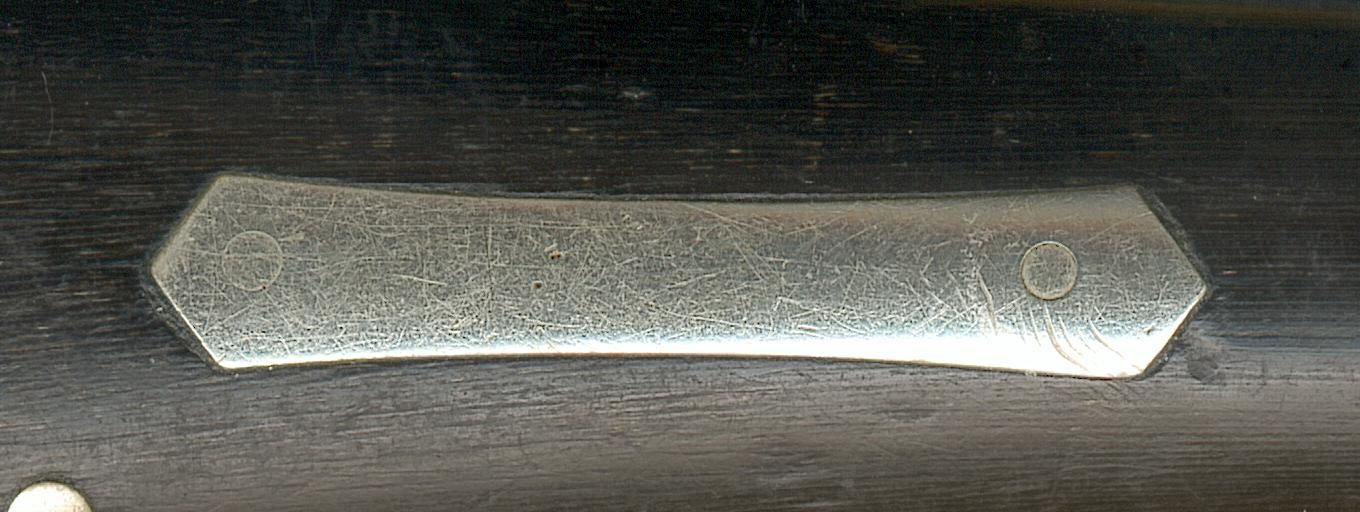
Here are the pics I sent to Ken for the shield. These knives are worn or flawed examples that didn't make it into my display, but I enjoy them for their educational value and character. The Eureka Jack's shield has particularly nice lines, and I believe that's the one that Ken used as a model. Like he says, a few thou makes a big difference!
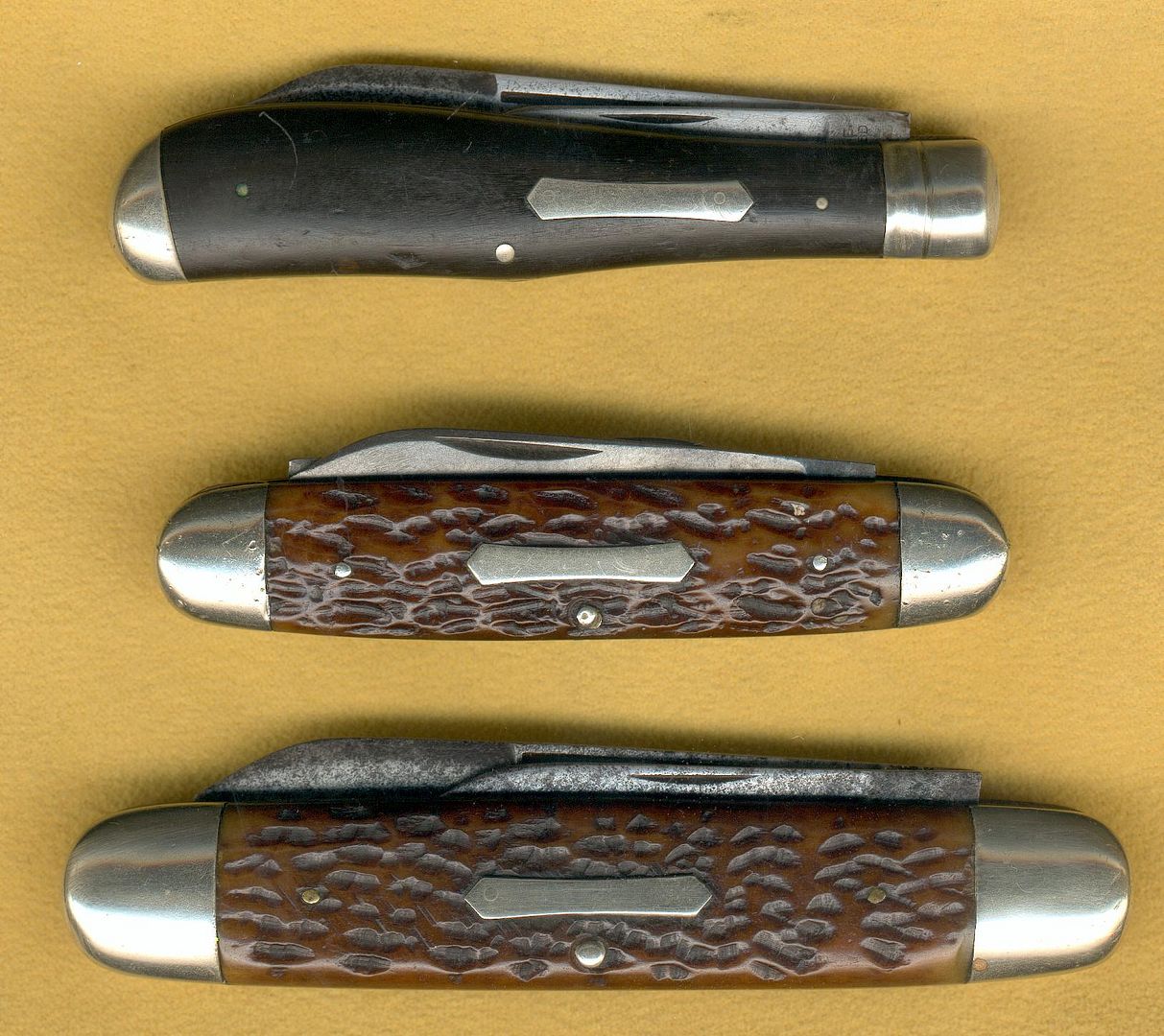
The Eureka shield:
Here are the pics I sent to Ken for the shield. These knives are worn or flawed examples that didn't make it into my display, but I enjoy them for their educational value and character. The Eureka Jack's shield has particularly nice lines, and I believe that's the one that Ken used as a model. Like he says, a few thou makes a big difference!
The Eureka shield:
Last edited:
Campbellclanman
Platinum Member
- Joined
- Mar 10, 2007
- Messages
- 16,309
Charlie...they are still great looking knives-again..the jigged bone always looks great to me, BUT...what is the top knife...the shape is awesome...I like the lines of it...could you possibly display the blades?...and tell me about this knife?
Thank you,
Duncan
Thank you,
Duncan
waynorth
Dealer / Materials Provider
- Joined
- Nov 19, 2005
- Messages
- 34,697
With apologies to Ken - a brief intermission!
Duncan, the knife you questioned is called a Eureka Jack. Not a common pattern, and this one has high mileage, but it snaps and functions perfectly.
A real pleasant, sculptural shape, and nice in the hand; just right at 3 1/2".
The bolsters are rat-tailed, AND threaded, however lots of pocket wear has softened them somewhat.
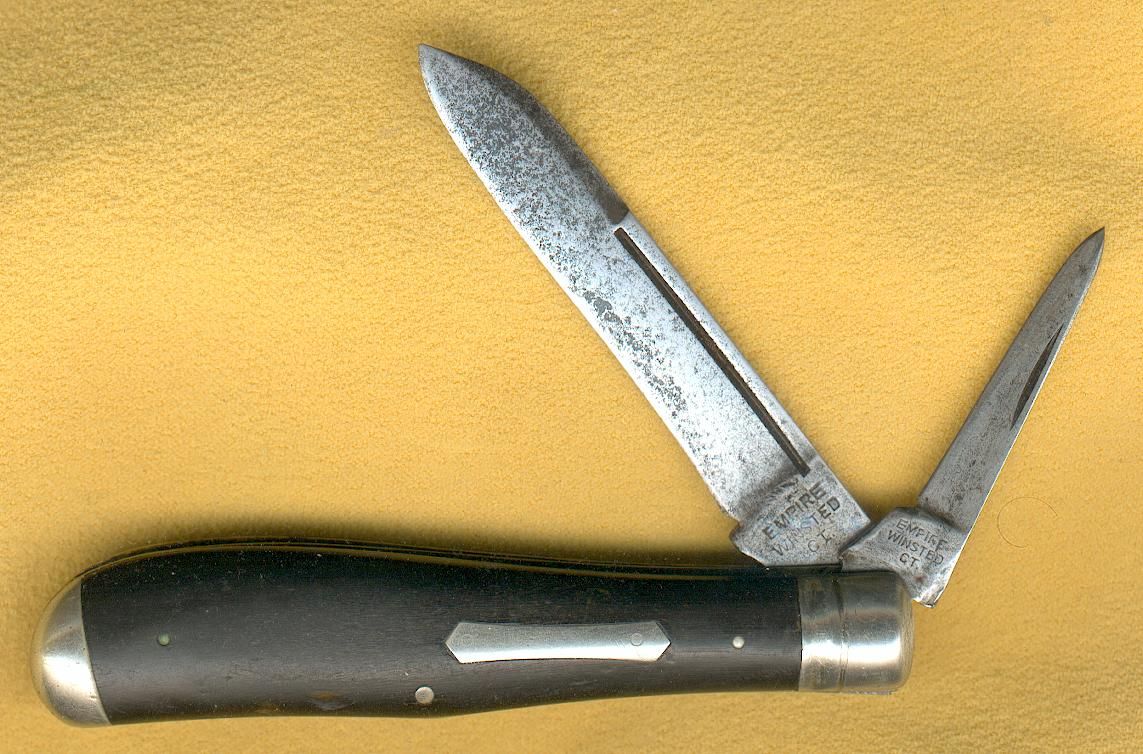
!Duncan, the knife you questioned is called a Eureka Jack. Not a common pattern, and this one has high mileage, but it snaps and functions perfectly.
A real pleasant, sculptural shape, and nice in the hand; just right at 3 1/2".
The bolsters are rat-tailed, AND threaded, however lots of pocket wear has softened them somewhat.