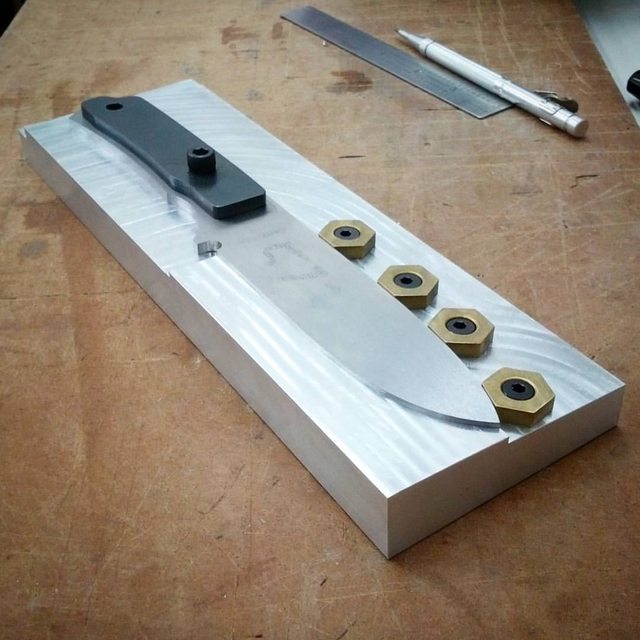
WIP: Designing and building the new Resolute with the help of CNC.

Good job Aaron. Nice to see a young guy reap some rewards for his hard work. You have obviously put a lot of energy and passion into what you're doing and I wish you all the success in the world.

You mentioned that you weren't completely satisfied with your fixture and that you were concerned about location so here's what I would suggest. Make your fixture quite a bit wider than what you have now and put the tapped holes around the periphery of the blank instead of down the center. Instead of loading your blank into the vise to drill it, use toe clamps from one edge only to clamp it to your fixture. Drill your holes and profile the half of the blank that you can reach all in one go. Put in a program stop so you can add clamps to the finished side and remove the first set of clamps, then complete your profile. You'll be done in one shot with just a program stop and no repositioning.
 
Good job Aaron. Nice to see a young guy reap some rewards for his hard work. You have obviously put a lot of energy and passion into what you're doing and I wish you all the success in the world.

You mentioned that you weren't completely satisfied with your fixture and that you were concerned about location so here's what I would suggest. Make your fixture quite a bit wider than what you have now and put the tapped holes around the periphery of the blank instead of down the center. Instead of loading your blank into the vise to drill it, use toe clamps from one edge only to clamp it to your fixture. Drill your holes and profile the half of the blank that you can reach all in one go. Put in a program stop so you can add clamps to the finished side and remove the first set of clamps, then complete your profile. You'll be done in one shot with just a program stop and no repositioning.

Hey mate!
Thanks very much! It's funny, I had a good idea that CNC would be difficult before I started down this road, but even I had honestly no idea just how much work it was going to be to get things running smoothly!

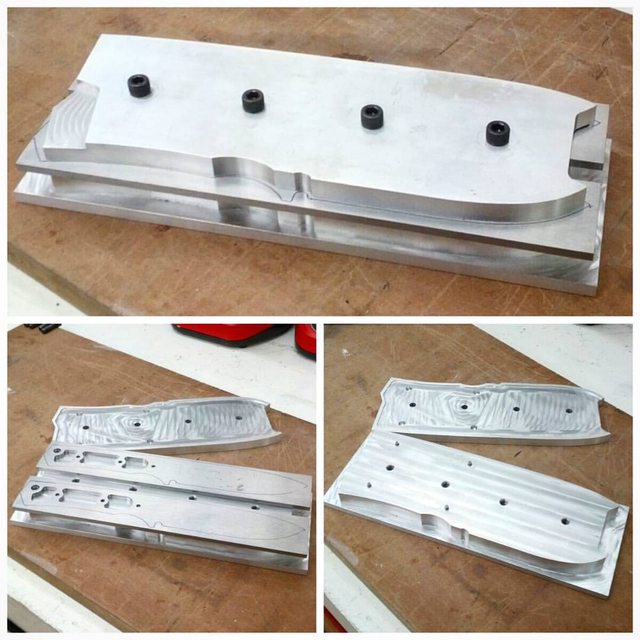
In regards to your fixture idea, I actually implemented a version of that just a few weeks ago! The new fixture has a large formed clamp that goes down over a pair of knives so I can machine the spine of one, then the edge of the other:

8TyIZisl.jpg


So far it seems to work very well! It supports the blanks well enough that I've been able to go back to HSM machining the blanks, rather than slotting, which is great... I hate dropping pieces off the blanks because there's always a chance they will end up in a place where they catch the tool on the finish pass, already had that happen once and lost a brand new endmill to it.

Here's a short video of the new fixture in action:

https://instagram.com/p/8yyspyCKNE
 
Looks like you have a good head for this stuff and are off to a great start. Keep at it and you'll find every shortcut there is... I mean that as in being efficient, not getting cheap with your work!

Also I think you have a good eye for design. I really like the look of the knives you're making.
 
Looks like you have a good head for this stuff and are off to a great start. Keep at it and you'll find every shortcut there is... I mean that as in being efficient, not getting cheap with your work!

Also I think you have a good eye for design. I really like the look of the knives you're making.

Thanks mate! I appreciate that!
 
I finally finished the video showing the production process for the blades of my knives! The video shows everything, at least in passing, including CNC machining, heat-treat, finishing, Cerakote and so on!

[video=youtube;98ly5-1bhHU]https://www.youtube.com/watch?v=98ly5-1bhHU[/video]

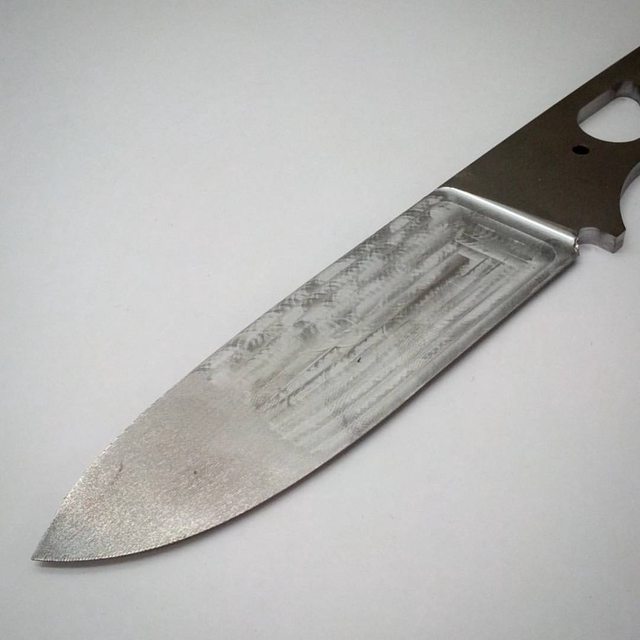
The CNC side of this still has a long way to go.. The new fixtures that I'm using for surfacing the blade bevel are working, but need some further tweaking and refinement.

The fixture:
bAqCMhNl.jpg


The result:
Tcu76uhl.jpg


I'm getting close enough now with the surfacing that just a little bit of hand sanding is enough to clean things up! Really nice to be able to approach it that way and to be able to avoid the belt grinder for that task as it greatly reduces the chance of mistakes.

I've also come up with a design for a fixture plate that will let me load all my operations for the blade onto the machine in one shot... I think that getting a completed blade off the machine every cycle will really make the process nicer, as opposed to doing single operations in batches. Much less standing in front of the machine, and I will also be finishing a part by hand every cycle as well, which will mean that problems will get picked up much quicker!

Overall things are going well, just slowly!

-Aaron
 
It's been fun watching you through out this journey. Thank you for including us. Jess
 
Really cool journey you are on for sure! Thanks for keeping us posted. You have sure put in a lot of hard work!
 
Really cool journey you are on for sure! Thanks for keeping us posted. You have sure put in a lot of hard work!

It has definitely been even harder work than I expected. I knew it would be difficult but some aspects of the fixturing have really thrown a lot of roadblocks in the way!

I am learning a lot though which is great, and I think I'm getting pretty close to a process that will just tick over nicely. I'm looking forward to that! It should also help soothe my poor credit cards :)
 
Beautiful work! You're definitely the reason I got into knife making. Thrilled to one day own a piece of your art.
 
Wow you have quite the setup! I remember watching you when you just had a filing jig and the two BrickForge!

Thanks for sharing.
 
Just read through the thread, very interesting. Just a question, the G10 will lessen the life of your cutters pretty significantly, and also seems that it will end up killing the bearings in your machine. Why not switch to micarta? I don't believe it's nearly as abrasive. I also prefer micarta because it seems to feel softer or warmer in my hands than G10.

If you already answered this and I just missed it, I apologize.
 
Aaron, I just thought of this, and I wouldn't be surprised if you have already, but given that you're still having to grind the corby pin heads off by hand, would it be possible to make a set of soft jaws to hold the assembled blade and handles by the tang and machine down the pin heads that way? Scratching up the cerakote would be a concern, but it could make that part of the process a lot more consistent. It might even allow you to do the handle rounding operation on the glued up blade, if remachining the handles after glue-up is too inconsistent.
 
Wow you have quite the setup! I remember watching you when you just had a filing jig and the two BrickForge!

Thanks for sharing.

Thanks mate! It seems so long ago that I started with the filing jig and so on, crazy how quickly time passes!
 
Just read through the thread, very interesting. Just a question, the G10 will lessen the life of your cutters pretty significantly, and also seems that it will end up killing the bearings in your machine. Why not switch to micarta? I don't believe it's nearly as abrasive. I also prefer micarta because it seems to feel softer or warmer in my hands than G10.

If you already answered this and I just missed it, I apologize.

Hey mate!
Essentially I just prefer the look and feel of G10 over Micarta. I think they are both great handle materials but I just prefer G10.

G10 will definitely eat cutters more quickly than Micarta, although given the number of parts I've made things are going fairly well. I'm still on my first set of tools for the G10 process, though the endmill that cuts the counterbores for the pins needs replacement now. Because I broke the process up into roughing and finishing for the profile (which is where I need to hold close tolerances) my finish tool seems to be holding tolerance for quite a while. To extend that I may get into using diamond tooling which is supposed to last 10x longer or more for a fairly reasonable cost bump.

As you said there's a definite possibility of G10 eating the machine as well... I'm using a dust collector to pull in as much of the fine dust as I can, and I will be upgrading that soon to capture more of the dust. So far I have not seen any amount of dust on the linear rails or ballscrews or anywhere under the way covers, though that's no guarantee that there is none getting there.

In the long term what I plan to do is to have a separate CNC mill setup just for cutting G10. G10 doesn't require the machine to be in as good condition as cutting metal does, so that machine will get second hand parts from my other future mills if and when it wears a part out. I think better dust collection will make a large difference.

The plan is to move to a larger space once I get things ticking over in a nice rhythm and keep them that way for a few months. I would then like to expand to a couple of extra Fadal mills. One dedicated for cutting steel parts, one dedicated to cutting G10 parts, and one dedicated for prototyping and making tooling. Ideally the new machines would be Fadal VCM10s or VMC15s which means that all parts will be interchangeable between them. Parts for these machines are quite inexpensive, so if I still go through ballscrews despite my dust collection on the G10 machine it will not be a great hardship, I don't imagine that even in the worst case I'll go through screws faster than one every couple of years.

All of this is still up in the air of course! We'll see how it pans out!

-Aaron
 
Aaron, I just thought of this, and I wouldn't be surprised if you have already, but given that you're still having to grind the corby pin heads off by hand, would it be possible to make a set of soft jaws to hold the assembled blade and handles by the tang and machine down the pin heads that way? Scratching up the cerakote would be a concern, but it could make that part of the process a lot more consistent. It might even allow you to do the handle rounding operation on the glued up blade, if remachining the handles after glue-up is too inconsistent.

Hey Neil!
I would love to do something along those lines! I have been thinking more about changing my handle fasteners to some method that would allow me to put 'caps' in the counterbores of the handles, then machine the handles completely to final shape before assembly. Perhaps the fasteners could be a press-fit into the caps, or I could use barbed pins to bite into the G10 instead? I have a few ideas to try but nothing solid as of yet...

Assembly like that, if I can find something that's as good, or better, than my current methods, would have the additional benefit of allowing me to assemble knives in a more 'on demand' fashion. ie: I could build up a stock of blades and different colored handles, then assemble them quickly once someone places an order... That would in turn allow me to give people more options for customization without having to build up a huge stock of pre-assembled knives.

Not sure how all that will work out just yet but I definitely have plans along the same lines as what you suggested! If you guys have any suggestions I would love to hear them! All the feedback in the thread has been great, I love getting the chance to bounce ideas of you guys!

-Aaron
 
I think another idea would be to put a flat along the sides of the handles so that you could machine the corbies flush without worrying about the curve of the handle, but I think that might be a looks/ergonomics compromise you're not willing to make.
 
Back
Top