WIP: Designing and building the new Resolute with the help of CNC.

Might be easier to just put in a few locating pins to insure perfect fit.

That would give you more leeway in the fastener dept.

this was going to be my suggestion as well... it's been helping me since i started using them.
 
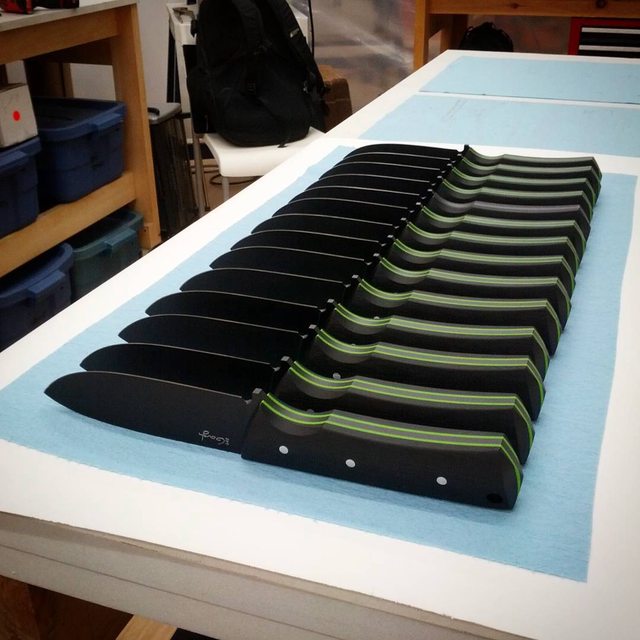
I'm stoked to announce that the first batch is now finished!


These bad boys are all ready to be packaged up, the first one is actually already on it's way to a customer! Very exciting!

Pretty crazy to think that this photo represents over 2 months of work!

The next batch will likely be much faster, and hopefully will produce less blems! I'm going to take a few days off and will likely start the new batch the middle of next week or so!
 
Congratulations Aaron! What improvements do you have in mind for your next batch? I'm still waiting to see if you can figure out how to machine the Corbies flush or rough out the entire bevel on the CNC ;)

Edit: I also have to say I was super impressed with your thermoforming jig for the sheaths!
 
Congratulations!! I got to handle and look over one of the first ones completed, very nice knives. Was good see you again, look forward to you having a table at the March CKG show.
 
Congratulations Aaron! What improvements do you have in mind for your next batch? I'm still waiting to see if you can figure out how to machine the Corbies flush or rough out the entire bevel on the CNC ;)

Edit: I also have to say I was super impressed with your thermoforming jig for the sheaths!

Haha, thanks Neil! That jig would have been even more impressive if it had worked :P

For the next batch the main improvement will simply be that I have the process mostly ironed out now, I should get to cruise through it with much less stop-and-start and hopefully put some money on my much-abused credit card :) Probably the only change I will make is to build a jig for sharpening wet on the grinder.

The batch after that I'll be looking at getting a second kiln with inert gas plumbing, and an oven specifically for the Cerakote, those two should speed things up significantly in their respective steps! Once the kiln, sharpening setup and Cerkote oven are sorted then that will leave the sheaths as the slowest and least consistent step...

There are 5 main areas that I want to address going forward:

1) Better materials and process for the sheaths. Whether I have those injection molded elsewhere or make them in-house I am not sure, but I want to improve that part of the process. Fibre reinforced nylon or similar is likely the perfect material, but that's not something I can do in house unfortunately so I'll have to investigate some options!

2) Another round of steel testing to decide if I continue using A2. I've been very happy with how it's performing, but now that I'm better at heat-treat and so on I want to test CPM154, CPM4V, CPM3V and a few others against A2 to see which has the best properties for my knives. Very high hardness with high toughness is the goal. I've been immensely happy with how high-hardness A2 performs, that level of performance with even greater toughness would be amazing! I'd also like to experiment with differential tempering to see if it can add useful abuse resistance to my blades.

3) Handle attachment method. As you alluded to, the step of having to hand-shape the corbies/handle is an opportunity for inconsistency and error! I would like to look at other attachment methods or machining techniques to eliminate that step. Preferably I would like the overall appearance to remain unchanged and I would like to improve strength at the same time which is a tricky proposition!

4) Test new coatings! I've been talking to a company about several PVD coatings that might work well for my knives. The main candidate right now is a dual layer coating of Chromium Nitride for wear/corrosion resistance with a top layer of a black coating called WCC for appearance. I plan to test this along with several other coatings like DLC and possibly TiCN (depending on steel) against Cerakote to decide what I'll use going forward. Cerakote definitely has exactly the appearance I want, and is very corrosion resistant but I need to see what else is out there!

5) Larger shop with dedicated production setups and tooling... Right now my production/prototyping machinery and tooling are one and the same which means that I'm either prototyping or I'm producing, can't really do both at once. I would like to setup a full set of production machinery so I can really dedicate tools to specific tasks and get everything streamlined. This will include buying a larger machining center with greater tool capacity so I can machine blades and handles at the same time.

At this point I may also look into bring on another person to work with me in the shop. I'm still not sure about this, and I definitely never want to go past the stage of 2-3 people (including me) in the shop, but I think it might be a good thing for my discipline and motivation as well as productivity. Finding the right person will of course be a challenge as I want someone that's going to really add to my capabilities and not just be a button pusher... We'll see, that particular thought is very speculative at the moment!

So that's pretty much the roadmap for the next 6-12 months! The goal for the next 3 months or so is simply to get a bunch of really good knives out to customers who have been patiently waiting, and to get myself into a less precarious financial situation!

-A

 
Congratulations!! I got to handle and look over one of the first ones completed, very nice knives. Was good see you again, look forward to you having a table at the March CKG show.

Thanks James! It was great to see you again, and I was very pleased I could be there to see you ace your Journeyman test!

I will definitely have a table at the March show, should have plenty of knives by then!

-A
 
So I finally finished the first of the videos showing the new process and I thought you guys might like to see it!

[video=youtube;t1YwH5SQj6Y]https://www.youtube.com/watch?v=t1YwH5SQj6Y[/video]

There is of course still much to do! I want to start machining multiple pairs of handle scales at a time so that I can eliminate the messy steps where I cut the G10 to size... I am also going to build a full enclosure for the VMC soon, along with buying a massive HEPA rated dust collector to pull in all the G10 chips.

Overall reasonably pleased with how things have been going! The process of making the blades has been kicking my butt, but I think I'm finally starting to make headway instead of scrap...
 
Cool man. It's nice for people to be able to see that doing it this way isn't a short cut.

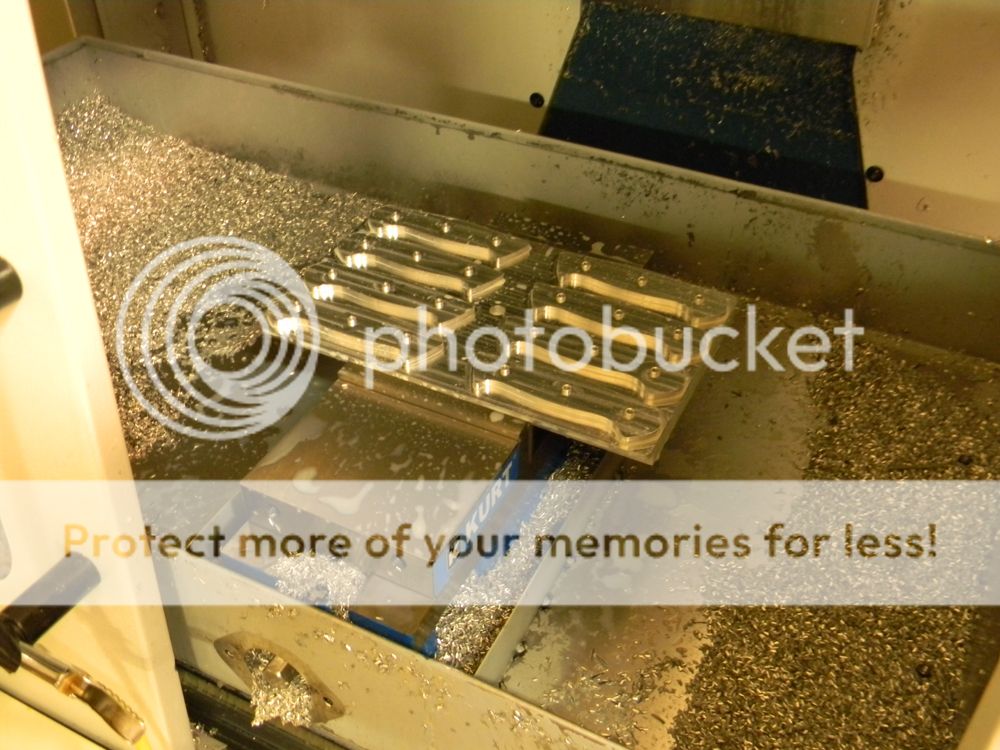
That G10 is going to wear out your mill prematurely, it eventually gets past way wipers and into ways and ball screws etc. and the life of these components can be reduced from 20,000 hours to 2,000. We run G10 on our scales machine which is built different. But overflow work goes on a conventional mill. I added a pan that sits on the table and captures a lot of the mess. It drains off one side into a hopper. This helps keep my way covers clear of fine abrasive grit. You might consider something like that to preserve your machine.

3.jpg~original
 
Cool man. It's nice for people to be able to see that doing it this way isn't a short cut.

That G10 is going to wear out your mill prematurely, it eventually gets past way wipers and into ways and ball screws etc. and the life of these components can be reduced from 20,000 hours to 2,000. We run G10 on our scales machine which is built different. But overflow work goes on a conventional mill. I added a pan that sits on the table and captures a lot of the mess. It drains off one side into a hopper. This helps keep my way covers clear of fine abrasive grit. You might consider something like that to preserve your machine.

3.jpg~original

Hey mate!
I agree that it's definitely not a shortcut, I would say that over the last few months it would have been quicker to make the knives by hand! However I am slowly getting there!

As far as G10 dust, I have been keeping an eye on the machine (inspecting under the way covers) and as yet I don't see any dust under there... The current (small, 160CFM) vacuum system seems to grab all the fine dust, and the heavy dust can't float up under the way covers.

I do hear what you're saying though and I will be keeping a very close eye on it! I'm hoping the new vacuum system (600CFM) should pick up everything rather than just the fines... I'll let you know how it goes! I will be replacing the ball-screws and spindle on this machine soon, so I'll be even more paranoid about it after that!

The mill that you usually run your G10 on, is that a mill with graphite package? Or something else?

By the way: I got the chance to handle one of your knives the other day! Really beautiful work mate! Was very cool to get to see one in person after seeing all the tooling and effort that has gone into them!
 
This post is full of awesome. Big fan of your videos. Very educational for new ( and i suspect fairly seasoned) makers.
 
Dude, seriously...

1-Your process is awesome
2-Your documentation of it on this thread is outstanding. From filming to explanation, all are extremely well done. It's better than a good book. I am ready to try my hand at cerakote now, just from one post
3- I am in my third year of medical school and I doubt most of my classmates and colleagues could accomplish what you have done with your mill and everything. Seriously the people on this forum are genius level.

Sorry for the man crush moment everybody, but I think a lot of us appreciate your willingness to share your experience and knowledge, it isn't necessary for you but it sure furthers our craft. You mentioned being stressed financially, but you shouldn't worry, between karma and your own ingenuity, I suspect you will do exceptional as a full time knife maker. Big thanks bro!
 
Thanks guys! Glad you like the thread so far!

As Nathan said I think it's really important to promote understanding of the fact that CNC is in no way easier... In fact from what I've seen so far it's *way* harder than making knives by hand, simply because of all of the up-front designing/building of fixtures and so on.

The making of the blades is still totally kicking my ass, Nathan has his process really dialled in for that and I would love to emulate his method, but my knife design makes that hard unfortunately.

I appreciate the support guys! It definitely helps to be able to chat with such nice folks when the process is being frustrating!

-A
 
You vids are really cool.

Sure it is hard when you are a one man show doing everything yourself and there is a large learning curve, but once everything is dialed in you will be able to crank out a lot more knives as a manufacturer with a greater ease then doing the same amount by hand.

Soon you will be cranking out more blades then you know what to do with
 
Whenever friends ask me about the knife making process, I tell them to check out three things: Blade forums, Walter Sorrels YouTube channel and Aaron Goughs you tube channel.
 
Awesome thread Aaron! I've been enjoying following along. You have a talent for making clear concise and attractive videos, not to mention knife making.

cheers,
mike
 
Cool man. It's nice for people to be able to see that doing it this way isn't a short cut.

That G10 is going to wear out your mill prematurely, it eventually gets past way wipers and into ways and ball screws etc. and the life of these components can be reduced from 20,000 hours to 2,000. We run G10 on our scales machine which is built different. But overflow work goes on a conventional mill. I added a pan that sits on the table and captures a lot of the mess. It drains off one side into a hopper. This helps keep my way covers clear of fine abrasive grit. You might consider something like that to preserve your machine.

3.jpg~original

Hey Nathan,

I've heard that about G10 and it's always worried me because we've jut got the one mill and run everything (including G10) on it. From your post it sounds like you're milling the G10 with flood coolant, is that correct?

thanks,
mike
 
You vids are really cool.

Sure it is hard when you are a one man show doing everything yourself and there is a large learning curve, but once everything is dialed in you will be able to crank out a lot more knives as a manufacturer with a greater ease then doing the same amount by hand.

Soon you will be cranking out more blades then you know what to do with

I'm definitely hoping that will be the case! It's certainly possible to make a living doing knives by hand, but I find that kind of endless repetitive work very hard to deal with! I'm hoping the CNC process will keep things fresh for me!

The one man show thing is definitely hard... I've been thinking about taking on someone part time to help with making sheaths, but I'd still have to do everything else! Even 'just' sourcing materials and tooling takes an incredible amount of time, not to mention actually making knives :)
 
... but I find that kind of endless repetitive work very hard to deal with!

For me that is an outlet for artistic expression. For me it is the one at a time creating with the flow until the knife is done then onto the next knife that is the most enjoyment and why I do it.

If I did it for a living I would starve to death...lol


Just keep a head of the wave that is coming. With companies like Kizer, Reate who are making high quality knives, with the best materials at good prices I think things are going to change for manufactures in an attempt to compete with them in the future.

Automation is awesome, and when you get a knife nut who knows blades, steels, material and heat treating running those machines what they can turn out is amazing and overseas they are doing that right now.

So keep going Aaron!
 
Back
Top