
-
The BladeForums.com 2024 Traditional Knife is available! Price is $250 ea (shipped within CONUS).
Order here: https://www.bladeforums.com/help/2024-traditional/
You are using an out of date browser. It may not display this or other websites correctly.
You should upgrade or use an alternative browser.
You should upgrade or use an alternative browser.
A Destruction Test Knife WIP
- Thread starter P. McKinley
- Start date


- Joined
- Jan 27, 2008
- Messages
- 2,010
The handle is roughed out.
I love working with cherry. I build and repair canoes and carve a lot of canoe paddles. Likely 80% of my paddles are cherry so I've become quite familiar with it. Although not from a paddle, this piece is a off-cut of 5/4's flat sawn that was destined for a mirror frame I built a while back. Nice solid stuff and I like the look.
I started by drawing some reference lines by eye:


I begin grinding in a depression on the middle line:

The belt sander wheel does a good job with this task:

This is feathered into a smooth U-shape:


I then take it to the vice(s) to remove the rest of the bulk with files and a Microplane 1/2-round rasp. I use this tool a lot when carving canoe paddles and it makes for quick going with remarkably fine control.

Done with the rasp:

I rough-shaped the butt end. Now I need to taper from the guard to the middle of the handle - creating the palm swell. So back to the belt sander for a bit of careful, tentative sanding:

I've spent an hour or so shaping this thing with large files. I still need to fine tune with smaller files and, of course, sand paper, especially around the guard.This is where I leave the handle to have some dinner. The next step is to get the copper pins in before I finish the handle.


.......back with more later..............
I love working with cherry. I build and repair canoes and carve a lot of canoe paddles. Likely 80% of my paddles are cherry so I've become quite familiar with it. Although not from a paddle, this piece is a off-cut of 5/4's flat sawn that was destined for a mirror frame I built a while back. Nice solid stuff and I like the look.
I started by drawing some reference lines by eye:


I begin grinding in a depression on the middle line:

The belt sander wheel does a good job with this task:

This is feathered into a smooth U-shape:


I then take it to the vice(s) to remove the rest of the bulk with files and a Microplane 1/2-round rasp. I use this tool a lot when carving canoe paddles and it makes for quick going with remarkably fine control.

Done with the rasp:

I rough-shaped the butt end. Now I need to taper from the guard to the middle of the handle - creating the palm swell. So back to the belt sander for a bit of careful, tentative sanding:

I've spent an hour or so shaping this thing with large files. I still need to fine tune with smaller files and, of course, sand paper, especially around the guard.This is where I leave the handle to have some dinner. The next step is to get the copper pins in before I finish the handle.


.......back with more later..............
Last edited:
- Joined
- Jan 27, 2008
- Messages
- 2,010
The pins are in.
I have some copper wire that I thought was the right diameter, but turned out to be just over size. I had my hopes up for a moment.

I'm using 3'16th" stainless steel brick ties.

To prepare, I'm sanding a clean piece scrap cherry wood from the handle block on fresh 400 grit paper. I'll mix this wood dust with the epoxy to use in the pin holes. As good as I am at drilling a nice clean hole.... I'm not very good at it and my drill press sucks, so it doesn't always happen. So, this blends any slop quite well, especially if very fine wood dust is used and a lot of it is used to make a thick paste.

The pins have been lightly sanded with 180 grit and cleaned with acetone. The pin holes in the block have been cleaned and run threw with an acetone-soaked Q-tip to raise the wood grain. I'm using standard 2-hr epoxy for this chore. Ready to put these in:

The pin holes and pins were both coated through with epoxy, and I also put a glob right in the entry hole as the pin is pressed in. The pins went in nice and smooth with a light hammer tap. The outside of the holes were packed with epoxy and I'll left to cure over night. Tomorrow I'll saw off the extra length and file to flush. The pins on the other side are nearly flush.

Tomorrow I'll hopefully get this knife finished and put and edge on it.
I have some copper wire that I thought was the right diameter, but turned out to be just over size. I had my hopes up for a moment.

I'm using 3'16th" stainless steel brick ties.

To prepare, I'm sanding a clean piece scrap cherry wood from the handle block on fresh 400 grit paper. I'll mix this wood dust with the epoxy to use in the pin holes. As good as I am at drilling a nice clean hole.... I'm not very good at it and my drill press sucks, so it doesn't always happen. So, this blends any slop quite well, especially if very fine wood dust is used and a lot of it is used to make a thick paste.

The pins have been lightly sanded with 180 grit and cleaned with acetone. The pin holes in the block have been cleaned and run threw with an acetone-soaked Q-tip to raise the wood grain. I'm using standard 2-hr epoxy for this chore. Ready to put these in:

The pin holes and pins were both coated through with epoxy, and I also put a glob right in the entry hole as the pin is pressed in. The pins went in nice and smooth with a light hammer tap. The outside of the holes were packed with epoxy and I'll left to cure over night. Tomorrow I'll saw off the extra length and file to flush. The pins on the other side are nearly flush.

Tomorrow I'll hopefully get this knife finished and put and edge on it.
Last edited:
- Joined
- Jan 27, 2008
- Messages
- 2,010
The handle has been sanded and oiled. I now have to leave it for the afternoon to dry. This evening I'll do some detail work on the guard, get the handle buffed and polished, and put a sharp edge on the blade.
To start, the pins are sawn off and filed flush:

Good enough for now:

Its time to fine tune around the guard and spacer:

Before:

Getting there:

I need to round off those flat surfaces on the handle:

Working with a file, the front is done and I'm starting the butt end:

An old 120 grit belt will help fair in the handle contours:

On to 220 grit:

Fine tune the curved butt:

The handle and copper spacer have been sanded with 400 grit. I'll give a final sanding with 800 using Watco Danish oil. I'm careful working around the steel pins so I don't work any black steel dust into the wood grain. This will then be wiped down very well and given a good, sloppy coat to soak in for an hour or so:

I'll leave this to dry before buffing. I still need to detail the guard and spacer and give the blade an edge

After:

To start, the pins are sawn off and filed flush:

Good enough for now:

Its time to fine tune around the guard and spacer:

Before:

Getting there:

I need to round off those flat surfaces on the handle:

Working with a file, the front is done and I'm starting the butt end:

An old 120 grit belt will help fair in the handle contours:

On to 220 grit:

Fine tune the curved butt:

The handle and copper spacer have been sanded with 400 grit. I'll give a final sanding with 800 using Watco Danish oil. I'm careful working around the steel pins so I don't work any black steel dust into the wood grain. This will then be wiped down very well and given a good, sloppy coat to soak in for an hour or so:

I'll leave this to dry before buffing. I still need to detail the guard and spacer and give the blade an edge

After:

Last edited:

- Joined
- Jan 6, 2005
- Messages
- 9,680
You are really fattening the pig, brother..... I cringe at the thought of the impending luau!!
Great progress thread.
Rick
Great progress thread.
Rick
- Joined
- Jan 27, 2008
- Messages
- 2,010
I hate getting up from the table still hungry.


- Joined
- Jan 2, 2006
- Messages
- 1,073
Are you fitting the whole thing up this nice to test the strength of your handle as well? it seems like a shame to sacrifice all the work you have put in to just test the blade. I am very impressed and interested to see how it holds out.
- Joined
- Jan 6, 2005
- Messages
- 9,680
Are you fitting the whole thing up this nice to test the strength of your handle as well? it seems like a shame to sacrifice all the work you have put in to just test the blade. I am very impressed and interested to see how it holds out.
This quote put my vigorous questioning of Blue to rest... the man has a plan...
This began as folly....to enjoy and learn from the process of making a new knife. Its how I learn. I also did it to see if a knife I built, could withstand a good testing. Am I going overboard to produce a test knife? Yup., But I'm not making a test knife..... I'm making a knife that will be tested.
- Joined
- Jan 27, 2008
- Messages
- 2,010
Thank you guys.
Knifemaker87 - I'm testing the knife..... the whole thing. There are particular points of interest I'll be watching closely, but moreover I wanted to make a knife, the way I make a knife, completely - and see how it fares.
Knifemaker87 - I'm testing the knife..... the whole thing. There are particular points of interest I'll be watching closely, but moreover I wanted to make a knife, the way I make a knife, completely - and see how it fares.
- Joined
- Jan 27, 2008
- Messages
- 2,010
Rick - Vigorous questioning is good.
Will the answers provide for uncontrolled laughter?
Stay tuned.............
Will the answers provide for uncontrolled laughter?
Stay tuned.............
Most JS's pass the test with 5160 blades. Also, maximum knife length is 15" with a 10" blade. Longer length, slightly convexed grind and distal taper, I'm told, are your friends for the JS test...
I just passed the Journeyman test last Thursday (at the ABS school), thanks to my friends Tim, Jimmie and Cookie

Brian's right on -- a 1084 blade will pass the rope and 2x4 test, but you'd better nail the heat treat for the bend test, which is where more people fail.
In addition to the 10" blade, you want to maximize the width: 2". That gives you a smaller included angle on the flat grind. I also ground the thinnest blade that I thought would cut the rope: my final thickness at the choil was 3/16", and I rounded the spine: it went through the rope like a laser, but bent like a filet knife in the vise, and returned all but 15° of the bend. I think you also want a full tang, unless you're really wanting to destroy a handle, and you're supremely confident of the mechanical integrity of your hidden tang.
I forged/ground a recurve, only because I'm a newbie knifemaker and noobs like recurves
 Seriously, I thought it would perform better on the rope, and it did seem to cut easier than the straight blades of some of my classmates, but honestly the cutting tests are pretty easy unless you botch your heat treat and roll your edge on the 2x4's.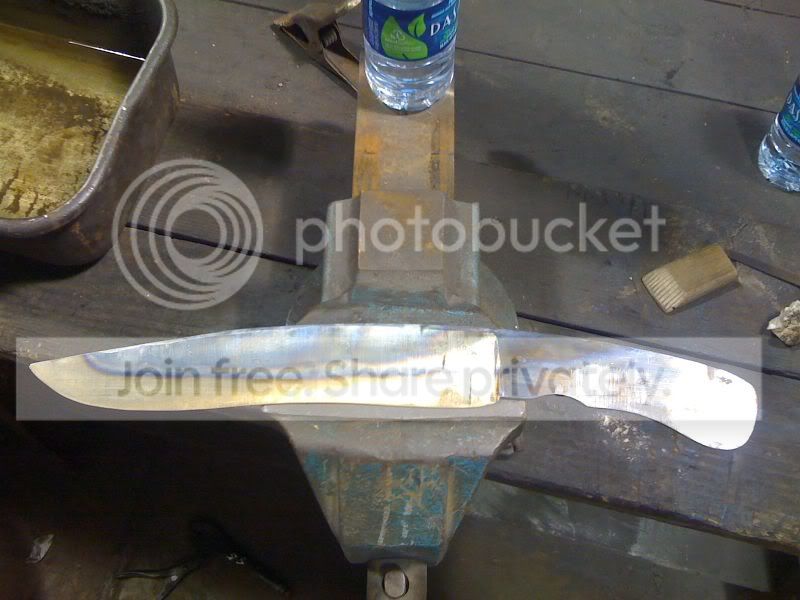
- Joined
- Jan 27, 2008
- Messages
- 2,010
Lazlo - Congrats on the JS!!
This is an 8 1/2" blade and is just about 2" at the widest point. I ground the bevels to within about 1/2" of the spine to create a nice thin flat ground blade. My blade is also 3/16" at the ricasso and tapers to near zero. I didn't round the spine, but the edges are "eased".
I think, if I were to build a "real" test knife it probably would be a full tang. But, we'll see how this does. I put two pins in this one just because I thought it needed it mechanically, not so much for aesthetics.
Anyway. This is the knife. I have a couple more things to do to it before its ready, and I need to find some rope...... enough to hang myself if needed!
This is an 8 1/2" blade and is just about 2" at the widest point. I ground the bevels to within about 1/2" of the spine to create a nice thin flat ground blade. My blade is also 3/16" at the ricasso and tapers to near zero. I didn't round the spine, but the edges are "eased".
I think, if I were to build a "real" test knife it probably would be a full tang. But, we'll see how this does. I put two pins in this one just because I thought it needed it mechanically, not so much for aesthetics.
Anyway. This is the knife. I have a couple more things to do to it before its ready, and I need to find some rope...... enough to hang myself if needed!
Lazlo - Congrats on the JS!!
Oh, I didn't get my JS, just passed the performance test
 Many miles to go before I can make a knife like you're making -- damn shame to break it (especially the handle)!
I didn't round the spine, but the edges are "eased".
I was wondering about that myself: chamfering or rounding the edges versus a fully rounded spine. Two of the blades I watched break cracked straight through the spine starting about 4 inches in front of the ricasso. Those were 1/4" thick, untapered blades with hard edges, so YMMV...
By the way, there's a degree of skill associated with the rope cut. Get someone to show you how to cut before you do the test.
The 2x4 is stupid simple: cut the corners, don't lever the blade out of the cut, avoid the knots
Last edited:
- Joined
- Jan 27, 2008
- Messages
- 2,010
Hey Laslo..... you know a lot of folks in Cape Breton who do the free hanging rope cut very often?
Having never tried the rope cut, I've been watching a bunch of videos and I'll do some practice cuts when I find the right rope. However, its going through the 2x4..... twice, that has me in circuit training!
Having never tried the rope cut, I've been watching a bunch of videos and I'll do some practice cuts when I find the right rope. However, its going through the 2x4..... twice, that has me in circuit training!
Hey Laslo..... you know a lot of folks in Cape Breton who do the free hanging rope cut very often?
Well you have to find a Mastersmith to test, so it's pretty much a sure thing
Make sure to pull any slack out of the rope, aim low (knee level) at a diagonal joint on the rope, stride up to it on your weak side, and pull the knife through the rope with a bit of an ab crunch as you step into it on your strong side. If you watch it done once, you'll figure it out. Your MS will have done it many times...
- Joined
- Jan 6, 2005
- Messages
- 9,680
Blue... the closest Master Smith to you is Christoph Deringer in Quebec. He is a great guy, just don't tell him you know me. The next closest in Canada is Wally Hayes. He is about 20mins from my place. Again, it is probably best not to mention me. There are a few MS's in New York.
Rick
Rick
- Joined
- Jan 27, 2008
- Messages
- 2,010
Huh, I thought Donald Bell would have had that ranking.
Thanks Rick. I'm not going that route this time though. I'm just going to give the rope one of those Happy Gilmore running starts and my patented "whirlichop" swing. Poor rope has no chance.... it'll part on its own just seeing me coming.
Thanks Rick. I'm not going that route this time though. I'm just going to give the rope one of those Happy Gilmore running starts and my patented "whirlichop" swing. Poor rope has no chance.... it'll part on its own just seeing me coming.
Last edited:

- Joined
- Apr 8, 2009
- Messages
- 1,367
Really enjoying this thread. I have been searching for an ABS maker in my area and found one in Snohomish, WA and another in Duvall, WA, both of which are very close to my location. I don't really want to cold call someone and ask if they're taking on an apprentices, but it looks like that's what it's going to come to. I'm following you and your thread very closely.
I have been searching for an ABS maker in my area and found one in Snohomish, WA and another in Duvall, WA, both of which are very close to my location. I don't really want to cold call someone and ask if they're taking on an apprentices, but it looks like that's what it's going to come to.
I think any Mastersmith would be glad to host your Journeyman test. It's not a formal apprenticeship, he just has to watch you do the cut, an you're supposed to bring your own 2x4's and rope.
Then again, I went to the Piney Woods Hammer-In on the weekend between the 2-week ABS bladesmithing class, and met at least a dozen mastersmiths, including Dr. Batson (ABS President). Every one of them was thrilled to welcome and support a fledgling knifemaker, and had seemingly infinite patience answering questions. And my stuff sucks compared to what you guys are posting...