No alternative to parks 50?

Status
Not open for further replies.
Today, the popularity of simple steels like 1095, W2 etc., is mainly due to the popularity of visible quench lines. However, along the way a lot of folks started to appreciate them for other reasons. How they cut not being the least of them. They also carry a bit of old fashioned nostalgia and romance, back to the days when a plain ol’ knife was your best friend.

Tai,

I have read most of your posts over the years, and at times, I thought that maybe someone may have been burning some very toxic stuff nearby and the smoke was drifting your way. While I haven't always agreed with what you have to say on certain issues, your above statement hit the ball completely out of the park. Many of my customers love those visible quench lines and many of those customers will NEVER cut anything with the knife they get from me, however, how they [might] cut, if they were used, is very important to me. Who knows......long after I'm gone, someone just might try actually using those knives.

You know, I think there are times when guys try so hard to "simplify" things that they end up over complicating them in the process. Park50 has become a bandwagon that lots of folks have jumped on because they heard it as the "buzz word" of oil.

Somehow there seems to be this delineation though.... this fault line separating the "technical nerd guys" and the "howl at the moon, numbers are a conspiracy" guys.... which is pretty crazy because in the grand scheme of things, we're all out to make the best knife that EACH ONE OF US can.

Nick,

I agree that many folks tend to complicate what could be a fairly simple process. Both your knives and Tai's are spot-on with design, fit, and finish. What it boils down to is......... did you/we make the best knife that we could at the time. The choice of quench oils are only another piece of the overall puzzle when making a long-lasting and serviceable knife.

Robert
 
I'd be worried more with the group that thinks the W.A.G method "works fine"

Someone spending the money for an engineered quenchant will more than likely have done their homework .
 
Here’s a recent rainbow quench on 1095 in “thrice used” canola. I’ve had the best results on these with canola that’s been broken in a little, and get the most “activity” on fairly thin blades. Fresh canola will work on these, but you have to adjust your temps., timings and geometry a little.

DSCN2611.jpg


DSCN2522.jpg


DSCN2605.jpg


DSCN2578.jpg
 
What's up with that rainbow quench anyway, Tai?

Do you wish to divulge anything about it? Are you just pushing the edge in farther incrementally as you quench?

I think it looks cool...

Also, I don't know that I've heard anyone mention polymer quenchants. They can be mixed with water to varying strength/speeds. I remember Don Fogg was interested in them a while back, some other guys too. I've not heard about them much lately.
 
Man! This is getting to be my favorite thread, bar none. I re-read it every couple of days.
"If you aren't striving to do your best in what you do.....you are the fool, not the person you are trying to prove/sell your foolishness to!" (my Dad).
SShepard - While I agree, in part, with your post about some WAGgers, the second part is a puzzlement of relativity.
Just because a guy has the money and buys the best and fastest racecar, it doesn't mean he's qualified to be in the competition. There are way too many "Biggest/best/most expensive" guys on this forum and all the other forums (we have all seen/read them) that couldn't or can't come close to making a quality knife.
It's not the tools you have, it's the how you use what you have to accomplish what you desire. The old Masters proved that for several thousand years. Just a fact of life. Sure, it can all be boiled down to numbers, measurements, calculations, physics, geometry, etc., but the end results of the best custom knife you can produce still have a lot of subjective mental calculations that were not measured and analyzed. You are able to do this just because of the amazing tool you are born with...your brain. Tools of calculation did not create man...man developed these tools to explain what his mind already saw. Some folks that are considered WAGgers by general consinsus are actually just able to tap that mental resource through sensory alertness and apply without using all the tools many of us rely on these days. Most are just crutches or training wheels we've gotten to used. The poets regarded these mental epiphanies, if you will, as muses. I think often our friend Tai is maligned because he has learned to "Loose the Muse" in his work and has no problems expressing himself. Regardless, his work stands on it's own as all of ours should. I like to work that way as well as much as I can, just not good at the open expression thing.
It is obvious as one reads down through this thread that everyone agrees on best quality end product. That's what makes this such a good read. Always a good thing.

ps - Missed you at Trackrock Robert.
 
What's up with that rainbow quench anyway, Tai?

Do you wish to divulge anything about it? Are you just pushing the edge in farther incrementally as you quench?

I think it looks cool...

Crazy mixed up microstructures. :)

Yeah, it's a modulated rate of submersion, something I developed myself. The edge goes in quick, then it slows down and gradually chases the heat out of the steel incrementally. It’s a single quench, but no two are done exactly the same. It works together with the wedge shaped geometry of the steel. Since the geometry is a bit different on each blade, the temps., and timings are done "intuitively". The best results have been on fairly thin and wide blades. I'm serious about the used canola for these types of quenches. Fresh canola is just a bit too fast. It can work, but just not as well. With fresh canola you're lucky to get 2-3 lines. On a bad day you only get one line reguardless of the age of the canola.
 
Last edited:
I will say Tai, that your quench lines do look really cool.

Edit: Is that naturally occuring ashi on the bottom line? I really like how that works out without the clay...Nice job.
 
Last edited:
Thanks Mike. Yes, those ashi lines are without clay, if that's what you mean. They only show on the bottom line in the pix, but several lines have them. I don't get those on thicker blades. That blade was forged from 3/16th, but came out a hair under.

The overall properties are somewhere between an edge quench and full quench, which sort of makes sense. It's a little of both,... but neither. By the time it's fully submerged the back is at/near a black heat, but oddly it still often picks up some detail there. It is metalurigcally very interesting to me. From my own testing and the feedback I've gotten on them, they perform very well.
 
After reading this thread, and knowing what I know about quenching (Which is little compared to many). I feel that it is obvious that quenchants are "paired" to certain types of steel for a certain type of result. I think we can all agree that Nick and Tai get amazing results using their own methods and materials. To say you can only use XXX quenchant on XXX steel doesn't work and is a bit shallow IMO. having said that I feel that to say "You can get great results if you use P50 on your shallow hardening steels" is correct, you can also get great results with Water, but you have to be willing to accept some broken blades in the process.

I think where Canola becomes a problem is, it is readily avail. and inexpensive. That is what I was told to use when I was starting out, and I did use it for my first 20+ knives. To use it as a catch all quenchant causes the end resulting knife to be less than it could be performance wise.... unless you know how to tweak the process like Tai has done, which I feel is beyond most makers abilities (Myself included in that group of course). I don't think people are wrong here just willing to accept different results.

Just to add to the pot, I am using McMaster Carr 11 sec. with what I feel are good results... :D
 
1095 is “hyper-sensitive” steel.

One of the main reasons I like it, is that it responds so readily and dramatically to thermal treatment.
 
1095 is like the prissy 16 year old spoiled girl of steels.....Has to be treated just right or it will blow up on you. I have some 1095 i am playing with and it is very very finicky. When treated properly, it will make you the happiest person on earth, when it is not, it might make you cry. That being said, 1095 is the steel that needs the fastest quench available, i have been using brine to do small test samples. I had quite an interesting conversation with Kevin about brine vs. P50. I have since been quenching numerous test pieces in brine to take up to him to have an analysis done on the micro crystalline structure. I want to stress test these against the P50 pieces. When i say P50 is a superior quench oil vs. canola, i meant specifically for 10XX series, W1, and W2.
 
I've never seen anyone else get a result quite like (usually nowhere near) Tai's rainbow quench lines. Very cool stuff!!! :thumbup: :cool: :)

What's funny about a lot of this, is that I used to feel compelled to argue with Tai about a lot of things, and then one day it really hit me that even though our approach is quite different... we are both in this to make the best knife we can, that represents each one of us. Once that really clicked in my thick skull, I was able to just accept that we each have certain techniques or approaches that we like.... and just go with the flow. :)

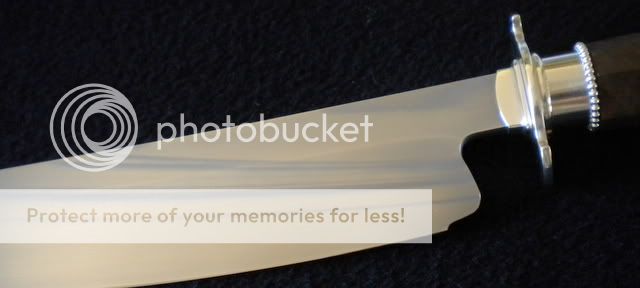
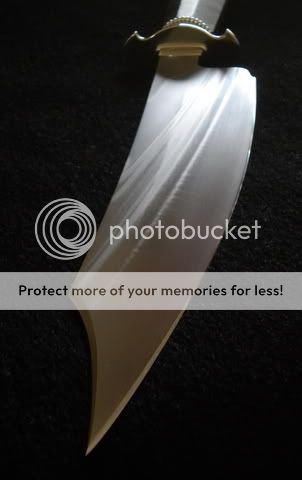
Speaking of crazy microstructures.... this is a blade I just polished out. W2 quenched point down into Park 50... no clay, just time and temperatures at work. ;) :)

[video=youtube;v9EpItK01hQ]http://www.youtube.com/watch?feature=player_embedded&v=v9EpItK01hQ[/video]
 
Nick I officially hate you! that is an amazing blade, you just using the thickness of the blade and the quenchant speed to cause the temper line/Hamon?

and are you getting royalties for that les schwab add?:D
 
Damn nice Nick! That looks beautiful. I saw a very similar hamon on one of Kevin's "GitchagoomiGane" blades(tamahagane bloomery steel), with no clay....makes me jealous lol
 
I've never seen anyone else get a result quite like (usually nowhere near) Tai's rainbow quench lines. Very cool stuff!!! :thumbup: :cool: :)

What's funny about a lot of this, is that I used to feel compelled to argue with Tai about a lot of things, and then one day it really hit me that even though our approach is quite different... we are both in this to make the best knife we can, that represents each one of us. Once that really clicked in my thick skull, I was able to just accept that we each have certain techniques or approaches that we like.... and just go with the flow. :)

Speaking of crazy microstructures.... this is a blade I just polished out. W2 quenched point down into Park 50... no clay, just time and temperatures at work. ;) :)

[video=youtube;v9EpItK01hQ]http://www.youtube.com/watch?feature=player_embedded&v=v9EpItK01hQ[/video]

:thumbup:...Nick, very cool. I do the same thing with Diehl W2. (We don't need no stinkin' clay.) :)
 
crex;

the WAG (wild assed guess) is a method no knifemaker should take in heat treating his blades. I'm speaking of knifemakers, nt people driving cars or flying a plane, or someone buying the latest cellphone just to look cool. I can almost garuntee that every knifemaker thats spent the money on an engineered quenchant has spent time and money (cracked/warped/broken) blades experimenting with other quenching mediums. Getting repeatable consistant results the way you want, is all about controlling the variables , atleast that's what I've found that helps me.
 
I am finding this thread very informative! It seems to me like a list should be made up (if one could be agreed upon) of steels best suited for the many different quenchants available. I am in the process of building my kiln for heat treating at home. I would like to keep the number of different quench oils down to as few as possible, but will do what it takes to accomplish the best heat treat that I can with the various steels I work with. I have done all of my heat treating at work so far. We have a drum of Mobile Thermrex R-21 quench oil. The majority of the oil quench heat treat we do is O1 material.

This is a few of the quench oils that I read mentioned alot. add to it if you like.

Parks 50
Parks AAA
McMaster Carr 11 second oil
Canola

Once I got this all typed I was thinking maybe this should be a thread all by itself. If anyone agrees let me know and I will do so.
 
1095 is like the prissy 16 year old spoiled girl of steels.....Has to be treated just right or it will blow up on you. I have some 1095 i am playing with and it is very very finicky. When treated properly, it will make you the happiest person on earth, when it is not, it might make you cry. That being said, 1095 is the steel that needs the fastest quench available, i have been using brine to do small test samples. I had quite an interesting conversation with Kevin about brine vs. P50. I have since been quenching numerous test pieces in brine to take up to him to have an analysis done on the micro crystalline structure. I want to stress test these against the P50 pieces. When i say P50 is a superior quench oil vs. canola, i meant specifically for 10XX series, W1, and W2.

Yeah, every little thing has an effect on 1095. It's real touchy steel, but that could be good or bad.

I wouldn't say P50 is necessarily superior to canola for those steels though. It just depends how you use them. P50 can be too fast in certain scenarios and canola too slow in others. They are just different. They both have advantages and disadvantages. It’s what you do with them that counts and what you do with them could be superior or inferior.

I don't see heat treating as an exact science. Metallurgy is the science. Heat treating is really more of an art, open to different types of applied logic, interpretations, expressions etc.

Heat treating is an art... or no discussion on it would be necessary. It's just not as cut and dried and most people would like to think. If it were an exact science, there would be no room for personal value judgements etc., and nothing to talk about,... just a boat load of static facts.

I think Nick's hamons prove that it's an art... an art that rests on metallurgy.
 
Last edited:
Since we are talking about quenchants I thought I would share some info that I heard Don Fogg talking about last spring. He said that at one time he used the polymer quenchants and would use a salt pot for his heat treating damascus. The thing that I found amazing is that he stated that he had the damascus fully polished and Etched prior to heat treat. the combo of the salts and polymer left the blade so clean tha there was virtually no clean up after HT.
 
Status
Not open for further replies.
Back
Top