Odd and unique shop tools

Looks like the ideas have sort of dried up.
Bet some even think they came close!
Here's what you do:
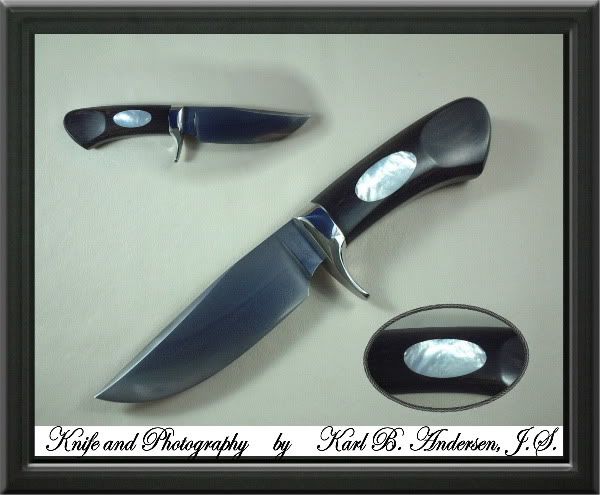
Clamp your assembled knife in the "Andersen Forge Inlay Device", and scribe around your oval inlay .
I7-1-1.jpg


Place the "Andersen Forge Inlay Device" in your vertical mill, and, using the attached "leg", level the inlay area to the level axis of your mill:
I8-1.jpg


Mill out the oval inlay pocket to your desired depth. With the help of the "Andersen Forge Inlay Device" you can remove about 99 and 44/100% of your inlay pocket and have not only a nice flat bottom of the pocket, but most of the pocket removal material can be removed in about 19 seconds.
Just mill right near the scribe line, and remove the remainder with rotary tools.
I10-1.jpg


After epoxying the inlay in place, leave the knife in the "Andersen Forge Inlay Device" and file smooth.

JS8-1.jpg
 
Cool! It has three uses then. I thought it was a straight jacket after driving us crazy for a day. We all knew it worked as a torture device!
 
When it comes down to it, the TYPE of inlay is irrelavent.
It's purpose is to hold the knife level in a mill.
No one got it.
Who's next?
 
Lets not start picking nits here.
There's no nit picking here.
Wasn't close enough to call it a "nit".
Before this gets out of hand and people joke about it or get confused about it, no one mentioned oval inlay or holding the knife for use in a mill to mill out the inlay pocket.
The last two items I've posted have BOTH had silver wire inlay.
It's easy to see that the mention of "inlay" was in reference to those.
Now, let's move on.
 
If no one gets it, then the person that was showing their shop tool gets to pick the next contestant. Therefore, I suggest that Mr. Anderson pick the next person to choose one of their unique shop tools.

This is going well. Great shop tool that a lot of us will make and use. This thread may turn out to be a great learning experience.
 
All are good ideas, but Rusty McDonald wins.

For whatever reason, the epoxy doesn't adhere to this type plastic. So when the job is done, the epoxy just crusts up on top of it and you can peel it right off. Eventually they get all gooey and dirty, but you can re-use them at least a couple times.

Incidently, this makes terrible spacer/liner material for the same reason :D

Take it away, Rusty! :)
 
Last edited:
Back
Top