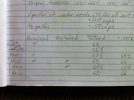
Surprising W-2 various quench medium hardness test results: Brine, Houghto-Quench k,

For any new makers watching the thread, can you elaborate on why you would expect full (or near it) hardness from a 9 ish second oil when you only have less than a second to cool the steel?

When we describe an oil as a "9 second oil", we are referring to the Magnetic Quenchometer rating of the oil, which is a quantification of the oil's cooling ability. The test begins with a 7/8" diameter nickel ball at 1625°F and 200mL of oil at 75°F. The ball is quenched in the oil as the stopwatch starts. The stopwatch stops when the nickel ball reaches 670°F. The rating (e.g. 9 seconds) is basically meaningless on it's own - the main purpose of the test is to compare one oil to another. http://www.shxf17.com/pdf/astmd3520-04.pdf

When we say a steel needs to cool in half a second, we are referring to the critical portion of the cooling curve.

Links for further reading:
https://books.google.com/books?id=m...agnetic Quenchometer to Cooling Curve&f=false

https://books.google.com/books?id=b...agnetic Quenchometer to Cooling Curve&f=false
 
Last edited:
How much do you think you can move the steel in half a second because once it’s plunged in it’s over.

I don’t know how I can make this more clear that it doesn’t matter if one has ideal conditions to attain maximum hardness in this test. All it matters is that all the samples are treated exactly the same other than one variable which is using different quench mediums. If I got 65 hardness with Brine all it matters is that the other tests with other quench mediums is done exactly the same in all other ways. The brine wasn’t agitated so the others don’t get agitated, Period!

This test is not designed to get maximum hardness it is designed to compare the effect of changing only the quench medium with a standardized procedure.

Ok , I'm sorry that I suggested that .Obviously you don t like suggestion , sorry again .......... but in some cases like in HT half a second is long time

agitation of a quench oil was necessary to destabilize film boiling and nucleate boiling processes of uniform heat transfer throughout the quenching
 
Last edited:
Ok , I'm sorry that I suggested that .Obviously you don t like suggestion , sorry again .......... but in some cases like in HT half a second is long time

Natlek I do appreciate relevant suggestions. I am sure some people completely understand my frustration today and others think I’m a total dick and I assume you fall into that second category but I have explained so many times the same thing and I have done my best to try to be understood so I can live with what people think and I’m just glad if I was able to help some people.
 
Last edited:
In post #51 here, you stated that the faster oils were used for some steels because of them being hyper eutectoid. Just to be clear - that's not the factor.
What gives steels differing cooling rates is the amount of ALLOY - not carbon.
52100 has as much or more Carbon than W2, but is a DEEP hardening steel because of all the chromium, and uses a much slower oil.
There are all sorts of hyper eutectoid steels that will air harden!! simply because of all the alloy.
1075 is NOT a hyper eutectoid steel but needs a really fast quenchant because it is very LOW alloy.

"Parks 50 and Houghto-Quench® K are considered 7 to 9 second oils and they are the type needed for hyper eutectoid steels like 1095 and W-2."

I see you are very touchy right now and I do not want to be argumentative -;) - just helping you to clarify a few things.
 
In post #51 here, you stated that the faster oils were used for some steels because of them being hyper eutectoid. Just to be clear - that's not the factor.
What gives steels differing cooling rates is the amount of ALLOY - not carbon.
52100 has as much or more Carbon than W2, but is a DEEP hardening steel because of all the chromium, and uses a much slower oil.
There are all sorts of hyper eutectoid steels that will air harden!! simply because of all the alloy.
1075 is NOT a hyper eutectoid steel but needs a really fast quenchant because it is very LOW alloy.

"Parks 50 and Houghto-Quench® K are considered 7 to 9 second oils and they are the type needed for hyper eutectoid steels like 1095 and W-2."

I see you are very touchy right now and I do not want to be argumentative -;) - just helping you to clarify a few things.

I do appreciate clarification so thank you for correcting me.:)
 
Last edited:
Forgive me if I missed it in the last page and a half of comments, but here is a reply considering your comment about not needing to agitate. If ANY steel should be agitated, it would be W2, at least for American steels, not to mention all of the other possible variables that seems to come along with certain batches of some of Aldos W2.

FWIW, he has had problems with certain batches from his W2 supplier in the past where I believe even single bars of it had many inconsistencies along it's length. This is one reason I believe people are calling for more tests (such as testing the oil quenched piece into brine), especially when posting an experiment on an open forum and calling your results basically conclusive, as this may be confusing to future readers looking to learn from it. So it's just one thing to keep in mind, as we are all (at least most of us) here to learn and help one another.

Anyway, here is a great video by another well respected forum member showing why you need to agitate the steel in your quenchants, and it doesn't have to do with volume or how conductive it is either. It has to do with the vapor jacket surrounding the screaming hot steel when it's first dunked in the oil/brine, which keeps the quenchant itself from being able to touch the surface of the steel and thus cool it.

[video=youtube;tRq7Zz6i5R4]https://www.youtube.com/watch?v=tRq7Zz6i5R4[/video]

~Paul

My YT Channel

Lsubslimed

... (It's been a few years since my last upload)
 
Maybe the quench volume does matter... I don't know. However, volume may make a difference depending on the quench medium. A pint of oil may not have the same effect as a pint of water due to the volume.

Another thing you keep mentioning is that agitation doesn't matter, as you only have 1/2 second. As I understand it, the quench medium is what helps you cool fast enough to get under that 1/2 second pearlite nose. However, the steel is still transforming after that 1/2 second. Thats why you don't take the steel out of the quench after only 1/2 a second. Also, agitating the steel helps ensure there is no vapor jacket around it.

I just want to clarify the .5 second time. The whole process isn't over in 0.5 seconds. When the steel changes from austentite to martensite, approx 1400f to 900f, that part of the temp change must be less than .5 seconds to prevent the formation of pearlite. Thicker parts of the steel, starting at 1500f for example, need to get to the 1400f temp first, then continue dropping quickly below 900f in that half second. Different parts of the steel will convert at different times and there is the time it takes for the vapour jacket to collapse. Someone newer to this might think that the quench itself is over in 1/2 second. It's just the one part of the transformation to beat the nose, and you still have to get to Mf.
 
1095_ttt_zpsp5vpgptu.png
[/URL][/IMG]

As you can see, you have to get to 900f in 0.5 seconds, then you have 10+ seconds to get to Ms, and you beat the pearlite nose.
 
Paul, you've added a good point - vapor jacket is the term I was trying to think of other day as to why agitation is required, even in a pint of quenchant - to break the vapor jacket that forms around the metal during quench. I just could not think of the term.

Willie, you wrote
Thicker parts of the steel, starting at 1500f for example, need to get to the 1400f temp first, then continue dropping quickly below 900f in that half second. Different parts of the steel will convert at different times and there is the time it takes for the vapour jacket to collapse.

Perfect comment - while I "knew" this, it just hadn't really sunk in so I could explain it. I knew there was a 1/2 second involved, and knew the total quench took longer than 1/2 second, you've explained exactly why.

Ken H>
 
I don't remember the exact conversion range, I think it's about 1390 to 915???? Anyway, that's the timed part of the transformation. What happens above and below are less critical, and as long as they don't move over to touch the pearlite nose, you will fully harden the blade. A hamon is when parts don't cool quick enough to get over the nose, resulting in pearlite in those areas.
 
Coldsteelburns and Willie71 and Ken H, I appreciate your information about the importance of agitation especially steels like W-2. Because I am working with these I appreciate that information and will be agitating when I am quenching my knives and I admit I didn’t understand the importance of transformations after the initial half second nose.

But as I keep pointing out with my tests I feel consistency is more important than a procedure that attains maximum hardness. Because of that I haven’t agitated in my tests because I feel agitation is a process that is hard to duplicate identically in every test and that is why in my tests I have just plunged my test pieces into my quenches. And not agitating the brine test which is my control produces consistent hardnesses of 65 on W-2 and 1095 so although it is not ideal it does set a high standard.

And coldsteelburns I find it difficult to believe that the problem with my W-2 is that I have a bad section on my bar because the piece that wasn’t hardened with Houghto-Quench® K came from a place right adjacent to the one that did harden with brine but since I will be in the garage tomorrow I will quench that piece in brine to see if it does fully harden for the sake of the greater good, LOL. :)

Like probably most here I do want to make the best knife that I can and when I read about people getting hardnesses of 68.5 like Don Hanson III with W-2 I know I have a long way to go but that is my long-term ideal and I plan on doing the same types of tests with quenchant temperatures, affect of normalizing bar stock with only stock removal, and yes even agitation, and whatever else may be suggested which seems viable. So just because I am ignoring agitating now in my tests doesn’t mean I’m dismissing it I’m just ignoring it for now because I’m testing one variable at a time and right now my variable is quenchants.

And Ken H has been kind enough to send me a pint of Parks 50 through the mail so when I receive that I will be doing the same quench tests with it against Houghto-Quench® K and Brine. Really interested in those results.
 
Last edited:
I noticed with w2 and parks 50 that the spot that I held the blade with the tongs during the quench would not harden. With such tiny coupons this may be a confounding factor.

People are questioning your methods because you are getting unexpected results.
 
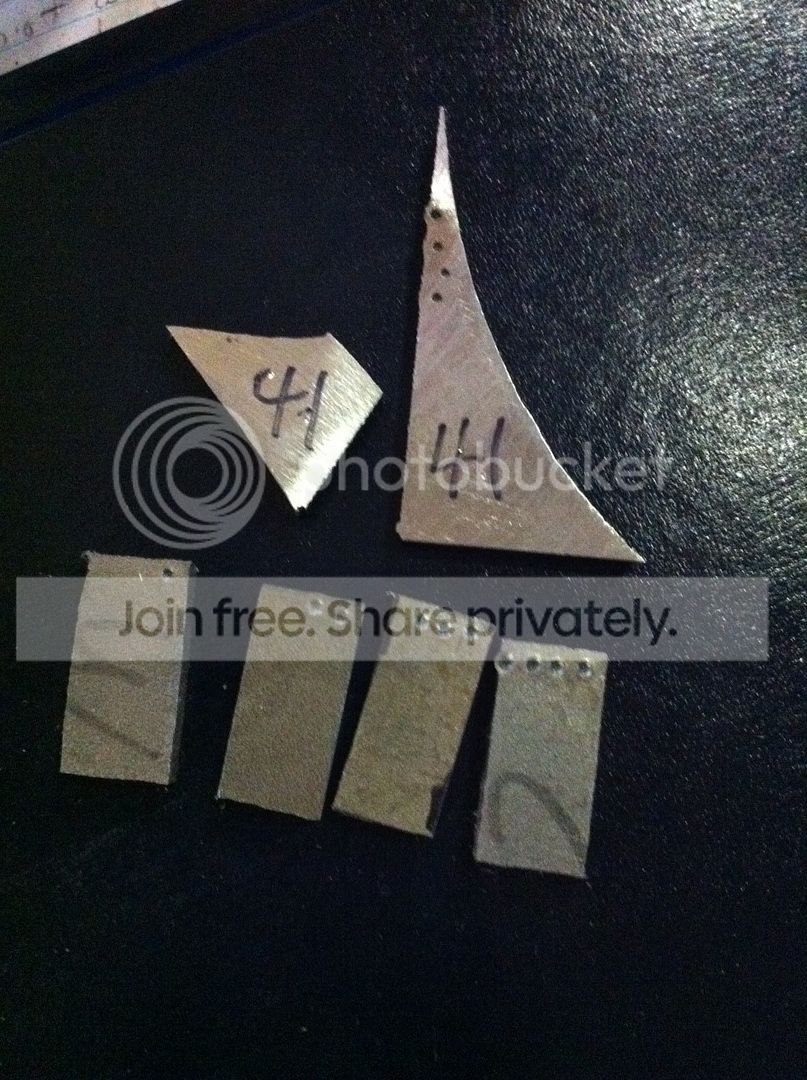
As promised today I tried to re-harden with Brine the pieces of W-2 which failed to harden with Houghto-Quench® K. I had two pieces that both had a hardness of 41 so since they were identical I normalized one piece to see if that would make a difference. I tried normalizing to see if that would increase my hardness.

photo%201_zpszalul2a7.jpg


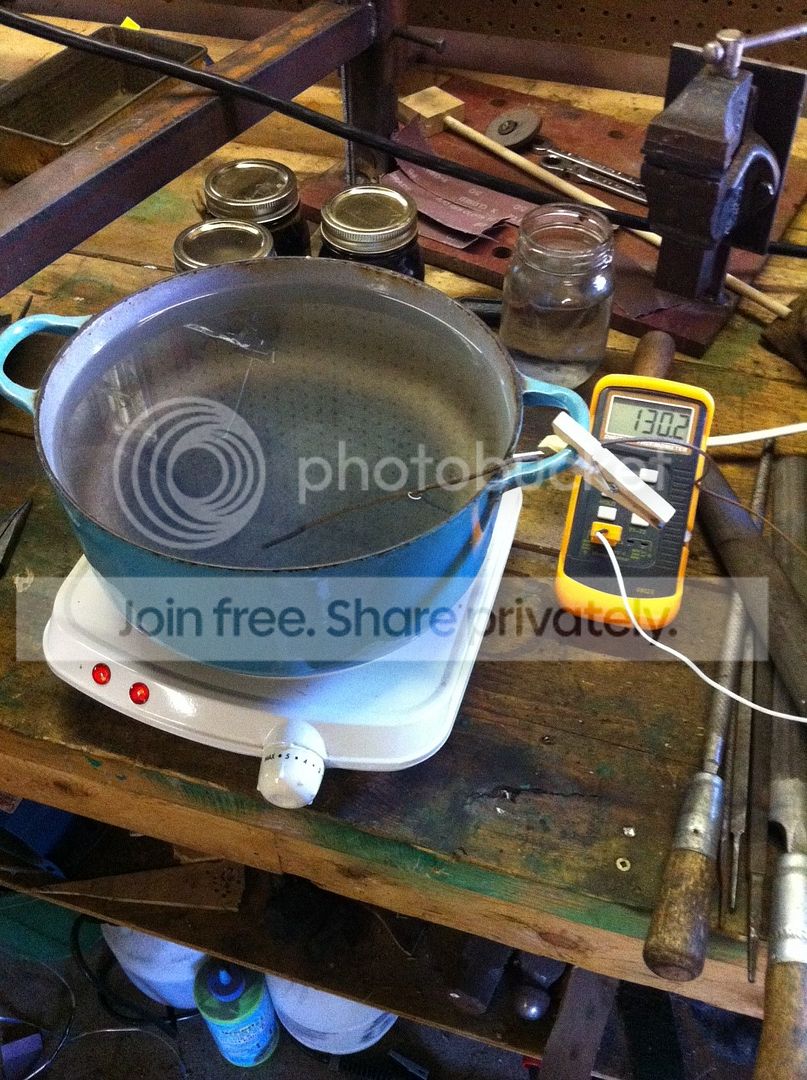
To quell the quench volume debate I used a gallon of brine at 130F.
photo%202_zps7ldav542.jpg


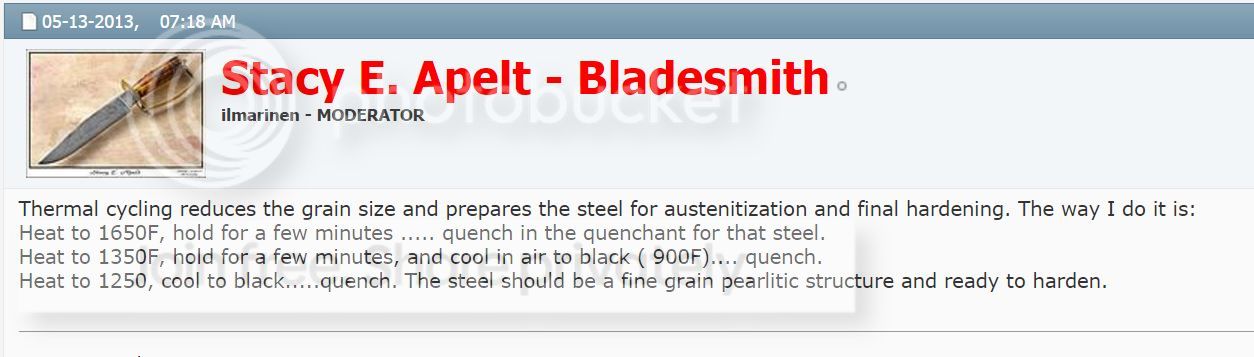
I used Stacy E. Apelt’s system shown here for normalizing:
normalizing_zpsgmpf7rnv.jpg


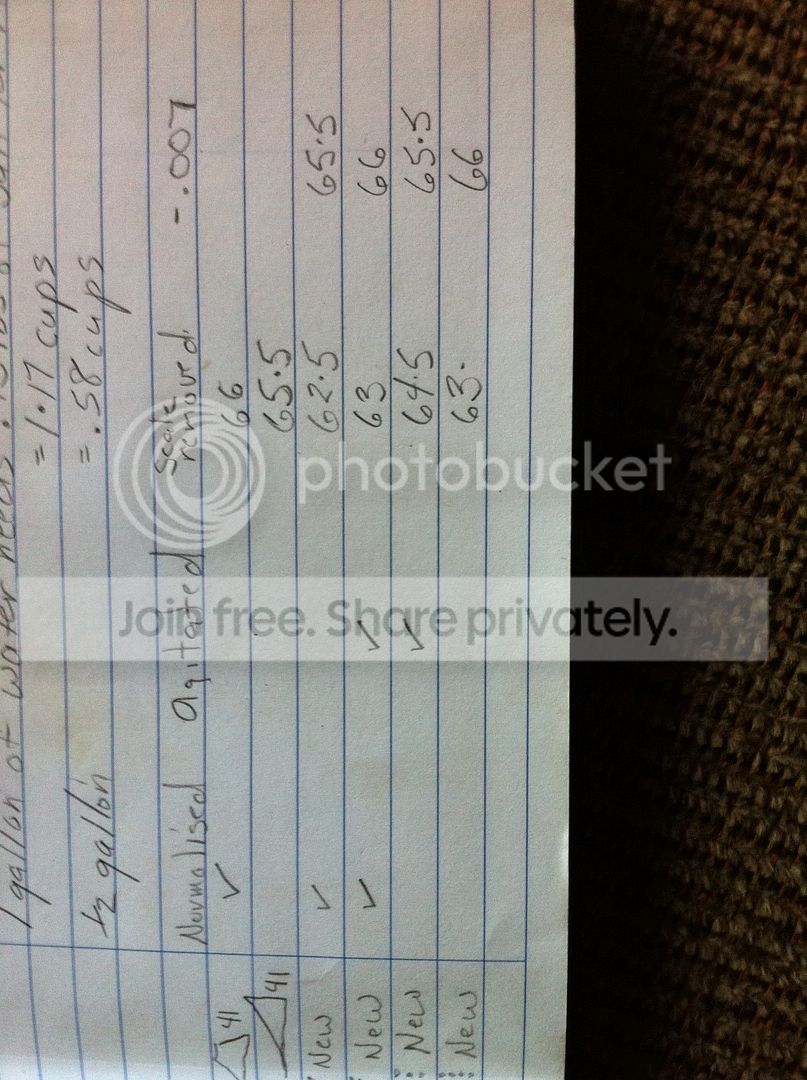
Since I was heat treating anyways I decided to test four new pieces with normalizing and without and with agitation and without. My first piece I normalized, my second piece I normalized and agitated during quench, my third piece I just agitated and my fourth piece I neither agitated nor normalized.


photo%204_zpsqiolxu7j.jpg

NO MATTER HOW I ROTATE THIS PHOTO IT COMES OUT UPSIDE DOWN WHEN I POST IT, MOST ANNOYING BUT WORKING ON SOLUTION. No solution found beyond getting it 90 degrees out or see thumbnail.

photo 3.jpg

It may not be easy to decipher from my notes but the results were that all pieces in this experiment ended up being between 65 ½ and 66 hardness. The two pieces that I re-hardened that failed to be hardened with Houghto-Quench® K were 65 ½ and 66 on the surface after scale was removed so I didn’t bother removing any more material.

Also all of my other test pieces whether I normalized or not or agitated or not were between 65 ½ and 66 on the Rockwell scale once I removed .007” to get rid of the decarb layer. And the one that wasn’t normalized or agitated was 66.


Obviously from the results the pieces of W2 that Houghto-Quench® K would not harden were fully hardened by Brine so the metal is good and the evidence still points to the fact Houghto-Quench® K just isn't up to the job.

I was really surprised that normalizing had no effect on hardness. It makes me wonder how Don Hansen III gets 68.5 because I was thinking it probably was the normalizing? Maybe it’s the fact that he forges? Or maybe Parks hardens better than brine? Will see when my Parks 50 arrives next week hopefully.

I was actually not surprised that agitation during quenching also had no effect on hardness.
 
Last edited:
I noticed with w2 and parks 50 that the spot that I held the blade with the tongs during the quench would not harden. With such tiny coupons this may be a confounding factor.

Yes JMJones I had considered where I grip my sample pieces may affect the hardening so I have made allowances for that. I punch mark all my pieces and I make sure that I pick them up on that end when quenching and I also use needle nose pliers and only grip the very end and take my readings about a third of the way in from the other end but I have tested many times over the whole lengths and they seem pretty consistent over their lengths.
 
Last edited:
Though it might not fit into your controlled scientific process, it would seem to me to make sense to try to harden your W2 in a large volume of K quench with agitation. Basically redo your experiment above but with K quench. You were getting hardened in brine, so don't suprise me you didn't get anything different trying it again. Brine is a very fast quench, on the border of being too fast.

Your example of four sprinters could be off if one was The Jamaican guy Bolt, if he had ankle weights on, he would still bet most of us here. He is the brine.
 
As promised today I tried to re-harden with Brine the pieces of W-2 which failed to harden with Houghto-Quench® K. I had two pieces that both had a hardness of 41 so since they were identical I normalized one piece to see if that would make a difference. I tried normalizing to see if that would increase my hardness.

photo%201_zpszalul2a7.jpg


To quell the quench volume debate I used a gallon of brine at 130F.
photo%202_zps7ldav542.jpg


I used Stacy E. Apelt’s system shown here for normalizing:
normalizing_zpsgmpf7rnv.jpg


Since I was heat treating anyways I decided to test four new pieces with normalizing and without and with agitation and without. My first piece I normalized, my second piece I normalized and agitated during quench, my third piece I just agitated and my fourth piece I neither agitated nor normalized.


photo%204_zpsqiolxu7j.jpg

NO MATTER HOW I ROTATE THIS PHOTO IT COMES OUT UPSIDE DOWN WHEN I POST IT, MOST ANNOYING BUT WORKING ON SOLUTION. No solution found beyond getting it 90 degrees out or see thumbnail.

View attachment 662650

It may not be easy to decipher from my notes but the results were that all pieces in this experiment ended up being between 65 ½ and 66 hardness. The two pieces that I re-hardened that failed to be hardened with Houghto-Quench® K were 65 ½ and 66 on the surface after scale was removed so I didn’t bother removing any more material.

Also all of my other test pieces whether I normalized or not or agitated or not were between 65 ½ and 66 on the Rockwell scale once I removed .007” to get rid of the decarb layer. And the one that wasn’t normalized or agitated was 66.


Obviously from the results the pieces of W2 that Houghto-Quench® K would not harden were fully hardened by Brine so the metal is good and the evidence still points to the fact Houghto-Quench® K just isn't up to the job.

I was really surprised that normalizing had no effect on hardness. It makes me wonder how Don Hansen III gets 68.5 because I was thinking it probably was the normalizing? Maybe it’s the fact that he forges? Or maybe Parks hardens better than brine? Will see when my Parks 50 arrives next week hopefully.

I was actually not surprised that agitation during quenching also had no effect on hardness.

Normalizing evens out the grain size and breaks up large carbides, if they are present, or if the steel is course spheroidized. If that isn't a problem, then normalizing won't affect hardening. Normalizing will correct for certain problems, but offers no benefit to hardenability on its own.
 
Normalizing evens out the grain size and breaks up large carbides, if they are present, or if the steel is course spheroidized. If that isn't a problem, then normalizing won't affect hardening. Normalizing will correct for certain problems, but offers no benefit to hardenability on its own.

My W-2 is from Aldo and I was sure that I read somewhere that it comes course spheroidized and that is why I thought normalizing may increase my hardness.
 
Jeff wrote:
And Ken H has been kind enough to send me a pint of Parks 50 through the mail

I'd LOVE to send you a gallon of Parks 50, but don't have any. I think you got my name mixed up with somebody else. I tried to send you a msg via email or PM, but didn't find anything listed for you.

I'm sure agitation is less important on small test coupons than on a large blade.

Have you considered putting a wire thru a hole to handle the coupon with so the tongs would not affect the coupon at all?

Ken H>
 
Last edited:
Back
Top